mulberryshoots

"Tell me, what is it you plan to do with your one wild and precious life?" ~ Mary Oliver

Month: November, 2013

“happiest moment” . . .

sliced Peking Duck . . .

sliced Peking Duck . . .

I’ve gone back to reading today, paging through Julian Barnes‘s “The Sense of an Ending,” which was, in my opinion, endlessly frustrating to read, no one character worthy of trusting what he/she said. This hardback volume was one that I had on the shelf, brought home when it first won the Man Booker Prize two years ago. It didn’t really send me then, nor in today’s briefing although I wanted to like it.

But another book called “The Collected Stories of Lydia Davis” did interest me in its smaller handbook size with deckled edges. The stories made me laugh and relieved the frustration I felt trying to decipher Barnes’s so-called “literary novella.” Lydia’s stories made me feel like I could call her by her first name. They were intimate, thank-godfully brief, and above all, humanly funny while being poignant, a hard combo to pull off. I also enjoyed reading about her as well as reading what she had written.

She was born in Northampton, Massachusetts, where I went to school. That seemed like an odd coincidence to me. Her first husband was Paul Auster, a writer who is also a close personal friend of someone I know by association (a friend’s brother) that seemed like a second, odd coincidence. They divorced and she remarried later on. Apparently, she’s been writing her kind of short stories, which feel to me like the word, poesy, for some reason. They are short, poetic and also whimsical. So, poesy seemed like a good description about her writing. She was named a MacArthur Fellow in 2003 which is comforting to know. AND, her collected stories won the Man Booker Prize this year to lots of people’s amazement! At my Truro writing workshop last summer, her name was mentioned and people were so surprised that I was the only one in the class who recognized her name, much less being familiar with her way of writing. My nature leans towards being original in one’s search for creativity. And for sure, her approach and writing are original.

I’ve been feeling hemmed in about writing these days, and this morning, took on writing hundred-word haiku like biographies of people that I know well. I enjoyed it for awhile but was sensitive to the fact that these little biting pieces were probably unmentionable to others, particularly the people I was writing about, including myself. It even felt a little misanthropic, which I felt guilty about for a few minutes, but was relieved to read that people sometimes react in misanthropic ways because they have a sense of naive innocence or high expectations and then are deeply disappointed in how things work out. Boy, is that the story of my life! Naive innocence, high expectations and then, boom!, my feelings or thoughts falling down with a thud. There must be a way to survive these occurrences without becoming cynical or jaded. I guess if one’s naivete or innocence is still operational (at least mine sometimes still is!) you can’t really be a true misanthrope, can you?

The reason I’m writing this post, though, is to share with you one of Lydia Davis’s stories. It’s called “Happiest Moment” and I thought it was so charmingly Davis that I wanted to share it in a post:

 Happiest Moment

If you ask her what is a favorite story she has written, she will hesitate for a long time and then say it may be this story that she read in a book once: an English language teacher in China asked his Chinese student to say what was the happiest moment of his life. The student hesitated for a long time. At last he smiled with embarrassment and said that his wife had once gone to Beijing and eaten duck there, and she often told him about it, and he would have to say the happiest moment of his life was her trip, and the eating of the duck. 

I think this story is priceless, don’t you?

simplicity (again!) . . .

DSC_0003Here’s a link to an interview with Jess Lee, the CEO of Polyvore on keeping it simple in a corporate culture. Her advice is to make lists of what you are doing, weed out those which are not important and focusing on what is, in a more focused way. Sounds simple, right? Actually, getting to simplicity is not that hard to read or talk about. Think about things. Prioritize. Focus. Weed out.

But it’s not so easy to carry out in action, though. What I have found in my journey to simplify is that it’s usually easy to start out and hard to maintain as a lifestyle. Being human, we go up and down about buying and accumulating things, a pattern that humorously seems to maintain a stubborn stasis of how much stuff we have. It’s hard not to be tempted by a nice necklace in a shop when you already have a few that you don’t wear that often in the drawer. It’s hard not to want a pair of boots for the winter season when you already have two perfectly good pairs that you like and wear. It’s hard not to think about gifts and surprises for friends and family when everyone already has all that they might need and more.

Still, the idea of simplifying is still so tempting, a siren’s call to pare down, slow down, reflect in silence. Dress more simply. Take jewelry off rather than putting it on. Looking for gifts that are simple but still wonderful. Last year, I made small mince pies to give out during the holidays. Eaten with a little cheddar cheese or ice cream, they were welcome presents not easily found in stores. This year, although G. has reminded me I still have jars of unopened mincemeat, I saw a recipe in the latest issue of Bon Appetit for savory shortbread made with caraway and fresh rosemary. Sliced in long strips, they will look great in cellophane bags with white dots that I used for the mince pies last year, tied with a ribbon and a sprig of fresh juniper from the yard. Maybe I’ll make both and offer up some of each. Providing “simple” gifts still takes work and care, doesn’t it?

We are planning a family holiday in a rental on the Cape after Christmas and are inviting a host of friends, their children and parents to a “dumpling fest” on the Saturday that we’ll be there. These are friends my daughters have known and played with since kindergarten. Now, their children will have a chance to meet each other, take walks out on the private beach and then come back to the house to eat piles of hot asian dumplings with different dipping sauces. Two kinds of soup: a clear soup with winter melon and a miso soup will simmer on the stove. This may not sound simple to you, but we are doing one thing that makes the whole thing do-able: and that is rather than making Chinese dumplings from scratch, we are going to heat up frozen dumplings (Korean ones with pork and chives; Trader Joe’s Thai shrimp dumplings and vegetable dumplings; pork bao etc.) There was a day in the past when I would have made everything myself from start to finish. But having tasted the Kimbo brand pork and vegetable dumplings, I’m satisfied that they’ll do nicely–even the wrappers are kind of glumpy like the ones that are home-made. I do confess that I’ve still had flashes of thinking I might make some up in advance anyway and freeze them. Probably not though.

So, little by little, simplicity enters our lives. Or, to put it another way, a not-so-complicated-as-usual mode might be a first step. I’ve also noticed that the fashion of the day is ultra simple clothing with very little other adornment. You can actually see the person underneath without all the flashy stuff.

Still, human nature is by definition often changeable and fickle. Besides, the holiday season is upon us with a late Thanksgiving and a few more weeks until Christmas and other holidays that are celebrated. Maybe the simplest thing of all might be just not to struggle so much with anything: being simple, not so simple or whether to make or buy. Just do what feels right and let it go.

Simple, right?

reconciliation . . .

DSCN5895_2

In the past few days, small quotations have stuck in my mind from reading, of all things, obituaries about two women writers.

One, Doris Lessing, who won the Nobel prize in literature for writing curmudgeonly self-centered books about her unconventional life, emulated by some struggling with how to live while tied down by family obligations; and Charlotte Zolotow, a prodigious author of seventy-one children’s books and (Harper Collins) editor of her own children books imprint. I must confess that I have tried to read Lessing’s “The Golden Notebook” numerous times because I liked the idea of journals with different colors depicting a woman’s life. But I haven’t as yet succeeded in getting past the complaining self-indulgent tone of it all. Zolotow’s books, illustrated by Garth Williams and Maurice Sendak among others, sound very different, described as helping the young to gain perspective about what happens to us all as we grow up.

In the Lessing article, a reviewer, fellow writer J.M. Coetzee, complained:

“There is something depressing in the spectacle of a woman in her 70s still wrestling with an unsubjugated ghost (her mother) from the past. On the other hand, there is no denying the grandeur of the spectacle when the protagonist is as mordantly honest and passionately desirous of salvation as Doris Lessing.”

In the Zolotow piece, Charlotte is quoted:

“We are all the same,” she wrote, “except that adults have found ways to buffer themselves against the full-blown intensity of a child’s emotions.” She added, “We are not different from the children we were — only more experienced, better able to disguise our feelings from others, if not ourselves.”

So, in one instance, a woman is chastised for remembering (and still being impacted) by how badly her mother treated her as a child; and in the second, we are reminded that many of us learn how to buffer ourselves as adults against the truth of our childhood memories. What to do?

I had trouble falling asleep last night and didn’t really know why. As I sat alone in the kitchen, enjoying a cold, blackberry Izze drink while thinking about things, I wanted to figure out for myself how to let go of strong traces of negative influences in my upbringing with the ongoing desire to be honest about them: a Lessing-Zolotow cocktail if you will.

Sometimes, it feels hard being honest with yourself especially since it’s a lot easier to complain and blame others. Another solution is to fool ourselves that everything is just fine when we know it isn’t. Neither really works in the end. And usually, unless it’s the middle of the night and all is quiet, one’s inner voice is hard to hear, being so timidly quiet and all.

Biting the bullet, eating crow, deliberating a choice whether to make things different are all things we may ponder, fleetingly or not. The word that comes to my mind after all this reflection and lost sleep is . . . reconciliation.

“Reconciliation” means:

1. the restoration of friendly relations

2. the action of making one view or belief compatible with another.

Based on these two definitions, I am thinking that perhaps it is possible to restore friendly relations within oneself once we face sad feelings (Lessing,) and not negate our childhood inner truths (Zolotow) but to reconcile them so we can live better and honestly unburdened once and for all. I don’t know how this may happen for others but last night’s little insomnia bout gave me great relief and removed these obstacles. Hey, maybe it’s my little Ganesh on the kitchen windowsill doing his magic! Whatever it is, Helpers from the Universe tying together bits and pieces from obituaries of all things, I’m glad to be able to think about reconciliation today. And perhaps to sleep better tonight.

viable . . .

Gram bouquet 1

Recently, I read that Ganesha, the image of a mischievous looking elephant in Hindu culture, is revered for removing obstacles. That’s a good way of thinking about making our way through life. Instead of fearing or worrying about being blocked from making progress, I placed a small totem of Ganesha on our kitchen windowsill last week and hoped that this gesture would serve to remove obstacles from our lives.

Well, it actually works, I want you to know. Last week, G.’s mother, who just turned 95, was having labored breathing, complained about swelling in her legs and generally looked and acted lethargically. Rather than be resigned to the idea of generally failing health (a heart not beating strongly enough for other organ systems to keep functioning, resulting in edema, or known generally as congestive heart failure) G. and his brother J. decided the only course of action was to take Gram to the hospital rather than let her stay another night at home. That was on Monday, five days ago. There, G. stayed with his mother through the night while tests were run: an ultrasound to see if there were any blockages in her legs, EKG, blood tests and so on. To our surprise, they discovered an infection in her legs and started IV antibiotics; administered Coumadin, a blood thinner, and so on.

ganeshOn Wednesday, our little Ganesh arrived in the mail, hand carved from deer antler by someone in Kathmandu, a little over an inch high with a lot of detail encased in a lightweight copper edging. It was meant as a pendant, but instead, I set it on the kitchen window where it rests between the piece of red rock that I brought back from Sedona, and the I-Ching rock that appeared along the Atlantic ocean where I dispersed my parents’ ashes. The intersection of these two rocks formed a good spiritual foundation for the little Ganesha to make its place in our home, I thought. It was a lucky find I made on eBay and I knew as soon as I came across it that it was the “right” Ganesha for our home. Lucky that it arrived when it did, both in my consciousness, and in the mail!

As expected, G. and his siblings paid visits to Gram in the hospital and then to the rehab center where she was moved to on Thursday where the infection in her leg continued to be addressed. Last night, G. and I paid a visit to Gram and found her in good spirits, that is, conversant, not depressed nor weak and tired. Her leg looked an angry red and was swollen. She said it was too painful to stand on and that her IV antibiotic session was scheduled for 11 p.m. that night.

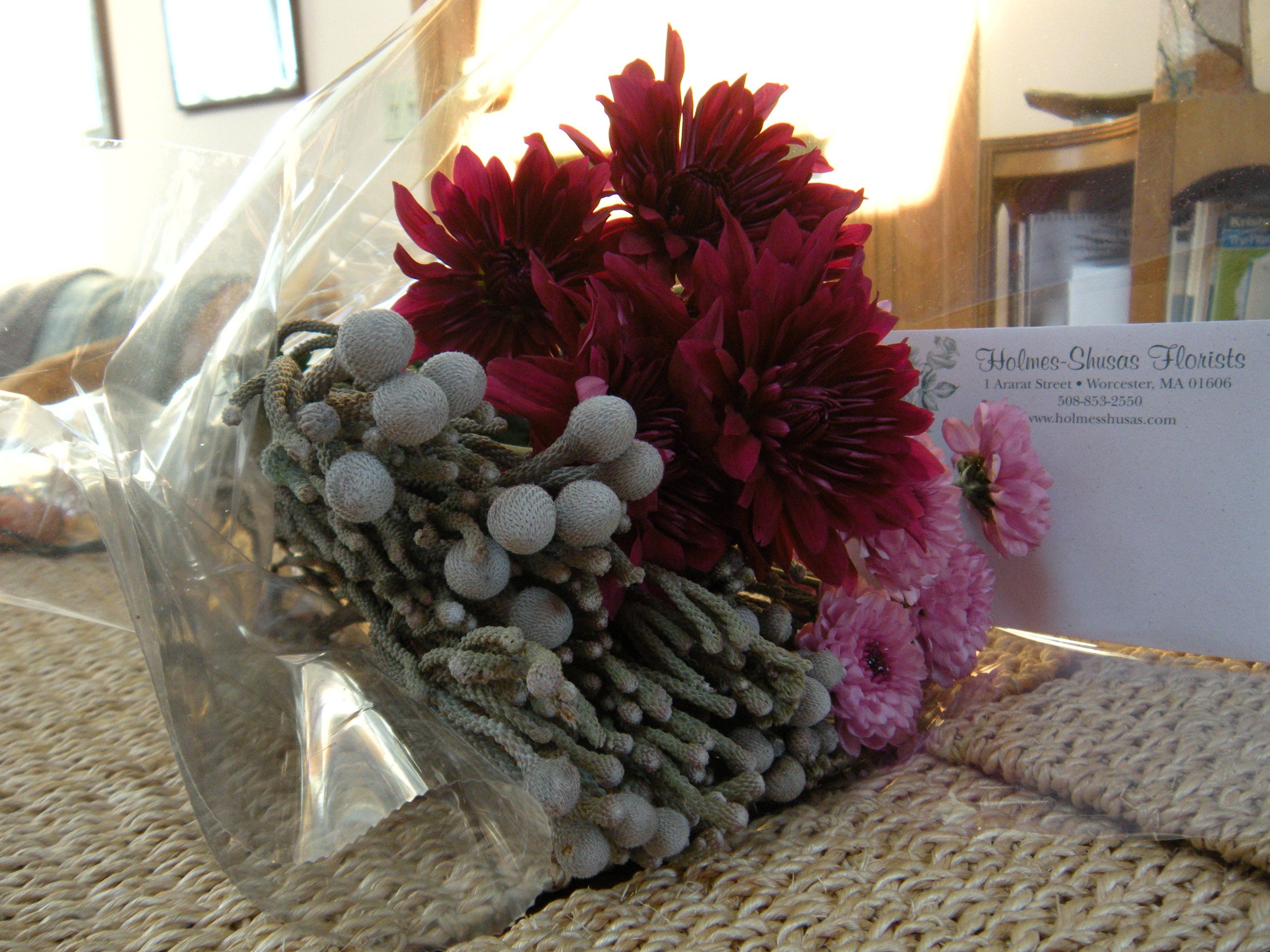
My daughter, M., who lives in Minneapolis, had wanted to send her flowers in the hospital earlier in the week. At the time, I said it would be a good idea to hold off until later in the week when we would know if she would be coming home or be transferred to a rehab place. Yesterday, I visited our local florist and saw some interesting grey-green textured leaves. A sprig of mulberry chrysanthemums, and a smaller sprig of rose-colored mums made a fetching bouquet to take to Gram along with one of those florist cards filled out with good wishes from the girls. She was surprised by the flowers and appreciated the note.

The reason I am writing this post is to describe a shift in the events from what felt like an impending death vigil whereby it wasn’t clear whether Gram would make it through the night. . . or the day, for that matter. When we saw her last night, she was philosophical about getting the leg better and remarking that she had lost six pounds because of her dietary quirks of not eating eggs, chicken or turkey. As a young child in a family of fourteen children, Gram had the chore of fetching the eggs from the chicken coop. Apparently, it was so loathsome to her (who knows what it was like?) that for NINETY years, she has refused to eat eggs, chicken or turkey. It must have been really bad. Anyhow, in hospitals, eggs are served for breakfast almost every day; chicken and turkey are preferred kinds of poultry when meat is expensive and also eschewed by many who don’t want red meat. As she related this situation to me last night, I was struck by how viable Gram seemed to be. Holding on to her stubborn refusal to eat anything that had sprung from her nasty childhood experience, she appeared to be kind of triumphant that she had lost six pounds as a result of it! The erstwhile “death vigil” had morphed into a “let me get well and get outta here” kind of mood. It was an extraordinary shift of events over the course of the week and I’m glad I was there to witness it last night.

The rehab center is one of the better ones in the city that we live in and G.’s family was fortunate that someone got discharged on the day that they needed a bed for Gram. The transition was smooth. Her stay of two weeks will end before it’s Thanksgiving again this year–(no turkey for Gram, though, as usual.) We shall see how the next two weeks will fare for her. The other residents were dressed in hospital gowns, white-haired and sitting in wheelchairs, congregated around an electric piano which was played haphazardly by one of the nurses, or later, in front of a large flat screen TV. The nurses were kind, low-key and helpful. That’s a good thing, we thought when we left.

It was a relief to be at home even though we were glad that she was faring along. The redness in her leg looked pretty bad and hopefully the IV antibiotic treatment will help the breakout of cellulitis. Of course, these symptoms still tell us that her immune system is depressed and that her systems are not as strong at ninety-five as we might want them to be. We’re just relieved that obstacles to her health are gradually being addressed. And hope that she’ll be able to go home soon.

Life is full of ups and downs and when there are a bunch of downs, it’s hard to be optimistic sometimes. It’s good to be reminded that despite setbacks, there can be a resilience that appears way beyond our control. Thank God for that. And Ganesha.

Gram bouquet 2

new things . . .

QUEEN ANNE'S LACE

It’s so much fun learning about new things from friends and vice versa, isn’t it? The other day, L. and I took a ride in the middle of a Thursday to a family-run farm nearby, about a half hour drive to Concord, MA. It was so much fun to show L. the unmarked little secret place to buy organic eggs on the honor system (she took a photo of the entrance with her camera.) and then to go back for a cup of hot dark coffee, and homemade scones in a new flavor: pineapple and coconut. L.’s eyes got big as we munched on the delicious scone. Then she put more into a bag for her family to eat later. We stocked up on Vermont Hubbardston blue cheese which is a chevre with a smoky blue cheese flavor that is heavenly when allowed to come to room temperature and it’s slightly runny. I have been known to eat a whole (small) wheel in the evening while eschewing dessert! It’s BETTER  than dessert!

Today, she wrote to me that the eggs were “eggs-traordinary”, the cheese was delicious as were the homemade scones. We have both been enjoying apple-mixberry pies and other fresh vegetables we found at the farmstand: eggplant, kale, salad greens. Going to the farmstand together also allowed for time to discuss our new joint endeavor called, “musical notes outreach,” a program for the elderly in nursing homes, assisted living residences and hospice. Our mission is simple as can be: “We want to make you happy by providing the sound of music.” Simple as that. L, because she has worked in the elder care community, knows activity directors in local venues as well as people in charge of palliative care in the neighborhood. Thanks to her efforts, we have two of our first bookings in December and are looking forward to introducing the program and seeing how people respond to it to see what they enjoy most. A menu of classical, Windham Hill and other songs will be offered.

When I played Bach’s Prelude in C major, both L. and I immediately agreed it would be a wonderful, simple piece to open each program. We might follow it by playing Charles Gounod’s “Ave Maria” overlay as a duet with the Bach Prelude. I’m thinking of playing the melody of the “Ave Maria” and then ask if they’d like to hum along while I play it again with the Bach Prelude accompanying it.  Our closing piece for each program will be “Devotion” by Liz Story. Along the way, there may be some Chopin Preludes, “Clair de Lune” by Debussy and some crowd pleasers like “You Raise Me Up” and some Windham Hill songs like “All For Us” that are simple and touching in their simplicity.

Here is a link to a wonderful Youtube clip by Bobby McFerrin singing the Bach Prelude with the audience singing the Gounod “Ave Maria” along with it. Just wonderful. I hope you’ll have time to play and enjoy it. Also included is a link to the song, “As For Us” which I’ve always loved, listening to it on a Windham Hill CD in the car. I couldn’t find the music score, but have jotted down the main progression of the piece by ear from the Youtube clip and am will include it in our programs.

So there is a lot of “new-ness” going on and it’s also a lot of fun. New friends, new music, new ways to play music. Stay tuned for how it goes in December with “musical notes!”

VICTOR