mulberryshoots

"Tell me, what is it you plan to do with your one wild and precious life?" ~ Mary Oliver

Category: Family

stirring the pot. . .

cream of tomato soup

Although I sometimes think of myself as being quiet and solitary, (“a taoist hermit”), in my professional working life, I was anything but. Although I tried very hard each time I was the “newest kid on the block,” to keep my mouth shut and not challenge anybody, it was hard for me to do any of these things longer than for the first week or two. It’s actually amazing that I had a professional career at all, all things considered.

I was a late starter getting into the workforce because my first husband didn’t want me to work (“life is long”). When my kids were in high school, I talked my way into a project management job at one of the two premier biotechnology start-up companies in the U.S. at the time. In those days, cloning was an art, carried out by molecular biologists who were treated and paid like rock stars. Nowadays, there are machines that clone while people are on their coffee break. Before I was hired, I was asked to interview with the “Senior Scientists” of the start-up company. They were very nice and very distracted by this waste of their time. In other ways, they behaved like Knights of the Round Table, coming to work at 2 a.m. and leaving whenever, or vice-versa. They purposely didn’t want anyone with a Ph.D. in science to be a project manager, which is why they were interviewing me, a liberal arts history and music major. What they wanted, it seemed, was to hire a nice “nanny” to find their notes and to run meetings that they didn’t want to attend.

Long story short, I was hired and in two years was promoted over a young Harvard MBA to Director of Project Management. I hired and trained young MBAs from Wharton and other business schools because that’s what senior management said they wanted (even though I wasn’t one.) There were four divisions in the company at the time: pharmaceuticals, agriculture, diagnostics and biocatalysis. The project managers covered projects in all four groups; there were over 25 projects with global business partners in the pharmaceutical division alone. I also managed my own projects, the most important one being recombinant Erythropoietin (EPO). Simply put, it is a glycoprotein that stimulates production of erythrocytes (red blood cells).

I remember one company-wide meeting when the CEO said, “Our number one priority is EPO; our number two priority is EPO and our number three priority is EPO.” It was a crazy time. Once the VP of manufacturing and I flew to Frankfurt for an emergency meeting and met our business partners in the airport lounge after 8 hours in the air. We then turned around and flew back a day later without leaving the airport! When I boarded the American Airlines plane the crew recognized me from the flight two days earlier. It was right before Christmas and everyone was in a festive mood. The stewardess put me in First Class and served glasses of champagne on a tray with red roses. Then, I was offered (I’ll never forget this) an unopened jar of Sevruga cavier the size of a softball–just for me. There were perks that went with all the pressure and this one beat them all.

Back to the grind, I led a global development team with business partners who succeeded under great duress to obtain EPO regulatory approval in Germany and Japan. Amgen won the U.S. patent rights over the company I worked for and built its company from its early success with EPO. During the patent litigation phase, I travelled to New York for depositions and testified on behalf of my company’s claims. Today, you might recognize EPO under its marketed name,”Procrit.” Athletes are accused of using it to stimulate performance. To this day, it is still the single most successful product ever developed by recombinant technology, generating over a billion dollars of revenue a year.

Wow, you might say. . .how did you survive that? Well, I read huge textbooks about Molecular Biology and Protein Chemistry without understanding or at least retaining much of what I read. The first year, I walked around the garden and cried a lot on weekends. Understanding a research scientist’s mentality, having grown up with my father (“my father, myself”) gave me a leg up towards coaxing them to do what management needed them to do. It was a privilege to be on this ride in the early years of biotechnology. The work was exhilarating and very, very stressful. I virtually disappeared from my family. I told my first husband that from then on, he would have to go to all the school meetings for the kids and to carry on at home as though I had left the planet. Which is also how it felt sometimes.

Anyway, that’s how I started working. They thought they had hired someone they could ignore. I managed to stir the pot enough to get things done. It was a lot of fun working with such intelligent people for such a long time. After the bloom of biotech faded, it got a lot harder to raise money, it was a lot more stressful and a lot less fun. But I had a good run. I lucked out. I worked very hard. And I’m glad that a product like EPO made it across the finish line.

serendipity and synchronicity. . .


I feel that serendipity and synchronicity have shaped my life to a large degree.

When my father decided at the last minute not to return to China right before the Cultural Revolution took hold, that was serendipitous. We had our shots, bags were packed, we were ready to go. Even though my grandfather accused him of being “disloyal” at the time and for years afterwards, my Dad made a life decision to stay in America and not to return to China. When I think about what my life would have been like, all I would have to do is look at my Chinese cousins’ lives, a generation whose future was stolen by the Red Guards. I might be wearing my hair in pigtails and growing cabbages. Or maybe I’d be online, writing a blog!

Without synchronicity, my lost dog wouldn’t have been found and my husband wouldn’t have found me (“life is long“). Seeing the first quartet of red cardinals was serendipity. Seeing a family of them in our rose arbor was synchronicity (“seeing red cardinals“).

Wikipedia (see links above) says that “serendipity” has been voted one of the ten hardest words to define. Maybe it’s one of those concepts where “you know it when you see it.”

How have serendipity and synchronicity touched your life?

seeing red cardinals. . .

photo taken by Timothy Hardin

Whenever I am driving along in the car and a red cardinal swoops in front of me, I think of it as a good omen. I don’t know why but I think of it as a secret messenger whispering in my ear that something good is going to happen. Or, simply that “hey, everything is fine!” It is a bird of affirmation. With this unfounded bias, whenever I see cardinals, the rosy, light brown female and the bright scarlet male, I sense that the Universe is playing a song and that I should listen to it.

In February, two years ago, my father lay in a bed by a basement window. He could see the trunk of a shrub outlined there if you propped his head up with a pillow. A few days before he died, we heard birds hopping on the branches of that shrub. When we looked up, we gasped when we saw not a pair of cardinals, but two pairs of cardinals. Yes, there were four adult cardinals brightly hopping on that shrub. If they were a “sign” of anything, the cardinals did not tell us what it was. They lingered for at least two days. Right on that same shrub–it seemed as though they were giving some last messages to my Dad while he was still here on earth. Or maybe vice versa, who knows?

My husband, G, is aware of my affection for cardinals. He shares an affinity for them too, I think. One day last year as I unloaded groceries from the car onto our front steps, he greeted me with a “shh” and beckoned for me to enter the side door of the house. Along the south wall, there was a twelve foot high iron trellis that G had erected years ago to support a bower of climbing roses, mostly pale pink “New Dawn” intermingled with “Constance Spry” . Signalling for me to step quietly inside the saw room, he pointed at the window and the underside of the rose bower, whispering the word, “nest.”

A proud father cardinal stood on a branch near a nest of baby cardinals, the mother nowhere to be seen. She returned a little later after a break sitting on the Sassafras tree on the other side of the driveway. Here, we witnessed two pairs of cardinals, parents and babies. Seeing them so close up in a nest built next to the house brought back the memory of the two pairs we had witnessed at my father’s bedside.

I don’t know what cardinals represent but click here to see what Ted Andrews, in his book Animal Speak says about them.

basil toutorsky. . .

Basil and Maria Toutorsky's home on 16th St., Washington, D.C.


I started playing the piano when I was three in China trying to imitate my Aunt Anna, a piano teacher. When my father was finishing his doctorate at the University of Chicago, he sent for my mother and me to come to America. We were living in Peking with his parents until the end of World War II. We travelled by freighter for three weeks, arriving in California. Then we took a train to Chicago, five days sitting up in a train, eating sardines on saltines for our meals. Our first home in Chicago was located in the cement basement of a house belonging to a Chinese family who kindly took us in. When he graduated, my father got a research position at the U.S. Geological Survey in Washington D.C. and we moved to a 2nd story apartment in a small house in Berwyn, Md.

Piano was important everywhere we lived. We had an upright in the Chicago basement which I would practice after I had started the evening’s rice to cook. In Berwyn, we also had a piano. That’s when my parents found a piano teacher named Mrs. Cortez to give me piano lessons. We stood by the highway and took the Greyhound bus to Washington, D.C., then took the D.C. Transit bus to 16th Street for my piano lesson. Sometimes my father would drive us there, reading scientific papers in the back of our old black Ford while he waited for me to have my lesson. Soon, Mrs. Cortez suggested that I take lessons with the Professor instead. She was a student of his as well, her teaching room right off the reception room filled with sumptuous furniture.

Before leaving Russia, Professor Basil Toutorsky was a renowned pianist and friend of both Sergei Rachmaninoff and Alexander Scriabin. He was also one of the nicest persons I had and have ever met. He took me under his wing for about four years from the time I was eight to when I turned twelve. The architecture of the house on 16th street made it a landmark in Washington. Click studio to see the outside and imagine what it must have been like for a Chinese kid to have piano lessons there. Inside, there were twenty-two grand pianos, placed two-by-two with keyboards that ran from one end to each other. Some were coved together as matched pairs in room after room.  We spent many hours playing four-hand pieces together, either on one piano, sitting side by side or on two pianos where we could see each other over the music desks.

By osmosis, this early routine of playing with Professor Toutorsky gave me a deep sense of music and rhythm. He taught me laborious hand and finger exercises that gave me strength and independence. I played a lot of technical exercises: Czerny, Cramer and lots of scales: chromatic through the circle of fifths, natural, in parallel and contrary motion. I later learned that the finger exercises were known as the Leschetizky method. To this day, I owe the development of my technical ability, ear training and musicality to Professor Toutorsky.

me, at the age of twelve, at the piano in Toutorsky's studio


He was also one of the few adults who showed me humor and compassion. One year for my father’s birthday, he recorded me playing Beethoven variations and encouraged me to say “happy birthday” on the ’78 rpm record that he put into a paper sleeve.

When I was twelve, he took me down to the Cosmos Club, an exclusive place where concerts were attended by Washington’s society elite. It was the first time I played a few notes on a nine-foot Bosendorfer grand piano. The tone of the Bosendorfer’s bass notes made a lasting impression on me. Later, I compared its tone to many of the instruments that I played, looking for that elusive and rare depth of sound. He also planned my first recital to be given at his home. As a momento, he showed me a photo of a music lyre in the Encyclopedia Britannica, and then with my assent, had the image of the lyre made into a gold pendant, engraved on the back with my name and date commemorating my”First Recital”.

first recital pendant

To this day, I am ever so grateful to this gentle man who gave me so much technical and musical training so magnanimously. My parents underestimated what he did for me. I don’t think they knew what Leschetizky method was. For sure, they didn’t realize how much Professor Toutorsky cared for me. Nor I for him.

doubled and re-doubled. . .


He was the King of Hearts

I don’t know why I am remembering so much about my Dad these days. This is one anecdote that I am posting because it’s so typical of him and how he behaved.

When I was in high school, I was pretty much a wallflower, a nerd, a geek. In fact one of my best friends in school whom I knew from the 6th grade nicknamed me “braintube”. He still calls me that and I call him “Jimmie” to this day in our emails even though we are both grandparents.

Anyhow, it was the 60’s and my high school friends and I played bridge pretty seriously. At our parties on Friday nights during junior high school, a bunch of us would get together to play bridge. Our parents also played. My best friend, Martha, used to invite me over for sleepovers and her parents would play cribbage or gin rummy by themselves, and bridge when the two of us made a foursome. Sometimes Martha’s brother Joel would spell one of us off. Her parents chain-smoked like chimneys while we played.

My brother, D., is eight years younger than I am, so when I was a junior in college, he was still in junior high. But he played bridge too. One weekend, my parents invited some friends over for dinner. While we were waiting to eat, my Dad asked if anyone wanted to play a couple of hands of bridge with him and one of the guests. My brother and I were partners as we sat down opposite my Dad and his partner. That my father barely deigned to play with me and my brother was pretty obvious. But as the play went on, my brother and I were dealt a lucky hand of cards. We bid a small slam. My father looked at us as if we didn’t know what we were talking about. I saw two tricks that we could lose, one sure one, and one depending on who had the high card for a finesse.

Dad doubled the contract. My brother, who is no slouch at being strong-willed either, redoubled. For those of you who don’t play bridge, what that doubling and redoubling meant was that: a) my father basically challenged us that we did not have a prayer of making the small slam contract; and b) my brother’s redoubling was like saying, “oh yeah, just watch us.” If my father won his double and we lost the contract, his side would have gotten 50 more penalty points. If we did make the contract redoubled, then we would get 100 more points than we would have without all this macho challenging stuff going on.

You know what happened, right, or I wouldn’t be writing about it. My kid brother and I won the small slam contract. The crucial finesse worked to our advantage so we only lost one trick. We got the redoubled score. And my Dad, bless his heart, never played bridge with us again.

scallion pancake recipe. . .


1.  Mix 2 1/2 cups flour with 1 cup warm water. Mix well and knead gently. If it is too sticky, add a little more flour. Knead gently until smooth; cover with a clean dishtowel and let rest 15-20 minutes.

2.  Wash and chop up a small bunch of young green scallions–slice them lengthwise, then chop and mix white with green parts; set aside.

3.  Take a fresh package of lard (manteca) and heat about 1/4 cup of it in the microwave until it is soft and spreadable but not liquified. Add in 2 tsp. of sesame oil and mix well; set aside. This should be the consistency of sour cream.

4.  Flour a board; divide the dough into 3 parts; roll out one part to about 6-7 inches–spread with lard/sesame oil mixture–not too thin, not too thick.

5.  Sprinkle the surface with coarse sea salt or kosher salt.

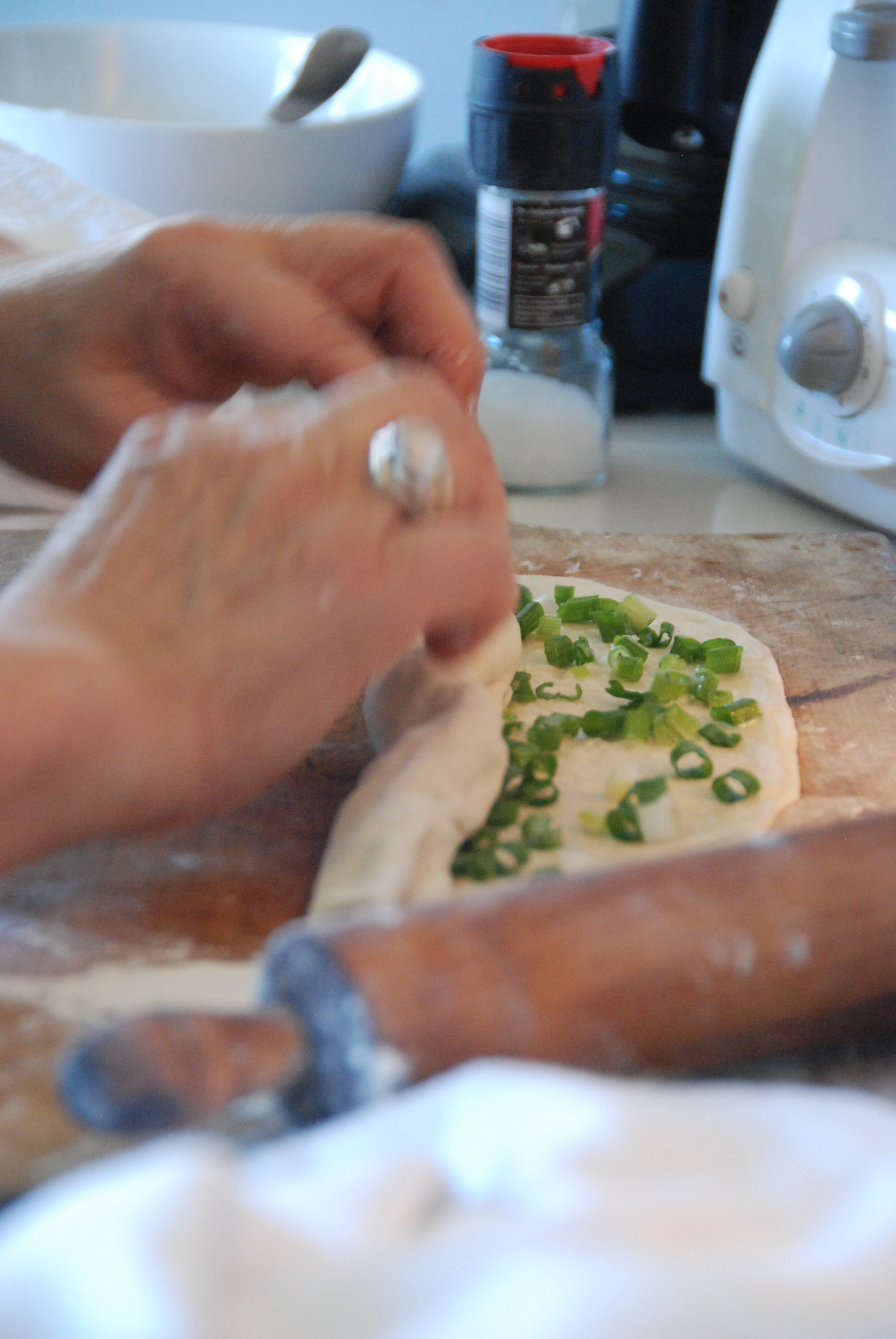
6.  Divide onions into three parts and sprinkle one onto the first pancake. Roll up securely and then, taking one end, curl it into a snail on itself. Pinch together, pat and roll this snail out into almost the same size as before.

7. Use a clean skillet and heat up some canola oil or Wesson oil–when the oil is warm, slip in the pancake and cook it gently (mildly sizzling but do not burn.) When it is golden brown, turn it over and cook the other side.

8.  Drain onto paper towels and cover with clean towel; wipe out the skillet each time, add fresh oil and cook the 2nd and 3rd pancakes.

9.  Drain each one separately on paper towels to soak up any excess oil.

10. When all 3 are cooked, put them on top of each other and cut in half with a cleaver, then crosswise, then in wedges.

11. If you want a dipping sauce, make one with lite soy, rice or Chinese black vinegar, sesame oil, sugar and a little water–grate some fresh ginger root into it if you want.

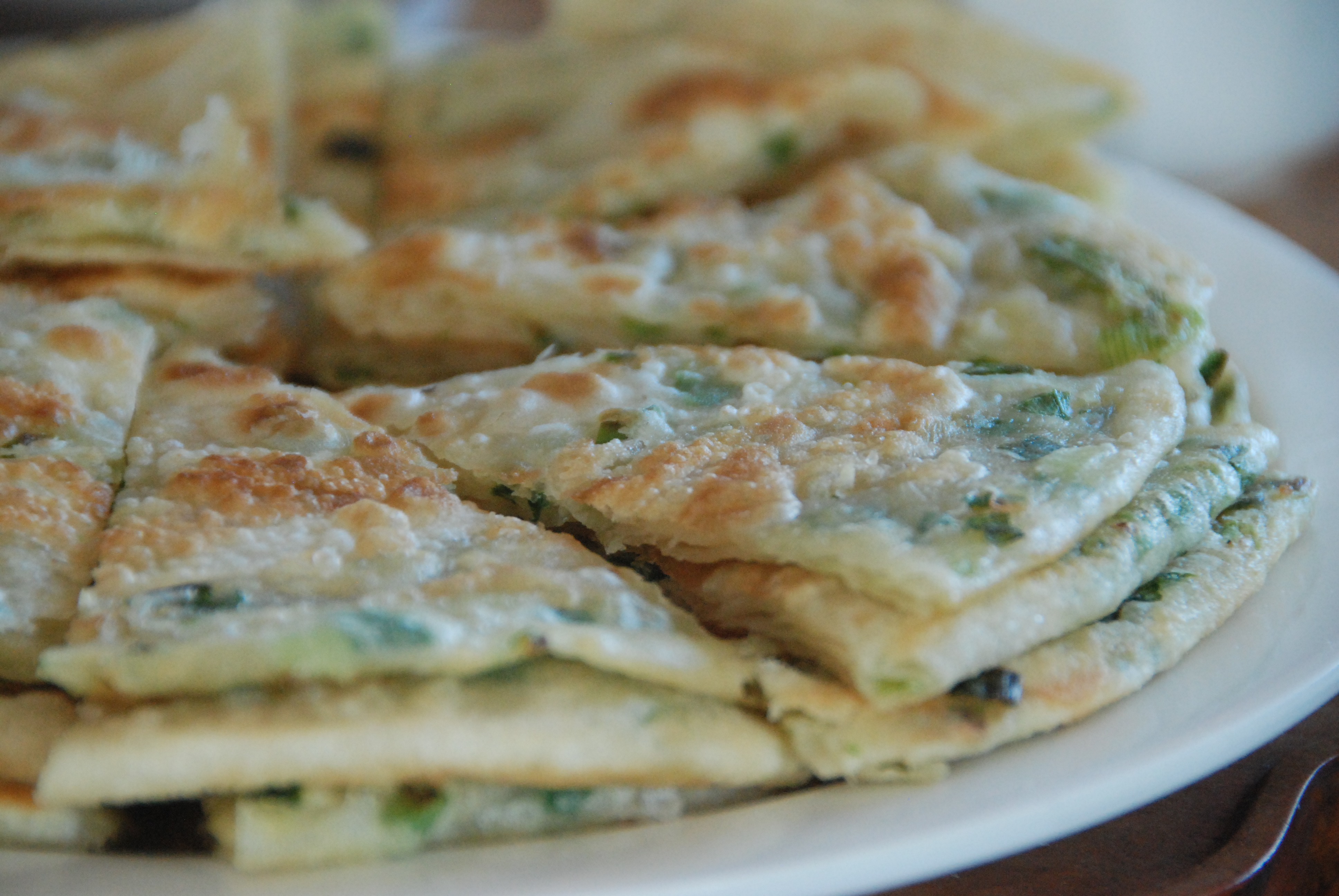
THESE were the best scallion pancakes that I have ever made.

making scallion pancakes . . .


hands down "the best EVER"

I was very good in chemistry and almost majored in it in college, at least when I was a freshman. What I mean is that I can follow experimental directions and also have an intuitive sense about mixing things together to see how they will react. In large part, that’s the process by which I approach cooking most of the time. The rest of being a cook for me is also intuitive but more free form, the reason a dish will turn out slightly differently each time even though you are following the same basic steps.

My Dad’s primo cooking dish was making scallion pancakes. He was absolutely rigid about how to make them and that his way was the only way. I watched as he chopped the green onions and put them in a bowl, made the flour dough with hot water and let it rest, shape the dough into a long snake and cut up portions, then roll each one out, spread with soft lard, sprinkle with salt, then onions, roll them up, then make a snail from the rolled up pancake, flatten the snail out again. Then cook carefully in a skillet, pile the cooked ones one on top of the next and then with a large cleaver, cut through all of them to serve them as fragrant, warm, savory wedges of salted heaven.

Recently when family was visiting, I impulsively decided to make them. But I didn’t have Dad’s exact recipe with me so I was a little dubious. I found a recipe online that sounded about right. It didn’t have a leavener like baking powder, which I distinctly remembered was Dad’s “secret ingredient.” I also remembered the last time I had included it that the pancakes were a little spongey to roll out.

I decided to follow the online proportions for flour and water and then go with my instincts. Instead of spreading lard on the surface of the pancake, I warmed a little in the microwave with a dollop of sesame oil. Then I mixed the softened but not liquid lard and sesame oil, spreading it thinly on the pancake. I used sea salt from a grinder. The green onions were washed carefully, slit down the lengths and then chopped finely, the white and the green parts. The fragrance of the raw onions filled the small galley kitchen I was working in. The dough without baking powder was easier to work after resting.

Everyone agreed as we wolfed them down that these were the best ever, Dad’s sacrosanct recipe notwithstanding. I wonder what he would have thought about such delicious scallion pancakes made from a recipe available on the internet. I also wonder if they’ll ever come out as well as this batch the next time I make them. The photo tells the whole story.

If you would like to try the recipe, I will post it next. One word of caution though: don’t try to make them if you are averse to using fresh lard (manteca at any super market) because actually, that is the true secret ingredient!  Let me know how they turn out for you.

ashes to ashes . . .

My father died at the age of 89 in February 2008. My mother died at the age of 89 in November 2008. By that time, they were no longer married. And had lived apart for quite some time before they died. Nevertheless, my mother was there when a Tibetan monk was chanting Prayers for the Dead for my Dad. He had his eyes closed towards the end. My mother walked up to his bedside and his eyes flew open. She looked at him and nodded. He seemed to nod back, closed his eyes and died.

My mother died painlessly in November the same year after being diagnosed with abdominal cancer in August. She had little to say as well. Both of them were cremated according to their wishes. That year, we had ashes from both of them that we took home. For awhile, I held onto them, not knowing where, exactly, to release them into the world. After awhile, I thought that it was not a good idea to keep them wrapped up, and that in order to release their spirits wholly, our little packets of dust needed to be dispersed in a kind fashion.

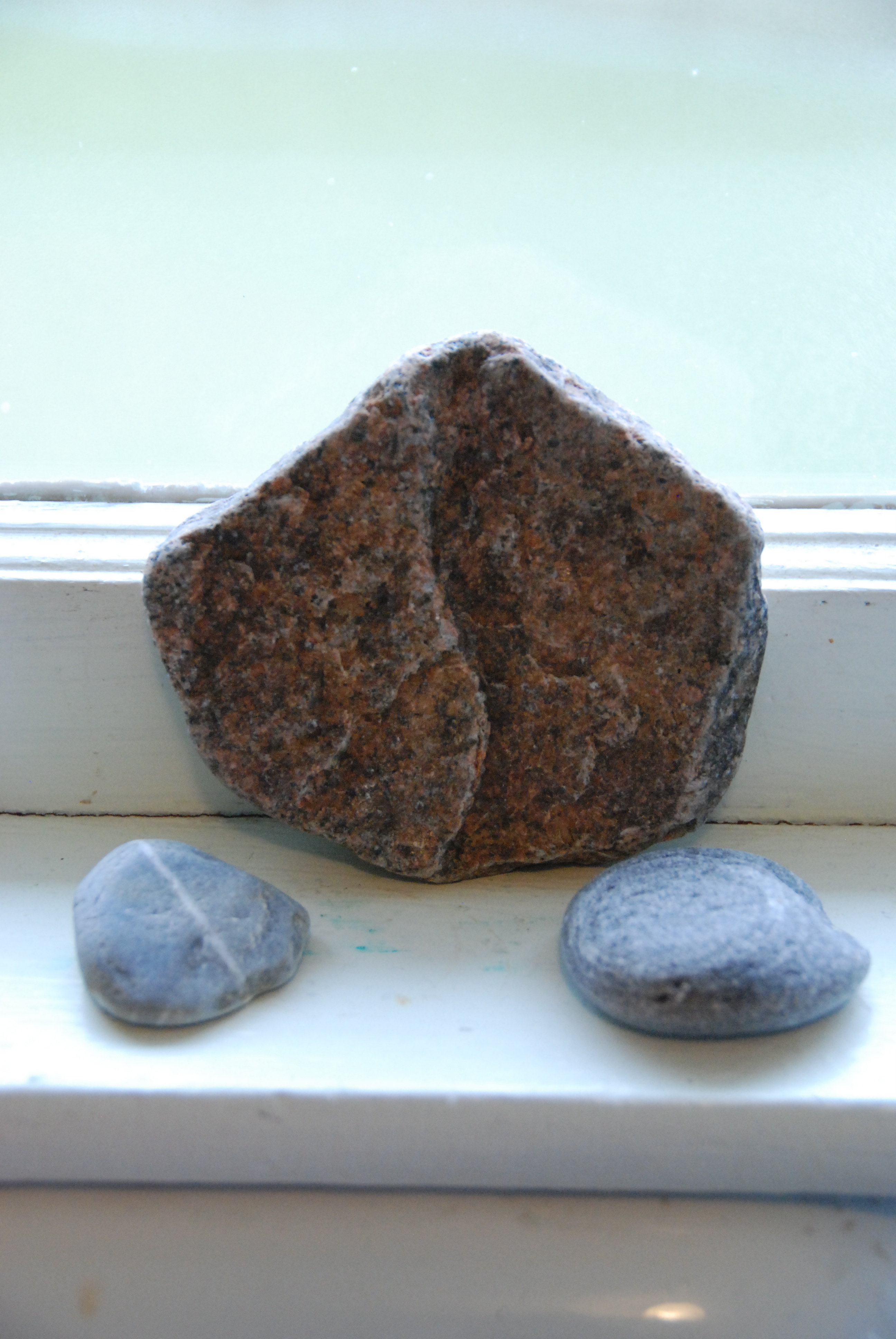
I finally decided to go to a nearby beach on the Atlantic coast of New England. It was twilight, my favorite time of day. Nobody else was there and it was low tide. I walked to the water’s edge and said goodbye as I released each packet of ashes. They swirled in the cold sea water, the dust settling as I carefully shook out the bags. I felt that it had been an okay kind of ceremony. As I turned around to walk back to my car, I took a few steps and looked down on the rocky beach. Not two minutes after I had finished releasing the ashes than there appeared two small rocks that stood out, one next to the other. One had a white straight line through it, and the other, a white circle. I felt that this symbolized my father (the straight line) and my mother (the circle.) I picked them up, feeling that it was an affirmation from them, or from the powers that be.

In about four more feet up the beach, I looked down again and saw a large flat rock with a wave indentation on it. It looked to me like an I-Ching hexagram, or a symbol of Yin and Yang. It felt to me like the Universe was giving me comfort that this release of my parents’s ashes was appropriate and well-received, in some way–or maybe it was just their way of saying a last goodbye.

fitting a puzzle together . . .

Putting jigsaw puzzles takes patience, an eye for shapes, colors and design. Some people are good at it and can spend hours poring over a myriad layout of tiny pieces, sorted by color, the edges already formed, at least if you are experienced at this kind of thing.

I have patience to knit, a sometimes tedious-looking kind of activity, repetitive, requiring counting and the willingness to go back and pick up a dropped stitch, or one that stands out from the tension of the piece you are working on.

My husband, G, could no longer knit than I could do jigsaw puzzles.

dad, upgraded to take-off . . .


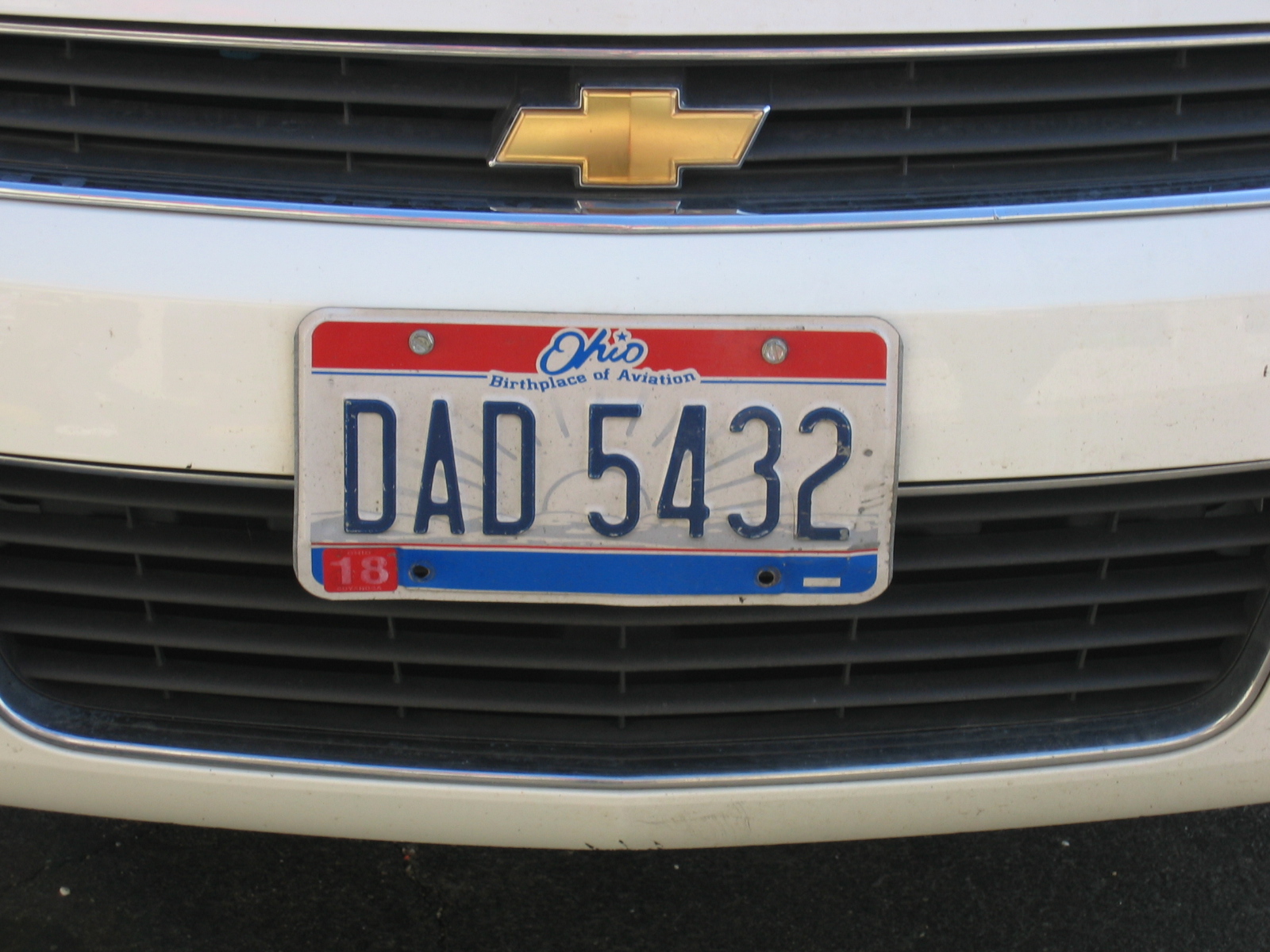
When we arrived to attend a small family service after my father passed away, the rental car agent asked if we wanted a free upgrade to a larger car with GPS. We said “sure.” Here’s the license plate of that “upgrade.”

The irony of this license plate is that my Dad was an astrogeologist who was at the right place at the right time: distributing moon rocks that astronauts gathered on the moon in the space flights taken in the 60’s. He was even quarantined for three weeks in a Gulf Airstream trailer with the astronauts when a glove blew a hole while handling the specimens. In an era of the novel, “Andromeda Strain,” it was thought to be prudent to isolate them, just in case. So, I guess the Cosmos thought it would be humorous for us to receive this last salute before my Dad took off into the wild blue yonder of the Universe!