mulberryshoots

"Tell me, what is it you plan to do with your one wild and precious life?" ~ Mary Oliver

Category: Life & Spirit

fresh start . . .

DSC_0923
Made a smoothie for breakfast that tastes lighter than usual and is very refreshing:

Ingredients:
almond coconut milk
freshly squeezed juice from two navel oranges
fresh spinach from Idylwylde Farm (half a handful)
fresh parsley (half a handful)
fresh blueberries (a quarter of a handful)
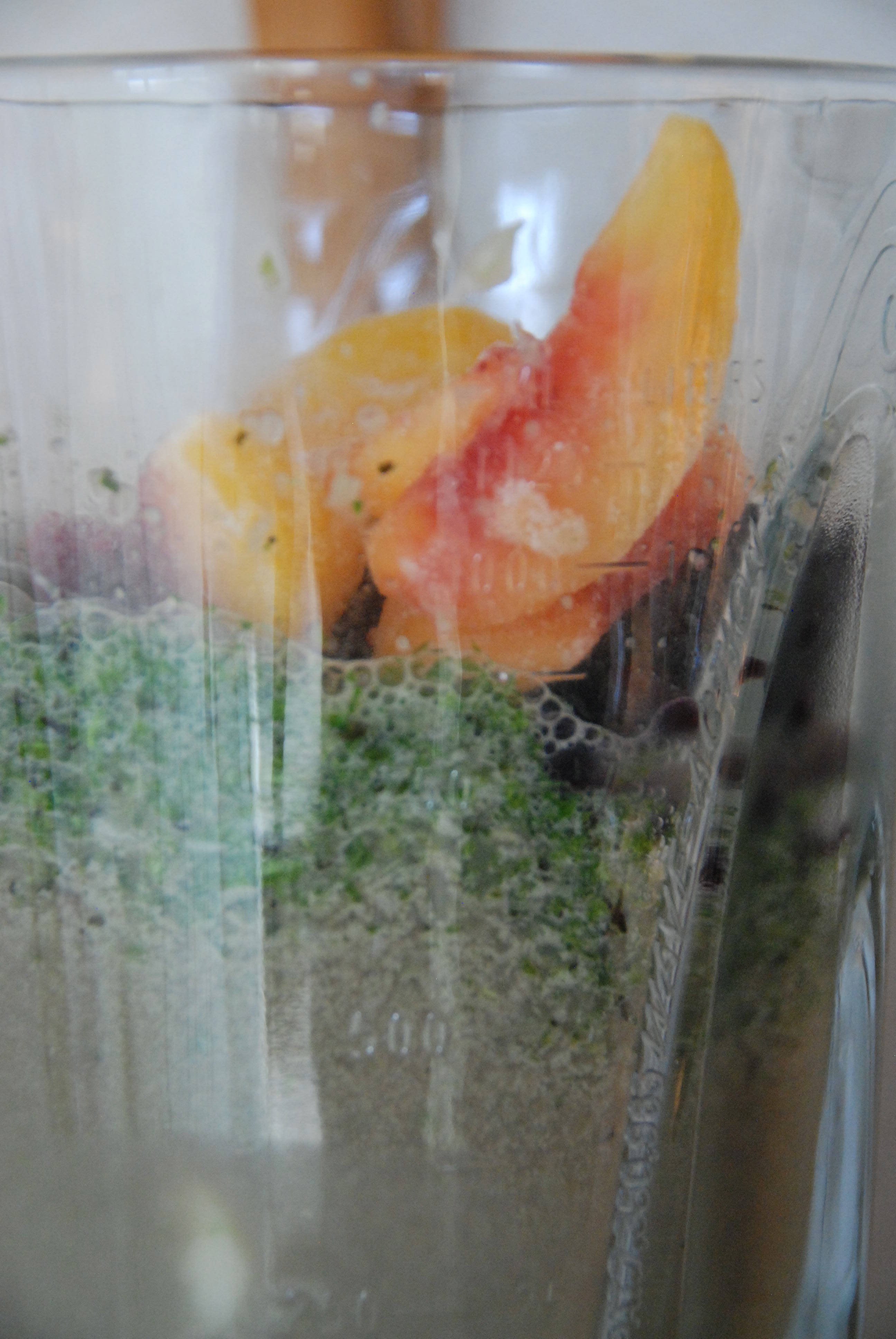
frozen peaches (about 6 slices)
frozen banana (fresh, cut up and stored in freezer)
a large knob of peeled ginger root

Mixed in the Vitamix. Makes two tall glasses, one reserved in the fridge for later in the day.

This smoothie was markedly different from others that I have made so far. Adding freshly squeezed juice from two navel oranges to the almond-coconut milk base added flavor and resulted in lighter liquid content. Parsley and spinach were less dense greens than kale by itself. Plus, frozen fruit (peaches and banana) made the drink colder than room temperature smoothies of the past. The knob of ginger root was peeled and at least twice the size I normally use. It added zing and provided a clean aftertaste. Overall, this concoction was lighter in density, more flavorful and colder than normal: a keeper recipe to jot down in my food journal.

Last night, photos (shuffle) appeared on my Mac laptop while we watched the game (the Bruins made a stalwart effort tying the game at 5-5 but lost in overtime.) As the images came and went, I couldn’t help but notice how much older I looked a couple of years ago and even as recently as this last holiday season. In addition to growing my hair longer, I think I may have lost about twenty pounds these last six months because I feel/look much healthier/better.

Of all the things that might have helped, I think the little Oster citrus juicer has made the most difference. Whenever I find myself craving something to snack on, I juice up a pink grapefruit and two navel oranges. It is a refreshing drink that also satisfies my desire to eat something. Plus, I keep the fruit in the fridge so that the juice is nice and cold. Adding fresh juice to almond-coconut milk was a good experiment.

So, that’s today’s fresh start for the day.

game four . . .

ghiardelli 1So for game three of the Bruins Stanley Cup Playoff game against the Blackhawks, I made a “tarte aux pommes” with simple ingredients I already had on hand. In the Times today, there was a small photograph at the bottom of the front page showing what looked like a chocolate chip cookie. But this one had chunkier pieces of chocolate showing, not your usual Nestle’s semi-sweet chocolate chips that come in the ubiquitous dark yellow bag that nearly everyone buys to make that old cookie favorite.

The featured article about baking these cookies was by an otherwise erstwhile health food columnist, Martha Rose Shulman. It turns out she is a ghost-baker for baking cookery book authors. As you know from reading my food posts, we like eating rather spare, healthy cooking too.

Not today. The reason why the cookies caught my eye and looked so delectable is that the recipe calls for cut up bittersweet chocolate. So when I was at the grocery store, I bought two bars of Ghiardelli chocolate labeled “Intense Dark.” My first thought was to bake batches of the chocolate mixed individually and to compare the taste. But in the end, I cut up the chocolate, mixed both kinds of bitter chocolate together in the cookie batter and slid the baking pan into the oven.

Here they are cooling on the oversized rack that I’ve been hoping to use for some time.

. . . bittersweet chocolate chunk cookies cooling on the rack

. . . bittersweet chocolate chunk cookies cooling on the rack


Here’s also hoping that the Bruins win tonight and go on to win their game 4 on Saturday night to clinch the Stanley Cup. Because at this rate, all of the healthy eating influences in the last few months will have been obliterated by our cravings while watching the playoffs. I guess we could try carrot sticks or something but these bittersweet chocolate chip cookies are a lot more fun.

The true test is of course how they taste. I just tried my first one, splitting it with G. to see what they were like. I’m not really much of a desserts person myself, which is why these crisp, light cookies with dark chocolate are so delicious! They are a lot less sweet than ones made with Nestle’s semi-sweet chocolate chips. Moreover, the FLAVOR of the bittersweet chocolate is intensely enjoyable.

Here’s to the Bruins winning tonight!

when less is (truly) more . . .

. . . the tree in recovery today

. . . the tree in recovery today


Some of you readers have heard me talk quite a bit about ways in which less is more. How simplifying by getting rid of things creates more space for energy to move around. For preparing less food at meals, cutting down from four (protein, starch, vegetables, salad) types of food to only two (vegetable and salad; or rice and vegetable; or fish and salad) reducing serving size at the same time. With less to eat, it tastes like more to savor somehow.

On the other side of the coin, though, I confess here to gigantic overdoing it when it comes to our money plant tree. It started out as a six inch plant on our kitchen sink.

. . . plant starting out on the kitchen counter years ago

. . . plant starting out on the kitchen counter years ago


Over time, it grew. And grew and grew until the top had hit the ceiling and I moved it to the one place that had room for it to keep growing higher. That turned out to be a big mistake. Here’s what happened. There was way more direct sun. If sunlight is good, then more sunlight should be better, right? I also thought the pot looked a little bare so I topped off the soil with some that was in a bag downstairs in the basement. More soil to grow with, I thought, naively. Last of all, water~! More water, I thought with all that additional sunlight and soil would make it grow faster and taller, right?

Well, it did grow fast with leaflets pushing up against the skylight. But it also dropped leaves that turned brown almost as fast as they grew in size. We had found a nest of cobwebby spider mites at the top and trimmed it off. After that, I was paranoid the plant was still infested with them and responsible for the leaves dropping like rain. In desperation, I wrote to a horticultural help line and a very nice man wrote back that this plant did not really like that much direct sunlight; that the photos I sent looked like natural secretions and that it might be a good idea to remove the soil that I had placed on top. Moreover, he said, the plant likes the soil to become dry before watering.

. . . money plant at its prime three years ago

. . . money plant at its prime three years ago


. . . tree dropping leaves on May 6th

. . . tree dropping leaves on May 6th


I was stubborn in thinking more was more in this case. But finally, we lopped off two feet off the top so that we could move it back to where it was before. The tree expert said it sometimes took three weeks for a plant to re-acclimate itself to a change in growing environment. So, I left it alone. It had indirect sunlight, the soil was still wet and I put it by our singing canary to keep it company.

Three weeks went by and still the soil was wet to the touch, much to my amazement. Finally, it was dry enough to the touch for me to water it with spring, not tap water as the expert had suggested. The leaves stopped dropping. The plant looked happy and happier as time went by because I wasn’t doing anything to it. For once, less really was way more in restoring this living thing to more optimal health: less sun, less soil, less water.

Now it seems happy. And so, dear reader, am I. In case you are a helicopter parent like me on occasion, you might also take heed of this little plant story. More is not always better. Sometimes, less is more. In fact, with almost anything these days, less is becoming more as a way of life.

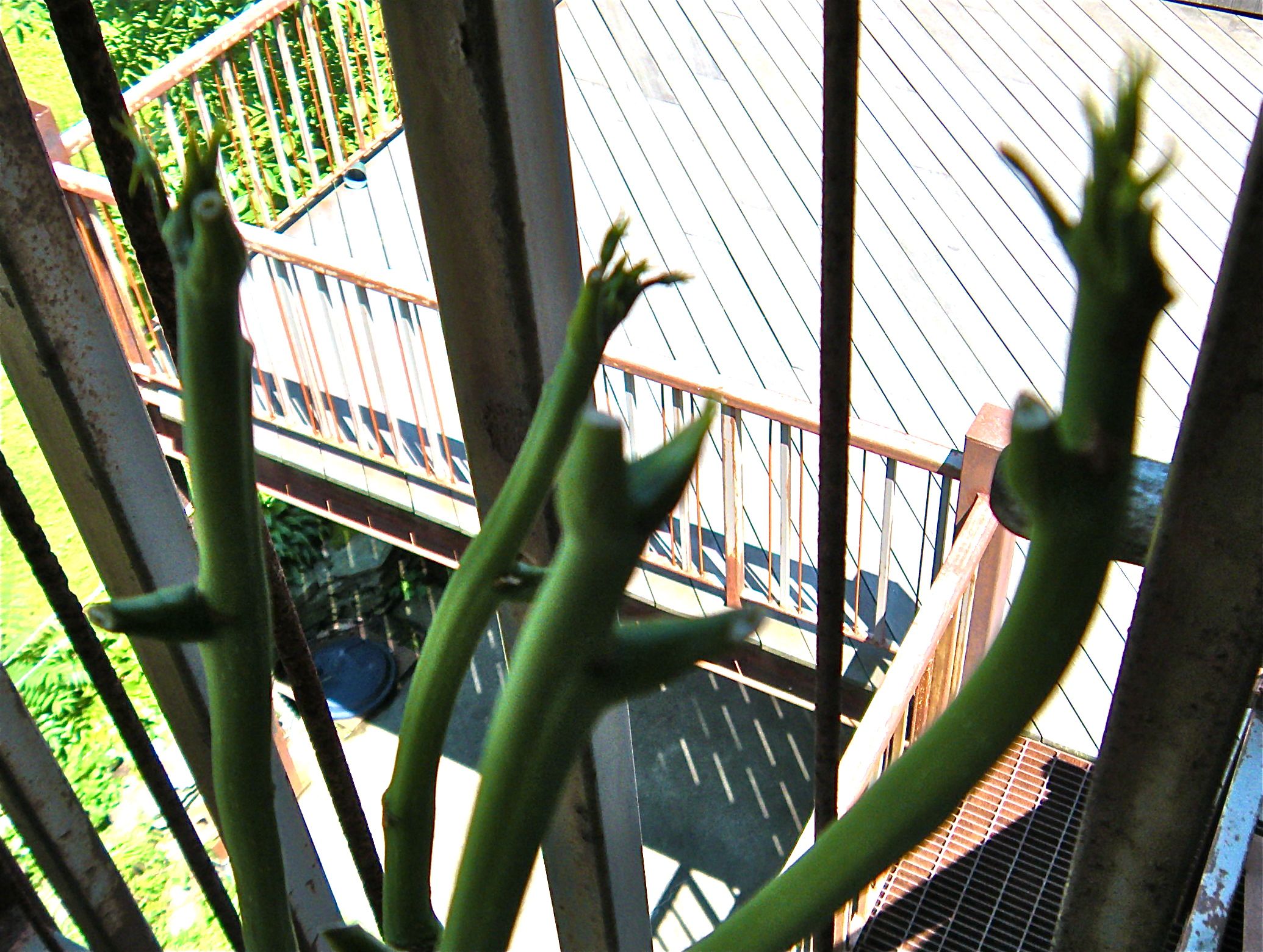
Here’s a look at the tiny sprout that emerged from the cut top just yesterday!

. . . money tree with tiny sproutlet on top

. . . money tree with tiny sproutlet on top

Postscript Photos: About two months ago, we cut about two feet off the top of the tree. I was reluctant to throw it away so I stuck it into a bottle of water out on the back deck. In the meantime, there’s been a lot of rain. I don’t know if that made a difference but was astonished to find small leaf growths all over it when I went out to water the amaryllis the other day. So here’s a photo of this embarrassment of riches!

. . . tiny leaves sprouting on cut stalk

. . . tiny leaves sprouting on cut stalk


At the same time, the little sproutlet that emerged where the top was cut off shown above in this post last week has been growing an inch a day. I kid you not! It now has three leaflets on about ten inches of growth.
. . . new growth where the tree was cut

. . . new growth where the tree was cut

still here . . .

beautimous garden for blog postI don’t know when I started to read obituaries regularly. Maybe it was when more people who were younger than I am seemed to be dying. The other day, a little video appeared on Skype made by my daughter M. and her two-year-old daughter, Josie. In it, they faced the camera and Josie, in her little voice said to her Mom, “not here?” “not here?” meaning we weren’t coming on the screen. It was a charming vignette and one that is relevant here because I think we all think about when we’re “not here” anymore.

In my writing, one of the themes that recurs is that the superficial trappings of fame are not necessarily what defines a life’s worth of living. In fact, I think it’s just the opposite. For example, I know of so many interesting stories about families who disperse as though shot out of a cannon, siblings who live and work in South America, Asia, Washington and New York City. I remember one family whom I was able to observe because the daughter was a good friend when we were both freshmen in college. I never saw a woman and a man so love in with each other as her parents seemed to be, all the time, in spite of raising a household of rebellious, independent, artistic teenagers. Just the way they looked at each other in the dusk by their swimming pool was so much more intense than Hemingway ever managed to convey.

There was another family who lived up the street from me when I was in junior high school. These parents were cold and formal, but the kids, who were my contemporaries, were wild and curious, unconventional and also gorgeous to look at. One of them went to South America and lived most of his life there; the middle son volunteered for the Marines, served a bunch of terms and then lived in Japan where he met his wife and now live in a simple cabin near Puget Sound and work as fishermen. The youngest, a daughter, changed her name and embarked to Alaska of all places where she taught herself how to play the HARP! which she takes onboard with her when she flies to perform at concerts in the rain forests of Brazil!

So you see, it’s not just people who are heads of things (lettuce) or invent things or are culturally visible who are worth mentioning. To me, there are far more interesting and inspirational lives out there, full of pathos, tragedy and illuminating joyousness. Here is an obituary of Mott Green, about a rebel with a cause who did it his way whose obituary appeared in the Times this week.

It seems to me that people’s lives are worthwhile in many small ways, whether or not there’s a fancy obituary written about them. Maybe I’ll come up with how to capture these characters in this phantom book I keep thinking is just around the corner that I will sit down and write in three weeks. Or maybe, I’ll just keep doing it right here, little by little, at least for the time being until I figure it out.
beautimous 2

buddha’s delight . . .

. . . soaking daylily buds, wood ear and shitake mushroom

. . . soaking daylily buds, wood ear and shitake mushroom

On Sunday, I spent all afternoon cleaning out the pantry. It was hot and the task was frustrating, having to temporarily lump disparate things in grocery bags in order to make enough space to reorganize things; then looking for where to store leftover hodge-podge goods. For once, I put food basics (rice, flour, salt, sugar) together and most often used equipment (oval gratin and baking equipment) together (DUH!) For someone slightly OCD, you might have expected I would have figured this out long ago! Better now than never.

It was also embarrassing or humorous, however you want to look at it to find out how consistent I am in my preferences; e.g., duplicates or similar ruffled pastry pans, some with removable bottoms; two extra-large cooling racks; twin muffin pans and so on.

When I consolidated the Asian foodstuffs into a white plastic three drawer storage unit on wheels (for only $11.99 at Target) there were numerous packets of dried tiger lily root ( a key component for making buddha’s delight) and wood ear (which gives texture to that same dish.) In fact, I calculated that I must have enough of these two ingredients to make buddha’s delight every week for a very long time.

Actually, that’s not really a bad idea. It was one of my cousin Pei-Fen’s favorite Chinese vegetarian dishes to cook. We shared it one last time together five years ago in her kitchen before she died this Spring. I’ve made it at home since but have as yet to come up with what made hers so definitively Buddha-ish. I think that it’s due to the fineness with which she sliced the cabbage, daylily root, tree ear and soaked mushroom pieces. The ingredients were mere slivers, resulting in a cooked melange of cabbage, aromatic with a little soy sauce and sesame oil added at the end. This dish, to me at least, is all about TEXTURE. The slightly bland flavor of the vegetables is married to their texture. It’s somehow aromatic and chaste at the same time: an ascetic aesthetic!

If you find recipes for Buddha’s Delight online, you’ll see an incredible diversity of ingredients that people use in this dish. My nirvana dish is purist and classic: no meat or shellfish of any kind; no eggs, no carrots, no broccoli florets, no snow peas, no bamboo shoots, no water chestnuts, no bean sprouts, no apple. . . nothing but a head of cabbage (not coleslaw, bok choy or napa) sliced by hand with a handful of the daylily buds, tree ear and shitake mushrooms. Graced with a little seasoning (soy sauce, mirin, oyster sauce and sesame oil) and a bit of water to steam the vegetables to a tender bite if needed. That’s it.

So today, starting little by little to use up this surfeit (glut) of ingredients, I soaked the makings in order to try my hand again at duplicating Pei-Fen’s dish. I had also cooked some brown rice the other day that I’ll use tonight to make something to eat along with the buddha’s delight: fried brown rice with edamame (soybeans), toasted nori (seaweed) and sliced scallions. The Buddha’s Delight dish will be more than enough and should last for a couple of days. Tomorrow, we’ll have it again along with buckwheat soba noodles in ginger broth.

Here are some tips for making my version of buddha’s delight:

BUDDHA’S DELIGHT:
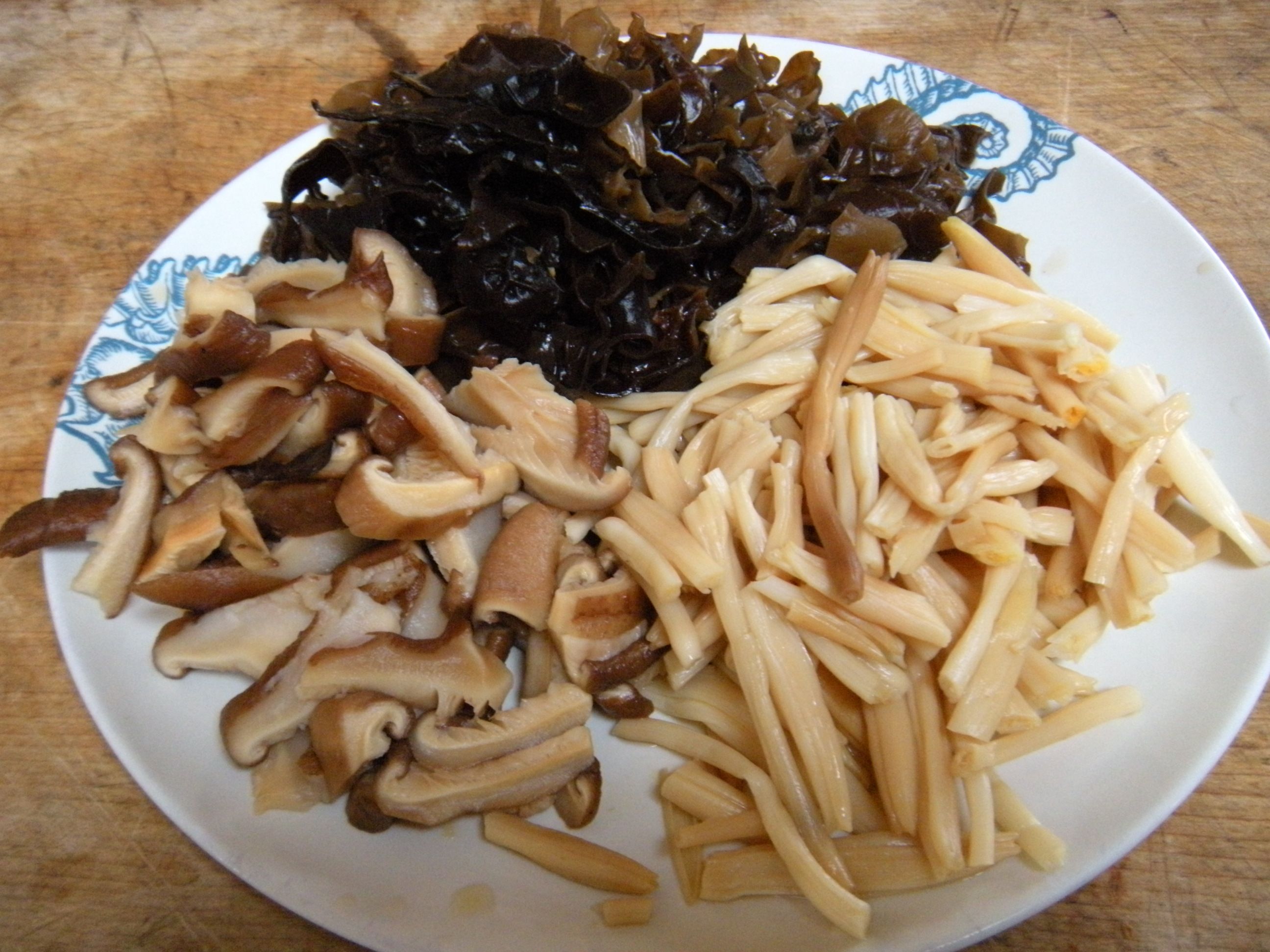
1. Soak a half-handful of dried daylily buds, dried wood er and dried shitake mushrooms (3) in warm water until all are softened (this takes awhile to soak so just start it earlier in the day)
2. Rinse pieces and drain well to rid of any grit.
3. Trim daylilies of hard stem ends and slice into thirds
4. Trim wood ear and slice up, removing any hard or rigid pieces in the center
5. Remove stems from softened shitake mushrooms and slice into small slivers
6. Squeeze and drain all of water.

cleaned, sliced, rinsed

cleaned, sliced, rinsed


7. Heat a medium size skillet and pour in grapeseed oil to make a thin film
8. When hot, saute three scallions, trimmed, split and sliced into 1 inch pieces.
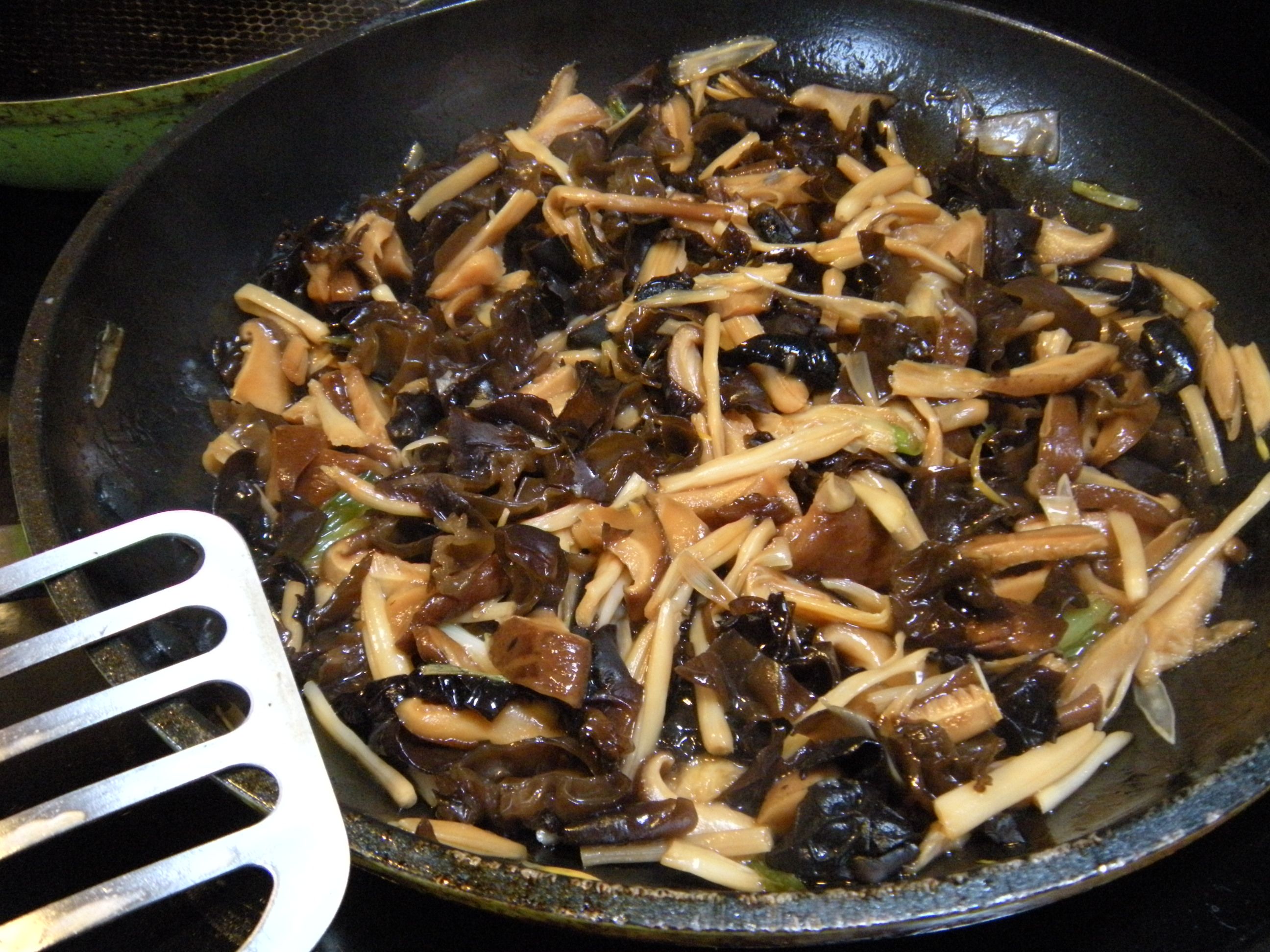
9. Add the daylily, wood ear and mushrooms; saute over medium high heat and mix together.
10. Add 1 tablespoon organic soy sauce (Ohsawa); 1 tablespoon mirin or cooking sherry, 2 tablespoons oyster sauce, 2 teaspoons of xylitol (sugar substitute) and mix together–the mixture will be aromatic and smell wonderful. This is a brief braising step that helps these ingredients to soak up flavor ahead of adding them to the plain cabbage.
11. Add a scant 1/4 cup of spring water, stir and mix everything together, letting the water steam and soften the mixture. Let sit on very low heat for about 20 minutes until ready to cook the cabbage.
braised daylily, wood ear and shitake mushrooms

braised daylily, wood ear and shitake mushrooms

Last steps:
1. Rinse head of cabbage clean. Slice large wedges and then cut each wedge into tiny slivers, using a cleaver or sharp kitchen knife. For the ingredients above, I used a little more than half a head of cabbage

half a thinly sliced head of cabbage

half a thinly sliced head of cabbage


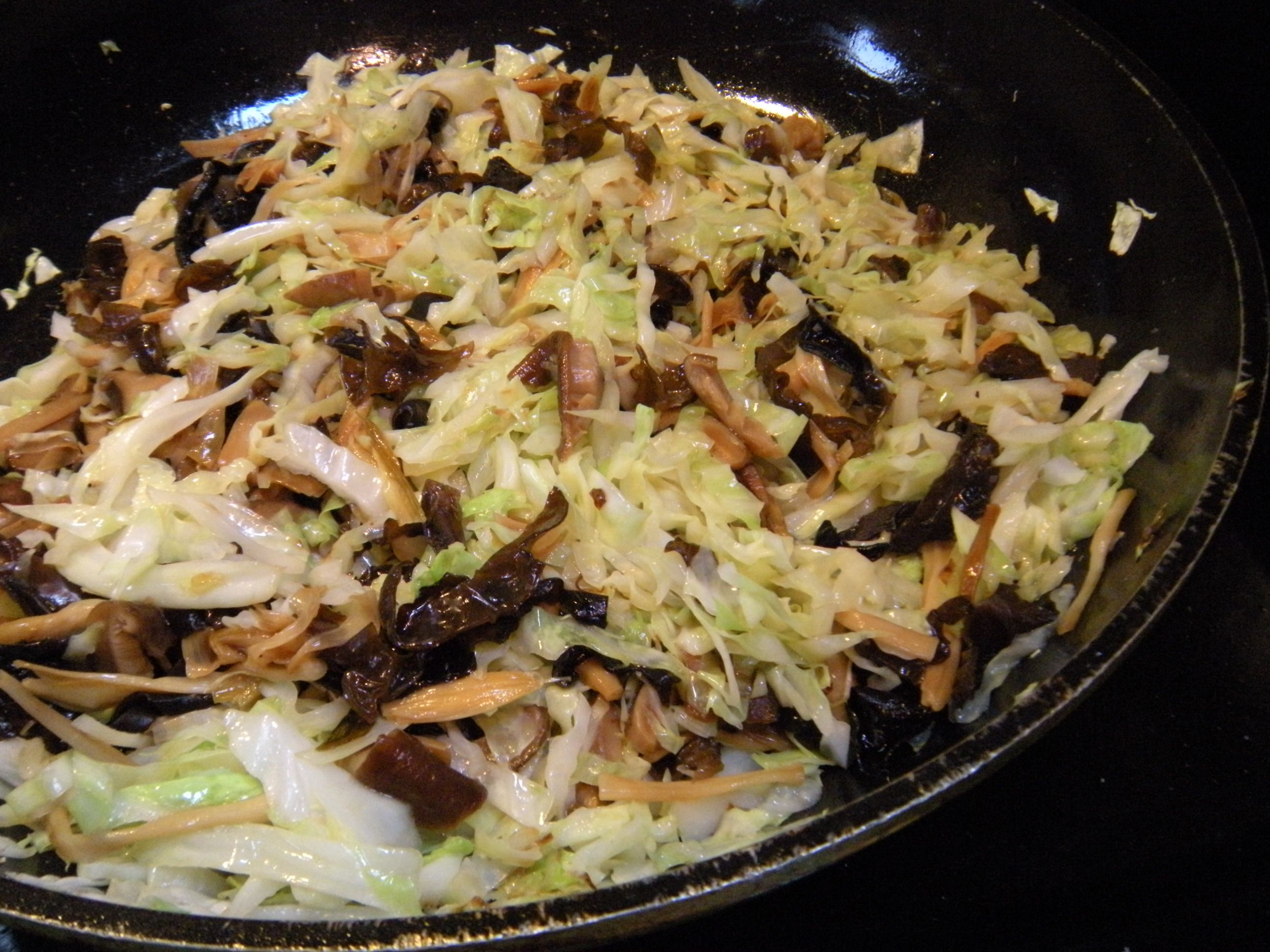
2. Use a large skillet and heat up grapeseed oil to cover the bottom. When hot, put the cabbage slivers in and saute, coating the cabbage and sprinkling with some sea salt
3. Stir the cabbage which will soften with the salt; make sure the cabbage is cooked dry
cabbage cooking in the pan

cabbage cooking in the pan


4. Add the skillet of braised mushroom, daylily and wood ear mixture to the cabbage
5. Stir it all together until well mixed
6. Remove to a serving dish
7. Add a tiny bit of sesame oil on top of the vegetables and stir to mix in the flavors
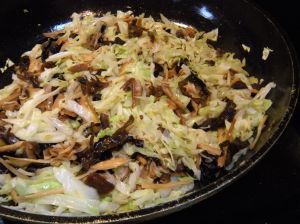
. . . Buddha's Delight

. . . Buddha’s Delight

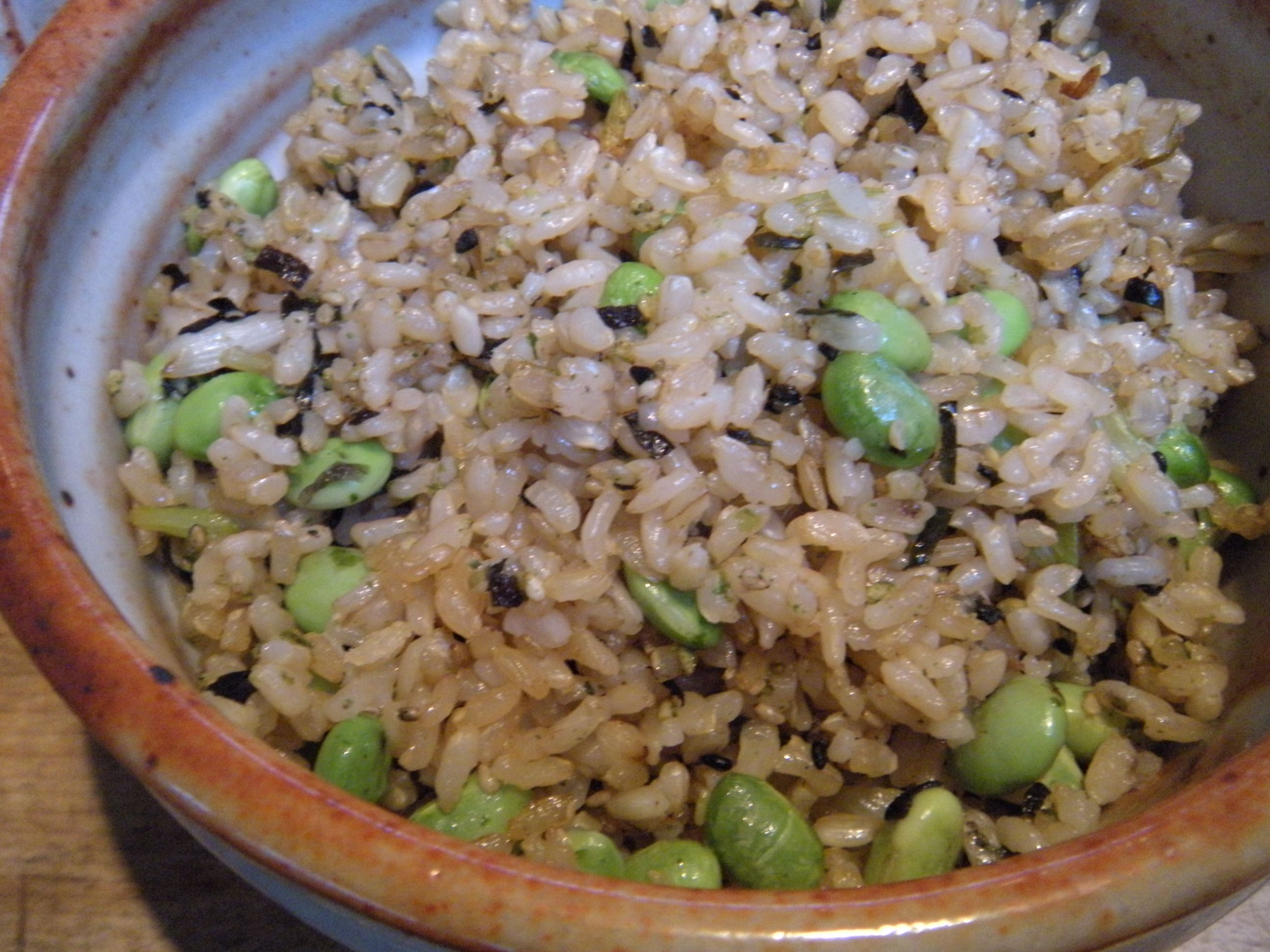
FRIED BROWN RICE WITH NORI, EDAMAME AND SCALLIONS:
1. Defrost half a bag of frozen shelled edamame (soybeans) in warm water and drain well
2. Have on hand a cup of previously cooked brown rice
3. Finely cut up three scallions at sharply angled diagonal slices
4. Heat up a clean skillet with grapeseed oil
5. Saute the green onions in the skillet, add brown rice and stir fry
6. Add edamame to rice mixture
7. Have a little dashi broth & a squirt of organic soy on hand to moisten and add a little flavor to the dish
8. Stir in nori, sesame rice condiment and mix gently.

. . . brown rice with edamame and nori

. . . brown rice with edamame and nori

Note: To enlarge photos, click once; to magnify, click twice on the image.

Postscript: We finished all but a small dab of rice and there’s half a handful of Buddha’s Delight left over. Maybe I’ll make it again next Tuesday.

latecomer . . .

 . . .  orchid plant shelf

. . . orchid plant shelf

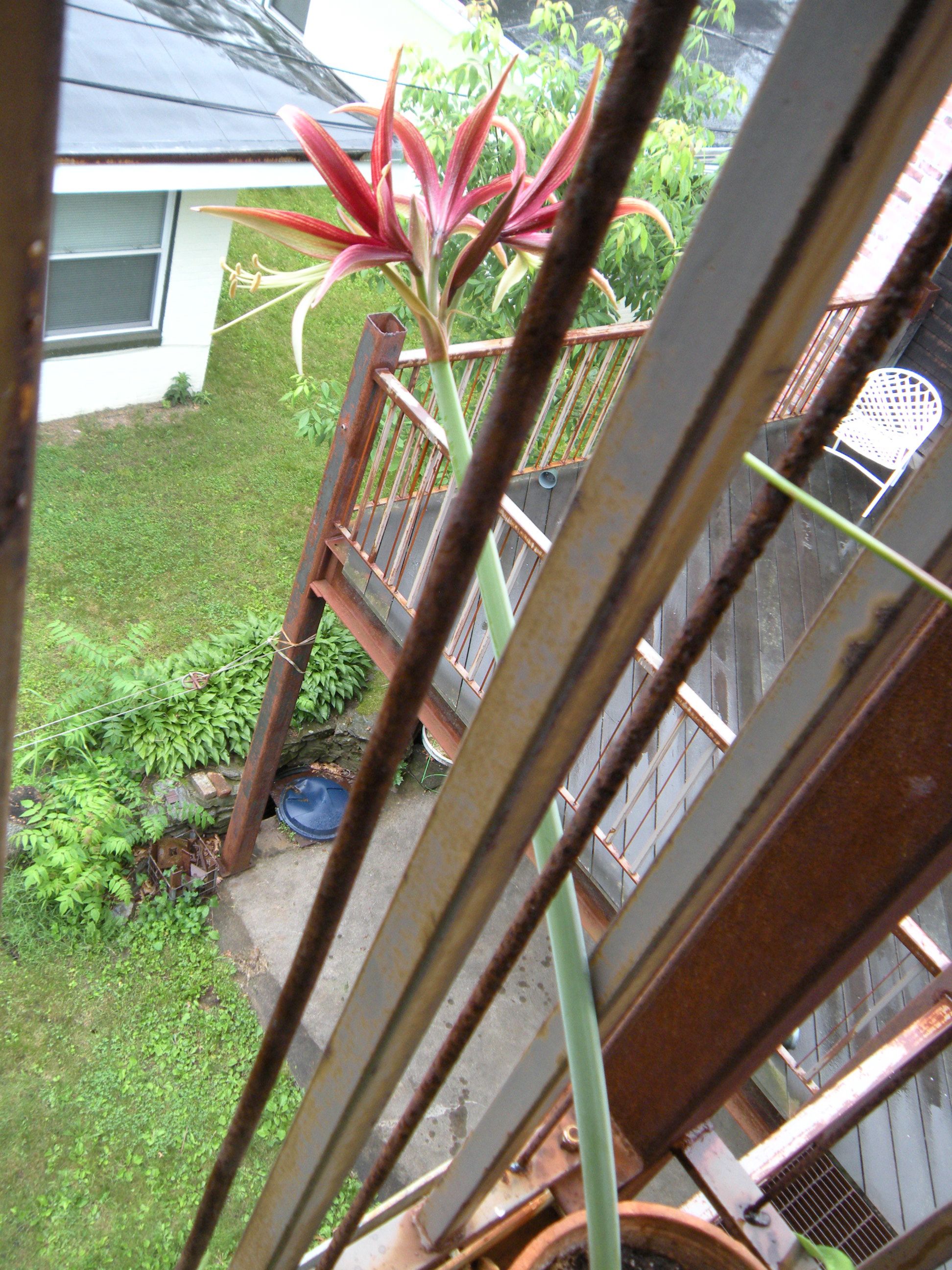
When I rearranged and cleaned up the shelf of orchids a couple of weeks ago, I culled out four pots of amaryllis, the soil dry and the flower blooms long gone by. After C.’s visit, I carried them out to the back deck so that the leaves would be watered by the rain, cut back at the end of summer, allowed to dry in the cellar and then brought up to the window shelf to flower again during the winter months. That’s the cycle for reinvigorating and nourishing these plants to bloom year after year. It is always astonishing when they come back and bloom, sometimes two stalks of four flowers each. That’s why growing amaryllis bulbs that originate from South Africa is so rewarding. These were forgotten and left untended in the front entryway over Christmas. But their blooms were so gorgeous in the dead of winter after the holidays.

We had a lot of rain recently as I noted in the last post. Yesterday, I went out with a pair of shears to trim off the unsightly yellowish brown leaves and to tidy the pots up. As I snipped the dried brown bits, I came upon this incredible late bloomer! Isn’t rain great?

    amaryllis in June!

amaryllis in June!


DSCN5217
DSCN5218

another winner . . .

dsc_0160I hope that you don’t mind all the references that I find by reading the New York Times everyday. Even if it’s just a wisp of a sentence, I sometimes learn about people and things that I might not ever come across. One of the columns I always look forward to reading on Monday mornings is entitled “Diary”: it’s contents are letters submitted to the newspaper because they exemplify what New York and New Yorkers are all about. Today was no different.
Years ago in this column, there was a letter about two couples out for an early evening walk. One of the women noticed a canary that had flown from one of the windows up around what looked like the fourteenth floor. She became worried that the bird would be lost in the park environment until her husband reassured her that when the light changed, the bird would fly back up to where it belonged. The other husband whispered to him whether he was making it up even though the reassuring husband was a biologist. Sure enough, in a few minutes, they watched the bird float up and fly back to where it (seemed to) belong. I have kept this little clipping in my journal.

Another one that I remember from some years back was about a pair of grandparents standing out on the curb, waiting for their granddaughters to visit from out of town, when they heard some soft singing by a pair waiting for the bus behind them. When the girls arrived, they invited the singers up to their apartment where they accompanied themselves on the piano, delighting everyone, especially the grandparents who were proud that this spontaneous exhibition of musical talent underscored what a cultural city they lived in. As the singers put on their coats and prepared to leave, the grandfather said jokingly, “You’re good enough to sing in Carnegie Hall – Let us know when you perform there and we’ll come to your concert!” Whereby they turned around and said, “Oh, would you like tickets for this weekend?” It turns out the singers were students at Juilliard and they had been rehearsing at the bus stop for a choral concert at Lincoln Center scheduled for that Friday!

And so, here is today’s winner:
*******************************************************************************************
Dear Diary:

I am a senior citizen, age 92. While trying to hail a taxi on Second Avenue on a busy, rainy Saturday night, a well-dressed young couple came along behind me, also trying to hail a taxi.

They seemed impatient, so they walked one block uptown to get the first cab.

A few minutes later, I saw them get into the first oncoming cab–my loss.

As their cab approached me, it slowed down and came to a full stop. The door opened and, as they both got out, the young man said, “It’s your cab.”

I thanked them profusely, got in, and went on my way.

Irving Shillman
*******************************************************************************************

I think you’ll agree with me that this one is a keeper along with the ones above. I don’t know about you, but this little anecdote cheers me that for all the trashy news on the air, there is still hopefulness for the future, at least as illustrated by this couple’s thoughtful gesture on the streets of New York.

starters . . .

a group of morning glory seedlings

a group of morning glory seedlings


morning glory seedlings planted near the clematis

morning glory seedlings planted near the clematis


Spring has been optimal for growing this year: alternating sunny, dry breezy weather interspersed with showers and soaking rain, sometimes for a couple of days. I am often surprised why people object to rain when it is so important to the natural cycle of things. Our Sassafras trees have the most graceful leaves when they unfurl in May.
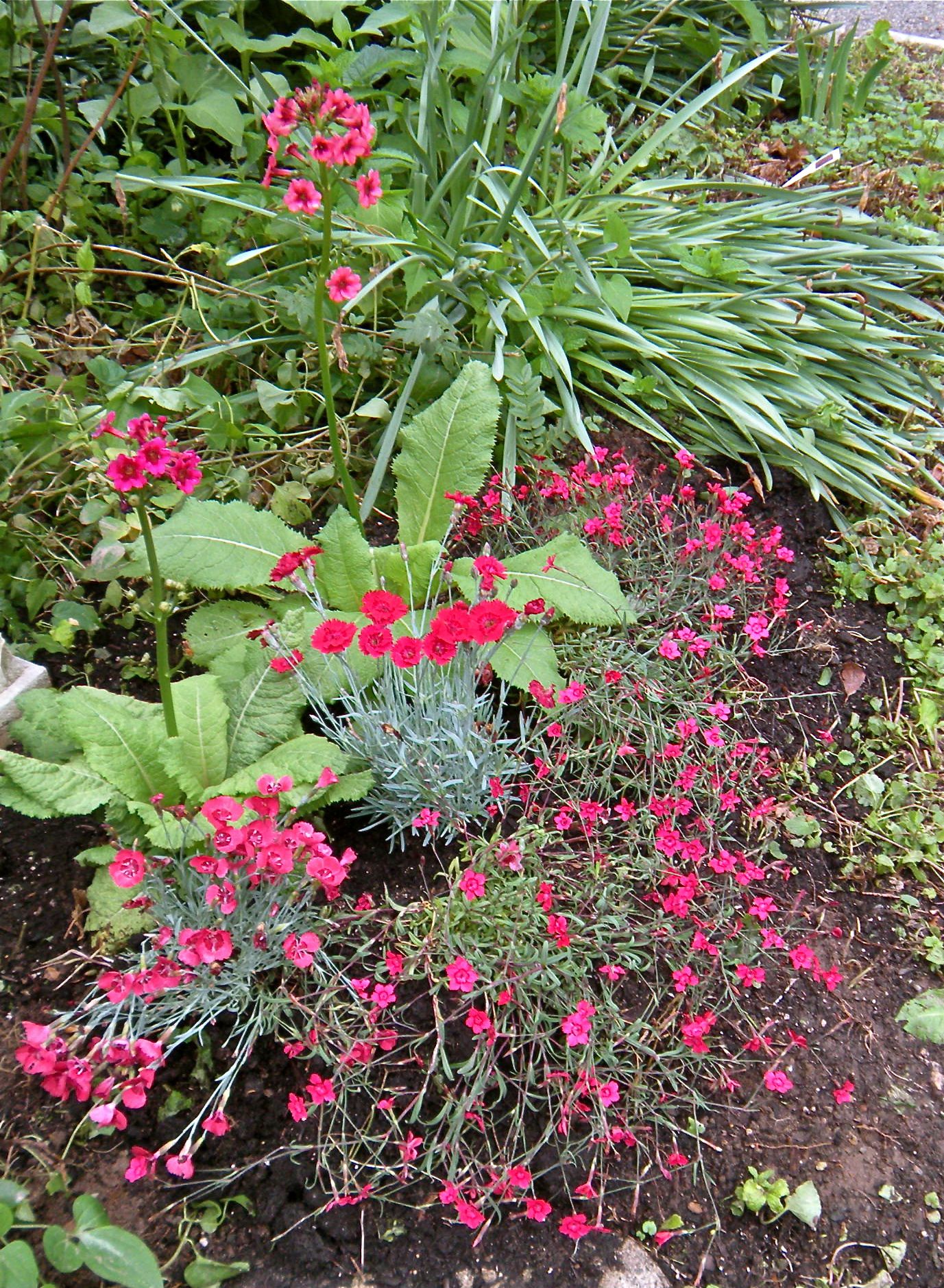
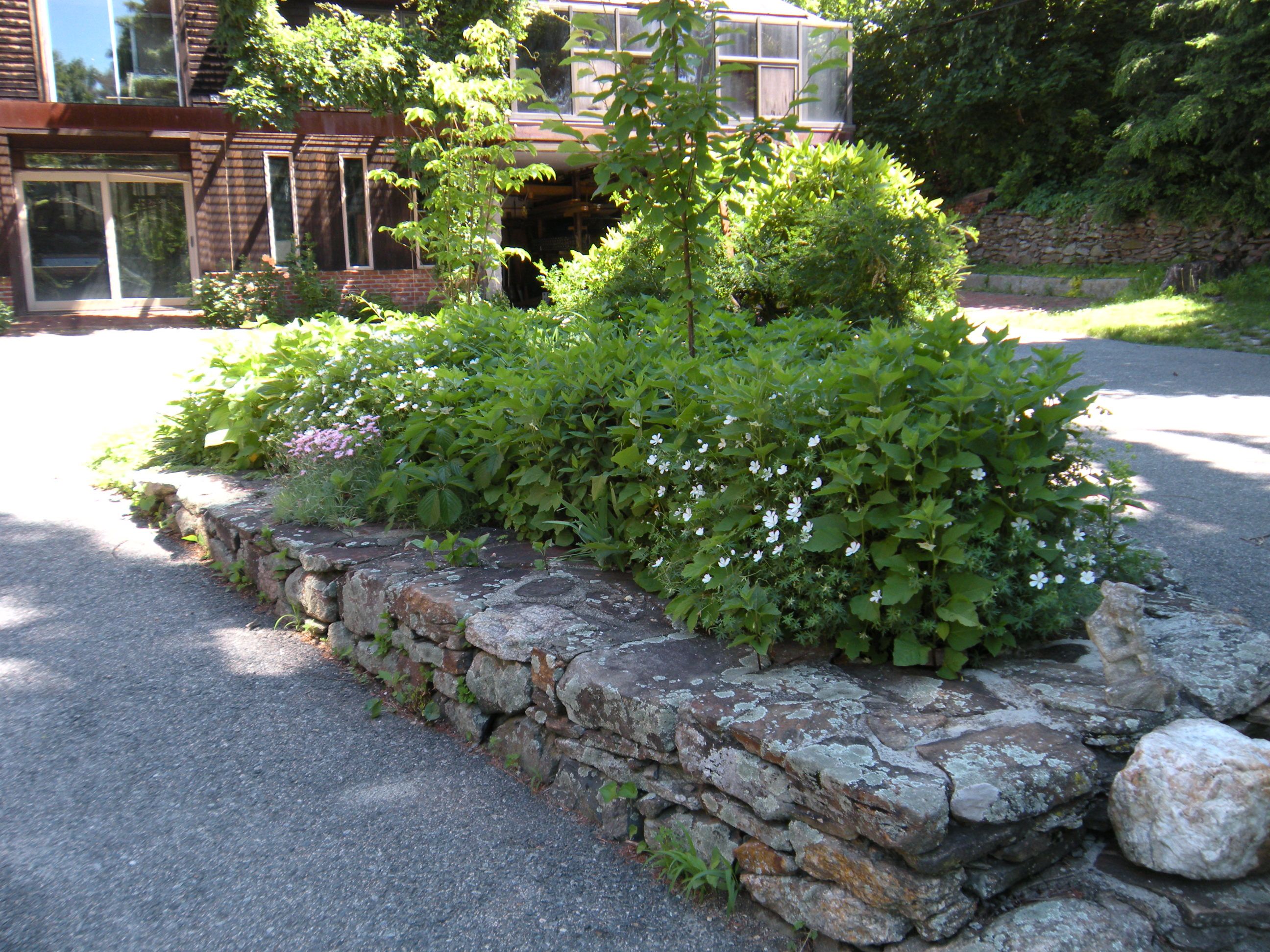
lush white and pink in the front triangle garden

lush white and pink in the front triangle garden


in front of the barn

in front of the barn


For at least a decade, we have had a planting ritual for “Heavenly Blue” morning glories right around Memorial Day. There’s a nursery in Framingham, about a half hour’s drive towards Boston that grows and sells morning glory seedlings that are about four inches high when I purchase them. The seedlings are not that easy to find and while I’ve tried growing them from a packet of seeds, they don’t seem to want to sprout for me. So I buy a flat of seedlings and place them in the shade under the rhododendron bush to keep cool until we have a chance to plant them. I cluster a four-pack together and plant them in the ground. Then G. measures out fresh twine from the decking above and anchors the string to a brick which nestles in the earth right next to the seedlings. As they grow, they wind themselves around the string and climb. This year, I planted clusters near the purple wisteria vine and the white wisteria vine in the front, thinking that by the time the morning glories bloom, the other flowers, roses and such would have gone by. One new place was near the clematis arbor (see photo above) where there is a wrought iron trellis that branches out in both directions under the stained glass window. I thought that they might take and clamber up the trellis to grace the house sometime in late Summer, early Fall.
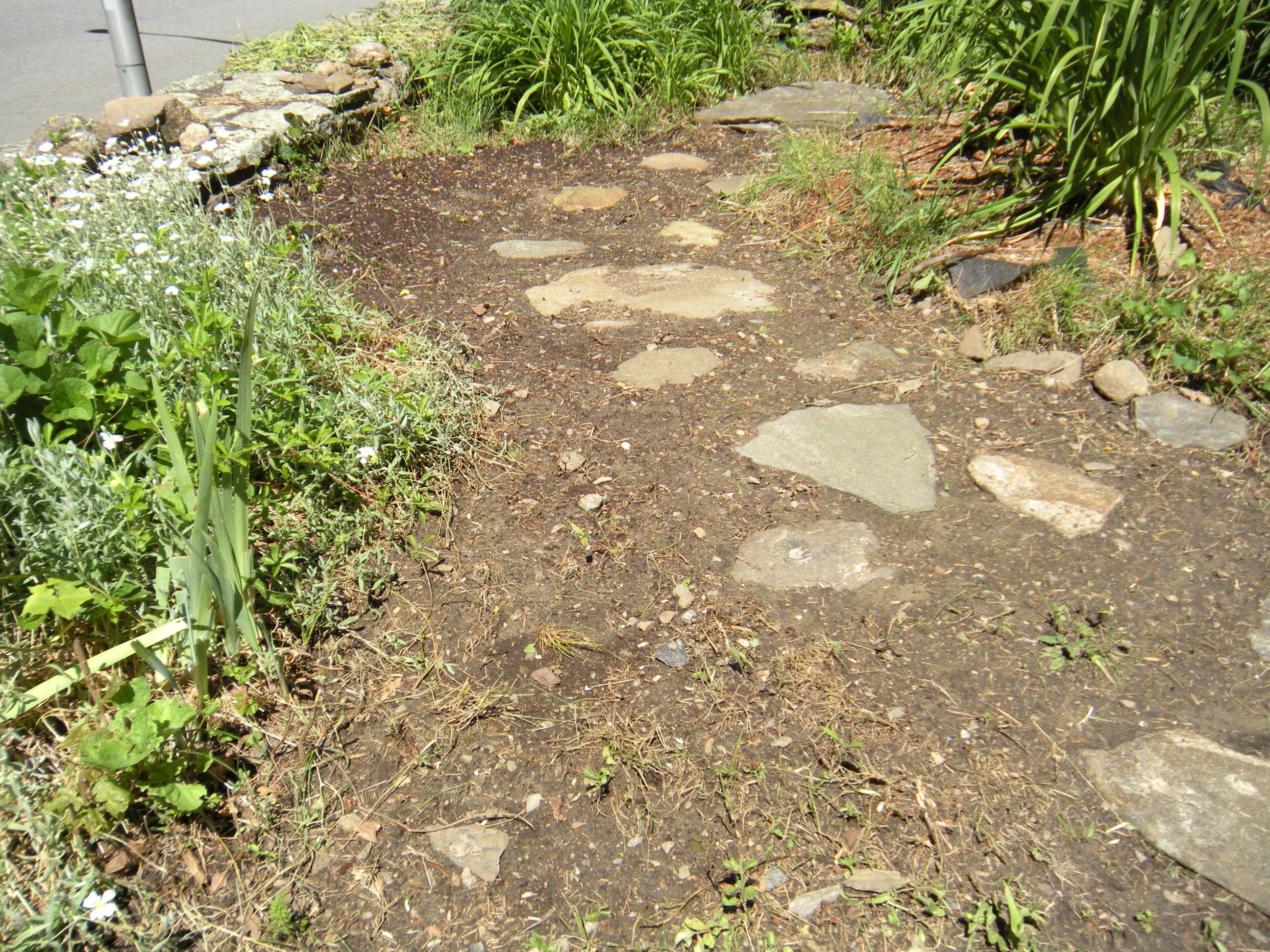
"Before" planting wildflower seeds

“Before” planting wildflower seeds


Finally, there’s a very rocky, poor soil area in the front near the street where G. pulled up the weeds and crabgrass, brought some compost over from his mother’s house across the street and the guys put in a stone pathway, sprinkling a mixed assortment of Northeastern wildflower seeds throughout. Afterwards, it rained for about two days, sometimes a heavy downpour from Hurricane Andrea in the middle of the night. Then, the sun came out and for the last couple of days, it has been temperate, sunny and dry with a light breeze: perfect weather for sowing and growing!

All of this is just to belabor a little bit the plantings that we made last week.
What’s most fun is to see what comes up and how they flourish as the Summer and Fall gently roll by. Later, that is.

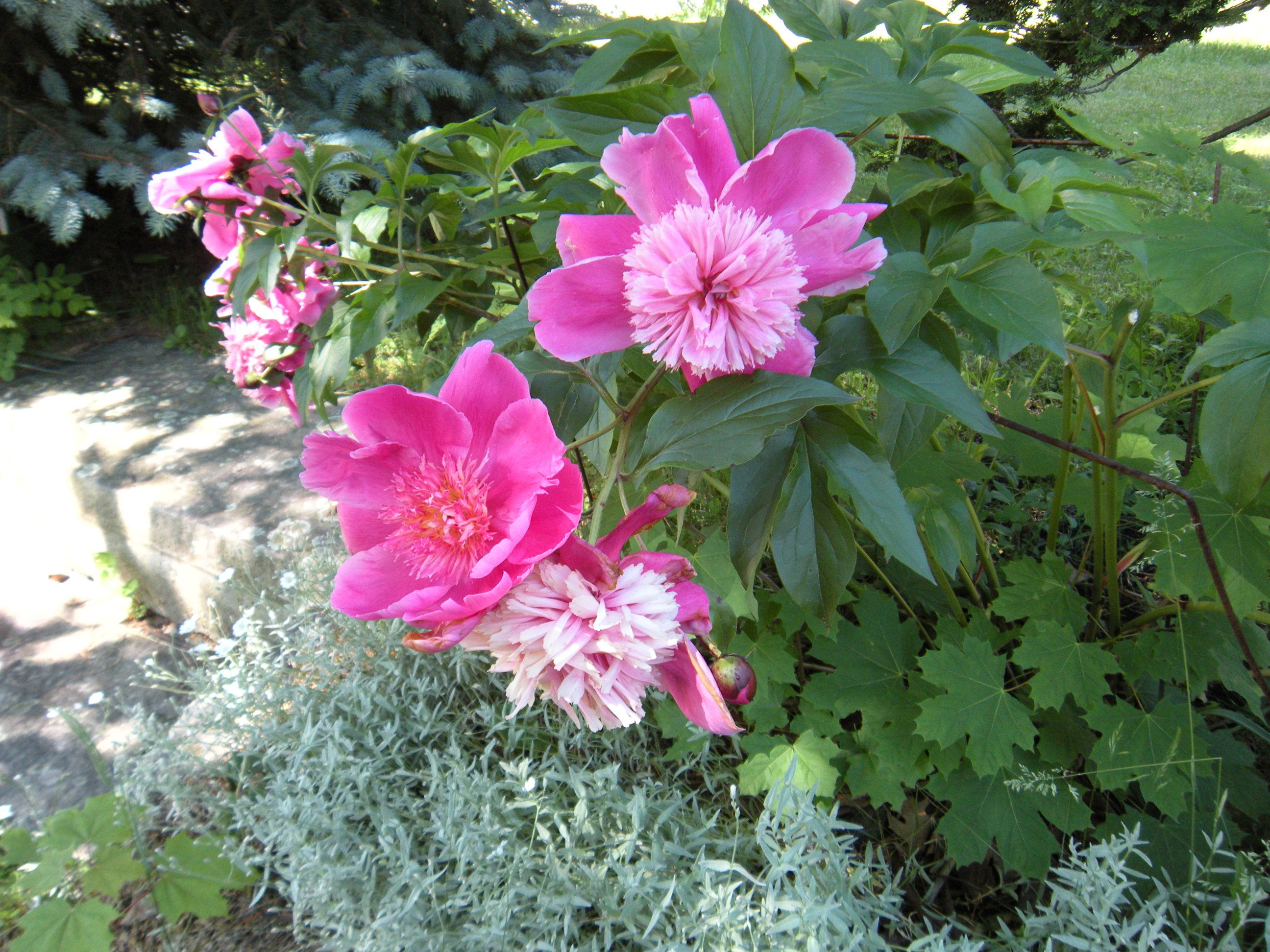
In the meantime, here are some photos of early roses and right-on-time peonies.

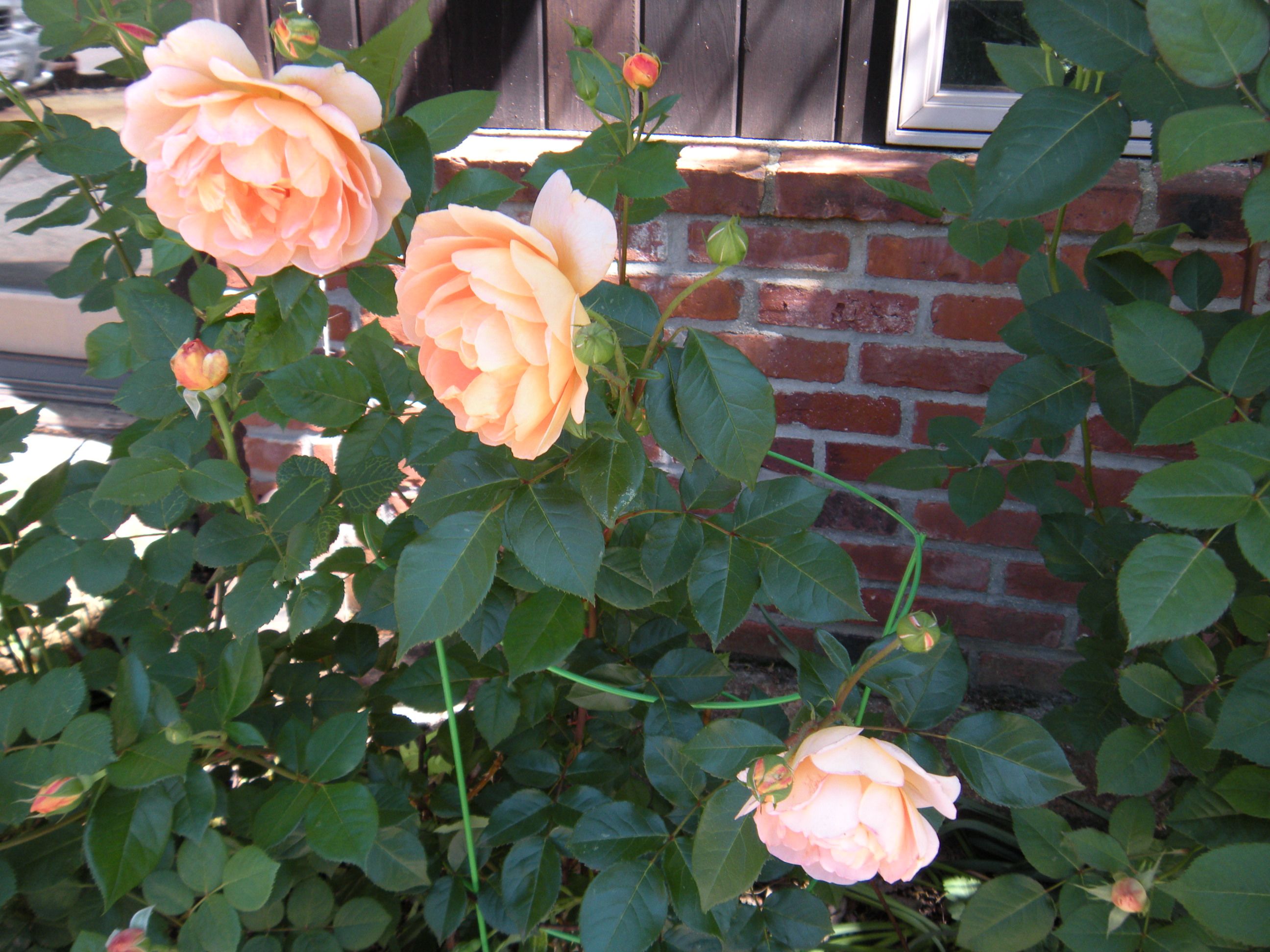
apricot roses by the barn

apricot roses by the barn


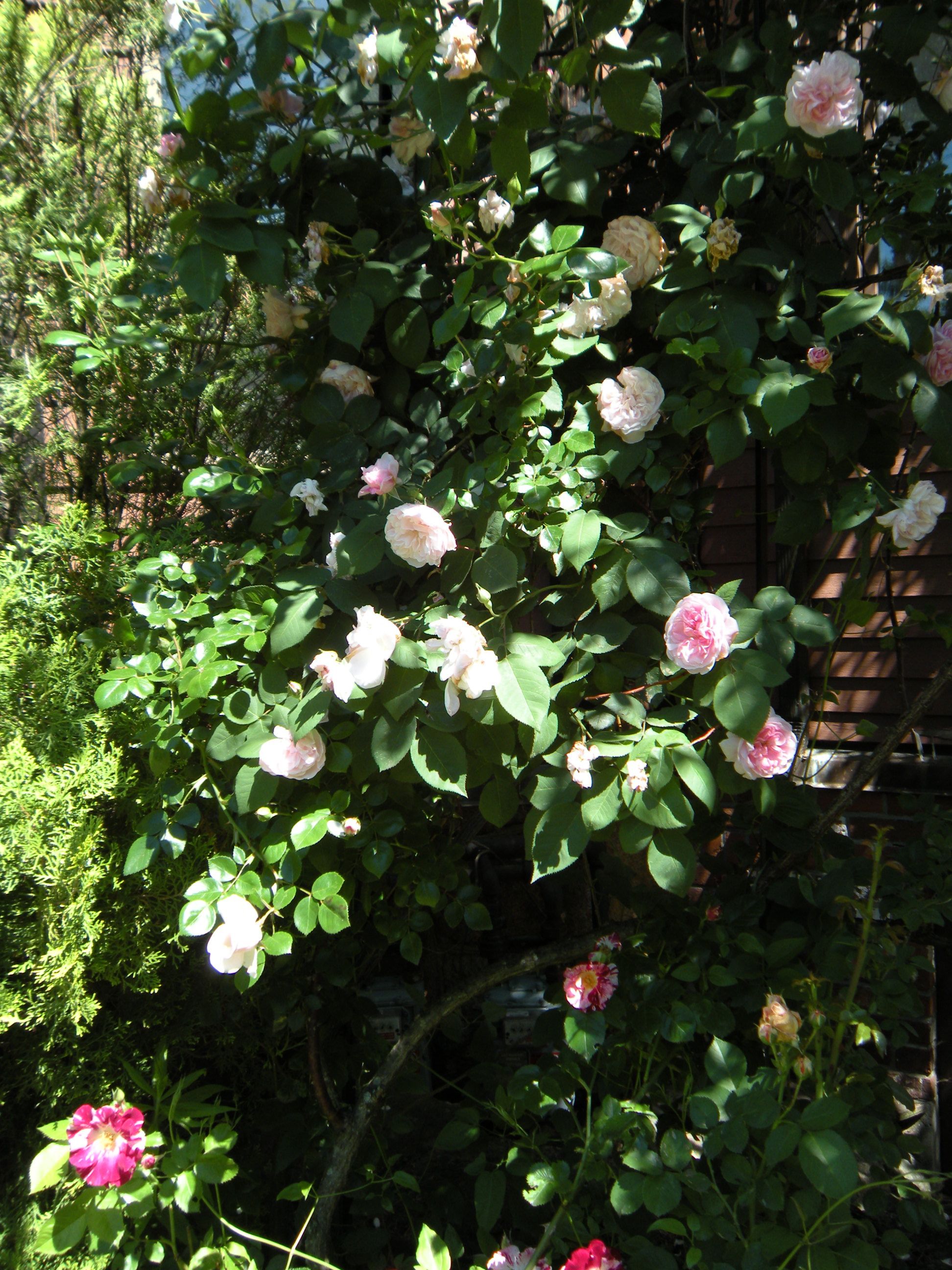
climbing roses

climbing roses

peonies along the driveway

peonies along the driveway

Note: to enlarge photos, click once; to magnify, click again.

greens . . .

washed watercress, kale, ruby lettuce and swiss chard

washed watercress, kale, ruby lettuce and swiss chard


While I was researching how people use their Vitamix machines on YouTube, I came across a fellow who took out a long plastic bin from the fridge filled with fresh Swiss chard and flat leaf kale that had been washed, dried and then stored. I thought this made sense because the greens would be handy to use, stay fresher longer and not languish in their plastic bags still full of grit. Besides, the bins stack easily in place of random bags piled on top of each other. The idea of an orderly fridge with space around things is a forever fantasy for me.

So, yesterday, I picked up medium and large size BPA-free plastic storage containers at the local grocery store; rinsed clean the fresh greens, let them drip dry and then placed them in the bins lined with clean paper towel.

I was a little apprehensive about using the Vitamix for the first time since it seemed to me like having a little black Lamborghini on my kitchen counter. For my first smoothie, I planned to make an almond kale mixture in the morning for breakfast, soaking some raw almonds in water overnight. The idea of a two-flavor smoothie appealed to me more than putting a Noah’s Ark full of fresh vegetables and fruit in all at once.

My thought was also to come up with combinations that appealed to my palate that were simple, clean tastes that I would want to have regularly for breakfast and lunches. Less is more feels like the right approach to develop my own vocabulary for how to use this machine. Otherwise, I’m afraid that it would just be a novelty for awhile, mixing together other people’s recipes for different sorts of things, but not with an intention to truly integrate new foods into our eating lifestyle. So, I’m developing my own “Zone” of concoctions, so to speak. The almond kale smoothie was light and tasty, thicker than just juicing and a lot less milk-shakey than some fruit smoothies I’ve had in the past.

Here are the ingredients if you’d like to try it yourself:

Almond-Kale Smoothie (adapted from “It’s All Good”, page 207)

a packed cup of kale leaves torn off the stem
a cup of almond/coconut milk (unsweetened)
1 tablespoon almond butter
1 tablespoon soaked raw almonds (let sit in water overnight in the fridge)
1 teaspoon Xylitol (sweetener, or a pitted Medjool date which I didn’t have on hand)

For lunch, I’m going to make a smoothie with fresh fruit. I peeled each of the bananas I have on hand and froze them individually, broken into thirds. My trusty little Oster juicer has worked well and I’ll make the liquid base for my lunch smoothie by juicing a pink grapefruit and two navel oranges. Then I’ll add some fresh pineapple, hemp seeds, a frozen banana and four ice cubes.

"primp"~grapefruit & orange juice, fresh pineapple, banana, hemp seeds and ice

“primp”~grapefruit & orange juice, fresh pineapple, banana, hemp seeds and ice


I began thinking I might make up names for these concoctions if I decided to keep them on my menu. Something like “Kayla” for the almond kale breakfast smoothie and “Primp” for the pineapple/citrus/banana lunch smoothie.

For dinner, I’m making leek potato soup, a (very) small lemon-grilled center cut piece of salmon, with a light green goddess dressing served on a green salad. So for today’s meals, I’ll have had a “Kayla” smoothie for breakfast, a “Primp” smoothie for lunch and one of my favorite soups with a salad and a couple of bites of fish for dinner. For dessert, there’s still a smidge of strawberry-rhubarb compote left to eat with a dollop of plain yogurt.

While I was out grocery shopping, it occurred to me that these kinds of meals might be akin to ones that are offered at those very pricey spas in Bali, the Golden Door or Canyon Ranch out here in the Berkshires. Except that having it at home was a heck of a lot less expensive than it costs for a three-(@$3000) or a 7-(@$8000) night stay (not including travel costs!) Of course, the spa experience also includes massages of all kinds, hikes and horse-riding. But massages and a walk around the neighborhood are easy to do at home–the horses, well, are more of a stretch. With this renewed perspective, I am now definitely edging towards thinking that buying the Vitamix was a BARGAIN (LOL!) rather than an extravagance!

In any case, I’m so inspired by how glowingly healthy Julia Turshen looks after losing sixty pounds that I feel I have just taken, as Lao Tzu* says, the first step in my personal journey to more radiant health and well-being!

Footnote: *A journey of a thousand miles begins with a single step.”

and it’s all good . . .

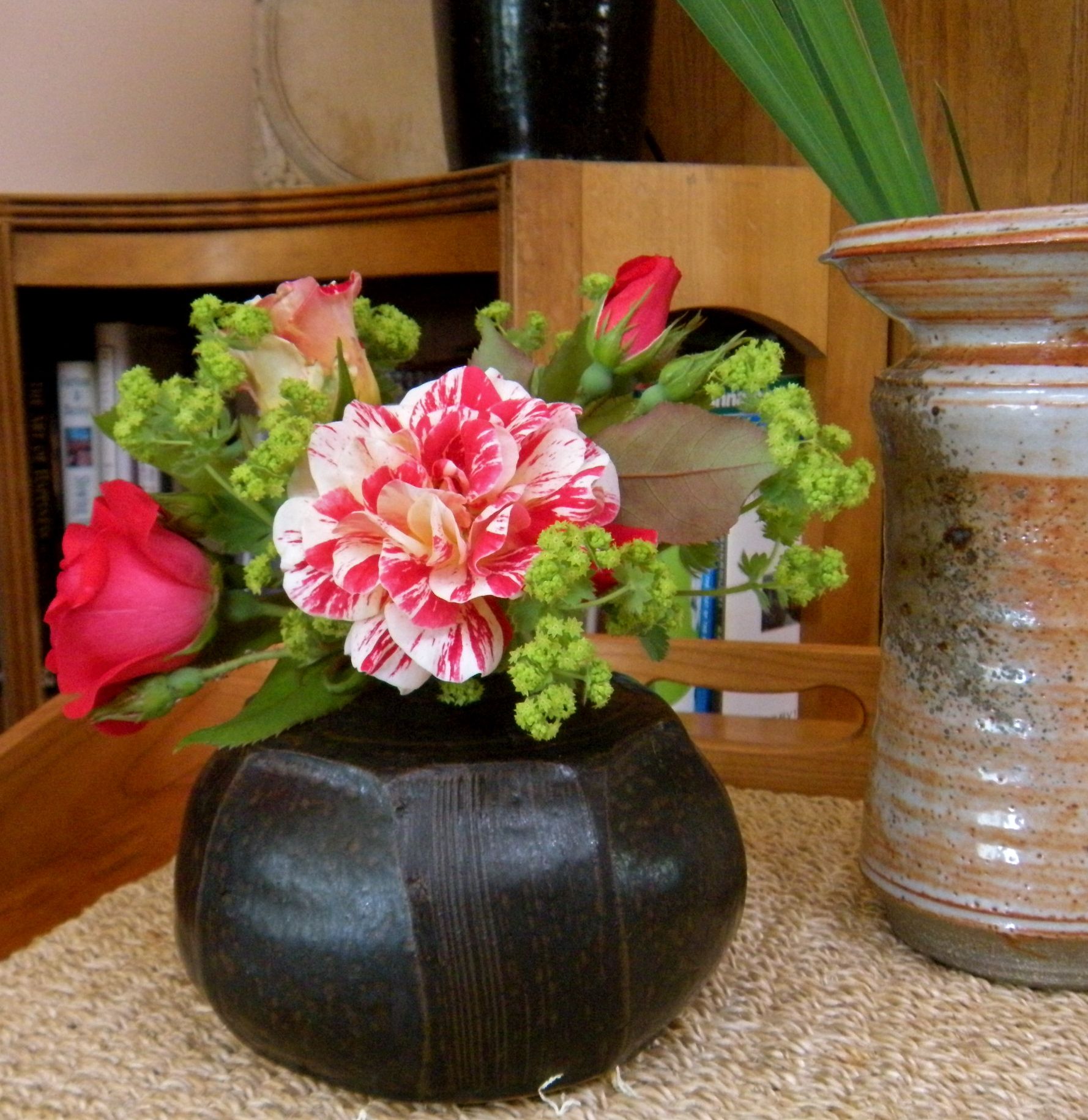
Early roses from the garden (the striped one is called "George Burns")

Early roses from the garden (the striped one is called “George Burns”)

As some of you may know, I like to cook. One of the most interesting things to me about it is that every day offers an opportunity to learn something new and to try it out right away and be able to taste it. In the last bit of time, we have been consciously simplifying what and how much we eat. At the same time, flavors, textures and new tastes emerge as our meals evolve.

The Food Network show, “Chopped” is fun to watch because the contestants take such different approaches to the incompatible ingredients in their food baskets. The judges’ comments are also instructive, critical about too little or too much seasoning, whether a dish hangs together and looks appetizing. Anyhow, “Chopped” is entertaining to watch besides the Red Sox and the Bruins (3 down, 1 to go!) As a result, G. now teases me by saying “Time’s up!” or Thank you, Chef!” when we sit down to dinner.

Another thread in my cooking lately, is searching for healthy recipes that are also compatible with our taste in food. I have been reading “It’s All Good,” authored by Gwyneth Paltrow and Julia Turshen, a cookbook that underscores non-gluten, non-dairy recipes that include many Asian ingredients. Recipes such as “Buckwheat soba in ginger broth,” “Scallion pancakes made with brown rice flour,” “Polenta with Shitake mushrooms and leek,” and “Avocado cucumber soup” are among the book’s highlights. There are before and current photographs of Julia Turshen that will tempt you to try out their food philosophy because her skin is glowing and she looks trim and relaxed after losing sixty pounds!

In any case, one of the elements in “It’s All Good” is the use of a heavy-duty blender like Vitamix although the authors are careful not to be elitist about this expensive piece of equipment. Coincidentally, my daughter, C., brought up the Vitamix last weekend when she was visiting, saying that friends of hers had raved about how versatile it was to use and also how easy it was to clean. After her visit, I took a three-hour Japanese Vegetarian cooking class at the Cambridge Adult Education Center last Sunday and my instructor, Yoko, also extolled the use of her Vitamix. She used hers to pulverize dried kombu and dried Shitake mushrooms individually to have on hand to make dashi stock or to add to a variety of dishes. I was impressed by how Yoko personalized the use of the Vitamix to suit a specific type of cuisine. These three Vitamix strands in the ether convinced me to look into it further and I ordered the Professional Model 300 in ruby red which arrived yesterday.

The first thing I noticed is that the very simple packaging mirrors the elegance of Apple computer packaging. You know what I mean if you own a Mac product. Right away, I was impressed with the foresight the manufacturer put into presenting their product. I read the manual and played the DVD of a youngish male cook (with heavily tattooed arms) who read his lines from the teleprompter rather stiffly but walked us through how to use the Vitamix. Seems like the most important thing is to load the ingredients from lightest weight first (on the bottom) to heaviest on top. The liquid and soft foods on the bottom draws in the heavier ingredients on top. Start the machine on the setting, “1” and gradually move the dial to 10 for 30 seconds or whatever amount of time is called for. (Apparently, using frozen fruits, you can make a berry sorbet in 30 seconds!) If needed, use the tamper (a pusher) which does not reach the blades to stir the ingredients while grinding. Clean by filling halfway with warm water and a couple of drops of detergent, run it on high for 60 seconds, rinse and invert on a dishtowel or drainer to dry. Simple. It all sounded good to me.

The one thing I noticed while watching the DVD, was that I instantly knew I preferred the Vitamix in black to the red one sitting on the kitchen counter. My daughter, C. has been wanting one too and so I talked to her on the phone last night about whether she’d like the red one if she was ready to purchase, or I could send it back just as easily. My other daughter, M. who lives in Minneapolis, has been sounding rather wistful whenever we talked about the Vitamix on Skype. M. said that her good friend Noemi, (whom they just visited in Winnipeg and is a real foodie,) loves her Vitamix which she has used for a long time.

I thought to myself (after paging through the very thick and heavy hardbound Vitamix recipe book that came with the machine,) that utilizing this expensive kitchen tool would be worthwhile only and if only one were able to personalize its use to make foods compatible with what we like to eat. Thus, (drumroll) the recipes in “It’s All Good” quickly morphed in my mind as an ideal companion to the Vitamix because the recipes use it a lot and the dishes mirror our palate. So, Voila! as the French like to say. I could now conceive of a rationale for owning (and paying for) one.

So here we are in the beginning of June, a day after G. and I planted our morning glory seedlings near the barn where they will climb up strings to the second floor landing and grace our days with visions of heavenly blue on foggy mornings in the Fall. Based on reactions from both my daughters, C. and M. I’m thinking maybe a Vitamix will appear in their Christmas stockings this year (counting in everyone’s birthday and anniversary gifts for a year too!)

In any case, it’s all good, isn’t it?

Addendum: Here’s a link to the book, “It’s All Good,” and if you’re interested, my review under the name Eden is titled: “It Actually IS (almost) All Good!”