mulberryshoots

"Tell me, what is it you plan to do with your one wild and precious life?" ~ Mary Oliver

Category: Life & Spirit

easy does it . . .

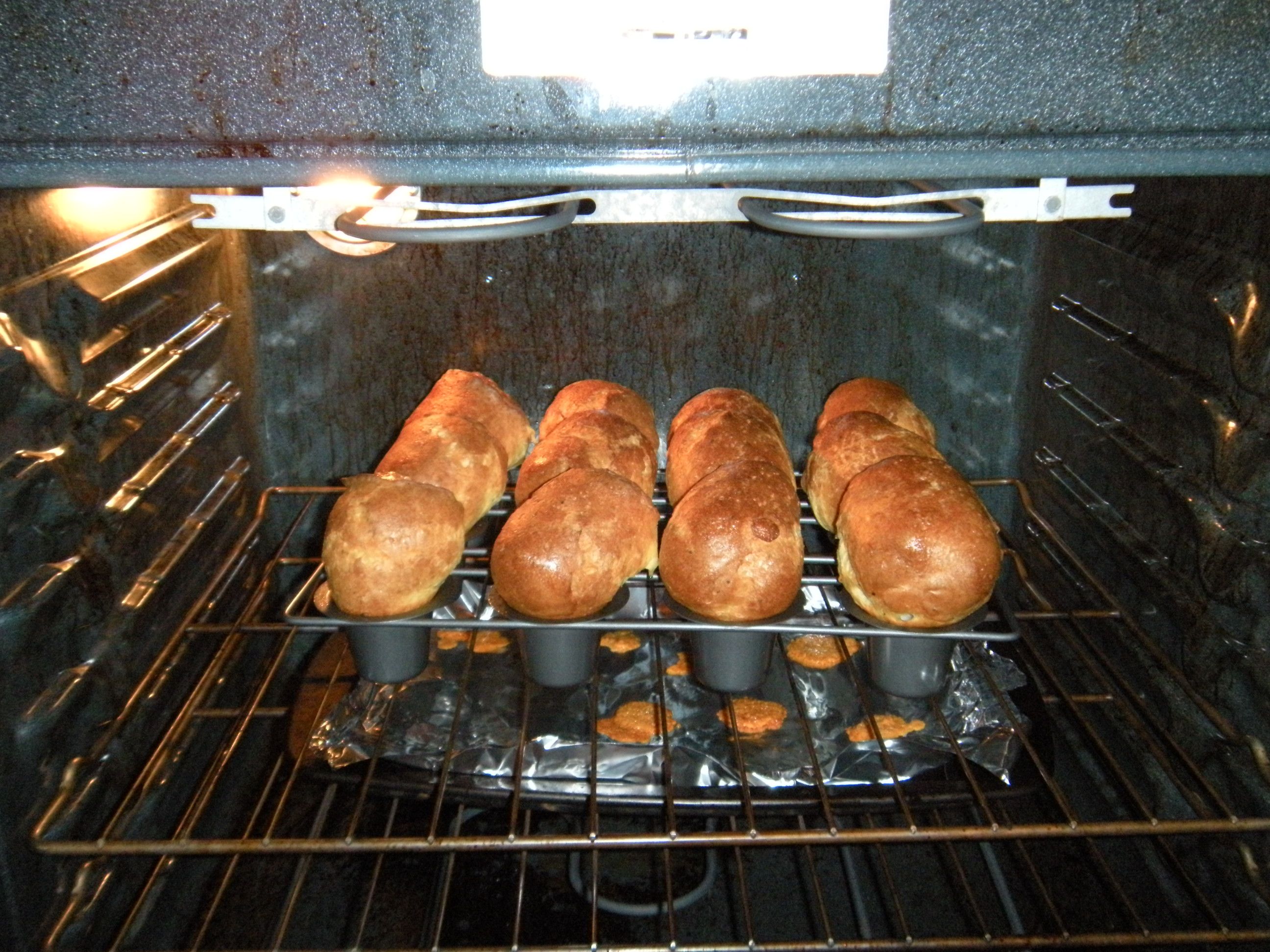
popovers in the ovenWe’ve spent all day working on a document that had a deadline and required all our attention. First, G. worked on it for the last couple of days; then I took over last night and was transfixed until 3:30 a.m. Resumed the task at hand from 7:30 a.m. to 2:30. Then G. reviewed what I had done and we finally wrapped it up around 5 in the afternoon. Some Easter day, huh?

It’s a good thing our kids are grown and the granddaughters have bunny business with their families where they live. It was refreshing, actually, to be able to dedicate our time and attention to something singular like this. It was rather a breakthrough in our thinking and so we were also buoyed up by the possibility of progress being made, slow and arduous as it seemed at times.

So, by 5 o’clock in the afternoon, we cleared away the mounds of paper and G. heated up the oven to 375 degrees for the long-awaited black pepper and gruyere cheese popovers I wrote about some weeks ago. I’ve been tweaking popover recipes since the holidays now and so was looking forward to yet another variation for mixing up these few ingredients: room temperature eggs, salt, pepper, whole milk this time heated up almost to boiling in a saucepan, flour in the same proportion of milk.

I slipped the popover pan into the heating oven, deciding to use the twelve cup smaller popover pan instead of the six cup big popover pans. It was the right choice because the batter filled the cups to almost the rim just right. I left a hair of space on the top so that when I dropped small cubes of gruyere cheese into the tops of the batter, it came just up to the top. The heated popover pan from the oven was sprayed with Pam to ensure that the beautiful puffs of golden magic would pop out when baked. The other trick was to leave the popovers in the 375 degree oven for exactly 40 minutes. They pop up amazingly about half way through and the temptation to take them out as they brown and brown some more before the allotted time is so tempting. STAY FIRM. Even if they’ve popped, the softer insides need the time to bake so that the popovers don’t fall immediately after taking them out of the oven. Let the buzzer run out. Open up the oven and let the popovers sit for just a few minutes (while you take pictures if you want) or set out platters to put the popovers on, sprinkling more gruyere cheese on top of them when they’re still hot.

popover closeup

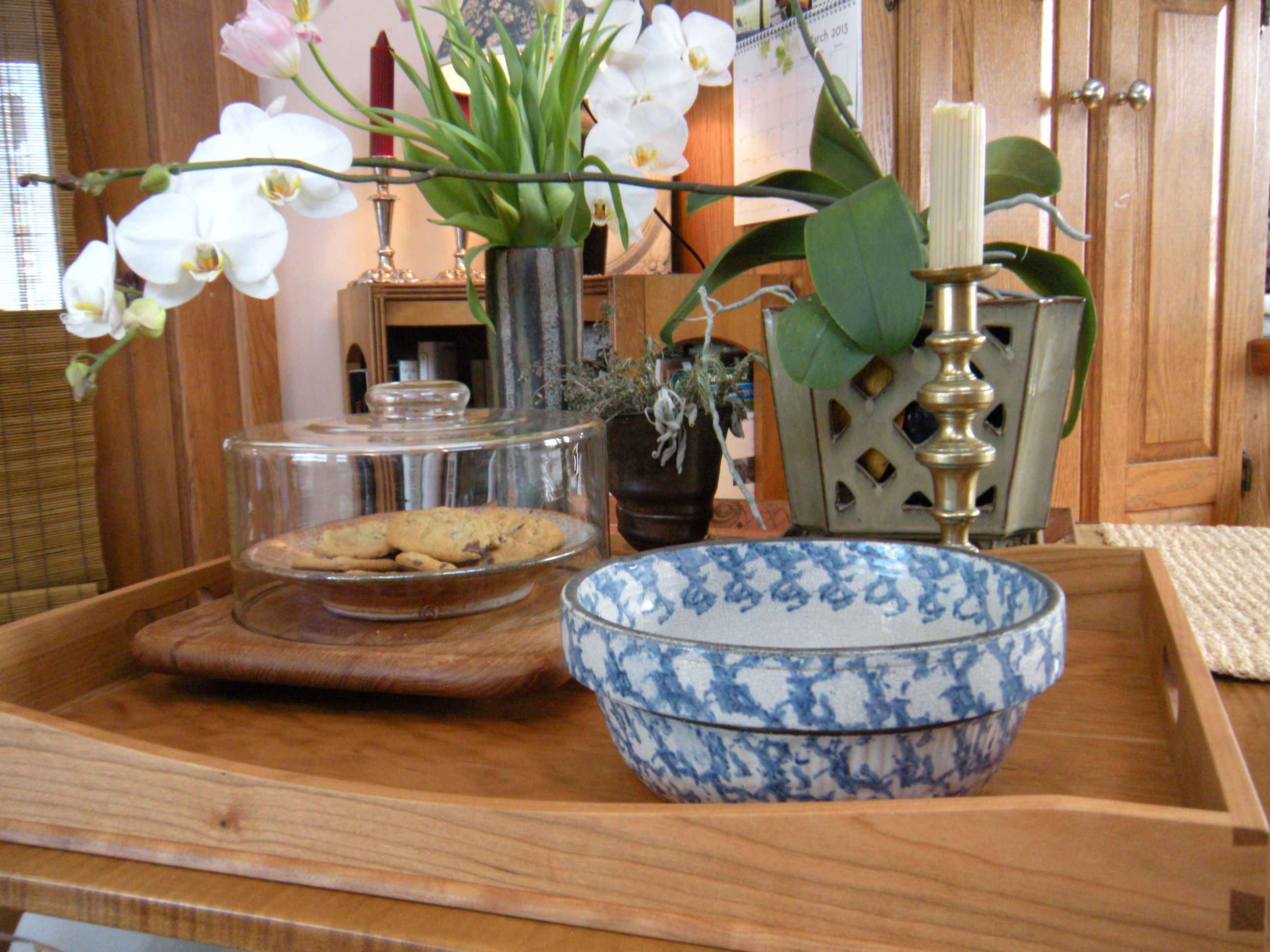
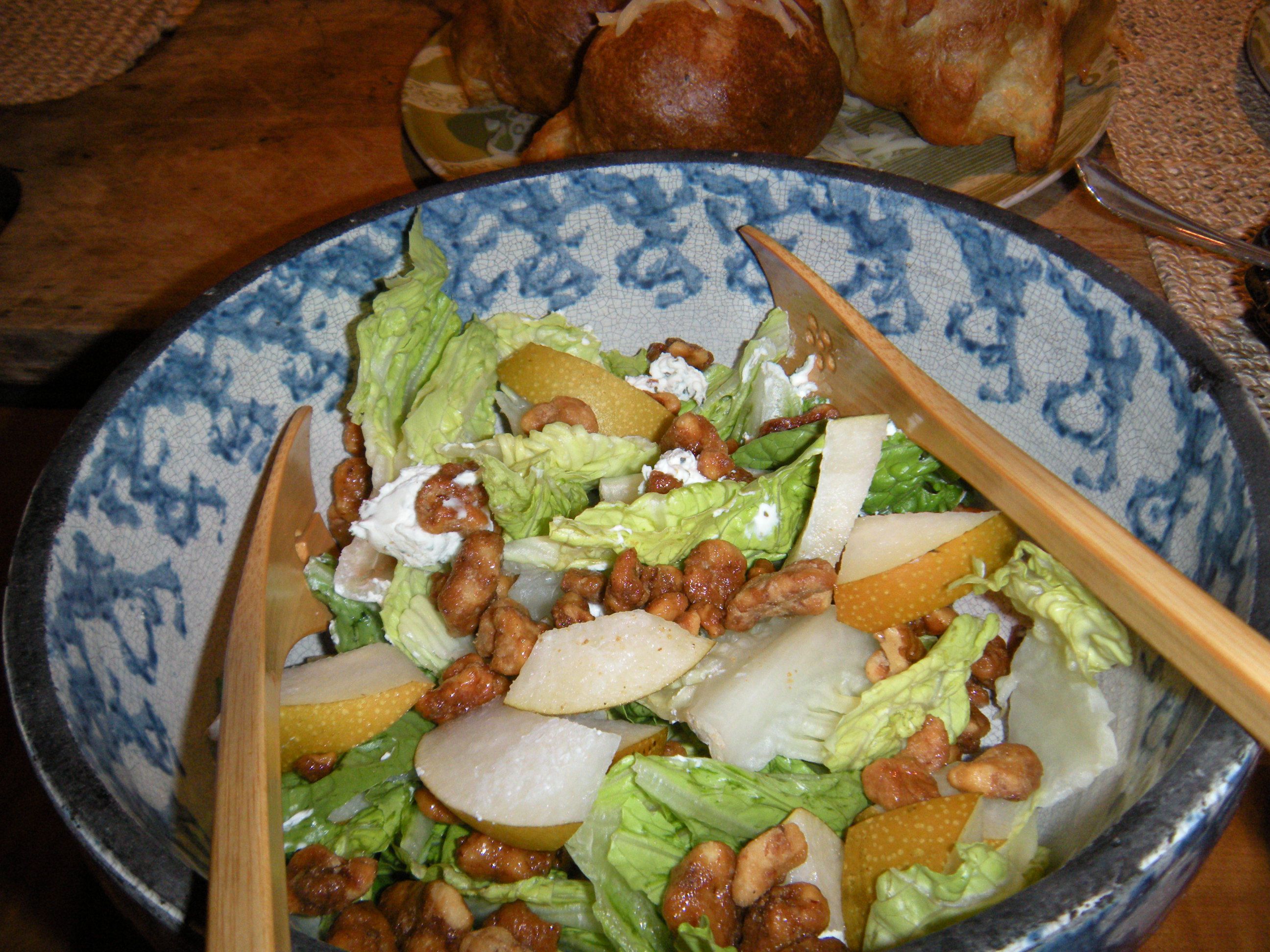
Usually, or in the old days (a few months ago,) I would have probably also made some rack of lamb, rare and on the bone with fresh rosemary, garlic and mustard a la Julia Child. Maybe a small bowl of baby brussels sprouts. But recently, I have been cutting out one dish, then another and G. and I have been happy and satisfied eating this way. So, tonight, along with these gruyere popover treats, I made a salad in the blue spongeware bowl:
spongeware salad

rinsing hearts of romaine in cool water and spinning them dry, broken up in crisp bites first in the old blue bowl. Then, half an asian pear, cored and cut up in medium-ish slivers, crisp and cool; about half a log of garlic herb goat cheese in small chunks, and best of all, a generous handful of those sinful maple glazed walnuts we’re not supposed to have. I made a small amount of vinaigrette with grapeseed oil, a squeeze of Meyer lemon, Japanese Marukan seasoned vinegar, and a dash of maple syrup. Whisked together and dressed in the salad, the light ingredients were a perfect foil for the rather robust popovers. We drizzled Billy Bee honey on the popovers halves pulled apart and steaming. Somehow, this brand of honey has more body and a taste that is discernably sweeter than other honeys we’ve tried.

It was satisfying to enjoy this simple meal together after all the hard work we had spent doing the rest of the day and also the day before. It was oddly also pleasant to have a holiday where we were free to spend the day on something else.

After cleaning up, G. left to take popovers to a neighbor who had been in an automobile accident earlier in the day; and some for his mother and brother who live across the street. We have three popovers left, perhaps for breakfast, or later for a midnight snack if we’re still up.

So, that’s the popover follow-up I promised. Hope you had a good day too.

pink magic . . .

A beautiful arrangement of pink peonies arrived today! Happy holidays, everyone. And thank you, C. for your thoughtful gesture.

pink peonies 4

pink peonies 3pink peonies 1

a hermitage . . .

DSC_0636Have you ever wanted to put your hands over your ears to shut out the cacophony of the world outside? To stop being nice or to help out when it might not really be needed anyhow? To live and let live when the latter part is complicated by a fear of other people’s vunerability to hardship or failure?

Is it like the first time you let go of the bicycle seat and let the two wheeler go on its own, rider and all? Or when you want to hold the hand of a toddler who is begging to walk but is off balance most of the time?

For me, it’s hard letting go, even at my age, truth be told. But when I find myself machinating or gnashing my teeth over someone else’s problems, the awakening needs to happen, and for me to hie myself off to the hermitage.

What is a hermitage anyhow? Is it a secluded place where hermits gather? Or is that an oxymoron because hermits by definition want/need to be all by themselves, rather than with other hermits? So, let’s say it’s a place of retreat by oneself. You can do that anywhere, it seems to me. . . even in your own house.

Retreat into one’s own place. That sounds like a plan to me.

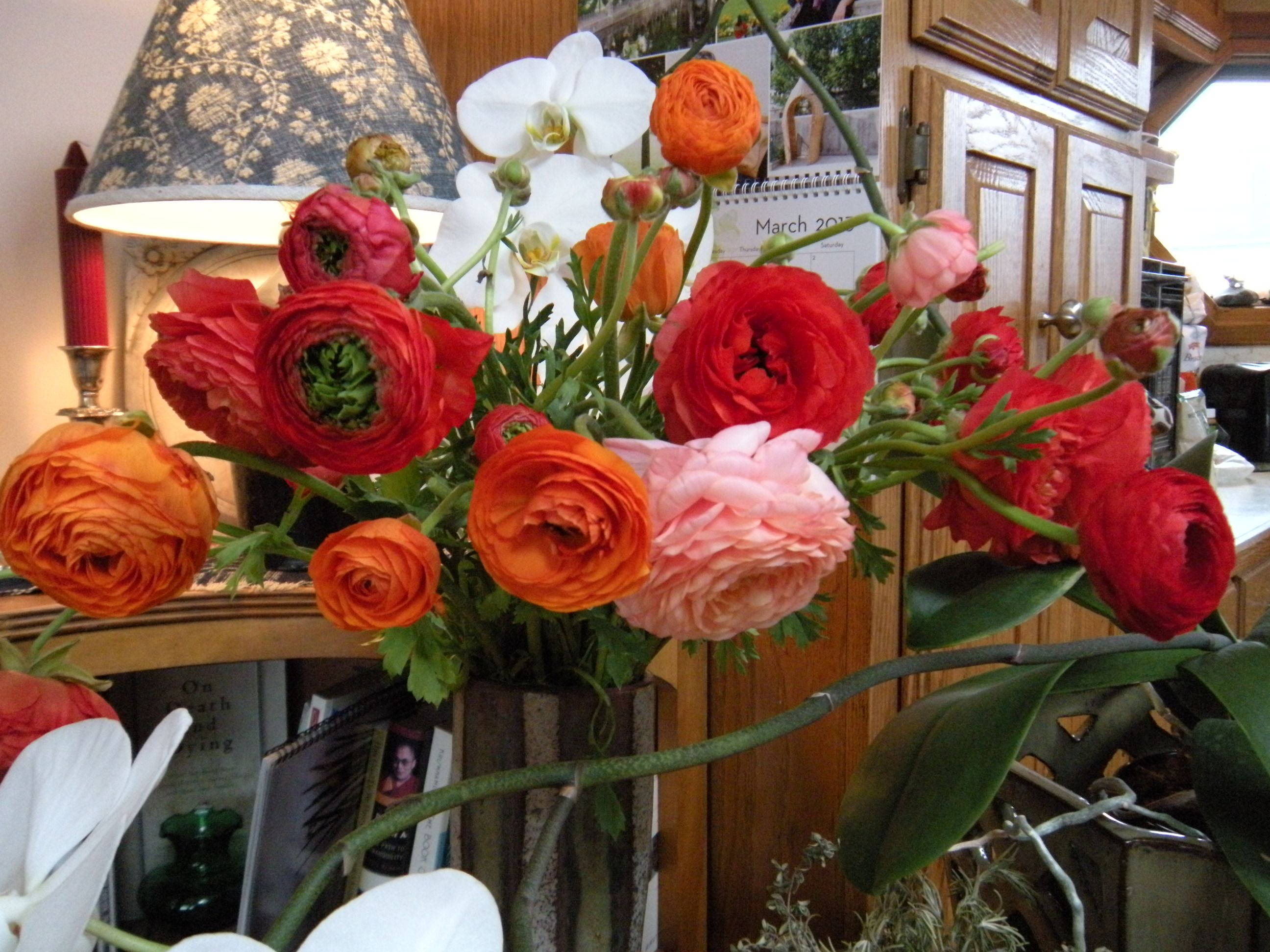
these gorgeous ranunculus from Trader Joe's will keep me company in my retreat!

these gorgeous ranunculus from Trader Joe’s will keep me company in my retreat!

“joy luck club” . . .

IM000320Have you ever seen this movie? It came out in 1993, the book and screenplay written by Amy Tan. In interviews with Tan, it’s evident that Tan’s mother both spurred her on and drove her crazy with her enigmatic attitudes. This quixotic combination of Chinese mother-daughter patterns is played out by four sets of Chinese mothers and Americanized daughters in this film, “Joy Luck Club.” For some odd reason, I’ve had it in the back of my mind to see it again and I’m glad I did.

Flashbacks to life in China illustrate the plights of multi-generational women who suffer due to the war, to unfaithful husbands, concubinage and the limited options for women with no means for supporting themselves if widowed or cast out by their families. This history and lessons learned endow these Chinese mothers with an urgency to see that their Americanized daughters do not share the fate of being devalued or unhappy, even if they unwittingly do it to themselves.

One of the most poignant passages for me was a mother who explained to her daughter that she was “trained to be a girl the Chinese way” according to three rules:

~ “desire nothing,
~ swallow everyone else’s misery,
~ eat your own bitterness.”

Rose, her daughter, realizes that she’s subjugated her own identity in her marriage because she felt less worthwhile than her husband. Lena feels inferior because she doesn’t excel in anything. Waverly confronts her mother’s pride in Waverly’s achievements as a chess prodigy only to lose her self-confidence and gives up playing altogether.

Does this sound very Chinese? Maybe or maybe it reflects life all over. As for me, I’ve learned something from watching the movie again. And that’s the realization that I don’t have to be a safety net for everyone all the time. And that there’s still lots to do!

perspective . . .

blue bestYou know how sometimes you go along for YEARS thinking that your life is or has been a certain way? Then, a conversation happens and it flips your perspective upside down? This happened to me yesterday when I was talking with someone I had known quite a long time, but not all that well. She is single and manages her own small business but is doing better, especially now that the economy seems to be shifting forward in a more positive direction.

We were talking about being lucky about our lives. I had thought about myself as having been “unlucky” in love because my first husband and I had a mostly silent marriage for over a quarter of a century before we parted ways and I didn’t marry my “first love” whom I had sporadically kept in touch with for decades, knowing he loved me in his own way all that time. Then, I met G., my second husband and we have been together for over 20 years. That is why I say on this blog that “life is long,” and that dreams eventually come true if you can wait long enough. At least that’s what happened to me.

“Meant to be” (MTB) is a good way to think about things, I think. My granddaughter has a very nice boyfriend who is a year ahead of her in school and going off to college soon. I wrote to her that if it’s “meant to be” then, no matter what they do to mess it up, they’ll still end up together eventually. And if it’s not “meant to be,” then no matter what they do to try to stay together, it won’t work. So, they might as well enjoy their time together since it’s largely out of their hands. She agreed, I was happy to read in her note back to me. I wish that I had known more about this “MTB” perspective when I was her age!

The other thing that I noticed to my friend is that I’ve also been extraordinarily lucky about the homes I’ve managed to find throughout my adult life. Luck played a large role each time in finding: the rent-controlled 12th floor apartment on West End Ave. with a river view in New York City during graduate school; the Lexington Victorian house with herbaceous border and apple trees where the kids grew up; the Georgian townhouse in Salem on the Common when I was newly separated; the contemporary condo on Lake Quinsig where I moved in a strange town before I met G. Then, moving to our Queen Anne Victorian home which he has restored for the past couple of decades. Serendipity had mostly to do with each of these finds and life transitions, it seems to me.

At the end of our visit, I realized, really for the first time, that I’ve been LUCKY in love, (not unlucky,) having loved and been loved by three great guys for long stretches of time and that I’ve landed on my feet in environs that are just as extraordinary. That I worked my butt off in a career that was extraordinarily stressful for a very long time may have been a way of paying my dues for part of my good fortune.

Luck, good fortune and “meant to be” were combined in my life as it unfolded. Thanks to any and all Helpers in the Universe for providing for me along this Unknown Way. Many…many…thanks.

meaning. . .

DSC_0567
What gives meaning to a life? I have been thinking about this since returning from visiting my 92-year old relative this past weekend who is weak and yet still lucid enough to send me off with an instruction to “take care of my family, take care of myself. . . and be happy.”

Is that all it takes? I take care of my family all the time, probably a little better than I take care of myself. But I think that last part about being happy is both the simplest and the hardest to carry out.

For example, I think one can DO lots of things to make yourself happy–and only we know what those things are that we especially treasure and enjoy. One of my discoveries of late is a “Rondo” movement of a Beethoven sonata played so tenderly and beautifully by a British pianist named Paul Lewis. (It’s the fourth movement of Sonata #4 in E-flat major, Op. 7.) G. and I went to a concert at Jordan Hall in Boston and heard Lewis play Schubert sonatas this January. Listening my way through these Beethoven recordings, I am amazed and taken aback by the freshness of the interpretations, so musical, clean and touching in its beauty of melody and line. Rapture is one way to describe it, I think.

[Here is a link to the piece on Youtube played by Daniel Alvadaras, someone other than Paul Lewis, but you can get a sense of the piece. Lewis’s rendition is available in the collected Beethoven sonatas.)

Actually, it has made me think about my mother and how important music was to her, all the way to the end. When asked why she went to the Unitarian Church that she had belonged to for decades when she said she didn’t believe in the afterlife, she answered simply, “for the music!” She sang in the choir and played recorder too, although she didn’t think that counting beats or measures was that important. I think one of her greatest wishes in life would have been to play an instrument as well as my sister played the violin and viola and I played the piano.

So, listening to Paul Lewis play this Beethoven “Rondo” makes me very happy today. DO-ing something like this makes me feel that BEING happy is a state of grace, whenever it appears. I am also struck by how individual our moments of happiness are. Someone else might not hear or experience what I am when I’m listening to this music. So many of the things around us that we cherish and enjoy are mere objects to other people. A line in a book or poem, flowers in a vase tilted in a certain direction; a meal, simple and warming may have meaning to us and make us happy but might not suit anyone else. But, if we’re happy, that’s a good thing.

Has something made you happy today?

Postscript: Icing on the cake tonight! Finding a YouTube clip of Paul Lewis and Imogen Cooper playing Schubert’s Fantasie in F minor. Luscious! Here it is!

DSC_0564

remembrance. . .

May-July 2007 354_2Last week, I received an email forwarded to me, telling me that my favorite cousin, PF, had had a stroke. Today, I visited her on her 92nd birthday, her three sons, their wives and children congregating at the family home, taking turns coming to see the matriarch in her hospital room on her birthday. They said she had fallen last night on the way to the bathroom, taken to the ER for an MRI to see if she had injured her head, keeping her up until 5 in the morning. Already weak, I was told she was very tired and might not be awake enough to recognize me.

Not to worry, as she said my Chinese name as soon as she saw me: “Sung-mei,” and held my hand, her wrinkly hand over mine. It took awhile before I gave her gifts that I had brought her that I thought she might like: a soft mohair taupe knitted capelet from Glasgow, Scotland, which she immediately took in her gnarled hands to warm them up, not caring if the soft thing went over her shoulders or not. She whispered in Chinese that she “liked it very much.” A deep mulberry fluffy throw went over her knees replacing one that had kept her lap warm. I attached the tiny earbuds to my Apple Ipod shuffle and turned it on to play music I had downloaded last night. It was a movie score, composed and conducted by her late husband, a famous clarinetist and composer who had died in 2003.

Pei fen
Of all my Chinese relatives, PF was the one I held closely as a role model. Unlike my mother who revered convention, PF and I were free spirits, fiercely independent and not afraid to experiment with food, making things or using things in different ways. She would use some pottery bamboo tools as hair sticks, winding her long dark hair quickly into a twirl on her head. Now, her hair was cut to shoulder length, but I brought a cherry burl hair stick to show her, because she had loved natural things like it in the past.

Back at the house, her three sons were busy behind closed doors discussing family business while the women sat in the kitchen doing a crossword puzzle. The dark red brick linoleum in the entryway and kitchen was an identical pattern to the one that was in my Lexington kitchen when the kids were young. I remember washing and waxing it to a dark shine so many times. It was a fond remembrance and an amazing coincidence that our kitchens had had flooring in common all those years.

As I leaned over to say goodbye, PF said slowly but very clearly to me: “Take care of your family, take care of yourself. . .and (a pause) be happy!” I’m glad that I went and had a chance for us to visit one more time on her 92nd birthday today.

artful recluse(s) . . .

DSC_1308This morning as I sat at the table with the sun streaming through the kitchen window, sipping my freshly made smoothie, I came upon the art section of the NYTimes which had a full page painting from 1644 of a Ming dynasty painter. The Asia Society has just opened an exhibition featuring works by reclusive artists so many years ago.

I was taken by the concept since it resonates with so many of my values and perspectives, including the search for Taoist hermits in the mountains of Sian that I had read about earlier. William Porter, nicknamed Red Pine, described his travels seeking reclusive Taoist priests and priestesses who lived alone in huts, subsisting on very little food, rainwater and sitting among pine needles. It was a romantic search, buffered by humorous encounters with some hermits, “hiding in plain sight.”

Living in solitude has long held an appeal for me and the journals of May Sarton, especially “Plant Dreaming Deep” and “Journal of a Solitude” struck a familiar chord with me when I had three kids at home and no solitude as such at all. I tired of reading Sarton after awhile because her writing became more whining and complaining amidst a lifestyle that included a home in New Hampshire and then on the coast of Maine, a multitude of flowers, inside and out, her loyal pets and friends who showered her with care and gifts of food, even as she continued to wring her hands about not being recognized sufficiently as a poet. That’s probably because her journals were her tour de force with women readers during her generation of writing–not poetry. In any case, her writing about the everyday was different from Anne Morrow Lindbergh’s but there was a common theme of domesticity around houses, flowers, food and gardening that appealed to many of us at the time.
DSCN3686
I don’t ask myself any longer why living inwardly is appealing. It just is. I have no desire to go on a cruise (esp. when many of the ships keep breaking down) where you’re trapped with hundreds or thousands of people whom you can’t avoid running into. Henry Beston wrote many years ago about living in a small shack which he wrote about in his famous book, “The Outermost House” during the 1920’s in Eastham, Cape Cod. To preserve those areas, the Cape Cod National Seashore reserve came into being in the 1960’s.

I guess if you’re artful or not, taking time alone can allow for a space for reading, rumination, creating and making things that reflect one’s inner senses and individual skill. At least, there’s a possibility to nurture and inform one’s spirit if taken.

For me, the last few weeks of winter have been filled with knitting, the amaryllis and orchids blooming, the canary singing, and I’ve even taken upon myself to (finally) read Proust’s “Remembrance of Things Past,” having picked up a used, boxed three-volume Pleiade edition. Come to think of it, Marcel Proust was a reclusive artist too, writing 4000 plus words in his dimly lit cork-lined bedroom describing the mores and human vagaries of French society which are so universal that they may mirror our own.

Let’s see how far I get with THAT while being grateful for peace and quiet, and most of all, time.

doing our best . . .

DSC_0157_2Do you feel down and out sometimes? Even after you’ve made things for other people, helped your spouse when he’s wet and cold from blowing snow for the second blizzard in two weeks, watered the plants, sweeping up the dried leaves and feeding the canary fresh seed and water?

Are you ever hard on yourself when you read about what others have done, especially if it’s something you would like to have done yourself? Well, here’s an antidote to all that:

The fourth (and final) agreement in Don Miguel Ruiz’s book, “The Four Agreements” is “Always Do Your Best.” He writes:

Just do your best–in any circumstance in your life. It doesn’t matter if you are sick or tired, if you always do your best there is no way you can judge yourself. And if you don’t judge yourself there is no way you are going to suffer from guilt, blame, and self-punishment. By always doing your best, you will break a big spell that you have been under.

Fine. I think it’s easier to always do your best than it is to stop judging yourself. So, maybe a change in emphasis to always doing our best is to also remember just not to judge ourselves all the time. That might be the key to happiness, don’t you think?

Amen.
DSC_0637_2

winter windowsill . . .

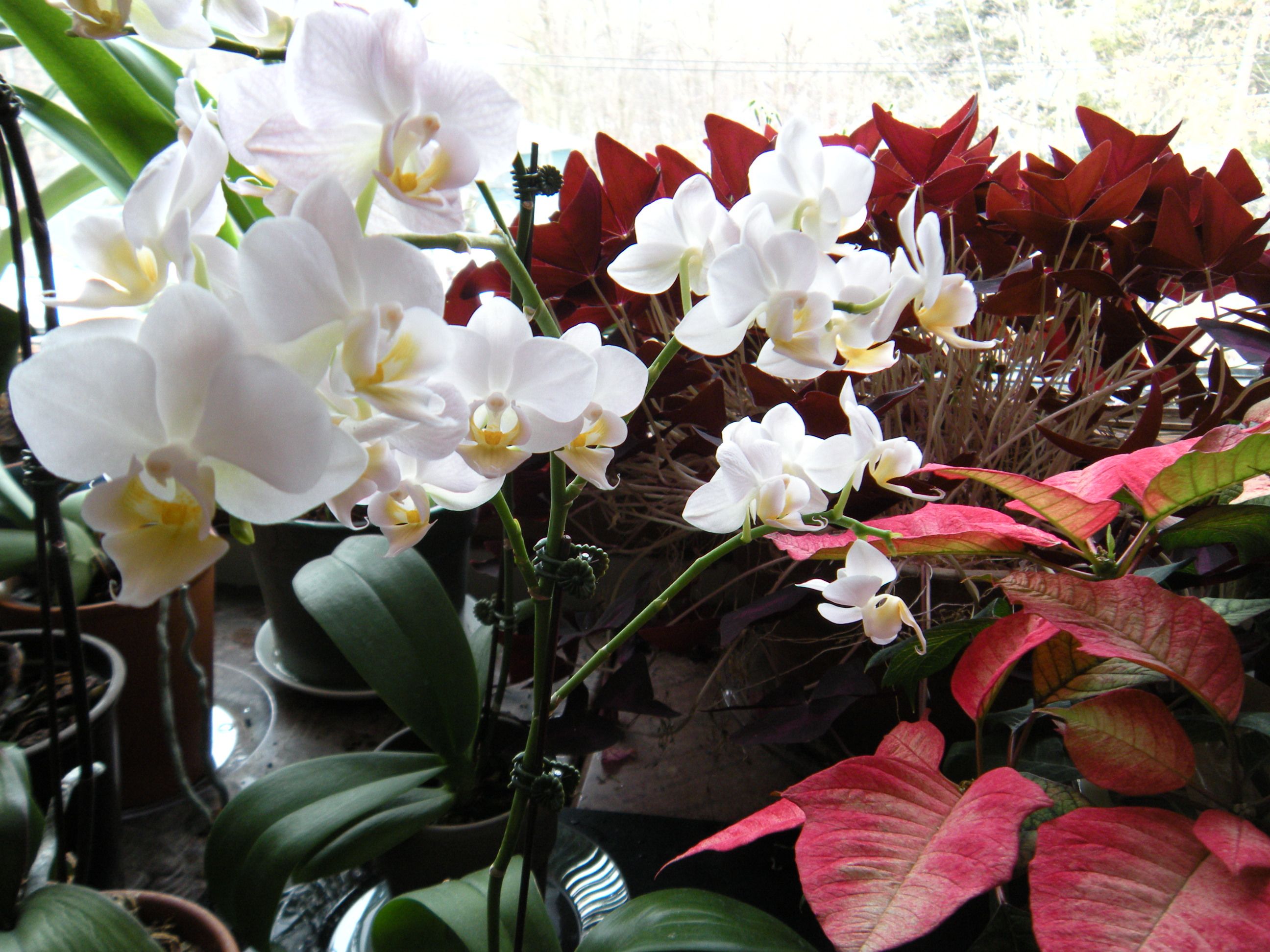
orchids 1It’s March, the Ides of Spring but it still feels like winter outside. This is the first weekend in a long time where we have not had a snowstorm and we are told that daylight saving time will be upon us next weekend!
orchids with oxalis
As I watered the plants this morning, it seemed like a good idea to capture some of what’s going on there: the amaryllis blooms are heartening since I forgot all about these summered-over pots during the Christmas bustle. Discovered hidden on the inside porch and given a little water, they appear in full regalia. It never fails to amaze me when amaryllis bulbs come back year after year. These neglected late-bloomers are a nice boost during the quiet early months of the new year.
orchids and amaryllis
amaryllis

During this quiet hiatus between the seasons, we are thankful for all the orchids, amaryllis and other plants humming along on our winter windowsill.