mulberryshoots

"Tell me, what is it you plan to do with your one wild and precious life?" ~ Mary Oliver

Category: Life & Spirit

the middle way . . .

Have you ever overreacted to something and then felt sorry afterwards? I was thinking about this and have come to the conclusion that disappointment is directly proportional to expectation. And you know what a rocky road that can be, right? Sure, the Buddhists and the Taoists and just about everybody else, Zen and otherwise, caution us not to have expectations. To tamp down our ego so that we can take the middle way. That would be nice but difficult sometimes because we are also human. Oh yeah, I forgot about thatIMG_9691!

Being human, we get excited, pouring love into things that we give those whom we care about. Sometimes their reaction is lukewarm, or delayed or whatever it is that didn’t meet our anticipation of what we had hoped for as their joy.

I’ve learned an important lesson which is kind of embarrassing at this stage in my life. And that is, that other people are not like me. In other words, the way that I might react to things is not the way other people do for the simple reason that we are different. Or there are other things going on. Or, whatever. I wonder where my naivete came from and how it has lasted this long?

Acknowledging to myself that I can be human and that others can be human differently, expands my little window on life. Somewhere within, the middle way runs through it.

(woman)kind . . .

DSC_0127For a long time, I’ve been thinking about how we women are, that is what separates us or makes us different from men: or mankind. For one thing, I wonder if women have really changed all that much from the days of our mothers or grandmothers. Surely, our daughters’ generation is more outspoken in their ways and in their choices, aren’t they?

At the same time, I also see many of us still putting our needs behind those of our partners, our children or our work. Sure, there are new visible women who have made it, like Sheryl Sandburg of Facebook who has just written a book counseling other women on how not to hold themselves back. Not that many have the resources that she does (help and money) to take care of children and households while forging their professional pathways in life. Will changing our body language and how we present ourselves to others make that much of a difference?

I was just reading from Anne Morrow Lindbergh‘s memoirs, “Locked Rooms and Open Doors – Diaries and Letters 1933-1935” in which she describes being terrified as Charles Lindbergh, her infamous husband, pilots their plane through a dense fog for over an hour, not speaking to her, looking for a place to land. Another one describes how she puts together a small study area for him, with his favorite books in the bookshelves, a standing lamp from the main house to create a space to please him, even though he doesn’t seem to notice when he sees it. And that’s all right with her, she says.

I don’t know, you know? Doesn’t this ring a bell like Jennifer Lawrence’s Oscar-winning character in “Silver Linings Playbook” where she complains about “waking up feeling EMPTY” because she does things for others, all the time? Maybe there is a compulsion gene that is in our female DNA that propels us to do things for others in order for them to be happy (at least in our way of thinking?) Or is this just our culture from the time we were young and took care of our dolls and stuffed animals?

There’s been a fuss recently about the 50th publication anniversary of Betty Friedan’s book, “The Feminine Mystique” and columnists writing about how they miss Bella Abzug. Gloria Steinman is still being interviewed, but I never felt personally that any of them represented me during the first wave of the Feminist movement.

I still feel that our issues as women are personal to the degree that we each have things to work out based on our individual situations. And that somehow, nothing much has happened to keep ourselves from constantly wanting to please those around us, to be accepted and acceptable by those we want approval from.

Perhaps it is just part of the human condition that what we do and care about others is also likely to be taken for granted some of the time. Maybe there will never be a movement that will transform or free us because this is just the way things are. Whenever I’ve brought up these thoughts with other women, they nod their heads in recognition and say, “yeah, that’s big.” Even so, I’m glad that I have daughters and granddaughters–a woman kind of family.

Postscript: By an amazing coincidence, PBS is airing “Makers: Women Who Make America” a three-hour documentary on the women’s movement. Here is a link to the trailer: http://video.pbs.org/video/2273015711/

two years old . . .

birthday candles
So as of Saturday, the 23rd of February, this blog turned two! Yep, been going for twenty-four months now, the view count is above 13,560 with visitors from over ninety countries.

Surprisingly, the fourth highest viewing country in 2012 was. . . (drumroll). . . Latvia! Go figure!

This morning, I received a sweet note from a reader saying that she had made tarts with her grandson (see “little hearts” post) and was reading “Gift from the Sea” by Anne Morrow Lindbergh (see post.) Sharing mutual experiences from the blog is so meaningful for me and I thank you for reading and writing to me about it.

Robert de Niro didn’t win the Best Supporting Actor Oscar last night, (see “Waking Up”) but Ben Affleck won for “Argo” as Best Picture, which I enjoyed seeing. From last night’s awards, the movie industry worldwide seems to be alive and well. Maybe we’re not going to hell in a handbasket after all, although you wouldn’t know otherwise from the antics of politicians in Washington. Or from reading about scuttlebutt at the Vatican, for that matter.

So, it’s a beginning of year three for the blog. A toddler in writing for me. Thank you for following it and for letting me know that you enjoy reading it. I’m surprised that the blog seems to have taken on a life of its own by now. And I’m interested, as much as you, to see what will come next. Thank you.

waking up . . .

DSCN4360
Yesterday, I took a trip to Northampton, about an hour or so from where I live, to exchange some yarn for a sweater vest that I wanted to knit for a friend. It didn’t take long to find a nicer color in a heavier weight Lopi yarn that would be more suitable for the project. There was still time to window shop at a couple of stores that I like and have a quick lunch before returning home.

On the trip out, I had thought that I might be able to get back in time to catch the matinee showing of the movie, “Silver Linings Playbook.” The movie had stirred a lot of fuss for Jennifer Lawrence, a young actress who has been nominated for an Academy Award for best actress. The leading man was Bradley Cooper, whom I don’t particularly care for, but the film also had Robert de Niro in it so I figured that would balance things out.

I was a few minutes late but the cashier lady kindly confided that the movie had great acting but was slow in the beginning and that I wouldn’t have missed much. The beginning was indeed very slow, setting the stage for why and how Bradley Cooper was struggling with himself. His character does this all through the movie, this viewer wondering off-handedly whether he would ever “get it” or at least pull himself together.

Lawrence’s character is messed up also (of course, why else could there be a plot, right?) but there was an electric moment in the movie, at least for me, which is why I am writing this post on a Sunday morning. Lawrence is yelling at Cooper, saying that she does things for everyone else all day long, all the time, and that when she wakes up in the morning, she “feels EMPTY!” Well, I can identify with that all right. In fact, I was thinking later on, that many of us women feel like we’re doing that at least some of the time, and maybe not even noticing that we’re doing it. Or that it leaves us feeling empty too.

Why is it that even when we KNOW that we’re doing it–being and doing for others, all the time–that we can’t help ourselves. Or maybe our circumstances are that if we don’t “do it,” then nobody else will. Or, maybe we should be doing for others for ourselves, right? I don’t know the answer to this but I decided when I woke up this morning that I am going to take the day off from it, maybe even a couple of days since Monday is a holiday.

Instead of pushing myself to complete projects to please others, I’m going to take a rest from knitting. Instead of thinking that I really have to put away some things and clean the birdcage or the fridge, I think I’m going to read for pleasure today. Instead of cleaning up, I’m going to stop and rest today. After all, nobody’s MAKING me do anything. It comes from inside somewhere.

Another observation offered by the movie, equally as powerful, was the portrayal of a henpecked friend of Cooper’s, trapped by his desire to please a demanding wife who insistingly wanted what seemed like more and more, running him and his life around like a drill sargent. That was the quid pro quo for men who take that heavy burden on, trapped in their silent anger in the basement or out in the garage, the equivalent of waking up feeling empty too.

This little movie can be grating and annoying at times, but it portrays how vicariously we take out our frustrations in life, wanting our favorite sports team to win for us, wanting to win our bets in life. While Jennifer Lawrence was interesting to watch, it was Robert de Niro who stole the show. I hope he wins a Best Supporting Actor Oscar next weekend.

“gift from the sea” . . .

DSC_2885_2 tbmAnne Morrow Lindbergh (AML) wrote a book called “Gift from the Sea” that was published in 1955. It became a best seller and is considered a seminal book in the feminist movement, largely because it was an early forerunner written in a gentle tone reflecting how hard it can be for women to have a life of their own while tending children, households and husbands. It was on the New York Times bestseller list for 80 weeks and has sold millions of copies, translated into 45 languages, I’m told.
DSC_1034_2
That’s quite an accomplishment when you consider that AML was also the wife of Charles Lindbergh, learned how to fly and accompanied him on long trips around the world, being the first woman to fly across the Pacific at the time. Sounds funny, doesn’t it? a woman flying for the first time across the Pacific? And of course, you might have heard about the infamous Lindbergh baby kidnapping and sorry aftermath. AML was pregnant at the time and had five subsequent children, four of them still living (Anne died in the 1990’s from cancer.)

Her book, “Gift from the Sea” was the first time a woman talked in a quiet tone about things that matter to us all, like the impossibility of loving someone just the same all the time. One of my favorite quotations from the book when I read it decades ago was: “The most exhausting thing in the world, I have discovered, is being insincere.” You can get a sense of her writing and rhythm just from that one sentence.

I wonder what it must have been like for Charles Lindbergh, the larger than life celebrity husband to know that her book was so popular and sold so well. I read that he supported her writing even to the extent of barring the children from disturbing her when she worked in her study. He was also a prolific writer and authored an autobiographical book about his solo flight across the Atlantic in his plane, the “Spirit of St. Louis” which won a Pulitzer Prize.

Later, the Lindberghs made some publishing gaffes–either due to foolish naivete or from idealistic ignorance–that got them into trouble with the American public. They were perceived, at least he was, as a pro-Nazi sympathizer and possibly anti-Semitic. Their fall from grace on the American stage lasted until Lindbergh died at the age of 72 in 1974. He was buried in Maui, Hawaii according to his own wishes, made when he knew he was dying from lymphatic cancer: the grave dug just so deep and so wide, facing a certain way; a coffin made from eucalyptus wood, the body wrapped in an old favorite Hudson Bay blanket and so on.

AML published thick volumes of her journals which bore wonderful titles like: “Hour of Gold, Hour of Lead” and “The Flower and the Nettle.” I remember cradling these books, reading them through and through when I had three daughters under the age of five. I also shared an intense love of everything domestic: houses, gardens, furnishings, rhythms of running a household. So her books were my companions, ones that I might not have been able to find in person to share how I wanted my home to be like. Of course, she was very rich and I was not, but she wasn’t pretentious in that way. She was also shy and reclusive and I liked that about her too.

Apparently, when one reads Reeve Lindgergh’s memoirs about the last years of her mother’s life and dying near her home in Vermont, Charles Lindbergh, though beloved by the family, was somewhat of a tyrant, controlling and autocratic. I read where he insisted on taking Anne away on flights just at the time the children were born when all she wanted to do was to stay with them at home. During the 1950’s when “Gift from the Sea” was published, it has been said that she had a three year love affair with her physician.

AML died at the age of 94 in 2001. She was cremated and her ashes scattered. Two years later, three children, now grown, revealed themselves in Germany after their mother died, saying that they were fathered by Charles Lindbergh. DNA tests confirmed their story, the eldest was born around 1957. But wait, there’s more. It turns out that the children’s aunt had two children by Charles Lindbergh and his secretary at the time had two children: a total of seven children in three households was revealed. My first thought on hearing this was to wonder if AML ever knew, either from Charles before he died or from elsewhere before she passed away so many years later.

So ironic, don’t you think, that this gentle soul who wrote so well about the difficulty women have to be themselves, to be allowed to be imperfect and so on, would have this happen as a footnote to her 45-year marriage to Charles Lindbergh, a national hero at the time of his transatlantic flight? It’s beyond appalling, I was thinking to myself. I’d also taken some pride that AML had gone to Smith, my alma mater too. In Reeve Lindbergh’s memoirs, AML tells her that she never wanted to go to Smith but preferred Bryn Mawr instead. One of her elders became President of Smith at one time and there is a residential building called Morrow there too–I guess that family ties to Smith were stronger than her individual choice.

So, it was a coincidence of sorts yesterday that I saw on eBay an auction for a first edition of “Gift from the Sea” with its own slipcase, of course published in 1955. I idly put in a bid on it because no one else had, and later found out it was mine for $10.00 with free shipping. I’m glad to have this early edition of this meaningful book because it has been one of my favorites for so long. I only wish that AML’s life had been easier, but perhaps she wouldn’t have written “Gift From the Sea” had it been otherwise.

That’s life, isn’t it?
DSC_0952

Postscript: Reeve Lindbergh, AML’s youngest daughter, writes in her memoir, “Forward from Here,” about the revelation of Charles Lindbergh’s seven children by three women in Germany after her mother’s death in 2001 and whether or not AML ever knew:
“She died two years before the news about the other families was revealed, and I have wondered how much she knew about my father’s secret life. A close friend of hers told me this: ‘She knew, but she didn’t know what she knew. . .’ That sounds very much like my mother.”

contentment . . .

DSC_0242_2The previous post gave some guidelines on longevity, marital and otherwise. “We live with contentment,” said John Behar. Did any of you hesitate at that word when you read it? Sounds so simple. Yet, all day yesterday after posting it, I wondered how many of us feel contentment and/or even know what that is?

Does it take becoming a certain age after striving for and achieving certain goals in one’s mind to feel contentment? Or is it a matter of the kind of values that you grow up with or find for yourself that feels like your purpose in life? How many of us when asked what we want to be when we grow up would say, “be contented?” Lest you think I am poking fun at this concept, I am actually doing just the opposite: that is, reflecting about what it takes to be content with one’s life on a daily basis.

Many of us have what we need to live each day: food, shelter and a way to pay our bills. What we THINK about all day long is what may account for an empty hole in our perception of how we are doing: we need more money; we want a better job; we want to re-do the kitchen; we want a new car; we have to have (fill in the blanks.)

I was thinking about the article about the Behars and that my stage in life seems to complement theirs: which is to watch my family grow and to go with the flow. I have discovered that all the nagging things that had to be a certain way actually are made-up ideas in my head and so I sent them packing. When G. forgets or does something that annoys me, I stop myself and say, is it worth it to nag him about it or what difference does it make anyhow? Believe me, it’s taken me a long time to get here. The driving motivation for me to stop “sweating the small stuff” is that I actively want to be contented. I want to acknowledge how lucky we are to be together and to live a life that is fairly simple except for all the cooking forays that I embark on. I knit and read a lot. I like to clean house and clear off the kitchen counters so that our place looks neat. We have avoided the flu so far this winter.

Contentment doesn’t have to be complicated. It’s how much we humans pile onto the idea of contentment that makes it, well, farther out of reach. For example, we can take contentment in little bites: when we have a cup of coffee or tea that tastes so good and hits the spot; or when we listen to a favorite song or piece on the radio while we’re driving in the car. Or when we sit down to a meal with someone we care about and enjoy eating it together. I wonder if feeling grateful has something to do with it? What do you think?

forever . . .

DSC_0032_2
In our local paper today, there was a long article about a couple who were “the longest married couple” in the country. It was pretty interesting because they grew up across the street from each other and fell in love. Then her father wanted her to marry someone else he had in mind so the couple eloped. That was over eighty years ago. Yep, you read that right. You see a lot of couples celebrating their 50th or 60th and I haven’t heard any around the 70th, but eighty years?

So of course someone asked them what accounted for their marital longevity and the answers were pretty simple:
“We just live with contentment and we don’t live beyond our means,” John Betar said. “Just go with the flow.” John’s now 101 years old and Ann is 97. The photo showed both of them smiling. They’re still living in their home along the Fairfield, CT. shore and enjoy watching their grandchildren and great grandchildren grow. John opened a grocery store in Bridgeport after they married.

Family is the key to their longevity, they said. They had five children and now have fourteen grandchildren and sixteen great grandchildren. “That’s what makes life what it is,” Ann Betar said. “We were fortunate enough to live long enough to see this. . . and it’s really one of the most gratifying things in the world to see your great-grandchildren, to see your grandchildren become adults.”

John Betar added, “That’s what keeps us alive. We live for them.”

Sounds like a great plan to me: live with contentment and within your means. Go with the flow and enjoy seeing your family grow up. I’ll second that.

nourishment . . .

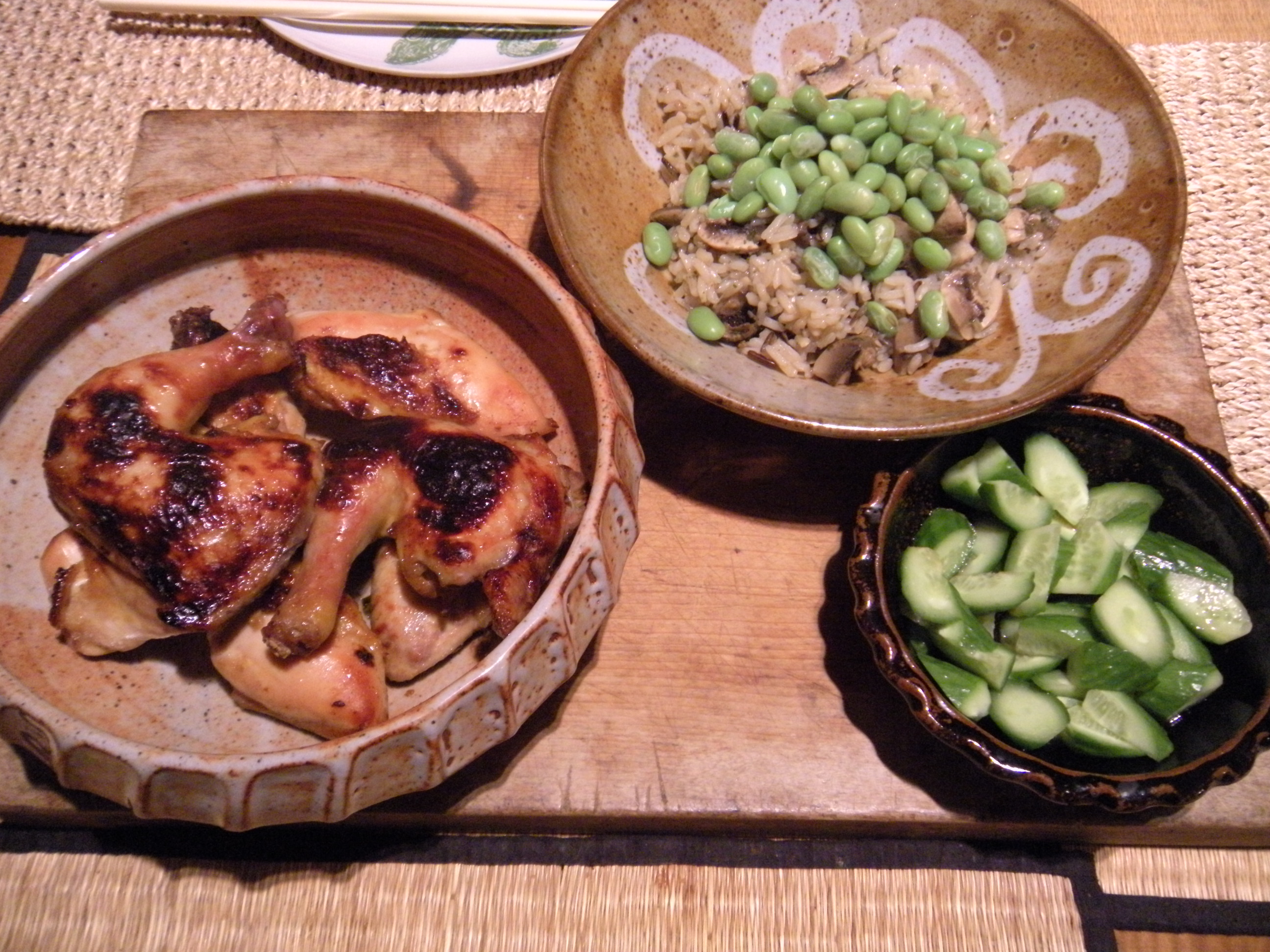
DSCN4691I was skype-ing with my daughter, M. this morning when she skipped into the kitchen to show me the dish that had just finished cooking in the rice cooker. To my astonishment, she spooned out what can only be called a melange of rices (arborio, minnesota wild rice, sweet brown rice, Japanese medium grain rice). She then proceeded to tell me, between mouthfuls of rice, that she had not eaten meat, dairy or eggs for the last four weeks, nourished mostly by grains, vegetables and a few treats (like sugarless reese’s peanut butter cups) that she had made herself.

Since she also goes to school, she sometimes presses the rice into the palm of her hand, adds fresh edamame (soybeans) and sometimes wraps the rice balls in nori (seaweed sheets) and brings them for lunch or mid-afternoon snack. By this time, I had mentally scuttled my plans for dinner tonight. I had a cornish hen in the fridge that I usually cut in half, make a little herb bread dressing and then roast the halves on the dressing, basting the hens with melted orange marmalade. This is after I’ve browned the cornish hen halves in a little olive oil and a pat of butter.

Changing gears, I rummaged around my pantry this afternoon and came up with Chinese sweet sticky rice, brown rice, white rice and some wild rice packets. M. had also said that sometimes she cooks the rices with a bit of shoyu and fresh cut up button mushrooms. So my first experiment with this was to combine the three rices with the wild rice packet including seasonings. Then, I cleaned six button mushrooms, sliced them in chunks and plopped them into the rice mixture along with spring water, scantly twice the amount of the combined rice in the rice cooker.

I looked at the cornish hen, rinsed it in cold water, dried it and then cut it into small pieces–legs, wings, and split the breast. Then I marinated it in a small amount of Korean Bulgagi barbecue sauce, sliced green onion and fresh ginger root for about an hour. Broiled the pieces with a quick brush of honey to crisp the skin.
DSCN4682
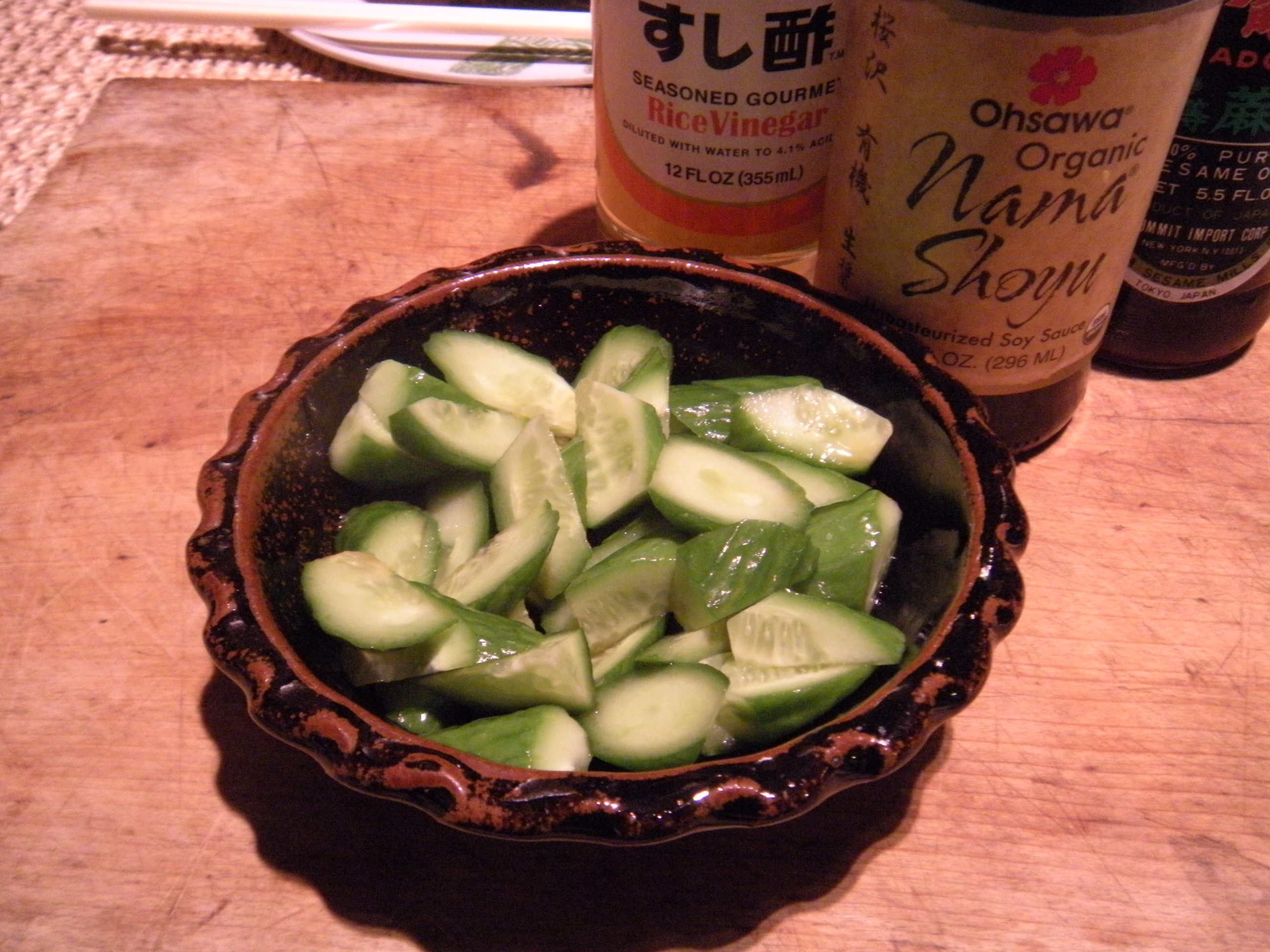
The rest of the meal consisted of cucumber salad, the tiny crisp cucumbers quarter sliced, then dressed with a small mix of Ohsawa unpasteurized soy sauce, Marukan flavored Japanese vinegar and a little sesame oil. I boiled up a handful of edamame beans to serve as garnish on top of the rice when it was served. DSCN4685

This meal was far more interesting and contained a lot less fat than the dinner I had planned earlier (stuffed cornish hen with baked potatoes.) My thanks to M. for her ideas–she looks radiant from her new regimen and is moving toward vegan/macrobiotic eating. I took a macrobiotic cooking class at Kushi Institute years ago when I had a form of viral meningitis and was determined to heal myself with food and Chinese herbs. G. enjoyed the new rice melange with mushrooms and we made up a plate for our tenant who lives downstairs.

With a blizzard forecasting anywhere from a foot to two feet of snow this weekend, I’m already thinking about the best time to make a large pot of beef shin and vegetable soup with fresh cabbage. On Friday before the storm hits, I’ll slow roast a large chicken that was on sale at the grocery store today along with a handful of baked potatoes. If the power goes out, we’ll have food to provide for all who live here. And then some.

Postscript: I’ve found that by starting three rices (brown, sticky and white rice) in the rice cooker using chicken broth earlier than usual, then letting the cooked rice steam in the cooker for an hour or so afterwards produces delicious, chewy, rice that goes well (better!) with just about everything than plain white rice. I cook twice as much as I need because the leftover rice is also tasty the next day with our evening meal.

nature and nurture . . .

IMG_8663
Today, there’s a fascinating article in the Science section of the Times which describes the work of Dr. Hopi Hoesktra, a biology geneticist at Harvard. Her recently published paper in Nature outlines work her team of researchers have done to distinguish genetically traceable traits in two different species of deer mice by the way that they build burrows and provide escape hatches (or not.)

We are not mice but we might as well be to think about what we have control over in the way that we look and behave in the world as much as the person beside us or across the table from us. Much has been made of how much acculturation (nurture) has influence on our personalities and character traits. What if, for example, much of it is genetically persuaded if not outright determined; e.g., “we were born that way?” Recently, there has been so much information about how behavior is influenced by our DNA and the physical/biochemical makeup of our brains. And this is not just from watching “House” on TV either.

In my own life, I have been surprised to gradually understand how many habits and traits I have that are similar to my father’s, the helpful and the not so helpful: insight and intuition, bluntness, adherence to what you believe in even though others may disagree. So much literature is devoted to describing these kinds of parallels in families and life consequences that result from them. I’ve often wondered whether it was the nurture from such strong traits growing up that causes that symbiosis or whether it’s mostly genes. Probably some of both.

In any case, the reason I am writing this post is that the deer mice research is truly fascinating to read about. And to think that we humans might also be genetically predisposed to either building long burrows versus fat ones and whether or not to provide an escape hatch in the burrow is, well, a humorous reflection on our own human behavior.

I know that many of us take life too seriously (that’s me) but that we may also have ancestors who have done that for eons before us it seems. How happy we are with ourselves depends on a lot of things. Luck is a big one, it seems to me. That’s been an influential factor in how life has made corrections for me almost in spite of myself, and for which I am ever thankful. So, with nature (genes,) nurture (environment) and luck (unpredictable opportunity) maybe it’s time to give in to the Zen idea of just going with the flow, and not to resist because of some preconceived idea that maybe we know better.

truly, madly, deeply . . .

May-July 2007 351_2
Truly, we want to leave this world a kinder and better place by our actions and thoughts;

Madly, some of what we say may be taken the wrong way;

Deeply, we are fortunate in our lives and have much to be thankful for.