mulberryshoots

"Tell me, what is it you plan to do with your one wild and precious life?" ~ Mary Oliver

Category: Life & Spirit

love (almost) conquers all . . .

tulips 2 jpg


I read a lot and am not usually patient enough to read a book as long as Hanya Yanagihara’s book, “A Little Life”. However, I found myself being lulled by the ease with which the novel progressed – the voice and long paragraphs that were more “tell” than “show.”

I found myself engaged in the voyeuristic and suspenseful plot which unfolded slowly through the novel, interspersed with the painful present-day life of the central protagonist, “Jude” (a namesake of another tragic character, “Jude the Obscure.”) Noteworthy also was the tender (that’s the only word for it) depiction of love and loyalty between men as friends and then as lovers. That the book’s author is female and Japanese, writing almost primarily about men (there are few female characters that have any development) is a marvel to behold. I don’t know how many times the words “I’m sorry” were uttered in the novel but I’ll bet there were a lot.

Only an occasional false note in the book appeared to me because I am a musician and a pianist – and that was a description of Jude playing Schumann’s Fantasy on the piano during an episode in which he is upset. That’s an amazingly difficult piece and it was already a reach earlier in the book to believe that he could play Bach Partitas at one point, but the Schumann was too far a stretch for my imagination to follow.

The story is almost unbearably painful. And the ultimate impact on me after reading it was to realize that so many of us are damaged goods walking around under seemingly okay appearances. Sometimes the hurts that we suffered from those who were supposed to be caretakers was repulsive and unforgiveable (as in this novel) or merely “normal” (benign neglect, selfishness, carelessness.) But all of us, it seems, have hidden hurts we are ashamed of and which we tell no one about.

That being said, we can have more compassion for what we don’t know about others (and might never know) that accounts for behavior that we don’t understand from those we care about. This compassion can be intellectual and abstract to help leaven judgment we might otherwise feel – and hopefully might last longer than a little while. That’s a lot to take from reading a novel but there it is.

a new classic in cookery writing . . .

kitchen towels

“Ruth Reichl – My Kitchen Year” is a wonderful book that also happens to be a cookbook that I can cook from every day. As a memoir of her days after Gourmet magazine abruptly closed, it’s easy to understand how she returned to the kitchen to assuage her grief during a time of uncertainty. Be that as it may, this book contains handwritten chapter headings with poignant photographs of the countryside throughout the seasons surrounding her home in New York state along with recipes that are classic and easy to follow. There are no foodie stylists around, just one photographer who takes the picture, then joins in eating the goods. This book is intimate in its charm and fresh with recipes that are classic updated with contemporary touches.

I happen to cook a lot and to also cook dishes that are similar to the ones that Ruth Reichl celebrates here. . . although she manages to insert special little touches that I hadn’t thought of before. For example, combining chopped shallots and onions to finest grated cheddar cheese before making a grilled sourdough cheese sandwich. Or, her best fried chicken brined in salt, then soaked in buttermilk and ONION before frying in coconut oil and butter.

Above and beyond the visual and culinary treats that this book offers, it also contains anecdotes that are poignant to Ruth Reichl – one of a woman offering to treat her to a sandwich while she’s waiting in an airport after the sudden demise of Gourmet magazine. Or the memory evoked during a fried chicken picnic at Tanglewood of a youthful trip to Israel, forced on her by her parents where she met another young woman who happened to be Carole King – who, along with James Taylor and Yo Yo Ma, provided the program for that Tanglewood fried-chicken picnic evening.

This all makes me feel that Ruth Reichl has lived a blessed life despite the very public humiliation of the closing of her Gourmet magazine after ten years as its editor. She’s married to Michael who is 75 who happily eats her blinis with sour cream and salmon roe in her videos, she also has a son whom she adores. Best of all, she’s moved from New York City to a low slung contemporary house in New York State that was built overlooking beautiful countryside with nearby farms and other provisioners of vegetables, cheeses and other organic goodies.

It almost seems like the whole demise-cum-survival scenario was “meant to be” as the next chapters of her and her family’s life. She just didn’t know it at the time.

I’ve always liked Ruth Reichl through years of reading cookery magazines and cookbooks. The graphics of those Gourmet magazines under her stewardship were unbelievably rich and beautiful if you might recall. I’ve saved all my copies of Gourmet from those times because they were such a feast for the eyes as well as for the kitchen. And with these few rainy days, I’m looking forward to pulling them out and looking at them once again.

In this book, I am particularly looking forward to trying her New York cheesecake recipe with the chocolate wafer crust and sour cream glaze, and other homey recipes like shirred eggs with pureed potatoes for supper with a simple green salad.

Finally, she makes a big deal out of making turkey stock for gravy at Thanksgiving – and she’s absolutely right that no matter how the roasted bird turns out, the stuffing and the mashed potatoes, with a deeply rich “made from scratch” turkey gravy, everybody will love whatever is on their plate. Not that Ruth Reichl’s “other” offerings would be anything other than tasty and tender.

I’ve reached a time when I shouldn’t be buying any more cookbooks. My cookery library started with Elizabeth David’s Penguin editions and expanded through the years with books by M.F.K. Fisher, Julia Child, Alice Waters, the River Cafe, Nigel Slater, the Conrans, Thomas Keller, Noma and Judy Rodgers. (We celebrated Christmas Eve with Judy Rodgers’ roast chicken and bread salad two years ago when she died at the age of 57 a few weeks before Christmas. It was out of this world and memorably delicious! – see photo on right)PCG 132
Still, I think that this new volume by Ruth Reichl will now be my favorite and will be a standby to look through for new things to try and to tweak classic recipes I’ve already made many times. It is a beautiful volume on so many levels.

In an interview published by the New York Times last week, Ruth Reichl was quoted as saying “You should have as much fun as you can because you don’t know what’s coming down the road.” Well, it looks like she not only survived what she didn’t see coming down the road, but with this memoir/cookbook, she’s also managed to illustrate how she’s landed on her feet, built a new home and produced what I think will become a true classic in the ever mushrooming world of cooking.

Good for her! – and good for us too!

Postscript: since this post was written, I’ve tried out Ruth Reichl’s pancake recipe. The only change I made was to use buttermilk instead of whole milk. They are truly the best pancakes I’ve ever had – delectably tender in the middle and slightly crispy on the edges. You might think pancakes are easy to make (and they are) but this recipe is head and shoulders (and different) from any others that I’ve tried.

Am also looking forward to roasting filet of beef sprinkled with truffle salt and eaten at room temperature with leftovers for sandwiches the next day!


“going for it ! . . . “

th

When asked about the Pope’s health and stamina, someone who knew him when he became Pope at the age of seventy-six two years ago said that he’s gained a little weight since then because he hasn’t had a chance to get much exercise. He also has one lung, suffers from diabetes and moves with a sore hip. You’d never know it from watching him during this visit.

The vigorous schedule he has met since he touched down in Washington, D.C. yesterday has been remarkable. Not only that, you can tell that this guy is truly in the moment all the time. That same person who saw him two years ago said he got the impression at the time that the new Pope, despite his health and his age, was “just going to go for it.”

And so he has done. The fifty minute speech he gave to the Joint Houses of the U.S. Congress today was spoken in English although his native language is Spanish (he’s from Argentina) and he is also fluent in Italian. He said that the U.S. is still held in the world as a land of hope – and that we should live up to that symbol of hope. This national identity has been lost in translation by political mud-slinging that has become a national pastime, it seems.

Somebody with moral courage had to speak up as he has. And I’m glad he did. He asked for us to pray for him. And so we will, even those of us who are not Catholic nor even particularly religious in a formal sense.

People here talk all the time about wanting to  “make a difference.” Pope Francis has illustrated how to talk the talk that’s long overdue while continuing to walk the walk all day long. For someone who is 78 years old,  Pope Francis is a pretty amazing example of what “just going to go for it!” looks like — and it’s still unfolding before our very eyes.

knitting . . .

sweater 1

I taught myself how to knit when I was ten years old, sitting in my bedroom, following a Vogue knitting pattern and emerging triumphantly with a white bed jacket, of all things.  It had a seed stitch border on it and ever since that first project, it’s been my favorite go-to pattern for most of my knitting projects including this one.

Knitting serves to while away time that one might be spending idly by and also as an outlet for one’s ideas. I challenge myself by knitting from scratch – that is, without a pattern which usually entails numerous do-overs until the sweater is finished to my satisfaction. And truth be told, I almost gave up on this one and put it away without sewing it up!

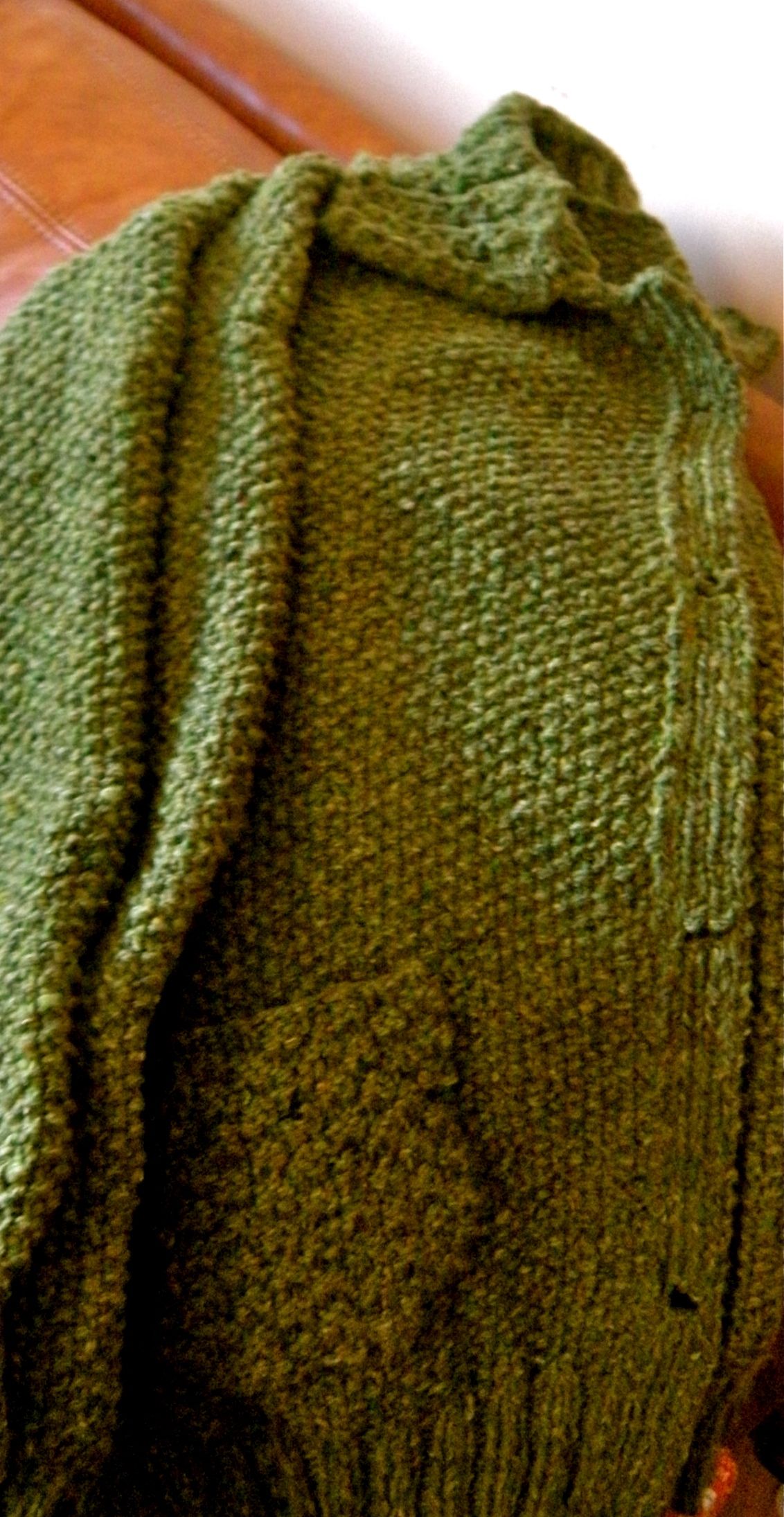
But, listening to “Bluebloods” seasons 3 & 4 on my laptop to keep me company, I decided to take it on, revamping the sleeves so that they morphed into a dropped shoulder dolman sleeve that was just the right length to the wrist after retrofitting the armhole opening once the fronts and back were sewn together. See what I mean?

It always amazes me how much time and steps are still required even though you think you’re done after the main pieces are knitted (fronts, back and sleeves.) For example, this neckline was finished with knitted ribbing first, then attached to the cabled ribbed collar (that started out as a bottom cuff) so that it would stand up properly.

The pockets were knitted in a moss stitch (double seed stitch) to contrast with the allover seed stitch pattern of the sweater. The front ribbing for buttons and buttonholes were knitted during this phase also and sewn edge to edge with the fronts so that they would lie flat. I’m waiting for the buttons to arrive (olive green tortoise shell with a raised edge) and will sew them on next week.

Knitting is sometimes carried out as a waiting game. I wouldn’t say that I was fatalistic while knitting this sweater, but I had a hunch it would provide many challenges before it was completed.

But it was the beauty of the yarn itself, a soft wool, silk and cashmere blend in a moss green tweed color that kept me going. I used to have a brown cable knit sweater that I wore while the girls were growing up and we lived in Lexington. Long gone, I’ve tried to replicate it a few times either by finding one used or knitting another one.sweater 2

But today, I have decided that this will represent that sweater to me during this next phase of my life. Good to change colors and to wear something a little different, just as it will be to refresh my outlook with a sweater knitted from this beautiful yarn called “Wintergrass”.


“have as much fun as you can” . . .


clematis %22Montana%22

This morning at breakfast, I read a quotation to live by from Ruth Reichl, cook and former head of Gourmet Magazine:

“At this point in your life,” she said, “you have to have as much fun in life as you can because you don’t know what’s coming down the road.”

She is 67 and her husband, Michael Singer, is 75. They live in a vast glass house they built eleven years ago in New York State. More can be found at this link:

national peach pie day! . . .


peach pie with pastry wheel

Someone said that today is National Peach Pie Day.

So, here’s our contribution, made with a shortcrust lattice edging and woven top; no bottom crust; peeled fresh peaches from our local Concord farm stand, Verrill Farm. To sliced peaches, added a tablespoon of flour, heaping teaspoons of cinnamon and nutmeg, 1 tablespoon of agave nectar, dotted with unsalted butter before weaving lattice top (like a potholder when I was 7!)

Shortcrust pie crust made this a.m. in small food processor: 1 cup flour, 1/3 stick cold butter, 2 Tablespoons cold lard; 4-5 tablespoons ice water. Whirred dry ingredients until blended, then added ice water until blended into a ball– wrapped and refrigerated until ready to use.

These lattice strips were cut with a vintage handmade wooden pastry wheel. Brushed with egg wash and sprinkled with turbinado sugar. Baked at 375 for 15-20 minutes until brown and bubbly. Will serve with a scoop of Haagen Daz vanilla ice cream on warm pie after supper tonight.

path to winning . . .

1101580519_400

Okay, so this is probably the last post I’ll make (for awhile at least) about the 1958 Van Cliburn Tchaikowsky competition. Not only had Russia just launched Sputnik six months earlier at the height of the Cold War, but this was also the very FIRST Tchaikowsky competition ever.

In an interview, Van Cliburn said that he was greeted at the airport by a very nice Russian woman who mispronounced his name – so in Russia, he was known as “Van CLEE-BURN.”

In addition, he said to the interviewer that it was an incredible jury which included world-famous musicians: Dmitry Kabalevsky, Emil Gilels, Sviatoslav Richter and chaired by the composer, Dmitri Shostakovitch! Apparently, there were some shenanigans in the scoring that went on as described in the article below – wherein certain jurors were scoring the American with mediocre marks (15s & 16s out of 25.)

Sviatoslav Richter caught on to this and began giving Van Cliburn all 25s, perfect marks while scoring everybody else with zeroes! “Either they have it or they don’t!” Richter was quoted as saying. The jury approached Khrushchev to get his approval for them to declare their choice of Van Cliburn as the winner. On the way home, the stewardess on the plane showed the pianist a copy of TIme Magazine with a pastel portrait of Van Cliburn on the cover.

Postcript:
Liu Shu Kun was a Chinese pianist who placed second in the 1958 Tchaikowsky competition when Van Cliburn won the gold medal. As a pianist, I was introduced to Liu Shu Kun when I visited Beijing in the 1970’s. AND he visited my home in Lexington, MA. in the 1980’s during a trip to the States. Small world, right?

http://www.azer.com/aiweb/categories/magazine/33_folder/33_articles/33_vancliburn.html

“at ease with whatever comes. . . “

DSC_0093_2If any of us has led a life as sincerely altruistic as Jimmy and Rosalynn Carter have for as long as they have (40 years after his presidency,) then I guess we might be at ease with whatever comes when we’re ninety years old too.

To me, It’s not just that his demeanor and self-possession make such a stark contrast to the bloviators (Trump & his Republican candidate counterparts) that we are forced to listen to in the news. More pointedly to me, it makes the everyday personal conflicts that all of us have with members of our family or friends that seem so petty and such a waste of time and life energy.

It’s interesting to note also that serious illness, like melanoma cancer and its invasive reach into the brain, serves as a catapult for the world’s attention. Had Jimmy Carter not gotten cancer and died instead by falling off a ladder, would the world (and the news media) have had a chance to acknowledge the humanitarian contributions that he and his foundation have achieved? For example, a rampant worm infestation in millions of Africans has been eradicated now to only a few.

Also notable to me is that his successor at the Carter Center is not one of their three sons or even Amy, the infamous redhead kid in the White House – but a grandson who was named Chairman of the Board last November. Jimmy Carter also mentioned that their endowment is $600 million strong.

Throughout these newsbreaks, his wife, Rosalynn has been silent by his side. But she has also been by his side doing rather than staying home and drinking tea. Did you know that Jimmy and Rosalynn Carter were BOTH awarded the Presidential Medal of Honor for their humanitarian efforts?

So, even if we’re not planning to fly to Nepal to build houses for village people or to travel to Guyana to monitor elections, what can we do to make our own lives more meaningful?

That’s a good question – and lives like the Carters are inspirational to taking a break from the bullying emptiness of campaign rhetoric and petty internecine struggles that seem so commonplace everywhere we look.

‘work in progress’ . . .

sweater

I visited a pianist friend of mine yesterday out in Hadley, Massachusetts. We’ve known each other since junior high school. He’s been ill but seems to be recovering better than anyone had hoped after what appeared to be a debilitating round of radiation. I played a piece by Robert Schumann called “Abschied” which he said he had never heard before.

I asked him if he thought he would start playing the piano again and how he would go about it. He said that he would “work up my technique first. then resurrect all the pieces I know I can play and get them up to speed. Then learn something new.” He also said he might get some work done on his Story and Clark baby grand piano.

I thought about that on the drive home. And also had a conversation about Beethoven sonatas last night with another pianist friend. I’ve been practicing some Bach and Chopin along with a piece by Schumann.

After yesterday’s conversations, I think what I’m going to do next is to sightread at a slow tempo all of the Beethoven piano sonatas starting with Book One. There are thirty-two of them in two volumes. I’ll play them slowly to listen to the harmonies and see what they feel like under my fingers. I’ve especially liked the Adagios that are in some of them. I’m pretty sure it will be an interesting experience.

and a work in progress. . .

Postscript:

Now that I’m thinking about it, in parallel, I think I’ll also read through my favorite piano concerto scores: Beethoven’s 3rd, 4th and 5th; Saint Saens 5th (“Egyptian”); Rachmaninoff 2nd & 3rd, Tchaikovsky (Van Cliburn’s triumphant Moscow performance) Brahms 1st and 2nd. That should keep me going for awhile at least.

a ‘jimmy carter meal’ part 2 . . .

jimmy carter dinner

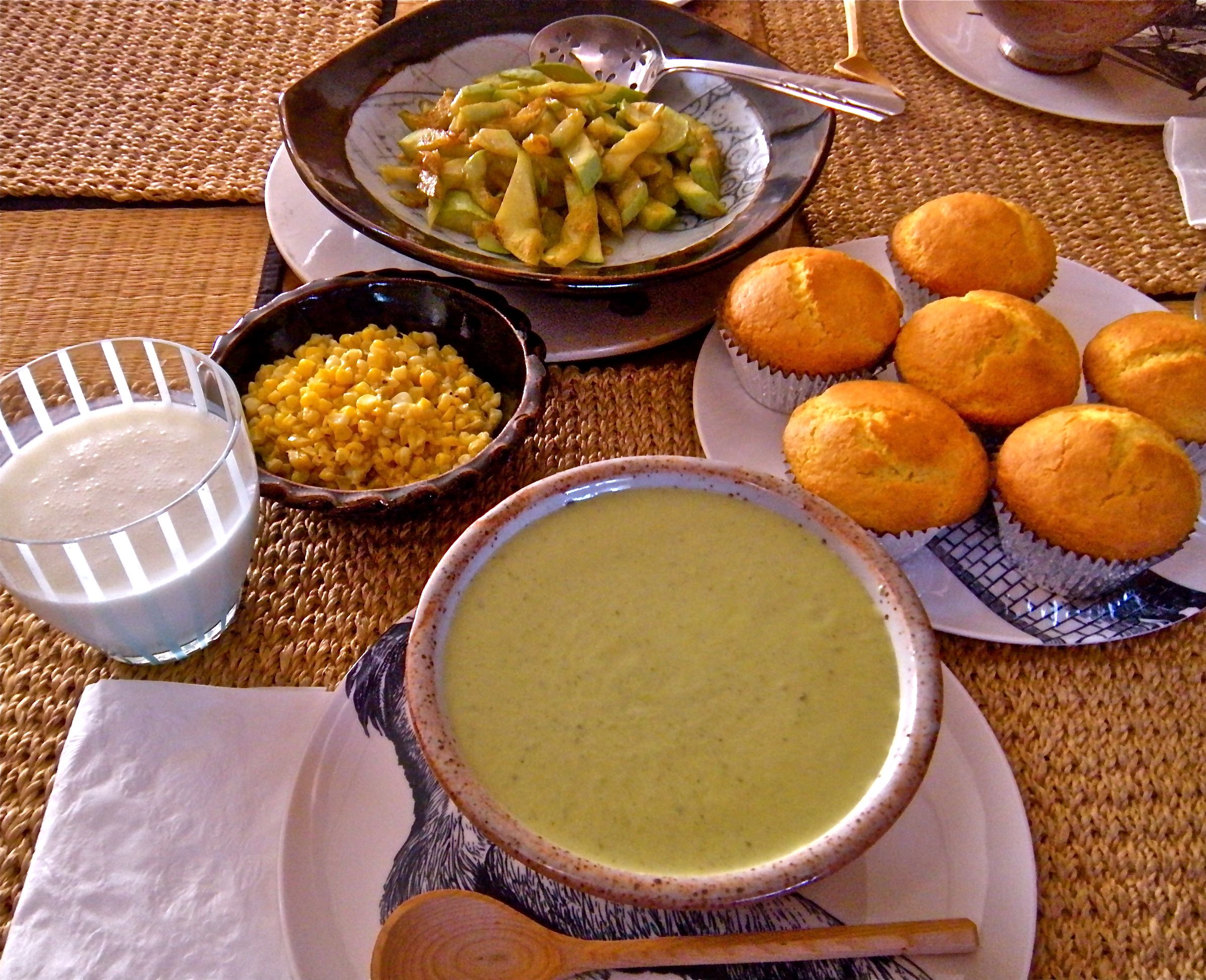
Here’s our dinner in honor of Jimmy Carter:

3 vegetables: cucumber soup, creamed corn, summer squash;

corn muffins;

and a glass of cold buttermilk!

Made from vegetables from farm stands ready to go on a Sunday afternoon at home. I noticed that it was a delicious meal, made from simple recipes whose tastes complemented each other in a soft and tasty way. Moreover, there was not a hint of obligation to be “vegetarian” – no moral tone to undercut the meal at all. It was just vegetables, cornbread and buttermilk.

I’m thinking we could do this pretty often from now on!

The only thing I might have done differently would be to make the corn muffins from scratch than from a Jiffy box. But the muffins were very quick and easy.

We raised a glass to Jimmy Carter and to his wife, Rosalynn – and hope that their days may be filled with grace whatever comes their way.