scenes of home . . .

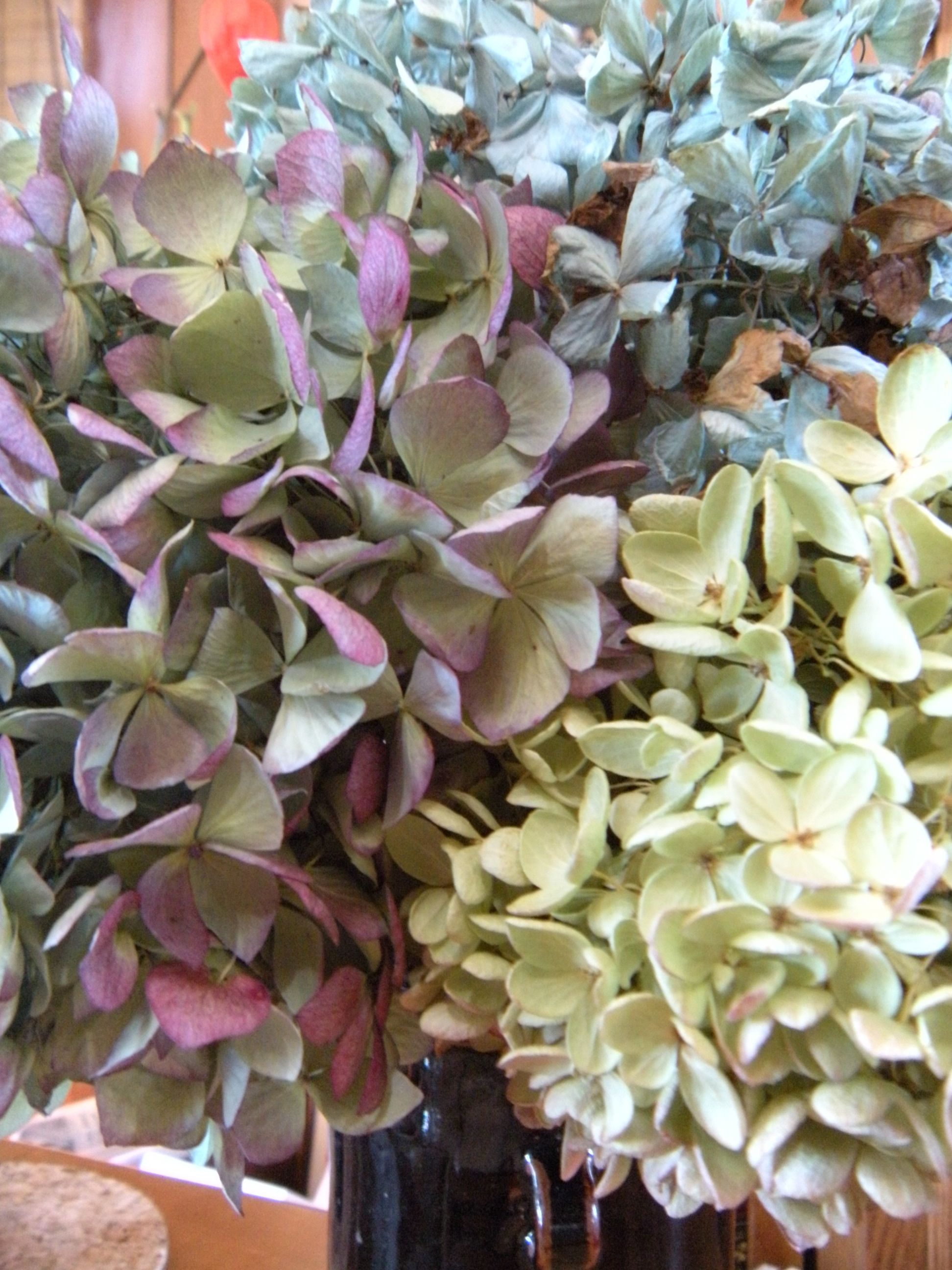


a reclaimed wood-fired soy bottle with sprigs of dill from herb planter
In the grocery store today, there was a single half napa cabbage for sale that looked pretty tired. I spied the vegetable grocery clerk and walked over to ask him if they had any more in the back. At first when I said, “hi” – he looked at me and said nothing. I said “hi” again and smiled this time. He said “hi” but looked glum. With a reluctant posture and very slow gait, he walked into the back to see if there were any more cabbages.
I waited by the door so as not to have him think I had forgotten about my request. He came out with two bedraggled cabbages and asked me which one I wanted. I asked him if he would cut one in half for me and pointed to the one that was lighter in weight. He said yes and went back to do the deed.
When he came out, I smiled at him and said, “You’re a doll,” and he smiled very briefly and said, “I wouldn’t go that far.”
Made my day!
“Do no harm” is what doctors are taught first while trying to evaluate what can be done to improve someone’s health. It is also the title of a book by Henry Marsh, one of the world’s leading neurosurgeons who practices primarily in London. In addition, he has travelled to the Ukraine for fifteen years, consulting for people of all ages including young children who have growths in their brains.
I started reading his memoir yesterday afternoon. It’s organized by types of brain maladies and operations he has performed throughout his thirty-year career. Now sixty-five, Henry Marsh is a vibrant, good-looking, albeit sometimes tired looking fellow. It turns out that after a twenty-five year old marriage that ended in divorce, he met his second wife a year later. Kate Fox is a beautiful (that’s the only word to describe her) blonde, social anthropologist who co-directs a study center in England and writes books about whether the British are really grumpy by nature or not. (Not is the answer of her study – they are just too polite.) Anyhow, their marriage and his dedication to her in the book happily punctuates this neurosurgeon’s life. He’s been lucky to have been able to succeed at a profession that is both draining and what he himself describes as a “blood sport.”
Last night, I found a documentary called “The English Surgeon” based on Marsh’s fifteen year collaborations with a determined Ukrainian doctor who sought to improve medical care in general and brain surgery in particular. It was eye-opening to observe the stark hospital environs in which Marsh and his friend inhabit and to witness the equipment that they had to use: a Bosch drill, parts of plugs that are used and thrown away by the handfuls in the UK but preserved and used for ten years in the Ukraine. Rudimentary doesn’t begin to describe the level of medical care there. It is brutally stark and a sense of hopelessness pervades the human landscape. Faces are pale and full of apprehension and worry. Many of those who come to Marsh with their X-rays are beyond help. Through his friend’s translations, over and over again, Marsh has to tell people that there is nothing an operation can do and that he cannot help them.
One woman in her thirties thought she had a virus from an insect bite. After looking at her X-Rays, they could not bring themselves to give her the bad news that she would go blind and die within two or three years because she was by herself unaccompanied by a friend or family member. They asked her to bring her mother from Moscow for a future visit before breaking the news of her fatal diagnosis to her. People milled around in the waiting room, vying to see the brain doctor from the West. One fellow, Igor, was operated on successfully while awake, anchored to the operating chair while his head was opened up with the aforementioned Bosch drill. (We had a hard time watching that part of the documentary which won an Emmy.)
Today, I’m starting to read the third chapter of Henry Marsh’s book that I began yesterday. It’s clear from the stories he relates that most of the time, the hardest decision is whether to operate or not. Recently, someone I knew from high school had radiation for brain tumors arising from Stage IV Melanoma. His brain tumors receded but as a consequence of the treatment, he was left in a permanently altered mental and psychological state. His behavior now is anti-social, impatient and deeply depressed. No longer able to drive, he is dependent upon home-aides for just about everything. His depression resulting from the radiation was labelled as “organic” – meaning that it wasn’t going to go away with anti-depressants or talk therapy. “Cures” and their after-effects versus quality of life is an endless personal debate many of us will face, whether we like it or not.
The brain is our operating dock for the movie of our lives. Reading about Henry Marsh’s experience, his failures as well as his successes is both illuminating and sobering. There’s no explanation for why tumors occur in young children or adults. If you are not afraid of learning about human suffering and what courageous people do to ameliorate it, I can recommend his book, “Do No Harm.” Two documentaries about Marsh have been made called, “Your Life in Their Hands,” and “The English Surgeon.”
As we go through our day, listening to the news, making lunch and cleaning the house, it’s helpful to acknowledge how lucky we are (so far) and to appreciate the technology and medical care we take for granted wherever we happen to live.
 Today at the end of our Seniors Strength exercise class at the YMCA, one of the members introduced his grandson (I’ll call him “Andrew”) who was visiting from Vancouver, B.C. A year ago, this trim looking fellow weighed 323 pounds, his grandfather said, relating that out of 1000 applicants, he was chosen as one of the 20 contestants for the reality show, “The Biggest Loser” which began in May of 2014.
He managed to stay on the show for six months (the winner’s pot was $1M) but was cut three months from the end of last year’s series. It turns out that there was a consolation prize for those who were eliminated who lost the most weight at home by the final viewing of the show. And guess what, Andrew did just that, weighing in at 181 pounds and winning $100,000 which was no small chunk of change either.
When asked what motivated him and kept him on track, he said it was the pending birth of his son (born in October, 2014) and living long enough to see him graduate from school and to have children of his own someday. Andrew described how he learned to cook his own food on the reality show, making up shopping lists, and providing his own meals in addition to exercise and training. Now, he cooks all his meals for the week on Sunday so that he doesn’t get tempted to stray during the week.
As has been reported recently in other news briefs, what you eat and how much less you eat is the biggest factor in weight loss, much more so than exercise. Perhaps even as high as an 80-20 percentage (eating better to exercise.) He also said that when you snack on an apple, to add some protein to it so that the glucose spike and drop doesn’t occur as sharply as it might with just fruit alone.
When he got home, he emptied out his pantry and lost enough weight to win the runner-up prize three months later. He gave one metaphor for what to eat: which was if you’re stranded on a desert island, you would eat four kinds of food: fish, vegetables, nuts and fruits. That about sums it up.
What I found most interesting about the visit by Andrew was the discussion about personalized motivation. My husband’s mother is 96 going on 97 in October. Despite falling, eye problems and taking about 16 different medications every day, she is determined to live long enough so that her son, J., doesn’t have to retire prematurely (forfeiting part of his pension) in order to take care of her. They live in the same house across the street from us and J., my husband’s younger brother who never married, enjoys taking care of his mother in her old age. Without his care, she might be living in a nursing home by now. He has sixteen weeks to go before he retires with a full pension. You can bet she’ll be around to see that happen too, four months from now when she turns 97!
So, if you want to be healthier for the sake of your children and your own health, that’s a strong motivator. If you want to stay alive long enough so that others aren’t penalized for taking care of you, that’s another. For myself, I think I would like to have a healthy life with few physical ailments and see my children get to the age I am now and see how their lives turn out.
And more than that, I’d like to stick around long enough to be able to keep taking care of my dear husband, G., and myself as long as I can. Now is the best time to start, whatever age we might be.
Rather than forcing ourselves with abstract goals (lose weight, get healthier) identifying personalized goals can give us a sense of meaning. Which makes all the difference, don’t you think?

Do you remember that children’s story, Goldilocks and the Three Bears? When she tried out the furniture in the house, one chair was too big, another was too small and the third one was “just right.” That’s how my quest for an ideal way to eat has gone: first, the Paleo diet with high protein and vegetables by Mark Hyman was “too big” because it allowed lots of luxury foodie type foods. Then, Joel Fuhrman’s strict diet of a vegan, all vegetables and no animal protein was, well, “too small” in the sense that it was so austere, it soon became hard to stick with. Plus, I noticed that the glossy sheen of my hair had disappeared and looked dry and dull instead after only a week of no eggs and butter.
What to do? I decided to add back a little protein especially since I missed farm fresh organic eggs and turkey bacon for breakfast. Fresh caught grey or dover sole may be my favorite dinner so I added that back in. I haven’t really craved other meats like beef, lamb or veal nor even chicken of late. Fresh fish and organic eggs plus some nice sliced prosciutto or ham for lunch was enough savory protein to balance out a high vegetable content diet. This past week, eating like this felt “just right.”
Imagine my surprise when I searched online how to reconcile the Hyman Paleo and Fuhrman Vegan diets, only to find articles about a “Pegan” diet! Yep, it’s a combo of a little protein combined with a primarily vegetarian approach to food with the addbacks of eggs and fish.
So, without knowing it, this compromise between a rather rich diet (Paleo) with the very rigid diet (Vegan,) it seems that the old adage, “the best of both worlds” has now been blessed by the diet gurus. Meanwhile, I kind of groped my way here because of how my hair had dulled and my preference for a high protein breakfast rather than a fruit one. I’m not really sure how much fruit is really allowed anyhow when trying to lower one’s blood glucose level. A handful of fresh blueberries after dinner seems like a middle-of-the-road way to go between the two extremes.
Settling into a routine of smaller portions overall and drawing from a prudent combo of eggs, butter, fish (animal protein) plus cruciferous (broccoli) and green leafy vegetables (kale, chard, spinach, collard greens) with small helpings of berries, nuts and seeds might be a “pegan” approach to eating healthy for us. I guess the only thing to do is to wait and see.
Here’s a scrumptious looking cookbook for superfood snacks such as “chocolate mint truffles” and “pomegranate salsa.”
http://www.amazon.com/Superfood-Snacks-Delici…/…/ref=sr_1_1…
Also found an eggplant color mini-muffin pan on Amazon to make non-gluten, low sugar bites of zucchini-carrot-golden raisins, pumpkin gingerbread or fresh corn.
Who knew that getting healthy could be this much fun?
P.S. and here’s a photo of flowers from our Japanese tree peony which is almost twenty years that grew from a $3. plant from Spag’s here in town.


Sometimes I find myself going whole-hog to do something and then read something which stops me in my tracks. Then, it’s time to change the original plan. Talk about change being the only constant in the Universe!
In my reading about how to lower blood sugar levels FAST, I first read Mark Hyman’s “Blood Sugar Solution” book with a claim that he was a consultant to Bill Clinton. His regimen was basically a stricter Paleo diet: protein for breakfast, salads and greens, a 1-3 ratio of protein to green leafy vegetables for dinner. Two snacks of nuts, seeds or something low-glycemic. No problem! I diligently made a table of what to avoid and what to eat with sample breakfast, lunch and dinner menus which I put on the fridge as a guideline.
I forgot that I had also ordered a used copy of Joel Fuhrman’s book, “The End of Diabetes.” It arrived yesterday and I almost didn’t want to read more after immersing myself in Hyman’s books last week. But when I picked up Fuhrman’s book, he gave case histories with actual numbers and DATA of people whose blood sugar readings plummeted after a WEEK, and significant weight loss within weeks and months! One 80-year old woman’s weight went from 148 to 110 over a few months. After ten days, she was taken off insulin, something she had used for twenty years! A fellow weighing 268 pounds lost 16 pounds in two weeks and was off insulin and medication in five months after losing sixty pounds! Numbers and data are compelling, aren’t they? So there was no stopping me from reading about his diet regimen which departs radically from a modified paleo diet (which afforded all sorts of luxuries as a foodie.)
“The End of Diabetes” is achieved by eating vegetables. That’s it. Fuhrman makes the argument and shows data that vegetable protein (who knew?) was just as healthy as animal protein. The most drastic weight loss and glucose drops occurred in people who followed his “nutritarian” diet: cruciferous vegetables (broccoli, kale, collard greens, etc.) non-starchy vegetables (tomatoes, eggplant, artichokes, avocadoes, lettuces, watercress); low-sugar fruit light portions: melons and berries; an ounce of nuts and seeds daily, and you can eat all the raw vegetables you want. THREE meals a day, NO SNACKS, especially after dinner. Because blood sugar is highest in the morning, he advises that you eat a very light breakfast of fruit or lightly cooked VEGETABLES! I also read that drinking an ounce of pomegranate juice lowered atherosclerosis and reduced artery plaque over the course of a year!
After I read the book, I tore up the first table I had so carefully constructed and devised a different way to approach my health. Mainly, I wanted to make a substantive effort (lose weight, lower readings, feel better, be more active) that would correct and reset my well-being meter once and for all.
So, yesterday for breakfast, I had a piece of tofu cut into cubes with a little oyster sauce dabbed on top of it. Delicious and satisfying! I boiled up a cup of frozen edamame soy beans from Trader Joe’s and ate them alongside. Instead of coffee for awhile, I’m sipping mugs of boiled water poured over a fresh lemon wedge. Poured a half glass of pomegranate juice to take my supplements with.
Last night for dinner, G. and I weren’t very hungry after having some nibbles at a recital that we went to in the afternoon. Plus, I had cheated by eating some Medjool date halves stuffed with Boursin cheese (a scrumptions combo of sweet and salty.) When I got home, I read that dates are low-glycemic fruit and okay to eat which was a relief. So for our evening meal, we sliced up a half of a ripe cantaloupe and ate the melon with handfuls of fresh blueberries, raspberries and dry roasted almonds. It was satisfying and refreshing. We also didn’t feel hungry afterwards and felt lighter this morning when we woke up.
Since I love to cook, I’m thinking of dishes to make that are appetizing that fit into the “nutritarian” guidelines. It’s hard, I’ve found, to eat other people’s recipes for very long. So far, I’ve come up with fresh spinach stuffed portabello mushrooms; cabbage, apple and walnut salad with a creamy macadamia salad dressing; eggplant parm without the ricotta, using fine gluten-free panko crumbs (yes!); spiraled zucchini “noodles” with shrimp scampi; vegetable soups made with onions, carrots, celery, cabbage and stewed tomatoes similar to macrobiotic recipes I’ve made in the past. I bought some Mrs. Dash’s seasoning that contains no salt and put my Maldon sea salt and Lawry’s garlic salt away.
I’ve also visualized the difference between eating the old way and the new way. In the former, a body is warm or (very) hot in the sense that all of our organs are being fed too much rich, heavy food all the time so that one’s physical infrastructure (organs, blood vessels, nerves, glands and muscles must work hard to process full tilt on an ongoing basis – like an engine that’s revved up and going 80 miles an hour, driving on highways all day long.
With vegetables, your liver, pancreas and your endocrine system go on vacation, so to speak, because they’re not asked to do so much. Your engine is idling in the driveway or just cruising down a shady lane at 20 miles an hour. So when your body system is cooled off from all that over-exertion, and then you add some exercise, such as brisk walking or going up and down flights of stairs, it gets your heart pumping and the cooled body is flushed out by more oxygen going through your pipes (and arteries.) Anyhow, that’s how I’ve imagined it to myself. Makes sense to me, at least and an added incentive to “cool things down.” Is that what they mean when they say, “chill out!”?
The only trouble with having so much more energy is that I don’t know what to do first today: take my walk, hang out the sheets on the clothesline, start picking up and vacuuming, clean out the freezer and pantry or cut up the strawberries and rhubarb to make a compote that I can eat for breakfast or lunch later.
Maybe I’ll pace myself and read some of the New York Times newspaper first. The Universe is taking good care of things (including Helpers) and it’s good to remember we can also give ourselves a break, to smile and to enjoy the day. Especially on a Sunday morning! Here’s to enjoying the day!
So this morning, I pulled out a couple of paperbacks in my library on Taoism: “The Wisdom of the Taoists” by D. Howard Smith and “The Elements of Taoism” by Martin Palmer. Once again, as always happens, we, the reader, are told over and over again how Taoism cannot be put into words while reading words by people trying to explain it to us. It happens every time and it always amuses me no end.
At the same time, there are differences explained between Confucianism and Taoism which for me delineate the difference between choosing to live your life according to what you think OTHERS’S expectations or “shoulds” rule your life (Confucianism) or for your spirit inside to align with a larger Universe (the Tao) and to pursue your life in alignment with your inner truth (Taoism.) That might be a glib way to explain the differences but at least, it illustrates how vastly different these two philosophies of life can be.
There were pencil notes in the texts that I had written years ago, including a reminder of a quotation that I saw on the wall in a calligraphic script when I woke up one morning. It was not a hallucination so much as it was a vision that I remember clearly in a large calligraphic font on the bedroom wall:
“The more we are at One, the more we are All One.”
Now if that isn’t an axiom of Taoist one-ness, I don’t know what is. In my life, especially in times of hardship, I have experienced alignment with a Universe which was invisibly beneficent. I didn’t feel threatened by it and I trusted in its goodness to support the unknown in a positive way. So many seemingly insoluble circumstances in my past (bankruptcy, divorce, joblessness) smoothed themselves out masterminded by Helpers from the Universe. Truly, I could not understand otherwise and it has borne itself out in my life ever since. Which brings me to “wu-wei”
In its simplest definition, “wu-wei” describes a state of non-doing and going with the flow, trusting that the unknown is meant to be and that we are less wise than it is in dealing with anything more than the present moment. Without a trust in the Universe, whether it be in the form of an all knowing Sage, or God, or Almighty, it feels impossible to let go and subscribe to trying something like “wu-wei”. Although it’s hard to do, it’s also really hard NOT to do if one goes through life thinking you can control events and everyone around you. Here in America, we live in a culture that promotes the idea that we are invincible and will overcome if we just try hard enough. That’s not “wu-wei” though.
Everyone is different and that’s why there is no one formula about how to be happy or how to be enlightened even if we could wrap our heads around it. The only knowledge that we may have of someone is that we don’t know much about who they are inside deep down, unless of course they decide to tell us or to talk about it with us. So, given that we don’t know and really can’t know much about all of the people or circumstances that we are trying to react to, marshal or get things done with everyday, no wonder we get worn out. That’s where “wu-wei” provides an alternative reality to live with, within ourselves.
Here’s a short excerpt about “wu-wei” from Wikipedia:
To follow Wu Wei you must first let go of struggle. Stop fighting with life and trying to make things happen. You are struggling against the flow. You must first realize that you can give this up. Then it is the case that you act, you are not passive – merely waiting for things to happen, but you are no longer opposing the flow of events. Instead, you act, but let go into the uncertainty of life, and you see how life actually occurs. You become open to the mystery of which you are part. In a sense it is total acceptance of yourself and this moment. Of course, it is necessary to practice this. While the way is not of time, and we can be there in an instant, practice connects us to this place over time. Through practice the way reveals itself. Only through practice can this truth be revealed.
“Wu-wei” takes care of that enormous expenditure of energy, expectation and sturm and drang from our lives.
The Walt Disney movie, “Let it Go” is popular not just for the freeing storyline of girls being able to rescue themselves rather than relying on males to do it for us, but it also exhorts all of us to “let it go” –release ourselves from the Confucian dogma of what everybody else wants from us or expects us to be. How about that, huh? “Let It Go” being a Taoist mandate to free yourself from the inside out? I’ll bet nobody at Disney was thinking about that message when they made the movie, but hey, it’s not far from what they’re actually encouraging lots of little girls to do. And perhaps some grown-up girls too.
Maybe the rest of us can take heart that as we age, even though there’s less and less influence that we seem to have on our children as they spread their wings, asserting themselves inwardly and outwardly, we can know that the Universe is there for all of us. So, why struggle? Why not float along in a life with “wu-wei”, going with the flow knowing that there’s more in store for us that we can’t know. And that change is the only thing that is constant. So, why worry?
Now, I think I’ll go and make cheeseburger sliders on snowflake rolls with chopped onion for lunch on Super Bowl Sunday. Whatever happens at the big game, I’ll bet that it won’t be predictable, not with all the hoopla over Deflate-Gate or whether it’s actually a Deflate-Gate-Gate? Maybe It’s a good time to practice some “wu-wei” about the outcome, right? See you later!
Sometimes, it feels like we are charging around trying to do as much as possible in a limited amount of time. Yesterday, my daughter C. and I had a dim sum lunch (her birthday treat) and we went window shopping at a handful of stores that we like to browse in afterwards.
After the surfeit of Christmas gifts, our browsing was short-lived in a couple of shops. And so we headed to Starbucks for a hot drink before parting ways and going home.
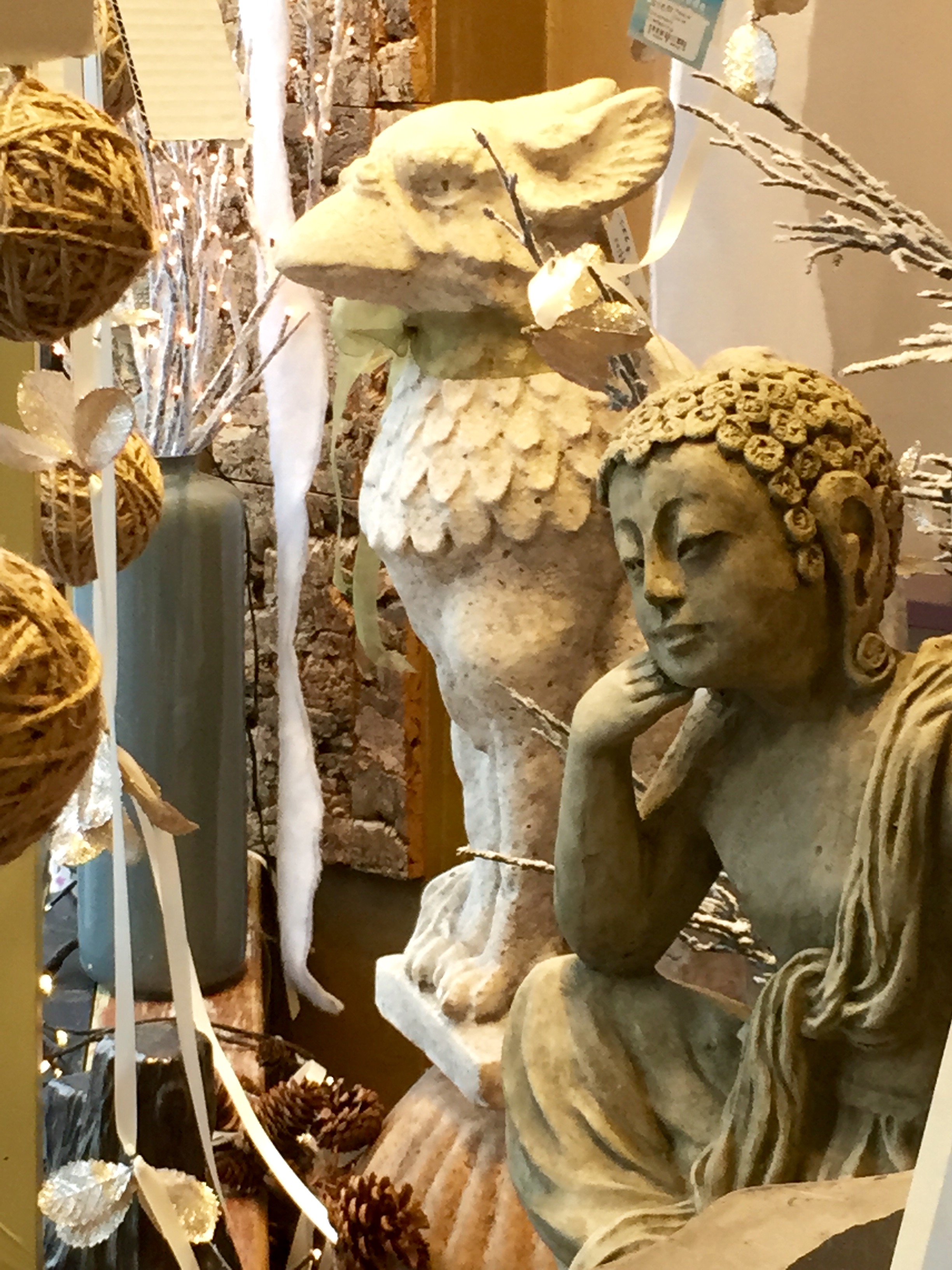
Derby Farm is a favorite store across the street from Starbucks and we decided to peek in because there was a large “SALE” sign in the window. I spied a large griffin statuary that reminded me of a number of gargoyle pieces that we have scattered in our yard that we purchased almost twenty years ago. This griffin reminded me of ones that you might see guarding the Notre Dame in Paris. I was momentarily tempted but it wouldn’t survive outside during the freeze/thaw of our winter months here in New England, and it was way too big to put anywhere inside the house.
Last night, C. sent me a snapshot of the griffin that she had taken with her phone as a memento of our day out together. Right away, my eye caught the peaceful smile on the buddha seated beside the proud griffin. The coiled curls on the Buddha’s head and especially the boldness of his ears also won me over. In Asian cultures and especially for the Chinese, the shape of the ears called “Buddha Ears” is significant because well-shaped ears like this signify an awareness for and ability to listen to everything. Take a look around at people’s ears sometime and you’ll see how greatly they vary in shape and how only a few are delineated as boldly as those on Buddha statues.
Because there was a 20% storewide sale that the shopkeeper mentioned aloud yesterday when we were in the store, I phoned to ask how much the Buddha might cost. Turned out that it was very affordable and I purchased it on the spot. This weekend, I’ll drive into town to pick it up.
This year on February 19th, the Chinese year is represented by “green, wooden sheep”. It seems to forecast a calm year and I am looking forward to it after such a tumultuous one last year.
Now, we have a peaceful Buddha to grace our home as well. Thanks to Serendipity and to C. for taking the photo and sending it along!
 mulberryshoots