mulberryshoots

"Tell me, what is it you plan to do with your one wild and precious life?" ~ Mary Oliver

after the (big) game . . .

drink

This morning, I made an almond-banana smoothie for breakfast.

Martha Rose Schulman’s recipe includes a frozen banana, flax seeds, some almond butter, a drop of almond extract and a splash of cold buttermilk. Refreshing.

Here’s the best joke I’ve come across online about the Super Bowl this weekend:

Reporter to Pete Carroll:

“Hey, Pete, would you like to win the Super Bowl?” Pete: “No thanks, I think I’ll pass.”

The Patriots landed at Logan Airport and the celebratory Duck Boats parade is scheduled today despite snow removal and public transportation issues in Boston. Fingers crossed that all will go well.

The snow continued yesterday and the temperature is below zero this morning as I write this post.

Hope it warms up a little soon.


Secretariat and the Super Bowl . . .

DSCN4930While waiting for the Super Bowl hype shows to blow over, I came upon a movie playing on TV in the afternoon, “Secretariat” starring Diane Lane and John Malkovitch as the trainer who she believed in, even if he didn’t believe in himself. It’s a tale of long odds, if you’ve seen this film: Penny Tweedy takes over her ailing father’s thoroughbred breeding farm and wins Secretariat as a colt in a coin toss by default. Her father dies and her husband plus brother connive to sell Secretariat to pay death taxes on the farm. She refuses, deciding to syndicate Secretariat’s breeding rights ($190,000) to thirty-two other owners, all of whom refuse her until the most prestigious owner of all, who gave up the colt at the coin toss (yes, it’s all true) decides to be the first to sign up. The others follow and Secretariat promptly loses his first big race due to an abcessed tooth.

Secretariat goes on to win the Triple Crown, the first time in 25 years, setting track records in EACH race that are still standing. It’s truly an amazing story. That it actually happened is sports history.

So, now we are down to watching the Super Bowl game and to see if this much maligned team can win their first Super bowl game in ten years. Yes, they’ve won divisional championships. Yes, they’ve gone to the Super Bowl in between years and lost, sometimes ignominiously (like the time Brady fouled in the first play of the game the last time.)

The Seahawks are defending their Super Bowl win last year. There’s been so much hype about the two coaches, Bill Belichick and Pete Carroll, both of whom have coached for the Patriots and Bob Kraft. And both, it turns out, are part-Croatian! Who knew? Plus they’re supposed to be crafty coaches with sophisticated knowledge of the rules so that they know what they can try even though nobody else may have.

Well, here we are. I’m finishing this post at 11:16 p.m. after a Super Bowl win by the Patriots that will go down with the ages as one of the most unbelievably tight and suspenseful victories of almost all time. After all, who could make up a last minute interception over the goal line by Malcolm Butler, a rookie from Alabama playing his first Super Bowl game? In his interview afterwards, he was asked about the three-bobble catch that the Seahawks made improbably while the guy was on his back and the ball was still bouncing around in the air. Butler said he thought he felt that because he didn’t prevent that catch, that he might be responsible for losing the game–and that he HAD to do something during the next play: which he did, by intercepting the ball in the Seahawk’s endzone.  The last 30 seconds of the game were the longest ones ever after Butler’s interception: a half yard from the goal-line moved five yards out due to a penalty, then fifteen yards out due to fighting by a Seahawk who was ejected from the game for unnecessary roughing.

It was amazing. Chris Collinsworth, the most urbane of all TV sportscasters put together was sputtering through the last two minutes of the game. He kept saying, “I can’t believe this!” And the rest of us couldn’t either. What a relief! I’m glad that I was “wu-wei-ing” it throughout the game. In fact, I threw the I-Ching when the Pats were down in the fourth quarter and it felt like all was lost. It predicted that the Patriots would indeed win the Super Bowl in the end after a few hitches. And what an ending!

This Patriots Super Bowl victory was as unpredictable as Secretariat’s winning of the Triple Crown years ago with a thirty length win over the second horse at Belmont stakes. Big risks, a lot on the line and winning at the finish line–making exceptional sports history for a long time to come.

Bravo! Whew! I’m going to bed!


“wu-wei” baby! . . .

truro photo for duvet cover

So this morning, I pulled out a couple of paperbacks in my library on Taoism: “The Wisdom of the Taoists” by D. Howard Smith and “The Elements of Taoism” by Martin Palmer. Once again, as always happens, we, the reader, are told over and over again how Taoism cannot be put into words while reading words by people trying to explain it to us. It happens every time and it always amuses me no end.

At the same time, there are differences explained between Confucianism and Taoism which for me delineate the difference between choosing to live your life according to what you think OTHERS’S expectations or “shoulds” rule your life (Confucianism) or for your spirit inside to align with a larger Universe (the Tao) and to pursue your life in alignment with your inner truth (Taoism.) That might be a glib way to explain the differences but at least, it illustrates how vastly different these two philosophies of life can be.

There were pencil notes in the texts that I had written years ago, including a reminder of a quotation that I saw on the wall in a calligraphic script when I woke up one morning. It was not a hallucination so much as it was a vision that I remember clearly in a large calligraphic font on the bedroom wall:

                                                    “The more we are at One, the more we are All One.”

Now if that isn’t an axiom of Taoist one-ness, I don’t know what is. In my life, especially in times of hardship, I have experienced alignment with a Universe which was invisibly beneficent. I didn’t feel threatened by it and I trusted in its goodness to support the unknown in a positive way. So many seemingly insoluble circumstances in my past (bankruptcy, divorce, joblessness) smoothed themselves out masterminded by Helpers from the Universe. Truly, I could not understand otherwise and it has borne itself out in my life ever since. Which brings me to “wu-wei”

In its simplest definition, “wu-wei” describes a state of non-doing and going with the flow, trusting that the unknown is meant to be and that we are less wise than it is in dealing with anything more than the present moment. Without a trust in the Universe, whether it be in the form of an all knowing Sage, or God, or Almighty, it feels impossible to let go and subscribe to trying something like “wu-wei”. Although it’s hard to do, it’s also really hard NOT to do if one goes through life thinking you can control events and everyone around you. Here in America, we live in a culture that promotes the idea that we are invincible and will overcome if we just try hard enough. That’s not “wu-wei” though.

Everyone is different and that’s why there is no one formula about how to be happy or how to be enlightened even if we could wrap our heads around it. The only knowledge that we may have of someone is that we don’t know much about who they are inside deep down, unless of course they decide to tell us or to talk about it with us. So, given that we don’t know and really can’t know much about all of the people or circumstances that we are trying to react to, marshal or get things done with everyday, no wonder we get worn out. That’s where “wu-wei” provides an alternative reality to live with, within ourselves.

Here’s a short excerpt about “wu-wei” from Wikipedia:

To follow Wu Wei you must first let go of struggle. Stop fighting with life and trying to make things happen. You are struggling against the flow. You must first realize that you can give this up. Then it is the case that you act, you are not passive – merely waiting for things to happen, but you are no longer opposing the flow of events. Instead, you act, but let go into the uncertainty of life, and you see how life actually occurs. You become open to the mystery of which you are part. In a sense it is total acceptance of yourself and this moment. Of course, it is necessary to practice this. While the way is not of time, and we can be there in an instant, practice connects us to this place over time. Through practice the way reveals itself. Only through practice can this truth be revealed.

“Wu-wei” takes care of that enormous expenditure of energy, expectation and sturm and drang from our lives.

The Walt Disney movie, “Let it Go” is popular not just for the freeing storyline of girls being able to rescue themselves rather than relying on males to do it for us, but it also exhorts all of us to “let it go” –release ourselves from the Confucian dogma of what everybody else wants from us or expects us to be. How about that, huh? “Let It Go” being a Taoist mandate to free yourself from the inside out? I’ll bet nobody at Disney was thinking about that message when they made the movie, but hey, it’s not far from what they’re actually encouraging lots of little girls to do. And perhaps some grown-up girls too.

Maybe the rest of us can take heart that as we age, even though there’s less and less influence that we seem to have on our children as they spread their wings, asserting themselves inwardly and outwardly, we can know that the Universe is there for all of us. So, why struggle? Why not float along in a life with “wu-wei”, going with the flow knowing that there’s more in store for us that we can’t know. And that change is the only thing that is constant. So, why worry?

Now, I think I’ll go and make cheeseburger sliders on snowflake rolls with chopped onion for lunch on Super Bowl Sunday. Whatever happens at the big game, I’ll bet that it won’t be predictable, not with all the hoopla over Deflate-Gate or whether it’s actually a Deflate-Gate-Gate? Maybe It’s a good time to practice some “wu-wei” about the outcome, right? See you later!


roses . . .

yellow roses

We’re having our first deep snow today. We count ourselves lucky because it’s almost the end of January, only about two months from the first day of Spring in March! G. went out and tested the snow to see whether it was heavy with moisture or whether the snowblower might be able to handle it.

For my part, I like to make a big pot of soup when there’s snow hurling itself to the ground outside. I couldn’t find a shin of beef yesterday to make a hearty beef-vegetable soup with carrots, onions and stewed tomatoes in a beef stock. Instead, I picked up a nice slice of ham which I will cut up and brown with some sweet onion and carrots, adding in dried green peas that soaked overnight. A chicken stock will simmer the ingredients to which I’ll add a bay leaf and a couple of whole cloves stuck into some chunks of onion, careful to simmer on low heat to keep the soup from burning.

Along with the ham and pea soup which I’ll puree in the Vitamix, removing the ham bits and adding them back in, I’m planning to make grilled Reuben sandwiches. On slices of dark pumpernickel bread, I’ll layer sliced corned beef, rinsed and dried sauerkraut, swiss cheese, a layer of Russian dressing made by combining ketchup and Hellmann’s mayonnaise with pickle relish, more corned beef and shredded cheese. On a stove-top grill pan, the buttered pumpernickel sandwiches will be slowly cooked with a weight (partially filled teakettle on paper towel) turned over and cooked until crispy, then sliced in half.

Seems like this would be a great supper to have if the Super Bowl were being played this weekend. We live in Massachusetts and find unfortunately, that we’ll have to go through another week dragging the Patriots through the mud before we can watch the game and then wait for the Roger Goodell shoe to drop. Seems rather partisan to drag it out for so long, don’t you think? Partisan for those who hate winners and want to besmirch reputations. What’s the name of that coach in Baltimore again? The Ravens coach who blew the whistle about under-inflated balls even before the Colts game last week?  We’ll see what happens. But I still hope the Patriots will beat the Seahawks next week. If they do carry it off, they’ll have proven that being in this crucible of public outcry won’t stop them from winning.

I’ll just have to think some more about what to cook for supper to watch the Super Bowl next week.

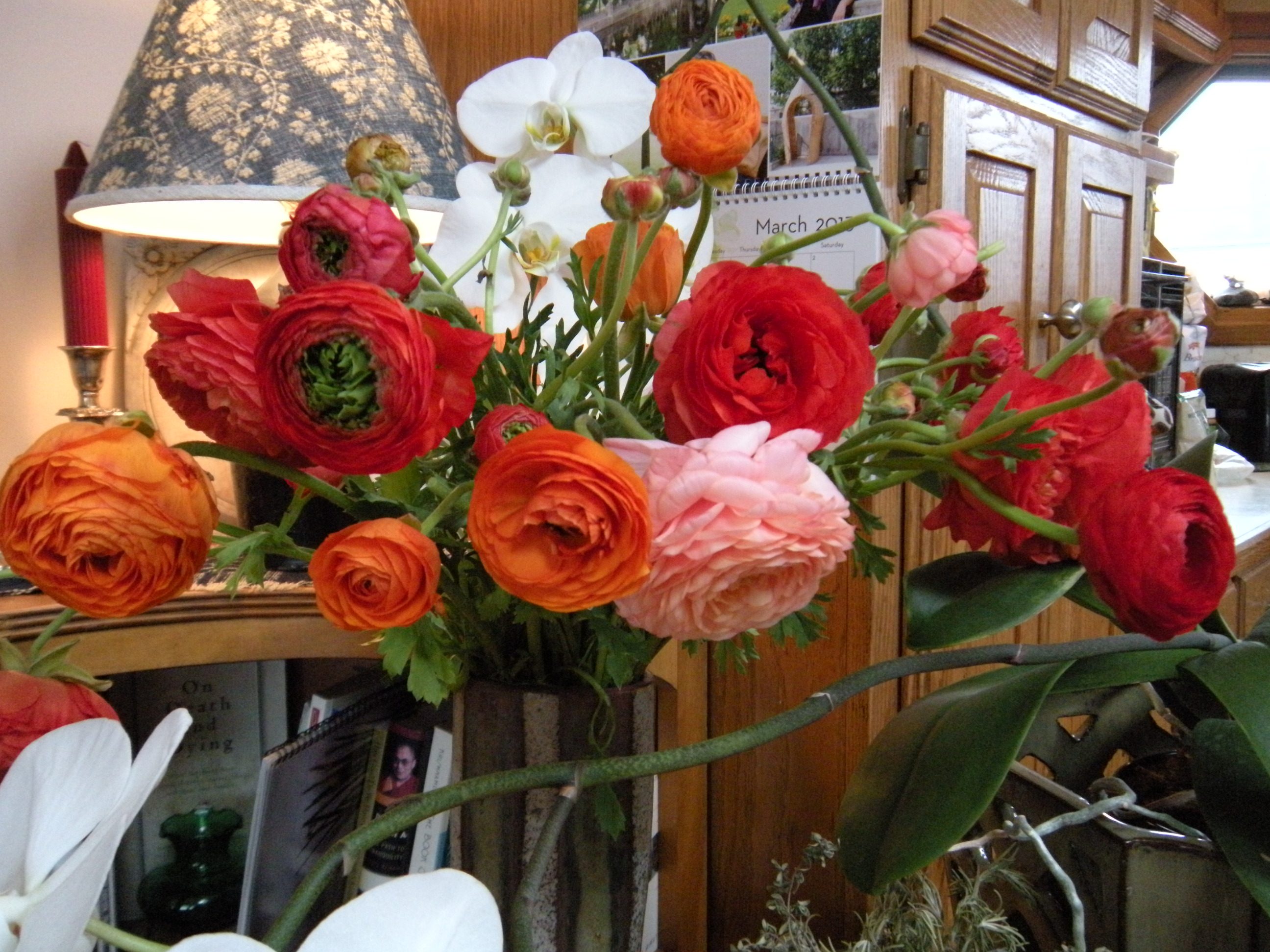
Oh, and I almost forgot to mention the sweet bouquet of long-stemmed roses that my husband brought home last night for no reason. That’s the best kind of surprise and the most touching.

Heck, I even put on my parka, scarf, boots and hat  this morning to clear off snow from the front stoop and to provide more space for our vehicles to move freely about the driveway.

One surprise deserves another, right?


posterity and the moment. . .

IM000281_2If you have had a chance to read my recent posts about being in the here and now, you will have gathered that according to Buddhist ideas, there is only happiness within, found in a present moment. In the past few days, I’ve gathered more books from the library about happiness-Buddhism-Asian thought and am struck by how often numbers play a role in scaling the sheer wall of enlightenment (although it’s not supposed to be linear, remember?)

One book by Thich Nhat Hanh, “The Heart of the Buddha’s Teaching” presents us with a dizzying number of things to understand and follow:

– “the twelve turnings of the wheel”

-“the noble eightfold path”

-“the three Dharma seals”

-“the three doors of liberation”

-“the three bodies of Buddha”

-“the three jewels”

-“the five aggregates”

-“”the five powers”

-“the six Paramits”

-“The seven factors of awakening”

“the twelve links of interdependent co-arising”

Honestly, I couldn’t read it after awhile.

Then I took out Deepak Chopra’s book from the library entitled “The Ultimate Happiness Prescription – 7 keys to joy and enlightenment.” At the end of each chapter, Chopra includes a reminder entitled: “To activate the (Sixth) key in everyday life, I promise myself to do the following.” This format and approach seemed like an ultra-linear approach to seeking happiness by following seven steps.

Finally, I took out what appeared to be the most readable book of all, a book of Zen koans called, “One Hand Clapping.” Laid out like colorfully illustrated Aesop’s Fables, I could glean some understanding of the oftentimes inchoate-seeming world of Asian philosophy.

So, there you go: from the myriad multiple-ness of innumerable tenets and a seven-step rather than a twelve-step (alcoholics anonymous) recipe or prescription for happiness, we land onto some koans that illustrate how to listen to one-hand clapping.

I am not making fun of Buddhism. I am just describing the observations that I’ve had trying to see the forest for the trees as I try to make my way out of the woods of so many numbered items having to do with happiness or enlightenment. It is mind-boggling.

Despite this, I have experienced something in the last few days by being ONLY present in the moment, not allowing myself to be seduced into thinking about the past NOR worrying about the future. What looked like a steep precipice of “what-ifs” turned out to be nothing at all, especially since everything having to do with the outcome was out of my hands. I could do nothing about it but to wait. And it was the quality of the waiting that had transformed into equanimity: I waited not in obsessive worry which is what I might have done before, but behaved in an accommodating and calm manner. It was transformative.

I’ve also been thinking about old age and posterity a lot. I don’t know what made me think of it but it occurred to me recently that people usually don’t get a chance to see their children in old age. It’s usually just the other way around: children get to see their parents grow old but we parents usually don’t get to see our kids in their seventies–not unless we live beyond our early nineties.

So, with the march of time, parents die usually when their children are middle-aged or approaching their sixties. Not often are parents still living when their children reach seventy and beyond. So, there’s usually not much chance to take care of our kids when they’ve gotten to be as old as we are now, the way that they take care of us now. See what I mean?

You may not think this to be a very interesting observation. But the truth of the matter is that as my daughter takes care of me by writing emails to me in the morning before she leaves for school to teach her classes, stays in touch with me when she is away on trips by sending me photos or by our mutual taking care of each other by sharing socks, down vests and jewelry that we both enjoy; I probably won’t be around when she’s reached my age. I hope that the younger generation of nieces will be as thoughtful and tender towards her as she is to me now.

In any case, how is this all related?

I’ve learned how to be in the moment, breaking old patterns of worry about the future and consciously avoiding a pointless waste of psychic energy worrying about things outside of my control. So all that reading had to do some good, right?

Second, I realized that what is most precious appears in very small things: daily emails, a shared photo or two, a pair of socks. These are moments of happiness, guys. That’s right. It’s that simple.


drinking a cool glass of water, today. . .

glass of cool water today

A book arrived yesterday (on Sunday) that I ordered from Amazon.com. It’s called “The Buddha’s Way of Happiness – healing sorrow, transforming negative emotion and finding well-being in the present moment” by Thomas Bien, Ph.D. As touted on the back and inside front pages, it is a book that makes accessible concepts that appear to be double-speak from other writers. Mostly, Thomas Bien talks about happiness and why it is so elusive to many of us. It’s because we are used to thinking about it as our American forefathers have prescribed as an unalienable right: “the pursuit of happiness.”

The author points out that right from the get-go, we are inculcated with the idea that the PURSUIT of happiness is our cultural and Democratic right. The word “pursuit” puts this constant activity OUTSIDE ourselves, striving to achieve certain goals; to dedicate one’s life to achieving one’s profession, to maintain a certain standard of living; craving for material goods along the way: the perfect wedding; clothes, jewelry, the perfect house; certain friends, emulation and applause from those who mean the most to us. And if we are not close or getting closer to achieving that kind of success, we are unhappy. Right?

It turns out that the “American Dream” is ALL about the Pursuit of Happiness.

So here’s the Eastern flip side to achieving happiness. It’s so incredibly different in its perspective that it’s sometimes hard to begin wrapping our heads around this other point of view. I’ve made numerous tries to understand the importance of meditation, stillness and the benefits thereof. But up to now, I haven’t gotten much farther than looking through the window of this approach to happiness and spirituality.

Thomas Bien, the author of this eminently readable book, relates that he thinks that God has hidden the source of happiness in the hardest place in the world for us to find. He has placed this source of happiness INSIDE OURSELVES. Rather than looking EVERYWHERE OUTSIDE ourselves for happiness: tasty food and drink, witty company, social standing, beautiful clothes, a luxury car to drive home in– the reservoir of happiness lies WITHIN ourselves.

Okay, so what? Here’s so what: the only moment in which you (or I or anyone else) can feel happiness is in the present moment. I’ve heard and read this a thousand times but have actually begun to comprehend what this means with the example that Thomas Bien gave in this book: and that is that you can’t physically drink a glass of cool water yesterday. Just as you can’t drink a glass of refreshing cool water tomorrow. The ONLY time that you can drink a glass of cool water is RIGHT NOW.

We have all heard that we can’t live in the past, gnashing our teeth at regrets about how we were treated by people we cared about. We can’t tell what will happen in the future either no matter how much we plan, write in our calendars and project our feelings. The only thing we can do is to be present in the moment and the metaphor of drinking a glass of cool water today helps us understand it in a more concrete way than before. At least it has for me.

He also says that searching to attain enlightenment defeats the very idea of enlightenment. I was thinking that It is not a goal nor similar to the metaphor of those two guys who climbed the face of “El Capitain” 3000 feet of sheer rock in Yosemite Park, free-climbing all the way to the top. It’s not that. You don’t need ropes. You don’t even have to be athletic. You don’t have to prove yourself like that. So, spiritual enlightenment is not something attained in a linear fashion; nor does practicing more ensure that you’ll get there. Enlightenment occurs in an instant or it doesn’t at all.

Taking a few deep breaths, stilling your mind and letting yourself be in the moment is something we can all do. Perhaps happiness within ourselves can be acknowledged, maybe not the first time we try it, but understanding that it’s there within us.

I don’t purport to get this yet.

But I did get the metaphor about only being able to drink a glass of cool water in the present moment. And if that can heal one’s sorrows, transform negative emotion and helps one feel better in the present moment, I’m all for it.

When I read that passage last night, I took out a bottle of chilled water from the fridge and enjoyed drinking the cool water slowly. I’ve always felt that the Universe provides us with solutions that are easy for us and that we, as humans are the ones who make things so complicated for ourselves that we get caught up in our own machinations, making things that much harder for ourselves. If this isn’t a great example of that, I don’t know what is.


“nirvana is right here, right now” . . .

nirvana is right here, right now. . .

nirvana is right here, right now. . .

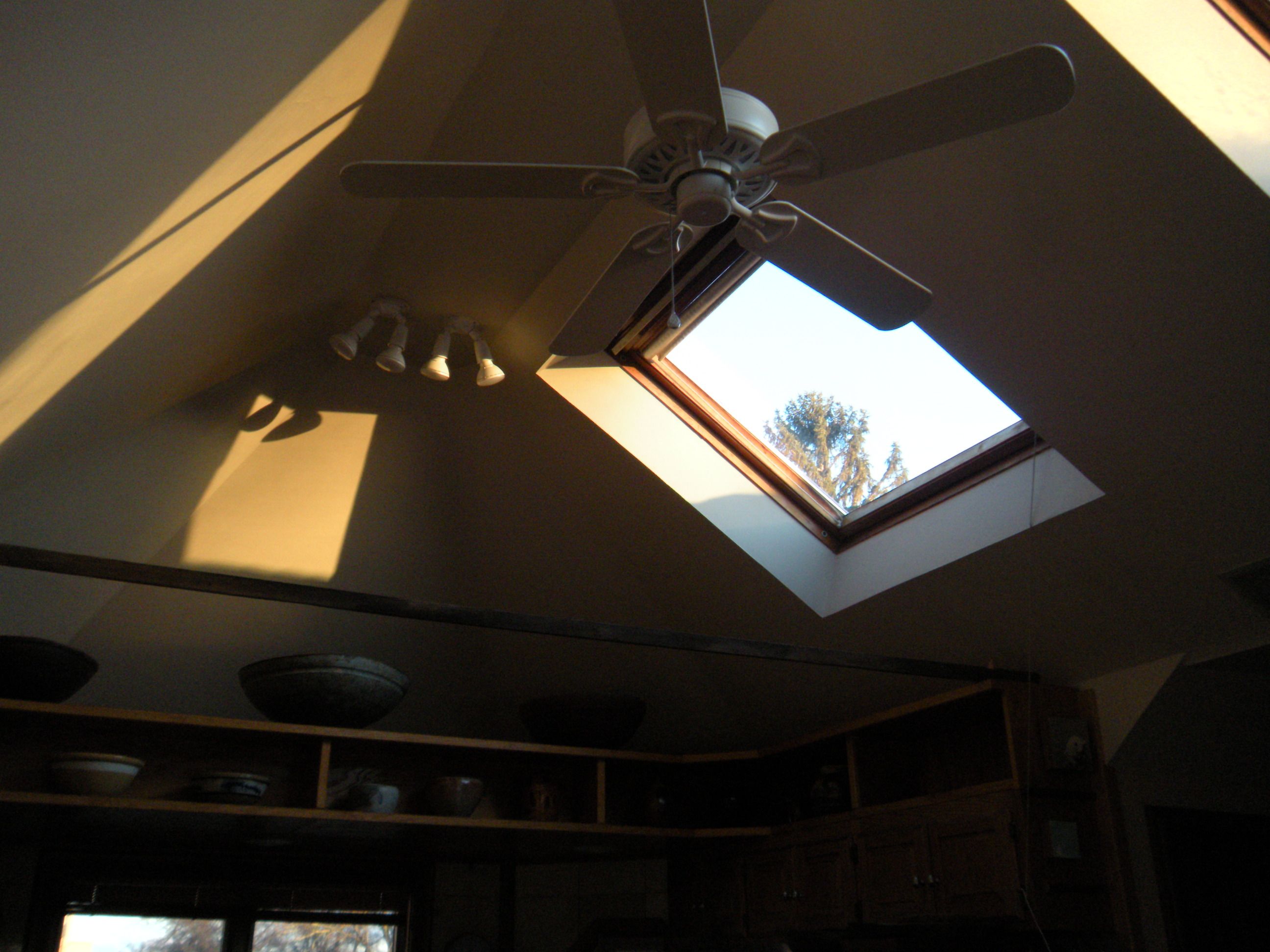
Since I’m Chinese, I have returned to reading Asian thought, especially since Zen seems like a safe place to be in this wild and precious life that I seem to be living in. As I awoke from a brief nap this afternoon, the afternoon sun lit up the room with a soft light and I could see the tip of the tall Norway Spruce in one of the skylights.

Here is some text I read in a book from my shelves of Taoist and Buddhist books called simply, “Appreciate Your Life – The Essence of Zen Practice” by Taizan Maezumi Roshi. On page 4, the Roshi writes:

“We do not see that our life right here, right now, is nirvana. Maybe we think that nirvana is a place where there are no problems, no more delusions. Maybe we think nirvana is something very beautiful, something unattainable. We always think that nirvana is something very different from our own life. But we must really understand that nirvana is right here, right now.”

He goes on to say:

“Do not be dualistic. Truly be one with your life as the subtle mind of nirvana. That is what subtle means. Something is subtle not because it is hidden, nor because it is elusive, but because it is right here. We don’t see it precisely because it is right in front of us. In fact, we are living it. When we live it we don’t think about it. The minute we think about it, we are functioning in the dualistic state and don’t see what our life is.”

In reading these paragraphs, I begin to faintly understand what is so hard to put into words: that when we release our mind and are in the moment of that moment, we are in nirvana. In nirvana, our life and the world is just this! There is nothing extra. But it is also all.

For a person like me who reads constantly and whose mind moves around rapidly, these pages were a refreshing halt to the machinery going on in my head. After reading the pages quoted above, I looked around the room I was in, the late afternoon sun glowing on the walls and I could feel the peacefulness of those moments, even though I was still thinking about nirvana rather than being in nirvana just by being in my life.

buttermilk biscuit crust . . .

pie in the oven

I couldn’t decide whether to call this post “chicken pot pie” or “buttermilk biscuit crust” since both are essential halves of tonight’s supper.

Yesterday, I went to Market Basket (the supermarket chain whose employees went on strike en masse this summer for over two months to reinstate their fired CEO, Arthur T. DeMoulas). I came home with a freshly roasted whole chicken for $4.69! You can’t even buy an uncooked whole bird for that. For supper, G. and I ate the dark meat of the bird along with some corn muffins cut in half, browned in a skillet and a large green salad.

This afternoon, we had chicken sandwiches for lunch from the wings and the rest of the dark meat. Since we’re not white meat eaters (could you tell?) I decided to cook onions, carrots, and cubed chicken breast in a bath of chicken broth until heated through. Then added frozen petite peas. I tasted the stock and it was savory, thickened with a little flour/broth combo that I stirred into the casserole. On the side, I browned half a dozen large button mushrooms in butter, cutting them into large chunks to add at the last minute before putting on the crust and baking the pot pie in the oven.pot pie core

Even though I had a Pillsbury pie crust in the freezer, I had a hankering for fresh buttermilk biscuit topping to put on top of the fresh ingredients in the pot pie. Since there was a fresh bottle of buttermilk in the fridge, I mixed some flour with very cold butter cut into tiny droplets. I used my trusty Wusthof serrated paring knife, cutting a half stick of butter into thin slices, turning it over, cutting more thin slices and then cutting crosswise letting tiny drops of cold butter fall into the flour with a small pinch of Maldon salt into the bowl.

I mixed the dry flour/butter mixture with my fingers, rubbing the butter bits into the flour until well mixed. Fluffing it with a fork, I added 2 teaspoons of fresh baking powder. Poured a half cup of cold buttermilk into the flour mixture with some leftover in a glass for me to drink (yum!)

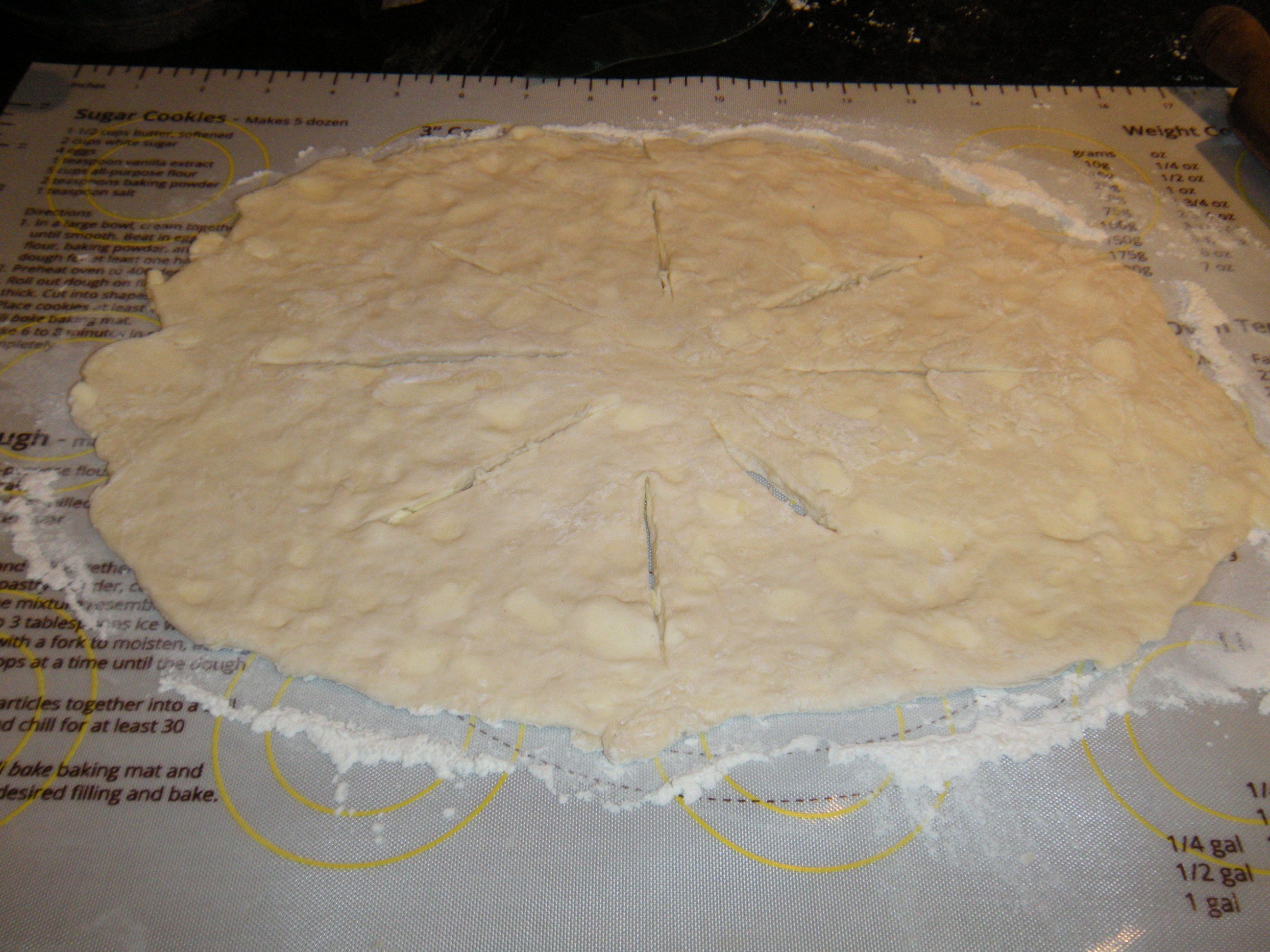
buttermilk biscuit crust rolled outAfter mixing gently with a rubber spatula, I lightly kneaded the dough a few times. Patting it together, I wrapped it in plastic and placed the dough in the fridge until ready to roll out for the top crust of the chicken pot pie.

Another important part of the recipe (learned the hard way) is to heat the chicken filling very gently to make sure it’s bubbling when put into the oven AND that there’s enough broth/gravy for the biscuit crust will absorb. So just to be sure, I made some more stock, added it and allowed it to cook down in the chicken casserole just barely simmering on top of the stove.

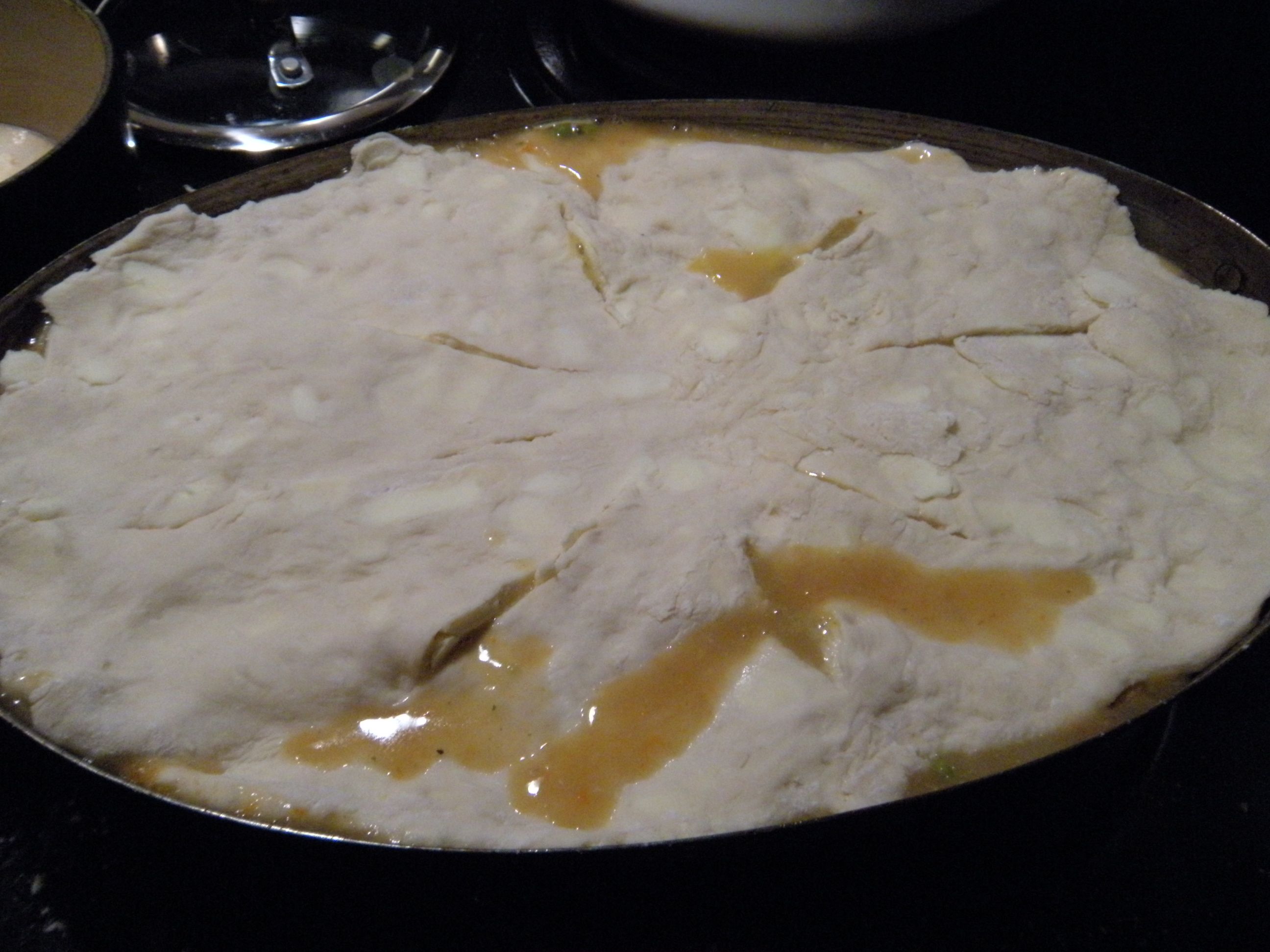
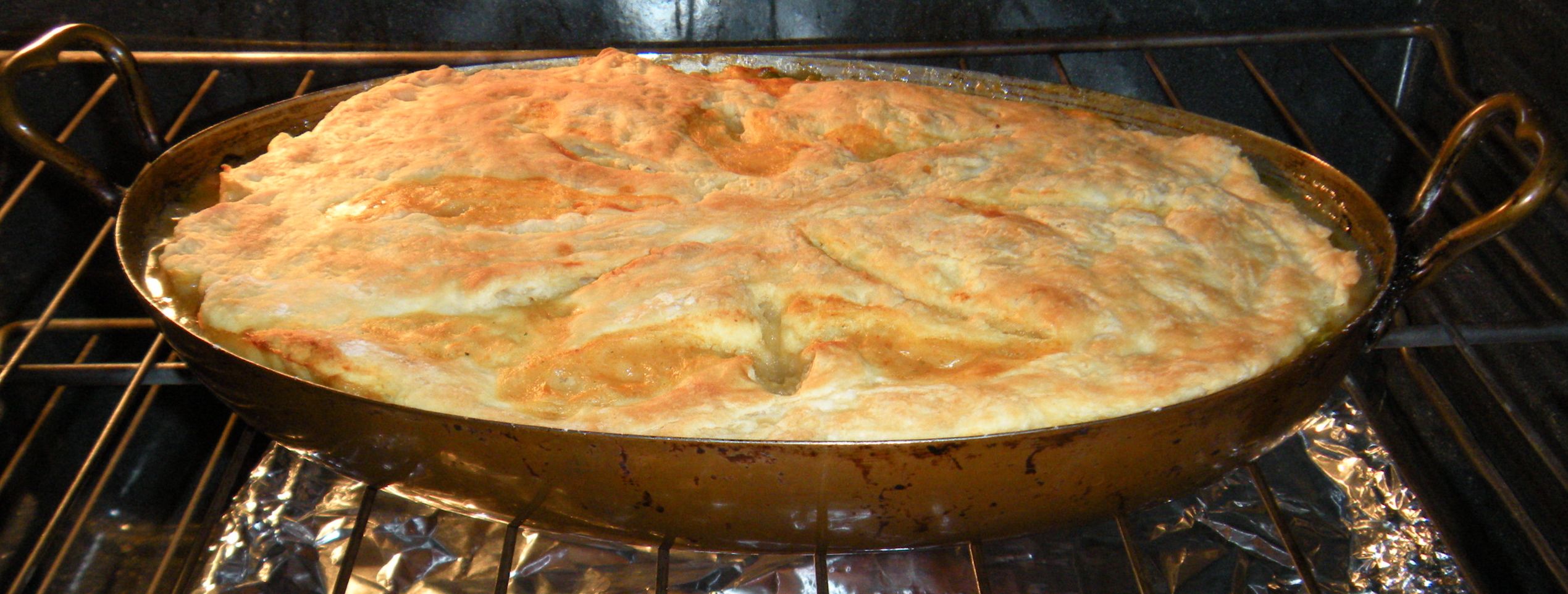
About forty-five minutes before supper, I heated the oven to 400 degrees, brought the pot pie in its copper au gratin pot to a bare simmer and rolled out the crust, using the cold dough from the fridge. I added the chunks of mushrooms to the chicken mixture and gently fitted the crust onto the top of the pan. Into the oven it went for about half an hour plus or until the top of the crust became golden brown and the biscuit top cooked through. I made slits in the buttermilk crust to allow steam to escape and put a baking sheet lined in aluminum foil underneath just in case the gravy dripped into the oven.

top placed on chicken

It took a bit of preparation this afternoon, but we can now feel good about eating a piping hot savory chicken pot pie and finishing all of the roasted bird from yesterday. There’s probably enough leftover for our lunch tomorrow!

end pie photojpg


a buddha . . .

FullSizeRender-4

Sometimes, it feels like we are charging around trying to do as much as possible in a limited amount of time. Yesterday, my daughter C. and I had a dim sum lunch (her birthday treat) and we went window shopping at a handful of stores that we like to browse in afterwards.

After the surfeit of Christmas gifts, our browsing was short-lived in a couple of shops. And so we headed to Starbucks for a hot drink before parting ways and going home.

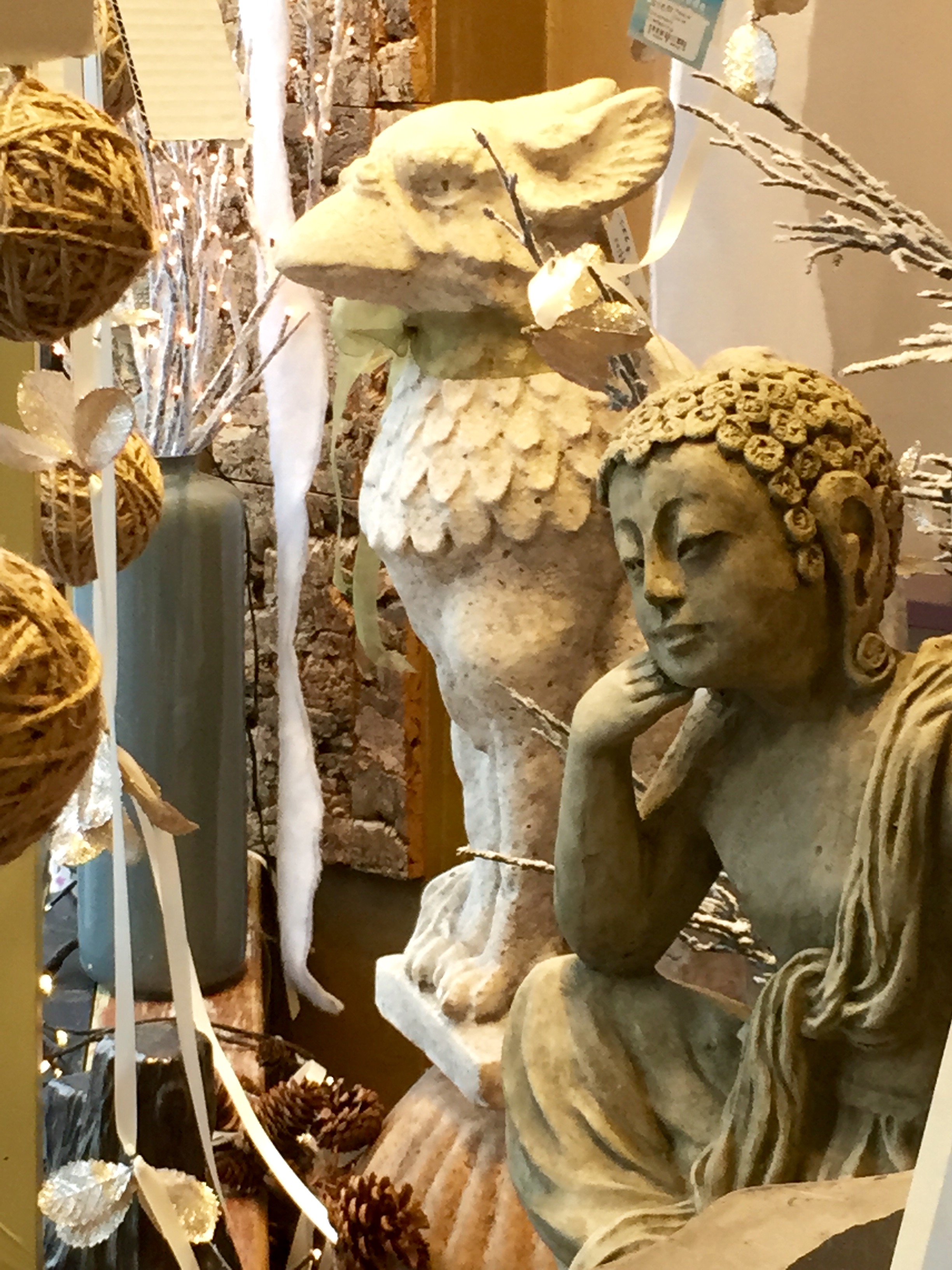
Derby Farm is a favorite store across the street from Starbucks and we decided to peek in because there was a large “SALE” sign in the window. I spied a large griffin statuary that reminded me of a number of gargoyle pieces that we have scattered in our yard that we purchased almost twenty years ago. This griffin reminded me of ones that you might see guarding the Notre Dame in Paris. I was momentarily tempted but it wouldn’t survive outside during the freeze/thaw of our winter months here in New England, and it was way too big to put anywhere inside the house.

Last night, C. sent me a snapshot of the griffin that she had taken with her phone as a memento of our day out together. Right away, my eye caught the peaceful smile on the buddha seated beside the proud griffin. The coiled curls on the Buddha’s head and especially the boldness of his ears also won me over. In Asian cultures and especially for the Chinese, the shape of the ears called “Buddha Ears” is significant because well-shaped ears like this signify an awareness for and ability to listen to everything. Take a look around at people’s ears sometime and you’ll see how greatly they vary in shape and how only a few are delineated as boldly as those on Buddha statues.

Because there was a 20% storewide sale that the shopkeeper mentioned aloud yesterday when we were in the store, I phoned to ask how much the Buddha might cost. Turned out that it was very affordable and I purchased it on the spot. This weekend, I’ll drive into town to pick it up.

This year on February 19th, the Chinese year is represented by “green, wooden sheep”. It seems to forecast a calm year and I am looking forward to it after such a tumultuous one last year.

Now, we have a peaceful Buddha to grace our home as well. Thanks to Serendipity and to C. for taking the photo and sending it along!


‘being mortal’ . . .

DSCN6897I started reading Atul Gawande’s new book, “Being Mortal” before Christmas and finished reading it today. As a physician, Gawande writes for the rest of us laypersons who are often at the mercy of physicians as our caretakers.

Many, as described in the book, are taught to make a difference by doing something medically about certain conditions, no matter what. They are not taught to be humanistic nor wise about how to think about how their medical “miracles” might not work as they hoped; nor to talk with people about what their fears are, what makes their time most precious to them and whether more procedures really make sense or not.

One of the most compelling story lines in the book is that of his own father’s illness, a tumor growing on his spinal cord. A surgeon himself, Gawande’s father decides to delay surgery until such time that he can’t perform surgery himself any longer himself. This turns out to be four YEARS later! As he descends into greater infirmity that progresses to being a near-quadraplegic, Gawande’s father tries radiation at the overzealous advice of a doctor, only to suffer from the treatments which debilitate him further and of no help.

Finally, a hospice nurse, in a matter-of-fact and direct manner, turned the tide so that he might live out his life in the way that is most meaningful for him: relatively pain free, freed of fear that he’s not doing the right thing with regard to medical choices, being more comfortable because his medications are being taken more consistently and documented as such. Being with his loved ones when he dies.

Doesn’t this sound like what we all would want if we had a chance to say so? Being comfortable and pain-free, not being afraid and being with our loved ones. Why should this be so hard for us to choose? Or a question to the medical community, why do physicians make it so hard for us to choose this over clinical protocols that we are told are not likely to work anyhow or might produce side effects that increase the severity of our suffering? Why is it so hard to avoid the medical train barreling down on us with increasingly difficult and costly measures that might help to extend our lives but which could also compromise the quality of whatever life that’s left in us?

About ten years ago, a friend named Margaret was diagnosed with a very rare form of bile duct cancer usually prevalent in middle-aged men over fifty. She was thirty-seven, a vegetarian and was learning how to kick-box. She was diagnosed in August. Her doctors said she had about six months to live if she did nothing. She was also told about experimental chemotherapy that would be painful and not likely to work. Her mother wanted her to do the chemotherapy so she did. I went to visit her in NYC early that Spring. She was brave and cheerful, dying three weeks later. Cancer ran through her family: first her Uncle, her sister, herself and her mother too. Chemo didn’t help any of them. But they tried it anyway, living out their lives by dying in the hospital. No one can make these choices except for the patients and their doctors. “Being Mortal” illustrates with examples how others have chosen given a different kind of dialogue between caretakers and those people who are ill.

Many of us will be faced with difficult medical choices if we don’t die first from accidents, sudden strokes and heart attacks. I hope that my daughters will read this book before we need it. It is one of those books that reminds of the old fairy tale, the Emperor with No Clothes–that everyone is shy to admit what is going on. In this case, it points out the obvious of what is NOT going on in medical academic curricula nor in common-sense training.

Most of all, it calls for training about how to talk to patients about treatments and their consequences. It calls for personal maturity by physicians to ask, and then to listen carefully to how PEOPLE (not patients) want to live before they die. And then for doctors to help give them as much time to accomplish that with recommendations for their care rather than pushing the clinical envelope, trying to be medical supermen.