mulberryshoots

"Tell me, what is it you plan to do with your one wild and precious life?" ~ Mary Oliver

Judy Rodgers postscripts . . .

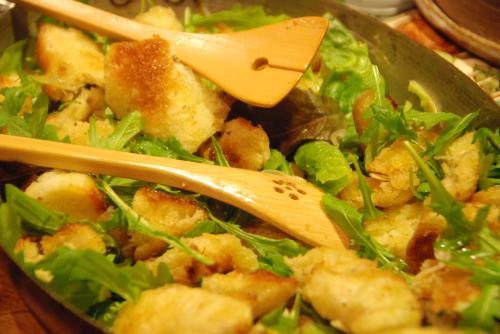
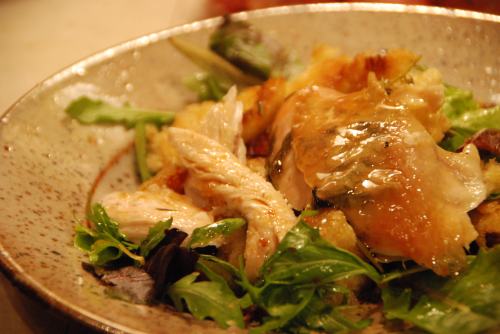
Please see “Judy Rodgers” post which described how we decided to make her famous recipe, “Roast Chicken with Bread Salad.” Here is a photo postcript  (taken by C.) of the dish which we prepared and ate for Christmas Eve Dinner.

roasted birds just out of the oven . . .
testing doneness . . .
bread salad . . .
bread salad . . .
roast chicken on bread salad . . .

December 26, 2013 postscript: As intended, we followed Judy Rodgers’s recipe to the letter: I bought 3 birds: 2 1/2 to 3 pound fresh organic Bell and Evans chickens at Idylwylde Farm (the ONLY place that had them); brined with Maldon Salt along with fresh marjoram, rosemary and thyme sprigs slipped between the skin of the breast and thigh of each bird beforehand; left to rest in refrigerator for 24 hours covered with paper towel and clean dishcloths. Taken out two hours before roasting; my daughters, Megan and Caitlin read the bread salad recipe which said, “begin several hours ahead” in the 2nd floor kitchen. I had bought three different loaves of bread, hoping to find one with the kind of open and chewy crumb “without being sourdough or Levain bread which would have had too strong a flavor.” The last loaf bought the day before, a crusty large Italian bread loaf turned out to be perfect. The crusts were cut off, the bread torn into bits, brushed with olive oil, browned in the oven, dressed with Champagne vinaigrette; the currants soaked in red wine vinegar, mixed with fresh rocket and mesclun after it had been steamed in the hot oven after the birds were taken out; pan drippings added to the bread salad and spooned over servings of light and dark meat servings of the roasted chickens. I am giving this detailed description because every step and ingredient was worth it.

Everyone agreed that the dish was spectacularly delicious and distinctive, festive and just plain wonderful for our Christmas Eve dinner. As with many things, we don’t think the experience will ever be the same the next time we make it, but will certainly be added to our best meals ever memories!

Postscript 5 January 2014: I wanted to add a note that because the chicken had been brined (I think,) the leftovers were still appetizing to eat for lunch today, the very last bits cut up in chunks, a tender sprig of celery or two chopped finely and Hellmann’s mayonnaise to bind it together for about a half hour before putting together sandwiches with toasted oatmeal bread accompanied by split pea soup.

Earlier, we had transported leftover roast chicken for sandwiches on the 27th of December to Brewster on Cape Cod, accompanied by a big pot of hearty soup made of stock from the carcasses, onions, carrots and barley. For frugality, I’m amazed that these three little birds fed and nourished us over the course of, what, eleven days!?  
“only one trip” . . .

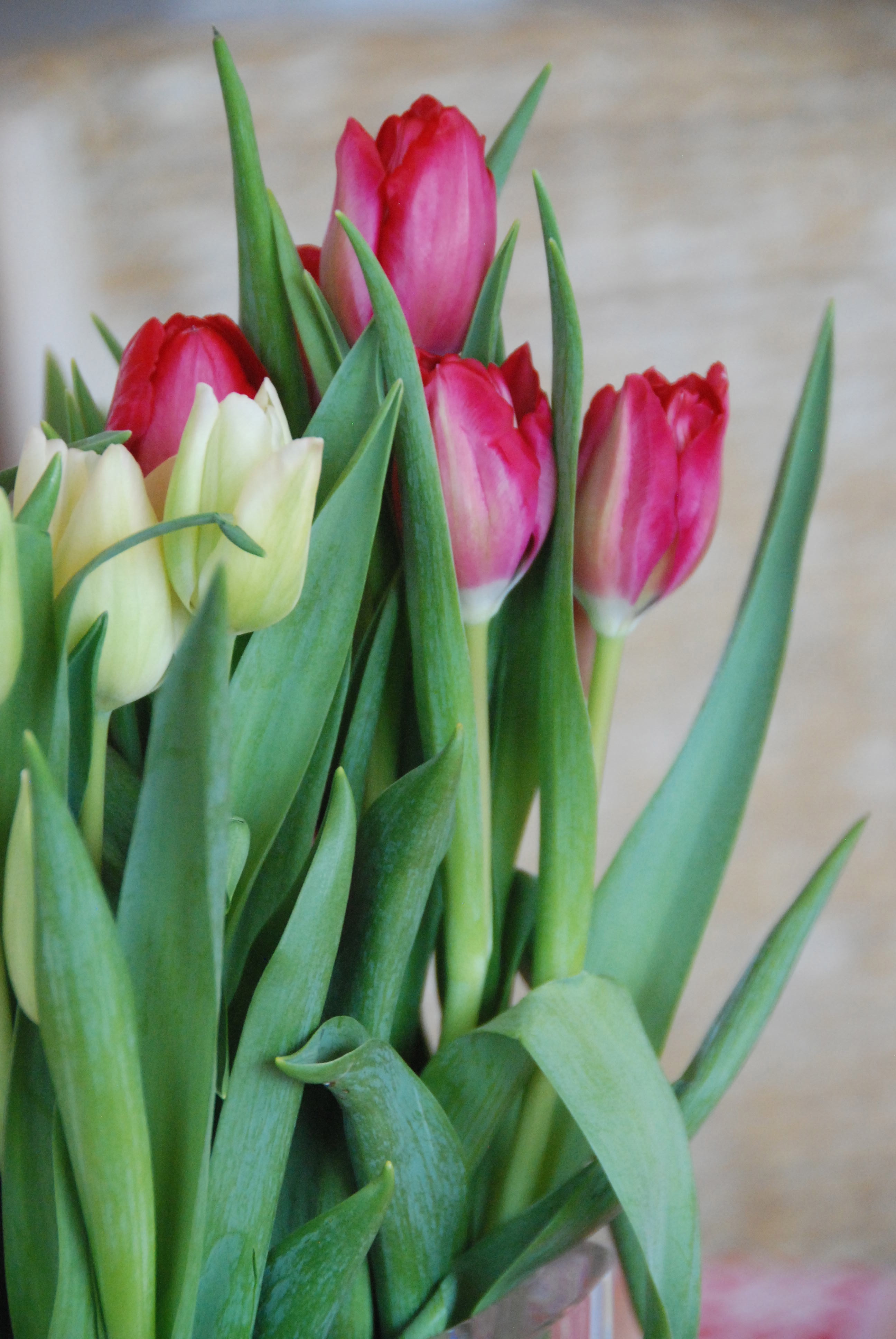
tulips my daughters gave me for my birthday . . .

tulips my daughters gave me for my birthday . . .

I woke up this morning and watched a video of an interview with Iris Apfel, a style maven who lives in New York City. At the age of 92, she looks fabulous and singularly fashionable in her own distinctive way of dressing. Or should I say, living.

For someone like me who prides herself on being both serious and frugal, the interview was an eye-opener. Iris has more things crammed into a corner of a room than I have in my whole house! She wears more jewelry at one time than I have in my drawer! Best of all, she has a husband who not only understands and appreciates her wild approach to living, but jokes about not having to sleep in a drawer!

Here’s the video clip that illuminated my perspective today. I’m not saying that we should all go running out and buy hordes of things for ourselves. When she was asked by Deborah Needleman, the editor of “T Magazine” (NYTimes fashion magazine) what style was, her immediate response was, “attitude.” Plus, she’s going even stronger at the age of ninety-two with new jewelry designs, recognition and accolades as a style icon. What a wonderful peek at her outlook on life to crack open my own super-serious, self-monitoring list of new year’s resolutions!

When asked to describe life in three words, Iris Apfel said, “only one trip.” Which spurs me to start thinking about taking more trips with my daughters to places and events that we might not do otherwise. And more often. What do we think we are waiting for?

Thank goodness for a breath of fresh air from this fortunate 92-year old woman: to truly be ourselves and to live as fully as we can on the only trip of our lives. That’s all. That’s everything, isn’t it?

another new year . . .

low tide . . .

low tide . . .

Isn’t the concept of a new year refreshing? especially in our American society which celebrates second chances and a makeover culture?

Every twelve months, we get to make (or think we can make) a new start. That’s where resolutions come in. Or just taking  the luxury of a few moments to take stock, look around and to wonder if life is what we want out of it.

I like doing it, truth be told, because for a little while, I visualize that my life could be different in ways if only it were under my control. That’s the folly of it all, though, because mostly the things that make me sad are not under my control, like other people’s behaviors or attitudes.

Of course, there’s the old adage that it’s how we respond and react to those things outside of our control that mediates how miserable we choose to be as life putters along for another year. Knowing this, however, doesn’t stop me from typing for about five minutes the things that I would change about my own attitudes, habits and behaviors for the coming year: forty of them, in fact. Many had to do with NOT doing rather than doing:

– not eating sugar, not shopping for food unless having finished what’s available in the house, not responding to certain repetitive situations that make me unhappy, not nagging people, not worrying, not buying to make up for the potholes in life that appear along the way, not being with or thinking about people who treated me badly, and so on.

On a more positive note, here are some of the things that I would do more of:

-practice the piano and learn pieces I have always wanted to play (Bach, Scarlatti, Schubert, Rachmaninoff), read a lot all the time including Donna Tartt’s “The Goldfinch” and having finished reading Elizabeth Gilbert’s “The Signature of All Things”, experiment with meals like an Asian breakfast of brown basmati rice, an egg on top and seasoned seaweed along with a large teabowl of steaming lemon-ginger herbal tea, take care of my canary, continue to grow poinsettias from year to year so that they branch out and look like a mini-tree like the one from last year on the kitchen table. Put everything away and if there’s no space for it, give it away, drive the car sparingly and be careful going up and down the stairs. Live simpler with less extravagance of thought, bearing and activity.

2014 also includes the Chinese Lunar Year of the Horse which begins on January 31st. And guess what Chinese Zodiac sign I was born under? It will be interesting to see how these almost parallel years will unfold.

January 1, 2014: This Zen saying came into view today, an apt one for the first day of a new year:  “when you realize there is nothing lacking, the whole world belongs to you.”


merry christmas . . .

our poinsettia ~ 2nd year

our poinsettia ~ 2nd year

poinsettia plant ~ christmas 2012

poinsettia plant ~ christmas 2012

nelson mandela . . .

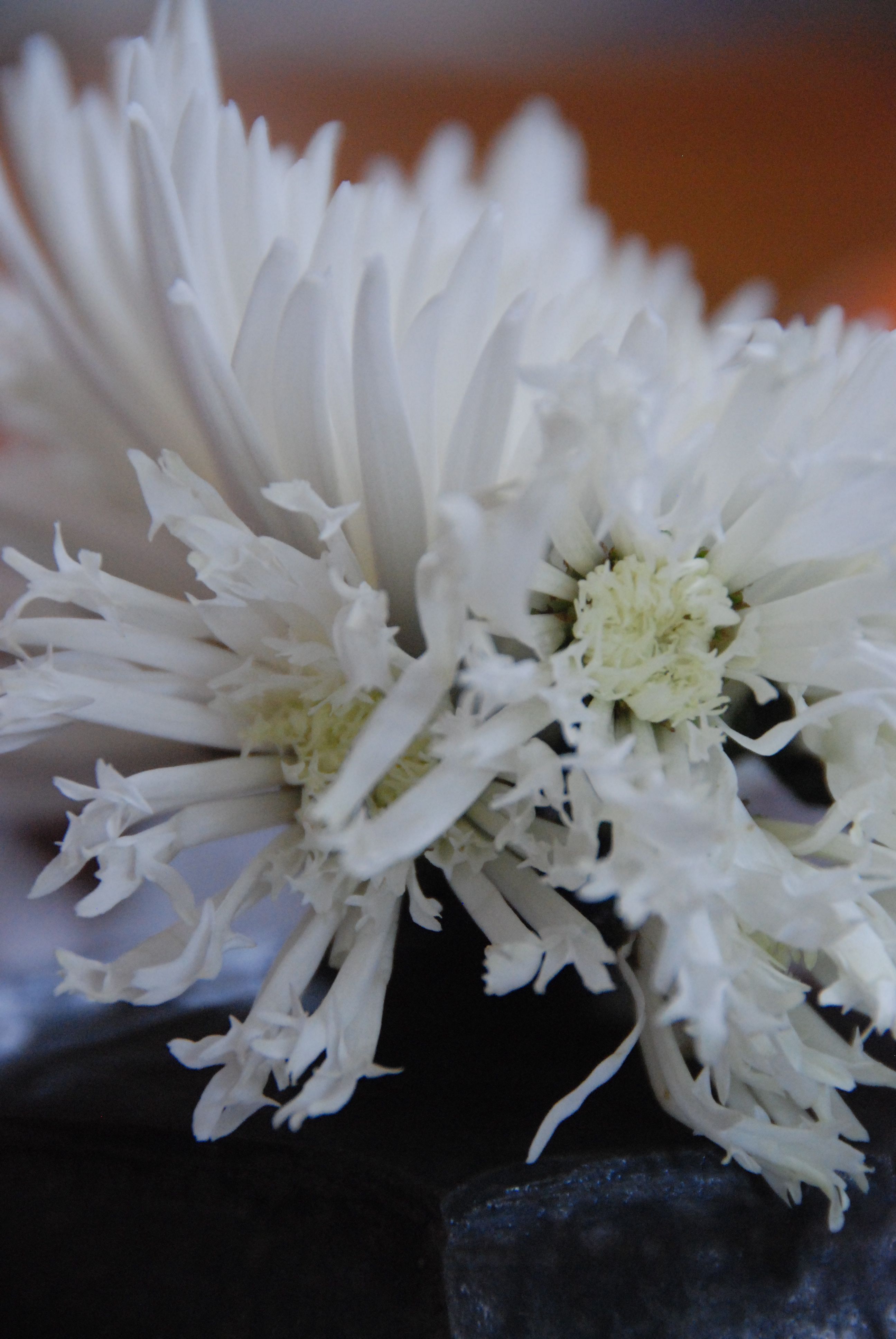
a white amaryllis (in China, white is the color of death, not black)

a white amaryllis (in China, white is the color of death, not black)

It feels odd to be writing two posts in a row with a person’s name as the title. Each passed away this week.

Today, most people know that Nelson Mandela died yesterday at the age of ninety-five. What they might not know is how he lived his dignity and showed it towards others. This trait is one of the outstanding qualities he has imparted to the world for those who witnessed his life. Twenty-seven years he spent incarcerated. Twenty-one years he and Winnie, his first wife, never touched but only spoke through a thick glass partition. When Winnie became somewhat of a firebrand, wearing combat attire and boots, they parted ways. Before and after the divorce, Mandela stayed quiet, not uttering a word of criticism about his former partner and spouse. Then, he fell in love again and married at the age of 80.

The most often asked question of Mandela is why or how he came to bear no spite towards those who fought against him, imprisoned him, betrayed his cause, or plotted against him. He has answered thusly:

“Hating clouds the mind. It gets in the way of strategy. Leaders cannot afford hate.”

I was thinking that we can also decide to lay down garments of hate that enfold us, whether it be towards those we feel have done us wrong, or ourselves when we feel we have not done right towards others up to now.

The answer I like the most about why he wasn’t more angry at his captors and about years spent in prison for more than a quarter of a century is this:

“Why aren’t you more angry?”

“If I thought it would do any good, I would be.”

Nelson Mandela was patient, pragmatic and persevering, serving the good of others rather than his ego. He changed the tide of history with dignity and respect. His wisdom prevailed and without him, Africa and the world might be a very different place today.

He has been called the moral center of Africa. I feel his life serves as a moral fable for us all.

Godspeed, Nelson Mandela. And thank you.

judy rodgers . . .

JUDY RODGERS FLOWER

This morning, inside the back of the second section of the New York Times was an obituary for Peter Graf, the tennis father (read ogre) of Steffi Graf who escaped her tyrannical father by marrying Andre Agassi.

Then, I glanced at the opposite side and gasped (literally) to see that Judy Rodgers had died. It’s not as though I ever met her, you see. But I have her beautiful cookery book called “The Zuni Cafe Cookbook” which won the James Beard Award when it was published in 2002. In the article, her cooking was described as “refined simplicity.” Her famous recipe for roast chicken with bread salad has circulated far and wide and was even published at the bottom of the page of her obituary today.

Still stunned, I went to the bookcase looking for her book and found her large, thick volume with the beautiful cover photo of nuts, nectarines and ham. THIS, dear reader, is why it is so gratifying to have a large library of books that I love, ever flowing throughout the house, in stacks on the floor, in old baskets, on the credenza waiting to be put away. To me, these books are like old friends who awaken to have a conversation once again.

Although my family eschews red meat for the most part, most of the time, somehow, I”ve had it stuck in my mind that we should have something beefy, English or some type of roast in order to feel “Christmas-y.” Last year, I roasted a filet of beef which was delicious although it’s not my favorite cut of meat. It also fed my granddaughter and her boyfriend the next day too. To be honest, I thought the homemade beef gravy was what made the meal so tasty. The depth of flavor entailed hours making homemade beef stock, offsetting the supposed benefit of being able to roast the filet in a short amount of time.

But this morning, struck by Judy Rodger’s untimely death (she was only fifty-seven,) I read more about her life and about her work. At the age of sixteen, living in St. Louis, she somehow ended up on a student exchange to France and was assigned to live at the home of the best chef in France: Jean Troisgros, “who happened to run one of the greatest restaurants in the world, Les Freres Troisgros, in Roanne.” As though Fate and Destiny had anything to do with her life’s calling?

Then, I turned my attention to looking through her cookbook, marvelling at the gorgeous photos of dishes. Paging through the book to the roast chicken and bread salad recipe,  I resolved, or settled my mind at least, to make it for our Christmas dinner this year. Although it may seem like a sentimental gesture (it is) and although I didn’t even know her, nor especially cooked from her book prior to this (I didn’t) my strong feeling today is to honor her memory by creating a very different kind of menu for this year’s Christmas Eve repast. I can’t wait to go looking for small, organic chickens under three pounds that are a requisite for this recipe. Brining them a day ahead with salt is an essential step. I think I will roast three birds in my beautiful old French copper roasting pan. And I will serve them placed on top of the bread salad with the vinaigrette recipe she suggests.

As a starter, her recipe for “Prosciutto and White Rose Nectarines with Blanched Almonds” sounds like a lovely beginning to the evening. Kale, prepared with garlic, onion and red pepper might be a robust side vegetable to have alongside the roasted chickens and bread salad. A modest cheese plate, according to Judy, and then a dessert such as “espresso granita with whipped cream,” (who cares if we can’t fall asleep, there are still plenty of presents to wrap, right?) Or, a toasted almond panna cotta with saba (whatever that is!) or a fresh peach crostata, served warm from the oven?

Perhaps I am reacting over-emotionally to the surprise of reading about her death, and I am kind of surprised at the intensity of my reaction to it all. I feel strongly that a menu of her recipes is just the kind of food that I would like to serve as a celebration of Christmas this year.

Godspeed, Judy Rodgers. And thank you!

Note: for a follow-up photo essay and description of how the roast chicken with bread salad turned out, please click here.


go gently . . .

1c4c5300a937da6d62bfa45828a8a475Yesterday, as I was waiting to hear whether G.’s 95-year old mother would be well enough to go home, I picked up the Sunday NYTimes and read this article about being gentle. We Americans so want things to be under our control: things that happen to us as a result of other people’s actions or non-actions. We want to control or at least influence the outcome of matters which are also outside of our control. Old Asian attitudes counsel us instead to meditate and to become aware of our energy, especially how we use it in ways that help us rather than hurt us.

In this article, it was interesting to notice how the husband made things better by going with the flow: building by hand the coffin for her mother when she died and then building one for his own when his mother passed away. He was more philosophical than I could be about his eldest daughter getting pregnant and having a child out of wedlock. But even more accepting when she became pregnant again! Now, they have two young children in their care at home. While reading about these lives, I was thinking to myself how he seems to be able to distinguish what he could do something about, and what he couldn’t, thereby making the best of events outside of his control. A very wise man. In contrast, I often allow myself to be saddened or frustrated by things that happen that are outside my control.

Then, there’s an opposite view voiced by a Welsh poet, Dylan Thomas who railed against the onset of old age and, of course, dying. His poem is entitled, “Do Not Go Gently Into This Good Night.” Here it is:

Do not go gentle into that good night,Old age should burn and rave at close of day; Rage, rage against the dying of the light. Though wise men at their end know dark is right, Because their words had forked no lightning they Do not go gentle into that good night. Good men, the last wave by, crying how bright Their frail deeds might have danced in a green bay, Rage, rage against the dying of the light. Wild men who caught and sang the sun in flight, And learn, too late, they grieved it on its way, Do not go gentle into that good night. Grave men, near death, who see with blinding sight Blind eyes could blaze like meteors and be gay, Rage, rage against the dying of the light. And you, my father, there on the sad height, Curse, bless, me now with your fierce tears, I pray. Do not go gentle into that good night. Rage, rage against the dying of the light. 

Instead of “rage, rage, raging against the dying of the light,” I’m going to enjoy the light, whatever it happens to be. And to go gently, wherever I may.

“happiest moment” . . .

sliced Peking Duck . . .

sliced Peking Duck . . .

I’ve gone back to reading today, paging through Julian Barnes‘s “The Sense of an Ending,” which was, in my opinion, endlessly frustrating to read, no one character worthy of trusting what he/she said. This hardback volume was one that I had on the shelf, brought home when it first won the Man Booker Prize two years ago. It didn’t really send me then, nor in today’s briefing although I wanted to like it.

But another book called “The Collected Stories of Lydia Davis” did interest me in its smaller handbook size with deckled edges. The stories made me laugh and relieved the frustration I felt trying to decipher Barnes’s so-called “literary novella.” Lydia’s stories made me feel like I could call her by her first name. They were intimate, thank-godfully brief, and above all, humanly funny while being poignant, a hard combo to pull off. I also enjoyed reading about her as well as reading what she had written.

She was born in Northampton, Massachusetts, where I went to school. That seemed like an odd coincidence to me. Her first husband was Paul Auster, a writer who is also a close personal friend of someone I know by association (a friend’s brother) that seemed like a second, odd coincidence. They divorced and she remarried later on. Apparently, she’s been writing her kind of short stories, which feel to me like the word, poesy, for some reason. They are short, poetic and also whimsical. So, poesy seemed like a good description about her writing. She was named a MacArthur Fellow in 2003 which is comforting to know. AND, her collected stories won the Man Booker Prize this year to lots of people’s amazement! At my Truro writing workshop last summer, her name was mentioned and people were so surprised that I was the only one in the class who recognized her name, much less being familiar with her way of writing. My nature leans towards being original in one’s search for creativity. And for sure, her approach and writing are original.

I’ve been feeling hemmed in about writing these days, and this morning, took on writing hundred-word haiku like biographies of people that I know well. I enjoyed it for awhile but was sensitive to the fact that these little biting pieces were probably unmentionable to others, particularly the people I was writing about, including myself. It even felt a little misanthropic, which I felt guilty about for a few minutes, but was relieved to read that people sometimes react in misanthropic ways because they have a sense of naive innocence or high expectations and then are deeply disappointed in how things work out. Boy, is that the story of my life! Naive innocence, high expectations and then, boom!, my feelings or thoughts falling down with a thud. There must be a way to survive these occurrences without becoming cynical or jaded. I guess if one’s naivete or innocence is still operational (at least mine sometimes still is!) you can’t really be a true misanthrope, can you?

The reason I’m writing this post, though, is to share with you one of Lydia Davis’s stories. It’s called “Happiest Moment” and I thought it was so charmingly Davis that I wanted to share it in a post:

 Happiest Moment

If you ask her what is a favorite story she has written, she will hesitate for a long time and then say it may be this story that she read in a book once: an English language teacher in China asked his Chinese student to say what was the happiest moment of his life. The student hesitated for a long time. At last he smiled with embarrassment and said that his wife had once gone to Beijing and eaten duck there, and she often told him about it, and he would have to say the happiest moment of his life was her trip, and the eating of the duck. 

I think this story is priceless, don’t you?

simplicity (again!) . . .

DSC_0003Here’s a link to an interview with Jess Lee, the CEO of Polyvore on keeping it simple in a corporate culture. Her advice is to make lists of what you are doing, weed out those which are not important and focusing on what is, in a more focused way. Sounds simple, right? Actually, getting to simplicity is not that hard to read or talk about. Think about things. Prioritize. Focus. Weed out.

But it’s not so easy to carry out in action, though. What I have found in my journey to simplify is that it’s usually easy to start out and hard to maintain as a lifestyle. Being human, we go up and down about buying and accumulating things, a pattern that humorously seems to maintain a stubborn stasis of how much stuff we have. It’s hard not to be tempted by a nice necklace in a shop when you already have a few that you don’t wear that often in the drawer. It’s hard not to want a pair of boots for the winter season when you already have two perfectly good pairs that you like and wear. It’s hard not to think about gifts and surprises for friends and family when everyone already has all that they might need and more.

Still, the idea of simplifying is still so tempting, a siren’s call to pare down, slow down, reflect in silence. Dress more simply. Take jewelry off rather than putting it on. Looking for gifts that are simple but still wonderful. Last year, I made small mince pies to give out during the holidays. Eaten with a little cheddar cheese or ice cream, they were welcome presents not easily found in stores. This year, although G. has reminded me I still have jars of unopened mincemeat, I saw a recipe in the latest issue of Bon Appetit for savory shortbread made with caraway and fresh rosemary. Sliced in long strips, they will look great in cellophane bags with white dots that I used for the mince pies last year, tied with a ribbon and a sprig of fresh juniper from the yard. Maybe I’ll make both and offer up some of each. Providing “simple” gifts still takes work and care, doesn’t it?

We are planning a family holiday in a rental on the Cape after Christmas and are inviting a host of friends, their children and parents to a “dumpling fest” on the Saturday that we’ll be there. These are friends my daughters have known and played with since kindergarten. Now, their children will have a chance to meet each other, take walks out on the private beach and then come back to the house to eat piles of hot asian dumplings with different dipping sauces. Two kinds of soup: a clear soup with winter melon and a miso soup will simmer on the stove. This may not sound simple to you, but we are doing one thing that makes the whole thing do-able: and that is rather than making Chinese dumplings from scratch, we are going to heat up frozen dumplings (Korean ones with pork and chives; Trader Joe’s Thai shrimp dumplings and vegetable dumplings; pork bao etc.) There was a day in the past when I would have made everything myself from start to finish. But having tasted the Kimbo brand pork and vegetable dumplings, I’m satisfied that they’ll do nicely–even the wrappers are kind of glumpy like the ones that are home-made. I do confess that I’ve still had flashes of thinking I might make some up in advance anyway and freeze them. Probably not though.

So, little by little, simplicity enters our lives. Or, to put it another way, a not-so-complicated-as-usual mode might be a first step. I’ve also noticed that the fashion of the day is ultra simple clothing with very little other adornment. You can actually see the person underneath without all the flashy stuff.

Still, human nature is by definition often changeable and fickle. Besides, the holiday season is upon us with a late Thanksgiving and a few more weeks until Christmas and other holidays that are celebrated. Maybe the simplest thing of all might be just not to struggle so much with anything: being simple, not so simple or whether to make or buy. Just do what feels right and let it go.

Simple, right?

reconciliation . . .

DSCN5895_2

In the past few days, small quotations have stuck in my mind from reading, of all things, obituaries about two women writers.

One, Doris Lessing, who won the Nobel prize in literature for writing curmudgeonly self-centered books about her unconventional life, emulated by some struggling with how to live while tied down by family obligations; and Charlotte Zolotow, a prodigious author of seventy-one children’s books and (Harper Collins) editor of her own children books imprint. I must confess that I have tried to read Lessing’s “The Golden Notebook” numerous times because I liked the idea of journals with different colors depicting a woman’s life. But I haven’t as yet succeeded in getting past the complaining self-indulgent tone of it all. Zolotow’s books, illustrated by Garth Williams and Maurice Sendak among others, sound very different, described as helping the young to gain perspective about what happens to us all as we grow up.

In the Lessing article, a reviewer, fellow writer J.M. Coetzee, complained:

“There is something depressing in the spectacle of a woman in her 70s still wrestling with an unsubjugated ghost (her mother) from the past. On the other hand, there is no denying the grandeur of the spectacle when the protagonist is as mordantly honest and passionately desirous of salvation as Doris Lessing.”

In the Zolotow piece, Charlotte is quoted:

“We are all the same,” she wrote, “except that adults have found ways to buffer themselves against the full-blown intensity of a child’s emotions.” She added, “We are not different from the children we were — only more experienced, better able to disguise our feelings from others, if not ourselves.”

So, in one instance, a woman is chastised for remembering (and still being impacted) by how badly her mother treated her as a child; and in the second, we are reminded that many of us learn how to buffer ourselves as adults against the truth of our childhood memories. What to do?

I had trouble falling asleep last night and didn’t really know why. As I sat alone in the kitchen, enjoying a cold, blackberry Izze drink while thinking about things, I wanted to figure out for myself how to let go of strong traces of negative influences in my upbringing with the ongoing desire to be honest about them: a Lessing-Zolotow cocktail if you will.

Sometimes, it feels hard being honest with yourself especially since it’s a lot easier to complain and blame others. Another solution is to fool ourselves that everything is just fine when we know it isn’t. Neither really works in the end. And usually, unless it’s the middle of the night and all is quiet, one’s inner voice is hard to hear, being so timidly quiet and all.

Biting the bullet, eating crow, deliberating a choice whether to make things different are all things we may ponder, fleetingly or not. The word that comes to my mind after all this reflection and lost sleep is . . . reconciliation.

“Reconciliation” means:

1. the restoration of friendly relations

2. the action of making one view or belief compatible with another.

Based on these two definitions, I am thinking that perhaps it is possible to restore friendly relations within oneself once we face sad feelings (Lessing,) and not negate our childhood inner truths (Zolotow) but to reconcile them so we can live better and honestly unburdened once and for all. I don’t know how this may happen for others but last night’s little insomnia bout gave me great relief and removed these obstacles. Hey, maybe it’s my little Ganesh on the kitchen windowsill doing his magic! Whatever it is, Helpers from the Universe tying together bits and pieces from obituaries of all things, I’m glad to be able to think about reconciliation today. And perhaps to sleep better tonight.