mulberryshoots

"Tell me, what is it you plan to do with your one wild and precious life?" ~ Mary Oliver

an american dream . . .

DSC_0109_2
I’m immersed in reading Claire Messud’s new novel, “The Woman Upstairs.” It is set in Cambridge and Boston so it’s entertaining to read about characters who meet at Burdick’s in Harvard Square, have friends whom they visit in Jamaica Plain, parents who go to Wellfleet for their anniversary and whose heroine grew up in Manchester By The Sea on the North Shore of Massachusetts.

The first line of the novel begins:

“How angry am I? You don’t want to know. Nobody wants to know about that.”

And from there, we are off to the races about women’s plight in the world, serving others, ending up in middle-age or mid-old-age or whatever, feeling as thwarted as their mothers and grandmothers, but in different ways. Believe me, I know about this because the premises of this blog is “life is long” and one can fill in some holes, maybe sooner or later, but that it’s possible. In fact, on page, 41, the book talks about women who are still “blithe in their belief that life is long.” HAH!

And in case you are wondering if I am feeling bad about not having written this book myself, you might be wrong. Lately, I’ve been exploring a new writing setting about a conversation between two women who are strangers to each other and gradually lay out what they think about their lives.

Rage is a big thing in Claire Messud’s book. Pumped up anger, she is most frustrated with herself because she “gave up” on certain ideals that she had wanted for her life. From where I am writing, it also seems possible that there are tons of men too who find themselves in the same boat at some time or another. This is not necessarily a feminist theme resurrected, it is a theme that comes from, in my opinion, the idea and ideal of the American Dream.

We are taught from a very early age that we can be or do anything as long as we work hard enough, are lucky, persevere and fulfill all of our talents and possibilities. It sets a very high bar in life and most of the time, or at least some of the time, most of us take turns at jousting with these ideal windmills. Don Quixote was at least on a horse on the ground, right?

So, we all want to be an entrepreneur, or a singer, or in a rock band, or in movies, or win the Nobel Prize for our scientific discoveries, or create something original in art, or write a bestseller, you get the picture.

I’m wondering if the reason so many of us feel anger or rage or disappointment or humiliation is that we are not feeling good enough about all the things that we have done and are still doing that are personally rewarding–like cooking or making a home that is restful and comfortable for ourselves and others. Isn’t one reason that we are so dissatisfied is that it’s just not in the cards for all of us to achieve our culture’s texted dreams? Where do we fit into this swirling mass of dreaminess in America? I’m also wondering if it isn’t about time for us to think differently about our days so that we can be happier with ourselves and with the people we are attached to?

I’m looking forward to reading the rest of this book because the pumping tension and rapids of rage bare many of the frustrations that we all have in life. What the heroine does with it is anyone’s guess. Stay tuned.

Postscript: Okay, so the story does a good job of showing the heroine’s vunerability and joyousness when she meets a family visiting from abroad, falling in love with the child, the mother-artist and the intellectual father who walks her home in the evenings when she babysits for the child. The depiction of infatuation and its emotions is nicely wrought and as a reader, I wanted to put out a hand to perhaps bring her down to some kind of reality, but the fantasy was necessary as a build-up in order for her to realize what the truth was (or seemed to be) in the end. Her fury and anger is understandable, at others but mostly at herself so that she comes alive in her own life as a result of these events.

Maybe that’s what it takes for some, especially in a novel about women’s rage. Watching this character’s plummet off the high ledge of her own fantasies is one way to witness a correction. I wonder if humiliation is a key ingredient to seeing the truth about oneself and conclude, that it probably is so. Rage and anger aimed at the outside world reverts inward, shining on our own foolishness for having such false expectations. Haven’t we all been here at one time or another? Eventually, even this wears off and we can go about learning perhaps to live in a new way. Let’s hope so, anyway.


christian de duve . . .

May-July 2007 354_2
As I was having my breakfast this morning, I started reading the front section of the New York Times from the back page first. Glancing down the editorials, I turned the page and saw a long obituary on the left hand page for Dr. Christian de Duve at the age of 95 in Brussels. He died by euthanasia, it seems, a way to die that is legal in Belgium. He had spent the last month writing letters to people letting them know about his decision to depart this life. Listed also were the names of two sons, two daughters, grandchildren and two great grandsons. Curiously, nowhere was it mentioned the name of his wife, whose name was Anne, as I recall.

You see, when I graduated from college, I married someone who decided to go to law school at Columbia University because his father, a partner in his own law firm in Ohio, wanted him to follow in his footsteps. Reluctantly, D. studied law although he circumvented practicing law by going on to study for a Masters in Urban Planning. His parents, (my in-laws) gave him money for his law school education, but volunteered none to us for our living expenses at the graduate students’ apartment building on Riverside Drive at the time.

Always resourceful, there was a typing pool of graduate student wives who earned monthly expenses by taking in dissertations (9 carbon copies) from the never-ending stream of candidates needing their work to be completed before graduating and getting a job. I remember using a heavy duty IBM electric typewriter and earning $300 a month (50 cents a page, 5 cents a carbon) for over three years while I also had our first and second daughters. In those days, copiers were nonexistent and I still can remember rolling the platen down carefully to make an erasure for each onion skin copy and calculating how much room footnotes would require at the bottom of the page. Ah, those were the days!

In any case, I did the typing after I became pregnant and had to quit my first job as a bilingual administrative assistant to, yep, Dr. Christian de Duve at the Rockefeller Institute. In those days, Dr. de Duve continued his laboratory at Louvain, Belgium as well as the lab at Rockefeller. Two requirements were necessary for me to get the job: correspondence in French and English and making Medaglia d’Oro espresso coffee to his liking. There were Belgian lab assistants, post Docs from Chile and Belgium and grant budgets to keep track of. I took the bus to work from the Upper West Side to mid-East side where the Rockefeller campus sheltered more Nobel Prize winners than practically anywhere else.

Dr. de Duve himself shared the Nobel Prize a few years after I left. And I remember going downstairs to lunch riding in an elevator with (future) Nobelists, Dr. George Palade, Dr. Rene Dubus and of course, Dr. de Duve.

He was kind and aloof. His beautiful wife, Anne, well dressed and also aloof, visited a few times a year. I’m not sure why she was not mentioned in his obituary, but I read in another article that de Duve’s “beloved wife died in 2008.”

In any case, Christian de Duve had a very long and productive life, it seems. I remembered a decade or so ago running into something that he had written online and had sent him a message. He remembered me and wrote back a friendly but reserved greeting. Just like him.

dogwood . . .

miniature dwarf red dogwoodI went to an event in a nearby town today and walked by a series of dwarf dogwood trees with unusual small reddish flowers. I picked a small sprig, feeling guilty, because I wanted to research the species when I got home so that we might find a tree or two to plant in our garden.

Dogwood is one of my favorite Spring flowering trees. I grew up in Northern Virginia, and as you may know, dogwood is the official state flower of Virginia. The classic white ones, called Cornus Florida, can be very majestic. We had a very old one with its trunk branching out in the courtyard of an old cottage that we once owned up in Rockport, a seaside town near Gloucester. I don’t care that much for the popular Kousa dogwood because it seems more like an untidy, overgrown shrub rather than a tree with a trunk, and the flowers look like flat petals that just came off an ironing board!

It’s been an interesting week. I am reminded once again how there are lessons to be learned and perspective to be transformed when one tests one’s assumptions amongst unfamiliar people. In the I-Ching, there is a saying where one finally realizes that someone we think is our worst enemy “covered with dirt,” is proven instead to be a friend and not an antagonist after all. Quite a profound realization, especially when it comes from within.

Tonight for dinner, we had sticky rice, tuna sashimi, dipped in a cooled sauce containing organic soy, tamari, sake, mirin and a little dashi. A small thimble of finely grated fresh ginger root and another small thimble of wasabi stood in opposite corners of the sauce dish. Some daikon (white radish) thinly sliced provided a cleansing crunch to the salt. I had some fine leafed kale (lacinato variety) that I chopped into large pieces after removing the center stem. Heated up some rapeseed oil (that I read about in my Japanese Farm house cookery book) sauteed some chopped scallions, added the kale and then turned off the heat so that the kale would not wilt and shrink. A couple of drops of Ohsawa soy and a squeeze of fresh lemon juice dressed the kale as I scraped it out into a bowl. Although it was a simple meal of rice, fish and kale–the condiments added complexity and made all the difference. The piquancy of the finely grated fresh ginger along with the hot wasabi in the fragrant dipping sauce made the tuna sashimi delectable to eat. Not very much of anything really, but a meal that was so good, I could eat it just about every night.

After dinner, I finished sewing on the buttons to the cable cardigan in a sky blue Rowan tweed aran yarn with white flecks that remind me of clouds in the sky or froth on the ocean for my granddaughter, A. I’ll put it in the mail after I wrap it up. I think that’s the seventh sweater or vest I’ve knitted since mid-January.

All in all, not a bad end to a couple of stressful weeks.

red dogwood 2

spring flowers . . .

DSCN5078We’ve been lucky this Spring with daffodils and narcissus blossoming all over the garden. There are many varieties of flowers–doubles, tinted centers, white ones, bright yellow ones, orange fringes, all beautifully fragrant. I usually leave them all outside but a few of them had flopped over and so I cut them and put them in a shino pottery vase by the kitchen window.
DSCN5080
DSCN5079
DSCN5072

best oatmeal bread ever . . .

oatmeal bread rising on   the kitchen counter

oatmeal bread rising on the kitchen counter


I don’t remember how I came upon this bread recipe because it’s a standard King Arthur flour recipe but I tried it out a couple of days ago and it was, hands down, the best loaf of bread I have ever tasted! And that’s saying a lot. I used to drive two towns over to Concord to buy some cracked wheat bread that was my favorite bread up to now. This oatmeal bread has a thicker crumb, is moist and toasts beautifully too–crispy on the edges and chewy on the inside. I like to eat it with unsalted Kate’s butter, drizzled with some Billy Bee honey that can be found at the local Stop and Shop (both the butter and the honey.)

If you want to fall in love with your kitchen, your house and have everyone in your family on their knees, try making this bread! It only takes about three and a half hours to make from start to finish, there’s very little kneading involved–in fact, I think that heavy kneading would just make it tougher. So this morning, around 9 a.m. I started the dough for my second loaf.

Then, I got an email from my seventeen year old granddaughter who said the bread sounded delicious and could she have the recipe? So here’s the step by step instructions I wrote out for her!

It’s the King Arthur Oatmeal Bread recipe–which you can probably download also. But here’s what I do that is slightly different and easier to follow I think!

Warm 1 1/4 cups of WHOLE milk in the microwave until it is warm to the touch of your finger but not hotter than that.
Put in 1 packet of Fleischmann’s dry yeast–the FAST RISING KIND.
Stir the yeast in the warm milk until dissolved
Take half a stick of unsalted butter and nuke it until it is soft but not melted–you can also leave a half stick in the sun on the counter before you start too. Use the paper to butter the loaf pan later on.
Put the soft butter into the yeast/milk mixture.
Add 3 Tablespoons of honey –I use Billy Bee brand from Canada that you can get at the Stop and Shop, but not at Shaw’s (it’s the BEST TASTING HONEY!!)
Add a teaspoon and a half of salt

Take a mixer and mix all of the ingredients above together until it is smooth.

Then gradually add 3 cups of King Arthur flour and 1 cup of Quaker instant oatmeal–you may have to stop the mixer and scrape the beaters and add the rest of the flour and oatmeal by hand. Put some flour on your clean hands and start kneading the dough until the flour and oatmeal is all mixed in. If it’s sticky, add a little bit more flour until you have a dough that doesn’t stick to your hands. But don’t put on too much flour–just enough so the dough isn’t sticky.

Knead it a little bit more until it’s a smooth ball. Just a few minutes and shape the dough into a ball.

Spray a clean mixing bowl with Pam. Settle the bread dough in it to rise, spray a piece of plastic wrap and put it sprayed side down on the dough and cover with a clean dishtowel. Set it on the kitchen counter (okay in light sun) and let it rise for about an hour and twenty minutes. When it has risen,

Knead the dough a little more but not a lot–and go easy on it so it doesn’t get tough–I do only about 5 minutes and I push the dough really gently.

Then butter your loaf pan or bread pan (I use a Le Creuset white porcelain bread pan that I just got on Amazon.com)–make sure it’s really clean and dry and butter all the corners. Then pat the bread dough into an oblong that will fit nicely into the bread pan, a little higher in the middle than the sides.

Then cover with the plastic wrap again and the clean dishtowel and let it rise again until the bread is about an inch above the top of the pan–about another hour or so.

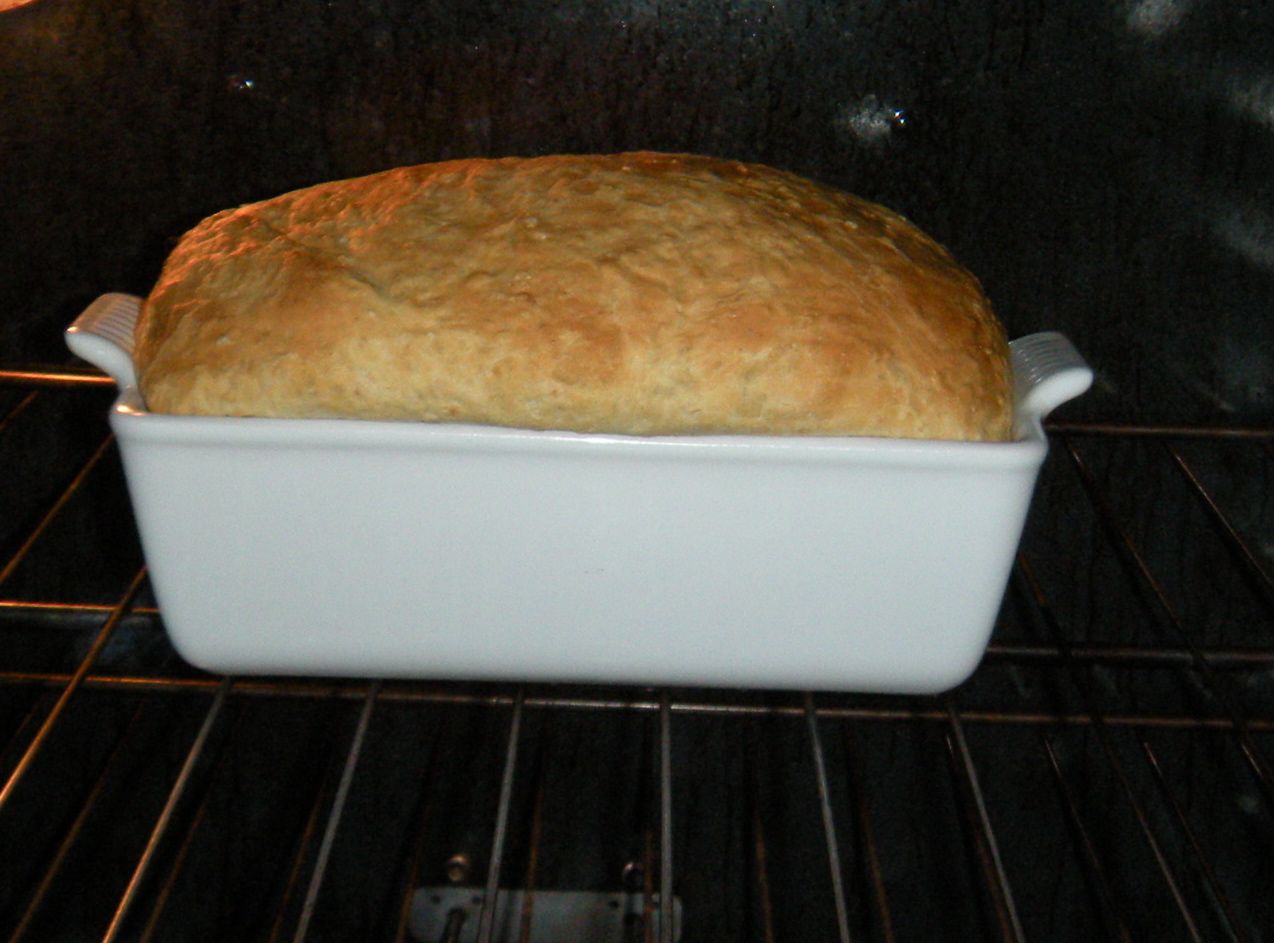
Preheat the oven to 350 degrees. When it’s preheated, gently put your bread pan into the oven and turn on the oven light so you can watch it bake without opening the oven door.

Bake for about 35-40 minutes and if the top looks like it’s getting too brown, open the oven about 5-10 minutes from the end and cover with aluminum foil. I was going to do this but the foil kept falling off and I didn’t want to burn myself so I didn’t do it.

Be sure to bake it for that long or the bread won’t be cooked through.

fresh baked in the oven

fresh baked in the oven


Your kitchen should be smelling like HEAVEN ON EARTH by this time!!!!!

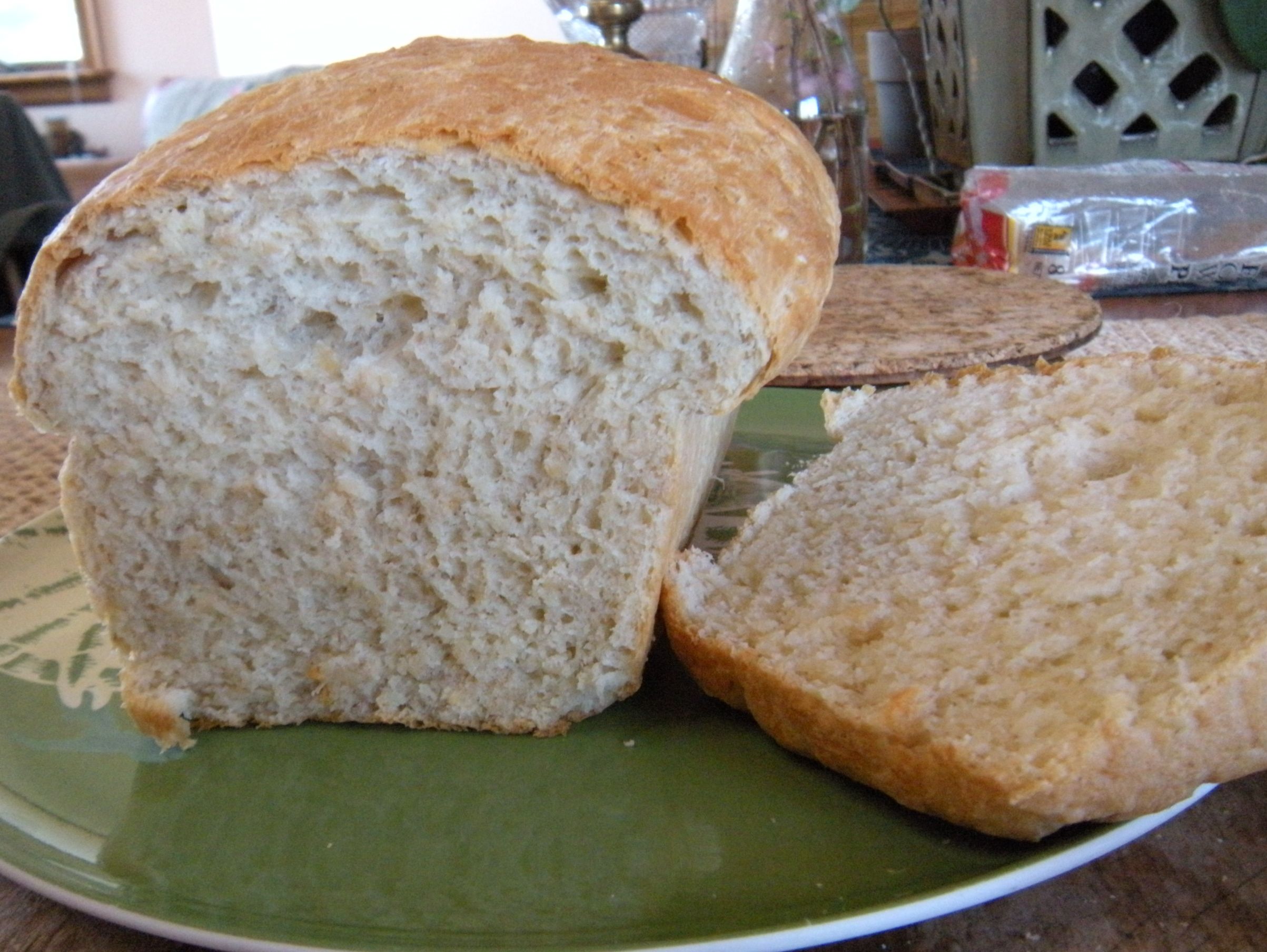
When the bread is done, let it cool a little in the pan, turn it on its side and see if the bread will come right out of the pan. If not, take a sharp knife and gently separate the bread from the inside edges of the pan. Let it cool a little more before slicing it if you can stand to wait that long.

When cooler, slice it with a serrated bread knife, VERY GENTLY, holding it on its side so you don’t smoosh the bread flat as you are gently sawing it with a serrated knife.

Then slather with unsalted butter and drizzle with a little honey.

I’ll bet you could eat the whole loaf with a friend at one sitting–really good toasted later too.

Then, you’ll wish you had made TWO loaves–although I think it’s better just to make one loaf at a time. It’s SO YUMMY!!

warm bread on the table!

warm bread on the table!


So that’s today’s post about making homemade oatmeal bread with a few photos to document this delicious entity.

Just also wanted to note that I’ve been pretty conscious of avoiding wheat these days, but I don’t think a little bit of it in this form will kill me.

           the first slice!

the first slice!

being happy . . .

May-July 2007 351_2We’ve had a long week so after G. was out all day today tending pianos, we decided to go out for a quick dinner at a local Chinese restaurant.

One of the reasons we like going to this place is a waiter named Sam, who has been there for the twenty years that I’ve lived in this town. We knew him from way back then and the three of us were happy to see each other again after such a long time away. Tonight, sure enough, I waved to Sam, returning his cheery salute. When asked, he assured me that the Shanghai twice-fried noodles were “thin” and not “thick.” We enjoyed our soup (wonton and hot and sour) and then Sam brought out a large plate of crispy pan fried noodles with fresh chicken, broccoli, snow peas and straw mushrooms.

As we ate our meal, we discussed things that were on our minds and our schedules for next week. When it was time to ask for the check, we both wanted to ask Sam what accounted for his positive attitude and why he was always so happy. We knew that he had a grown son who lived in California and had a good job working in computers; and that Sam also had some family, a sister, who lived in town that he saw on occasion. Other than that, he seemed to spend nearly all his time working in the restaurant, folding crab rangoon and wontons during slow times at lunch and serving customers.

His first response to why he was happy was that he “didn’t have any problems.” Then, when we pressed him further, he said that he didn’t think too much about things or about the future. And then, he said, “and don’t pressure yourself too much.” On his days off, his favorite thing to do is to cook for himself. When I asked him which dish he liked best to cook for himself, he immediately said, “steamed fish,” bought live and steamed with ginger, scallions, a little wine–then with some hot oil spooned over the fish. Sounded good to me. In fact, his simple outlook on life sounded very good to me too. Isn’t that what all the Zen priests say anyhow: live in the moment and don’t take yourself so seriously?

So, this bit of wisdom appeared at the dinner table tonight. Together with the huge rainbow that arched over our house yesterday morning, we should be all set. Just stop thinking about things so much ~ for me, though, that’s easier said than done!

somewhere . . .

This morning a little after 6:30, I opened up the shades in the living room and saw a gigantic rainbow shimmering in the morning light. It was raining a little and the sun was out. By the time I called G. to come and look at it, and then thought of taking photos, it had already begun to fade.

DSCN5041
DSCN5038
DSCN5036

heartache . . .

Christmas, Faculty party 07-08 023_2Who doesn’t have heartache over something? It could have happened to us when we were children, during high school or college, relationships that once were the end-all and be-all, only to fall apart. There are as many kinds of heartache as there are people, it seems.

Often, it occurs when we have something in mind or our perception of a person’s qualities that were mistaken or idealized rather than real. Sometimes it takes years, decades even, before the denial wears away and you see the person for whom he or she really is, or has become. And you ask yourself, “who is this?” rather than “what happened?” Sometimes heartaches are true and real. Others, not so much. Disillusionment is really self-inflicted heartache, you might say.

This post is inspired by an article about older people, in their eighties even, who have begun talking to therapists for the first time. As the population grows older and the older keep living, the prospect of living for another ten or fifteen years in old age shouldering anxiety, long-standing depression or heartache doesn’t seem like a very sensible thing to keep doing. Some even say they wish they had started finding new attitudes about their past and their lives earlier.

One said, “Everybody has a certain amount of heartache in life–it’s how you handle the heartache that is the essential core of your life….I found that my attitude was important and I had to reinforce positive things all the time.”

Ruminating about this, it seems to me that heartache can arise from the aspect of “blame.” Either you blame others or you blame yourself for something that happened long ago that you feel bad about. Blaming doesn’t really alleviate heartache, it just reinforces its presence. I’m all for not having heartache around. There’s enough to preoccupy us each and every day without it.

So here’s the article about “A load off their minds”.

And here’s to clearing out our own closets of heartache.

a few grains of wheat . . .

I don’t know about you, but living here in the Boston area, it seems that the police and Federal authorities are tooting their horns too much while taking credit for the capture of the two brothers suspected of the Marathon bombings.

Yes, they did post the photos and asked for the public’s help in identifying who the two suspects might be. How-some-ever, (I don’t use this made up word often but it seems to be appropriate here) it turns out that they had a file on the older brother from a visit carried out by the FBI in 2010. How embarrassing is THAT? And, yes, publishing the photos got the brothers panicked, it seems, so that they decided they needed to get away. Why did they stick around in the first place? to plant more bombs–which it seems they had on hand?

Then, the powers-that-be shut down the city on Friday because they lost track of the second brother after a “firefight” in which the older brother was injured and later died. An estimated $330 M dollars of lost commerce later at five o’clock on Friday, we were then told that it’s now “safe to come out” even though the police and the FBI didn’t seem to have a clue where the missing suspect might be. Contradictory and confusing.

But of course, as we all know now, had the Watertown fellow (David Henneberry) not been allowed outside, he wouldn’t have noticed that the tarpaulin on his boat was loose. That he had the courage and the foresight to go and get a ladder to look inside was a testament to the level of help he provided to the police. This guy is the true hero and not the ten thousand policemen hanging around all day on Friday. Never mind that Brian Williams, the NBC newscaster spoke with contempt that boats were allowed in suburban areas. Without a boat to hide in, who knows who else might have gotten hurt by the wounded and desperate nineteen-year-old trying to find refuge in that neighborhood?

So, the police didn’t find him, although that didn’t stop them from riddling this guy’s boat (reportedly costing $50K new) and showing off with a helicopter with thermo-energy registering equipment. Are you kidding us? There were about twenty shots fired. By WHOM? Kelly Tuthill, a reporter for WCVB uttered the most memorable line of the whole siege when she said in real time, “This isn’t BAGHDAD! This is WATERTOWN!” when asked if she was close enough to hear the gunshots. She and Sean Kelly did a fabulous job of staking out the last altercation which finally brought the suspect to law enforcement officers.

It sure seems like LUCK had as much to do with the suspenseful denouement of the marathon bombing as anything else. President Obama was right when he acknowledged all the law enforcement groups working well as a team together, but he added, “That’s what they’re SUPPOSED TO DO!”

Now, the FBI has some explaining to do regarding who interviewed the older brother in 2010 and what happened after that. Now, the Justice Department has a chance to embroil us into ever evolving complexity about reading Miranda rights, treating the suspect as a terrorist and where to try him, if it comes to that.

Meanwhile, the relatives, the parents of these two brothers are protesting their innocence and that they have been framed. Most of the time in these kinds of bombing incidents, the families are ashamed and embarrassed and HORRIFIED that anyone in their family could kill and maim so many people. Not so here. What’s up with that?

So, let’s not be fooled by the self-congratulatory bombast that is being aired on TV. Even Wolf Blitzer, who is not necessarily my most favorite commentator looked visibly non-plussed as he was listening to the Police Chief of Watertown go on and on about how the police captured the suspect.

Without Mr. Henneberry, (who has had a spontaneous Facebook site set up to raise funds to buy him a new boat,) the suspect could have died and not been discovered for weeks or somehow eluded capture.

Let’s look at the few grains of wheat among the piles of chaff that are being set out as fodder for the American public. We can figure things out for ourselves. Or at least, we should.

Postscript: Today, Tuesday the 23rd of April, we just saw David Henneberry being interviewed on our local TV station. When asked about how he felt about people wanting to raise money to replace his riddled boat, he said, that it was just a boat, when people had lost their lives and their legs. He said any money raised should go to those people to help them. And that besides, he has a canoe in the garage. What a great guy!–modest, humble and alert! Thank you!

A few more grains of wheat postscript: It’s now Thursday, 25 April, 2013 and the following admissions have come to light:
1. The boat WAS within the Watertown police blockade perimeter, only 4-5 blocks from where the car with pools of blood was abandoned.
2. The suspect did NOT have a gun inside the boat although Ed Davis, the Boston Chief of Police said so earlier, justifying the hail of bullets fired at the boat prior to capture.
3. The suspect was not read his Miranda rights before his confession, so it can’t be used in court against him.
4. The publicly appointed legal counsel to the suspect have to take an enforced 3 week without pay furlough due to Sequester legislation.

spring! . . .

DSCN5021
DSCN5023