mulberryshoots

"Tell me, what is it you plan to do with your one wild and precious life?" ~ Mary Oliver

Tag: I-Ching

toeing the tao. . .


So what does it mean to live a taoist life? I added a new tagline to begin the new year: “one woman’s (taoist) way of life.”

Here’s how it happened. . .

While the bottom was falling out of my life over twenty-five years ago (see eggs in one basket), someone gave me the Book of Changes, or the I-Ching, translated by Richard Wilhelm. At first, I thought it was an Oracle book, readings sought by tossing coins to focus on hexagrams that might shed light and wisdom on conundrums facing me when there seemed to be no answers in sight.

I read a lot about the I-Ching and I read the book itself a lot by throwing hexagrams and writing down in spiral notebooks all the words that were intuitively meaningful to me so that I might be able to piece together what it seemed to be saying to me about my very uncertain future.

Over time, as I filled up notebook after notebook of what the hexagrams were relating to me, I began to see a pattern emerge:

a) my questions were often too specific because I was in a rush to learn what might happen to me (yes or no questions about what to do next) so I learned to form broader and more open-ended questions, such as: “what would be helpful for me to know, or understand in such-and-such a situation?” rather than, “will this or that happen?”

b) the majority of the time, I found that I missed nuances or misinterpreted unfavorableness for favorable outcomes that I hoped would come true. In hindsight, the misinterpretations contained some ambiguity to the situation, or some ambivalency within myself that I did not want to admit or to look at.

c) sometimes the I-Ching would ignore my question altogether. And instead, tell me what I really needed to know, even if I didn’t want to ask about a particular situation.

I found that consulting the I-Ching was the equivalent to accessing one’s inner wisdom, one’s higher self and the wisdom of the Cosmos, the Sage, or whatever higher power you believe or don’t believe exists in the Universe.

And because the I-Ching is the foundation of Taoism, with quite a bit of Confucian overlay in the Wilhelm edition, I started to read about the difference between these two ancient Chinese kinds of thought.

In a nutshell, Confucian thought values society over the individual and emphasizes the importance for the individual to be acceptable and recognized by the society in order to be worthwhile. In other words, you are defined only by the judgment and alliance with what others tell you to be or do. In some ways, I find Confucianism more like “Confuse-em ism” because who one becomes is interchangeable with what one thinks others expects of them, rather than being true to oneself. Importance in the community and what others think of you supercedes what you might want to be or do.

Taoism is the individual finding your own way–like Lao Tsu and the Tao te Ching writings in which whatever you do is to do nothing and to want nothing but to be yourself without attachment. Taoist hermits are reclusive and live in the moment for its own sake.
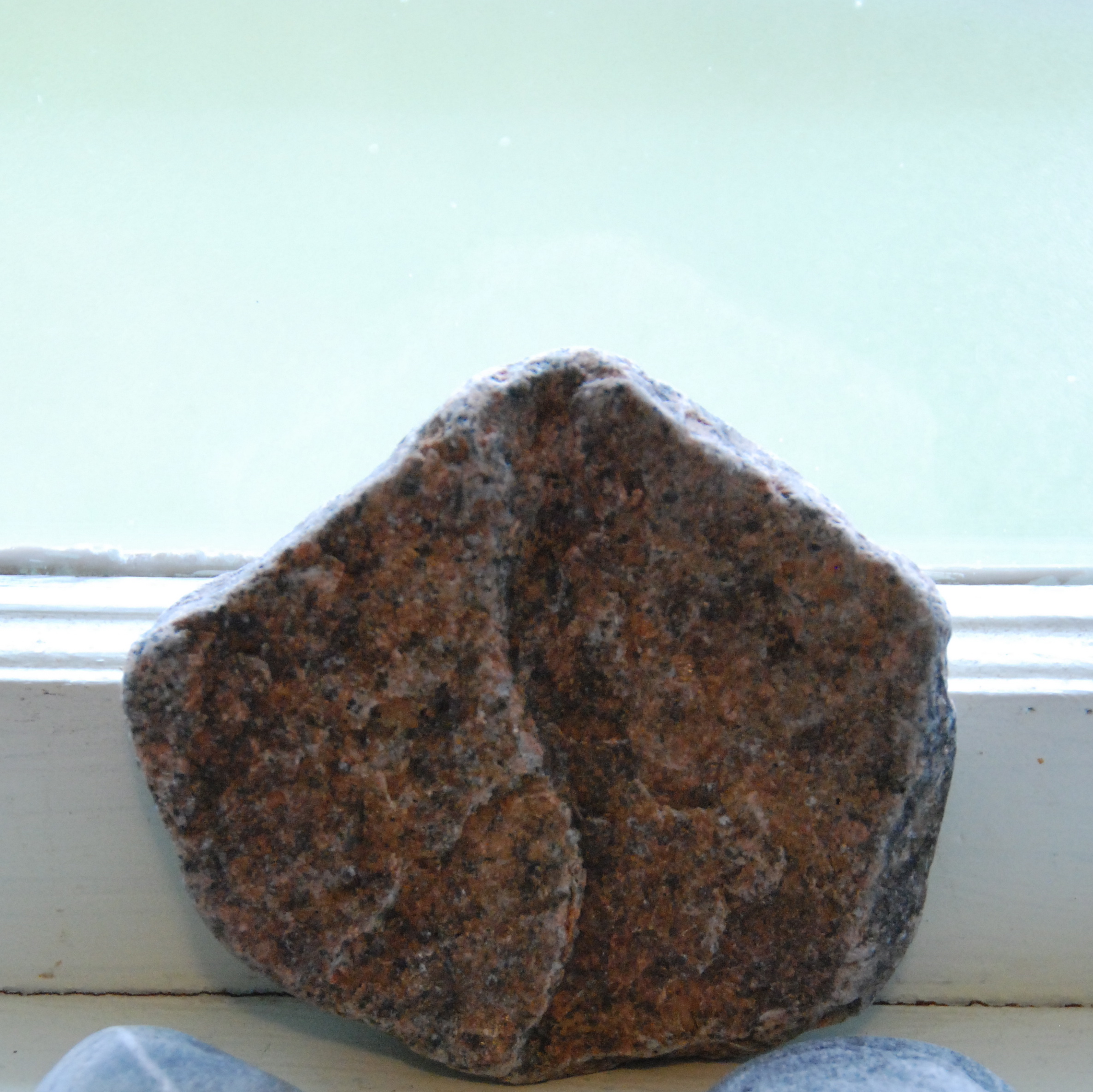
So, toeing the Tao is a way to describe letting one’s energy roam and attract like energy in synchronicity and serendipity. Something like the energy of writing about this here in today’s post.

Postscript: tonight, a new friend wrote to me about purchasing a book on the I-Ching and a number of other chance happenings, asking me what I thought the significance might be to them. My immediate reaction was to suggest that she learn how to consult the I-Ching hexagrams, and to utilize the events as a way of accessing this ancient book of wisdom. I hope that she will try it out. It is a good way to begin, and how it began for me years ago. So I wish her well. And you too.

a standstill gives way. . .

sunrise at thacher island, cape ann -- photo, a. dalton


There are periods of time when everything seems to come to a standstill. Last year was one of those times. From the autumn through the end of the year, family misunderstandings abounded. Then they took a turn for the worse. During that time, my three canaries went through their yearly moult. Silent as stones, they sat lethargically in their cages for weeks. Tiny feathers littered the floor and down floated in the air. I gave them egg food to supplement their diet; then gradually added back their usual song food. Often, it took awhile before the birds would sing again as their feathers grew back in. During this standstill, no sounds were heard at all, not even little peeps.

Two years ago, somebody gave us a good-luck money plant. It was about four inches high and sat on our kitchen windowsill. Since then, it’s had a couple of intense growth spurts. I repotted it twice and moved it into the other room as it got taller. In November, as I adjusted the support stake, the thin trunk doubled over and almost broke in half. We bandaged it with a splint taped around it, but the plant looked like it was not going to make it. Distraught, I started misting the wound where it had cracked open, four feet midway to the top, hoping that the added moisture would reach the tiny leaves above. The lower leaves began to discolor and fall off, one by one every other day.

The winter solstice arrived on December 22nd and the days began to lengthen and brighten up a little. As I cleaned the house in preparation for the holidays, I came across an old string of prayer beads made out of fossilized coral. Not knowing where to put it, I impulsively wound it around the old bronze Buddha which sat on the maple chest under the skylight. A day later, I found another string of prayer beads made of fossilized bone that I looped three times around a second Buddha, the silk tassel dangling like a pendant on the gilt statue’s chest.

One snowy day in January, I heard soft chirping noises. Short snippets of song followed. Soon, even the bird that hardly sang at all was joining the other two in song. After four months of eerie silence, a cacophony of canary song filled our rooms. Nothing had changed except the passage of time and the quality of light coming in the windows. The maidenhair fern made a comeback too. As for the money plant, we counted twelve new shoots appearing over the course of three days in the same week that the birds started singing again. As I watered the plants along the west side of the room, I also noticed that the Trader Joe orchid plants had branches of new growth with flower buds on every plant. We couldn’t believe all this was happening at once.

According to the I-Ching, a period of stagnation will eventually turn into its opposite. Change is the only thing that does not change according to this ancient book. Although I have had my share of ups and downs, it is still hard during a time of despair to have faith that things will improve again. It is human nature to worry that perhaps this time, the dark will stay forever, even though we know from experience that it is darkest before the dawn.

This dawn arrived, ushered in by a chorus of birdsong, a multitude of new leaflets on the money tree and a dozen orchid buds ready to open.

I am thankful and filled with awe. Hallelujah!

ashes to ashes . . .

My father died at the age of 89 in February 2008. My mother died at the age of 89 in November 2008. By that time, they were no longer married. And had lived apart for quite some time before they died. Nevertheless, my mother was there when a Tibetan monk was chanting Prayers for the Dead for my Dad. He had his eyes closed towards the end. My mother walked up to his bedside and his eyes flew open. She looked at him and nodded. He seemed to nod back, closed his eyes and died.

My mother died painlessly in November the same year after being diagnosed with abdominal cancer in August. She had little to say as well. Both of them were cremated according to their wishes. That year, we had ashes from both of them that we took home. For awhile, I held onto them, not knowing where, exactly, to release them into the world. After awhile, I thought that it was not a good idea to keep them wrapped up, and that in order to release their spirits wholly, our little packets of dust needed to be dispersed in a kind fashion.

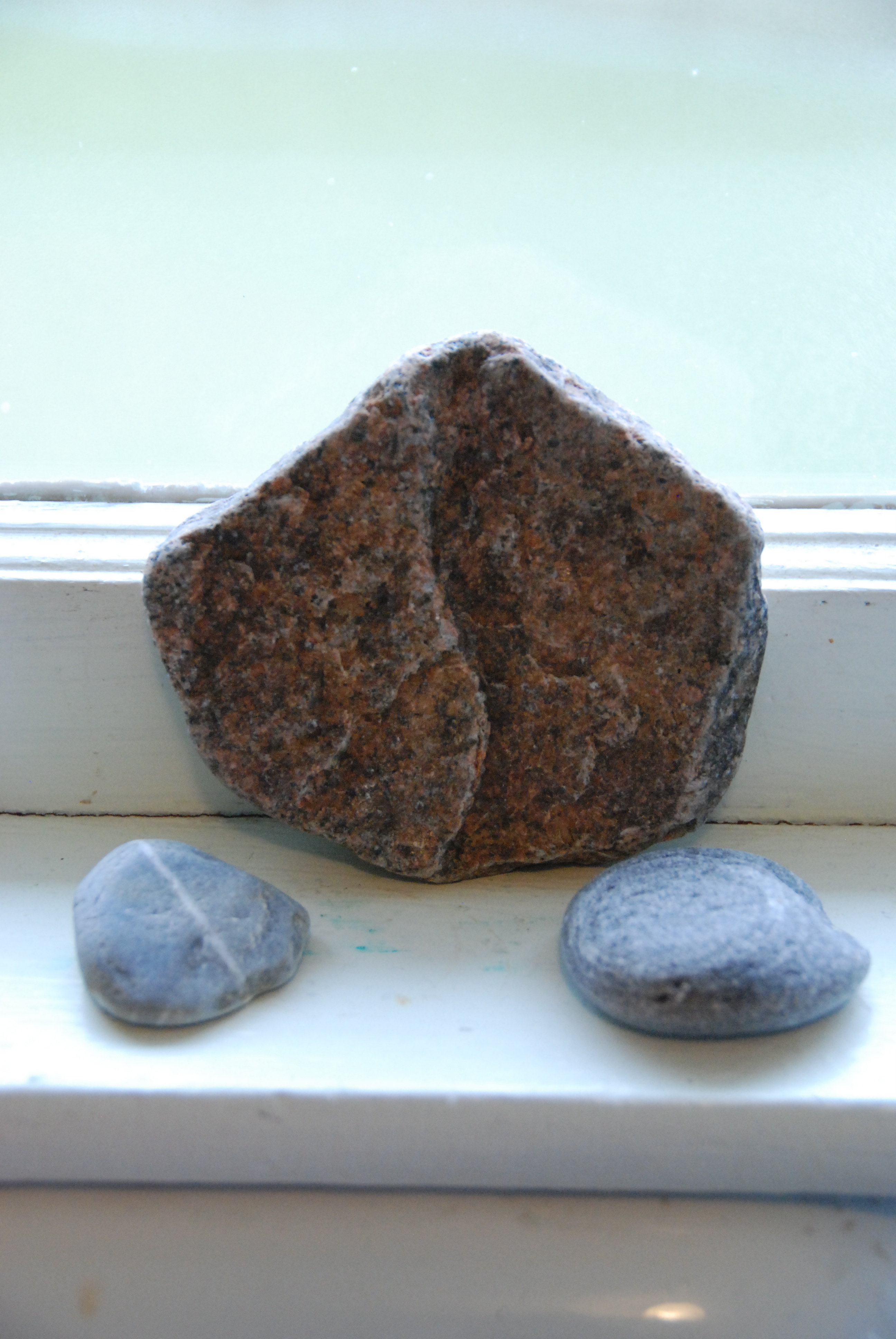
I finally decided to go to a nearby beach on the Atlantic coast of New England. It was twilight, my favorite time of day. Nobody else was there and it was low tide. I walked to the water’s edge and said goodbye as I released each packet of ashes. They swirled in the cold sea water, the dust settling as I carefully shook out the bags. I felt that it had been an okay kind of ceremony. As I turned around to walk back to my car, I took a few steps and looked down on the rocky beach. Not two minutes after I had finished releasing the ashes than there appeared two small rocks that stood out, one next to the other. One had a white straight line through it, and the other, a white circle. I felt that this symbolized my father (the straight line) and my mother (the circle.) I picked them up, feeling that it was an affirmation from them, or from the powers that be.

In about four more feet up the beach, I looked down again and saw a large flat rock with a wave indentation on it. It looked to me like an I-Ching hexagram, or a symbol of Yin and Yang. It felt to me like the Universe was giving me comfort that this release of my parents’s ashes was appropriate and well-received, in some way–or maybe it was just their way of saying a last goodbye.