mulberryshoots

"Tell me, what is it you plan to do with your one wild and precious life?" ~ Mary Oliver

Category: Food

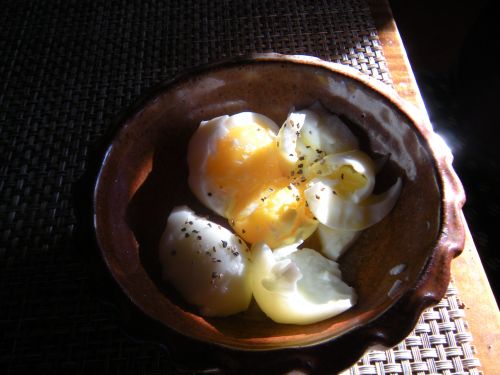
perfect soft-boiled eggs (to me). . .

soft boiled eggs

For years, I have been making soft-boiled eggs for breakfast. When the eggs are organic, free-range, whatever, there’s nothing more pure in taste than a nicely turned out soft-boiled egg. The white is not runny but still tender and the yolk is warmed through and runny just enough. How to do it consistently?

I read somewhere a few years ago to boil eggs this way. Bring a small pot of water to a full boil without the eggs. This is the trick. Once the water is boiling, slowly lower two fresh eggs into the water. Set the timer to six minutes. (five if you like runnier eggs) When the timer goes off, pour the boiling hot water off into the sink and run the eggs under a cold water faucet. Drain and enjoy!

I like to sprinkle them with Maldon salt and cracked pepper. Sometimes I’ll add a dab of Chinese oyster sauce – a habit from my Dad who ate them that way every morning when it was prepared for him.

So, there you have it on this quiet, sunny, dry Sunday morning.

And good morning too!

it’s almost summer! . . .

it's almost summer! . . .

it’s almost summer! . . .

Now that we’re approaching Memorial Day, we’ve “fired up the Barbie!” as they say in Australia & New Zealand. Ours is a modest cast iron hibachi like the Japanese use because we prefer cooking over real charcoal briquets and wood-chips to cook and flavor our food.

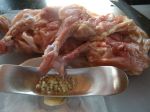
Recently, I’ve marinated some flank steak (yesterday) and chicken thighs (today) to grill on the hibachi. After breakfast today, I “butterflied” the chicken pieces by cutting all around the thigh bone so that the meat is flattened out, more surface area to soak up the marinade and easier to ensure that they are cooked through without burning the outside while the inside is still too pink.

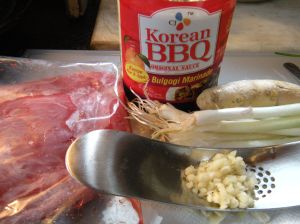
The marinade is the same for both the flank steak and the chicken: About a half cup of Korean barbecue sauce that you can find at asian markets; 3 fat cloves of crushed garlic, slivers of fresh ginger root and 3 scallions, washed and sliced.

flank steak marinade ingredients

flank steak marinade ingredients

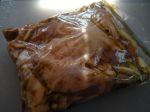
The meat fits conveniently into a sturdy sandwich bag along with the marinade and I squish it around so all of it is evenly distributed. Then I pop it into the fridge until about an half hour before I’m ready to grill – about the time I start the coals and give them plenty of time for the fire to calm down – not too hot but a steady cooking heat.

Here’s a photo of the “butterflied” raw chicken thighs:

"butterflied" chicken thighs

“butterflied” chicken thighs

chicken, marinating

chicken, marinating


And the piece of resistance – the chicken browning on the charcoal grill (below).


Bon Appetit!

chicken browning on the charcoal grill hibachi! Yum!

chicken browning on the charcoal grill hibachi! Yum!


(big & chewy) ginger-molasses cookies . . .

ginger molasses cookies title

A couple of weeks ago, I posted a recipe and photos of some crispy, thin gingersnap cookies. They were good (enough) and we enjoyed them but the other day, I picked up ONE gigantic ginger-molasses cookie sprinkled with sugar at Idylwylde Farm. G. and I split it and we thought it was one of the best things we’ve ever eaten. It was moist, chewy and full of flavor.

We’re having a visit here this afternoon, playing some piano music and so I thought there might be enough time to try making these large ginger-molasses cookies to have with tea.ginger molasses cookies 1

Here’s the recipe that I found online that I’m going to try – I added a little more of the spices and thought of one inclusion that might make them interesting: chopped up candied ginger (a la chocolate chips in cookie batter) which might give the cookies a little more “zing”. One thing I might try next time is to substitute light brown sugar for the granulated sugar.

a "six-pack" of large ginger-molasses cookies . . .

a “six-pack” of large ginger-molasses cookies . . .


carrot-orange cake . . . and music too!

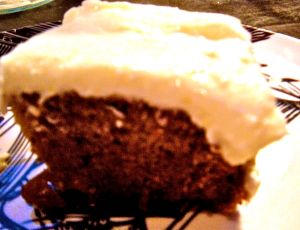
carrot-orange cake with cream cheese frosting. . .

carrot-orange cake with cream cheese frosting. . .

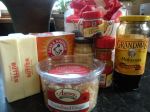
For years, I’ve made this carrot-orange cake because it’s a favorite with my family. It’s a little different from a straight carrot cake recipe because it includes orange zest and freshly squeezed orange juice (navel oranges) in both the cake batter and in the cream cheese frosting recipes.

By trial and error, I’ve discovered that hand-grating the carrots (washed but unpeeled) on a box grater works the best because the grated shavings are light enough to stay suspended in the cake batter. One year, I used a Cuisinart to “grate” the carrots and they turned out to be too finely ground – and sank heavily into the bottom of the cake! This hand-grating on the hole side of the box grater takes awhile and is the most laborious part of the recipe but it’s really worth it.

The other tweaks that I’ve made to this classic recipe (mine was from Bon Appetit,) are using golden raisins instead of dark brown ones, slightly heaping teaspoons of cinnamon and ground ginger, slightly more than half a teaspoon of nutmeg. And gently folding in the grated carrots and golden raisins at the end in an up-and-down motion with a rubber spatula (similar to folding beaten egg whites into a souffle.) carrot cake 1

For the frosting, I use two packages of Philadelphia regular cream cheese (not non-fat) and ONE stick of unsalted butter rather than two. I also only add as much confectioners sugar (one heaping cup rather than five cups) as the frosting will taste slightly sweet, but not as (overly) sweet as what the recipe calls for. Fresh orange juice and grated orange zest liven up the frosting as well.  Instead of cutting the cake horizontally as the recipe suggests, and because it is such a dense, moist cake, I frost it right in the pan just as it is. A small square serving of frosted cake goes a long way!

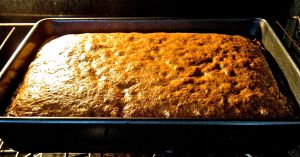
It is baking now and smells divine. This carrot orange cake will be shared with my 97-year old mother-in-law who lives across the street, a few friends to whom I’ll take some tomorrow – and the rest will be shared with those who are close by.

Oh, and by the way, an old friend who’s a pianist recommended Leon Fleisher’s 1987 recording of Beethoven’s “Emperor” concerto conducted by George Szell (“listen to the longest, most fabulous diminuendo that goes on forever at the end of the second movement!”) Seems like a good pairing to me: eating homemade carrot-orange cake with cream cheese frosting while listening to Leon Fleisher playing the “Emperor” in his heyday! Doesn’t get much better than that!

And happy mother’s day too!


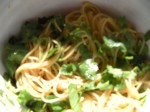
asian noodle salad, rebooted . . .

DSCN9500

G. and I thought the asian noodle dish was exceptionally tasty – light and refreshing. We finished almost all of it, believe it or not, and had about a cup left over.

So, this morning after breakfast, I prepared and added these ingredients to that leftover salad:

  • DSCN9493another batch of cooked angel hair pastaDSCN9497
  • 2 tiny carrots cut on the diagonal
  • a handful of chopped red cabbage (so convenient in a bag in the salad section)
  • 3 inches of English cucumber, the sides sliced finely – the seeds discarded
  • a chunk of fresh cilantro leaves
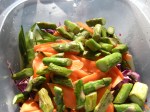
  • asparagus tips that needed to be used up sauteed in coconut oil in a skillet
  • 1/3 cup leftover marinadeasian noodle salad, rebooted

When the pasta was well-drained and still steaming, I poured the leftover dressing on it. I then added the cilantro to the warm noodles and stirred it together. To the vegetable mix, I added the dressed noodles and combined all together.

The dressing from the noodles seemed to be enough for the vegetables too. If not, I’ll make a little more and add it right before serving it tonight. In the meantime, it’s now in the fridge with plastic wrap covering it. Will serve it along with some lamb rib chops, a la Julia Child (mustard, fresh rosemary, garlic) glaze in the skillet for dinner tonight.


whole-meal composed salads . . .

a classic nicoise salad (courtesy of Pinterest)

a classic nicoise salad (courtesy of Pinterest)

For a long time, I’ve been trying to transition my cooking/meal preparation habits from the standard baby-boomer generation meal of protein, potatoes/grains, vegetables and perhaps a salad on the side. I haven’t been very successful up to now until I was introduced to the concept of a whole-meal chopped salad such as those popular in California and elsewhere. It also offered a new outlook to combine a number of green vegetables like kale and romaine together rather than just one or the other in a salad. Old food habits die hard, I guess.

Anyhow, the leap-frog to the idea of a whole meal composed salad occurred when I came upon some new salad dressings and garnishes that made eating raw greens as the main feature of dinner both palatable and also interesting to prepare.

So, I’m sharing some of these ideas in case you’d like to experiment with them yourselves:

SELECT GREENS from: fresh kale, romaine, napa cabbage, fresh spinach, arugula, lettuces. De-stem, roll leaves together and slice thinly. Kale and romaine are especially good together.

GARNISHES (choose from):  chopped scallion, chopped chives, maple salad walnuts, honey toasted salad almonds, golden raisins soaked in warm orange juice, craisins, fresh orange segments, pomegranate seeds

Toss the greens with the garnishes and set on a dinner plate as the composed salad base. Then, choose from various veggie and protein choices that complement the salad on the plate.

VEGGIE CONDIMENTS: sliced avocado, cherry tomatoes, sliced hard-boiled eggs, boiled creamer potatoes sliced in half, boiled green or yellow string beans, caramelized sliced brussels sprouts etc.

PROTEIN CONDIMENTS (to choose from): seared fresh tuna dipped in sesame seeds and sliced thinly; teriyaki salmon, shrimp scampi, marinated beef ribeye cut into strips; chicken tenders, prosciutto ham

(We’ve been surprised by how little salmon we need to buy to make one piece grilled in a pan with teriyaki sauce and divide it into servings on top of two salad dinners.)

But the real linchpin for me that makes this whole meal salad thing work is a salad dressing that is delicious enough to eat often and that harmonizes with the cornucopia of ingredients at our disposal as suggested above. Even better, these dressings are made ahead of time and are ready to use when composing the salads.

I’ve found two that we enjoy; both of them are derived from the Hillstone Restaurant chain to which I was introduced in a Bon Appetit review article (http://www.bonappetit.com/restaurants-travel/article/hillstone.)

One is a fresh-basil vinaigrette with fresh lemon juice from the Napa Grille Restaurant (http://www.popsugar.com/food/Kale-Chopped-Salad-From-Napa-Valley-Grille-Recipe-Video-30110625)

and the other is a buttermilk garlic dressing from Houston’s (http://www.food.com/recipe/houstons-buttermilk-garlic-salad-dressing-80631.)

With this shift in emphasis, our refrigerator is a bounty of washed greens and dressings that are ready to serve; our pantry yields tasty, crunchy and appetizing garnishes; and a small fresh serving of protein can be whipped up in a very short time just before serving dinner.

Hope you might also enjoy experimenting with this way of eating: prioritizing fresh greens and de-emphasizing large servings of protein.

It’s healthier, it’s a lot more economical and now, we’ve found it to be even more delicious!


a winter supper . . .

flowers and candlesGjelina, a restaurant in Venice Beach, California, serves simple vegetable dishes and has recently come out with a cookbook. It arrived on Sunday and the dishes looked appetizing, promising flavors that might be more complex than usual.

Since we are wanting to pare down on all the things that we should be eating less of (red meat, potatoes, sugar and bread) I thought we’d try changing our mindset so that we would share a vegetable dish as our our dinner, rather than as a side dish to add to a heavier meal.

Michael Pollan, in his little paperback called “Food Rules” says basically that we should eat primarily what grows above the ground (greens) and eat less, stopping when we feel 70% full. Thus, I thought it might be a novel idea to shift our expectations and cut down by sharing a vegetable side dish that preserved flavor and that also retained foodie cooking flair that I would miss terribly if all we ate was steamed green vegetables! I took macrobiotic cooking lessons years ago and while it might be healthy, it wasn’t long on flavor or culinary interest, at least not to me.

So tonight, I roasted orange beets, marinated them in a sherry vinegar, orange juice, olive oil dressing to which I added avocado and fresh segments of mineola oranges, topped with toasted, crushed hazelnuts. It was satisfying and tasty too. Next time, we thought we’d put this dish on a bed of arugula and watercress greens.

vegetable dinner

Other dishes in the line-up for supper this week are cooked coarse corn grits (polenta) topped with a fresh mushroom melange and a poached egg on top; roasted acorn squash with brown butter and fresh rosemary and caramelized Japanese sweet potato wedges served with yogurt and fresh lime sprinkled with sliced scallions. A bountiful green salad of arugula, baby spinach, watercress with a sharp soy-ginger-lime vinaigrette might be tasty alongside. Or add some garlicky shrimp scampi to the aforementioned green salad.

To break the monotony, I did come home with a Bell & Evans organic chicken that I’ll brine on Wednesday and roast with potatoes for dinner with an old friend on Thursday night. AND, since fresh crabmeat from Maine is still available, I might make a crabmeat quiche as a treat for the weekend!

And so it goes.


fresh lemon rosemary shortbread cookies . . .


Tonight’s dinner consists of fresh ginger marinated thin ribeye steaks grilled and sliced over a large green salad with arugula, lettuces, cucumber and grape tomatoes. The dressing contains a touch of jalapeno pepper and some fresh lime juice.

ginger steak photo for blog

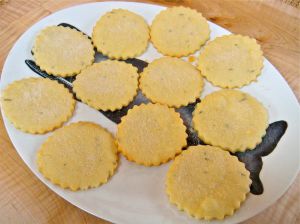
To complement it as a small sweet for dessert, I thought I’d make half a batch of Meyer lemon fresh rosemary shortbread cookies.  I didn’t have enough flour to make a whole batch – and just as well because we probably shouldn’t eat so many of them. Lemon zest grated on the microplane, fresh rosemary leaves chopped up (left over from making lamb loin chops over the weekend); one stick of unsalted butter, lemon juice, vanilla, flour and salt completed the ingredients list. The dough is chilling in the fridge for an hour so I thought I’d take a few minutes to write up this short post for a shortbread cookie experiment.

When the dough is chilled, the recipe calls for rolling it out to about 1/4 inches thick and cutting out cookies to bake about 10-12 minutes in a 325 degree oven.

And, here they are! Scrumptious!

lemon rosemary shortbread cookies


homemade turkey stock . . . our best kept secret for Thanksgiving dinner!

branches with fruit found around the pond with our 19th century "self-portrait" of Rembrandt

branches with fruit found around the pond with our 19th century “self-portrait” of Rembrandt

The day before Thanksgiving is the day that I dedicate to making the turkey stock for gravy. As I’ve learned, gravy and stock are two different things. The gravy is what you serve with the meal – but the stock is what goes into the gravy along with the last minute drippings when you’re almost ready to eat.

I read somewhere that if the gravy for your Thanksgiving dinner is full of robust flavor, whatever you put it on (the roasted turkey, stuffing or mashed potatoes,) will ensure that the entire meal will taste delicious!

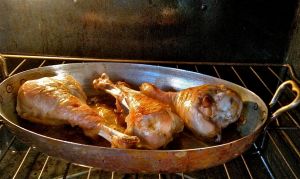
Made sense to me so for the past couple of years, I’ve been fine-tuning the stock that I use for gravy. I used to take the neck and giblets out of the fresh turkey, saute them with some vegetables and add water to make the stock on the morning of the big day. But I’ve graduated to making the stock from roasted fresh turkey parts (sometimes wings or this year, drumsticks.) Instead of all water, I use half water and half chicken broth. Plus, I do all this the day before so that the house smells wonderful and the stock has a chance to be de-fatted overnight.

Because I’m also providing roast chestnut dressing and gravy for a second Thanksgiving gathering on Saturday, I decided to make double the amount of stock just to be safe. It’s not a good idea to run out of gravy as there’s little you can do about it at the last minute when that happens – and when it’s tasty, people seem to want more of it than you’d think! Been there, done that (run out, that is.)

turkey drumsticks for stockThis year, I browned and roasted three turkey drumsticks. Cut up a large vidalia onion, five stalks of leafy celery, 5 large carrots and browned them in butter in a pan with Bell’s seasoning and salt in a stockpot until the drumsticks were done. Then cut the turkey meat, placed it with the drippings into the stockpot of sauteed vegetables and added spring water to cover. Skimmed off any foam and then added two cans of Swanson low-sodium chicken broth. stock vegetables

Will now barely simmer the stock for a few hours. Taste for whether it needs salt along the way. When cool, will strain the broth and de-fat it after it’s spent the night in the chilly pantry. Tomorrow, it’ll be ready to go when the drippings from the roasted turkey are available.

When almost ready to eat, I’ll melt a stick of unsalted butter in a large pan, gradually add about 1/2 cup flour (for this double amount of stock/gravy) and whisk together to make a roux, add some stock to thicken, add roast turkey drippings, add more stock little by little until the gravy is the consistency desired. Taste and season with Maldon sea salt and cracked black pepper.

This may seem like a LOT of trouble to go to for turkey gravy. But in our family, the gravy is second in importance to the primary one – which is the roast chestnut stuffing (cooked inside the bird!) – and the actual roast turkey almost seems like an afterthought around our table (just kidding, sort of)!

Happy Thanksgiving one and all!

(and many thanks for reading my blog!)


‘meat pies’ . . .

meat pies 1

On our trip to New York City to see “the King and I,” my daughter C. mentioned the meat pies that she and her husband were given to eat on their way back from Europe this past summer. This got me thinking about those traditional Cornish pasties and other meat pies that the British are so famous for and I began to think about various experiments that I could carry out for something easy to make and also would taste delicious (plus store in the freezer!)

So, rather than buy beef stew or other cuts of meat that would require long cooking in order to be tender, I chose to use 80% ground beef (otherwise known as hamburger.) The 80% lean to fat ratio has a lot of flavor and I can also buy it in smaller packaging rather than those humongous blocks of ground beef that they sell at the grocery store. I also thought large chunks of fresh mushrooms and plenty of vidalia onion would be sufficient, simple ingredients to combine with the beef.

Instead of making my own crust, I decided to try this first batch out using ready-made in the box Pillsbury pie crusts from the dairy aisle bin. I opened them up and used a soup bowl as a template for size and then rolled them out just a little before adding the cooled filling.

All the meat filling took was some care first browning the chopped vidalia onion, then adding the big chunks of mushrooms and resting that mixture in a bowl while I browned the ground beef in the electric skillet. Once the beef was almost done, I sprinkled on Lawry’s garlic salt and some coarse pepper. Added the mushrooms and onions back in and stirred it together. Once it was cooled, I tasted it and it seemed to lack enough salt. So in went some pinches of Maldon salt which I stirred in while still warm.meat pies 2

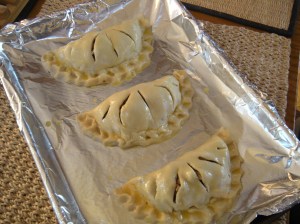
Since it would have wreaked havoc to try to fill the pie pastry with the meat mixture until the latter was completely cooled, I swept the floor and cleaned off the crumbs from the placemats on the table. When it was time to put everything together, I rolled out the pie crust rounds a little to give more room for the filling and put in enough of it so that the pastry would hold it, the edges rolled up all around the pie and then the roll crimped by hand in order to provide a double seal for the juices.

Small cuts with a sharp paring knife allowed for steam to escape from the pies and a light wash of egg plus water was brushed over the entire little meat pie. Then into a 375 degree oven. I baked the first batch about 20 minutes and then left it in about 8 minutes longer just to be sure the crust was browned enough but not burned on the bottom. They looked pretty good!DSCN8742

While the first batch was baking, I formed four more pies and covered them with a clean dishtowel. There was a small bit of meat filling left so I divided the leftovers into two individual serving-size ramekins for our supper tonight. To plump up the ramekins, I found a russet potato in the pantry, rinsed it off and put it into the oven to bake along with the meat pies. Later on, I’ll scoop out the baked potato when it’s cooked and mash it with some light cream and butter to put on top of the ramekins for a mini-shepherd’s pie for our dinner tonight.

The second batch of four meat pies came out looking pretty nice too – and the only reservation that I have about any of this is 1) of course how do they taste? and 2) whether there will be any left to freeze for return airplane trips after Thanksgiving.

We have been having glorious weather – temperate, sunny, gorgeous sunrise and sunsets. There’s something in this New England Fall air recently that is so delightful in these mid-November days. I wonder what it is?