mulberryshoots

"Tell me, what is it you plan to do with your one wild and precious life?" ~ Mary Oliver

Category: Food

supper . . .

It started to get hot today, the air conditioning kicking on when it reached 82 degrees. There was a strong breeze though and the humidity wasn’t that bad. For dinner, there was a pack of Bell and Evans chicken thighs that I rinsed in cold water this morning and then marinated in some Korean Bulgogi barbecue sauce. I left it covered in the fridge and then took it out mid-afternoon, turning the pieces over in the marinade and then covering the top with a plate.

I would have liked to grill the chicken on our little cast iron hibachi out on the back deck since it’s so warm, but some birds, (we think they’re robins,) built a nest in the alcove right under the hibachi. There don’t seem to be any eggs there to hatch, but the birds come in for a rest stop every once in awhile. (How would we like to be out in the pouring rain if we were birds?) Anyhow, that’s why the hibachi is out of commission, at least for right now.

. . . nest built under the hibachi on the back deck

. . . nest built under the hibachi on the back deck


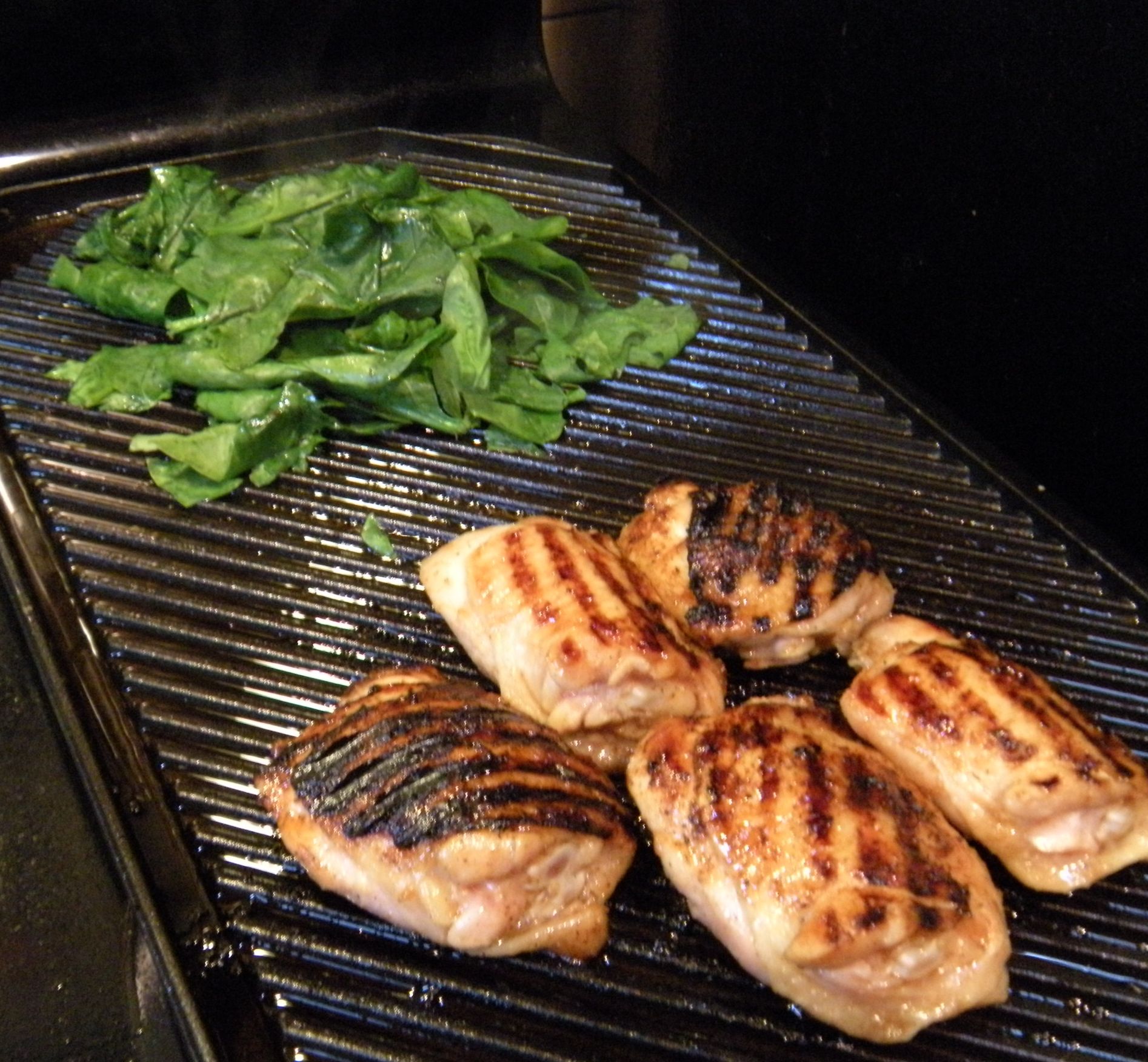
So I took my rectangular grill pan and set it on two burners. I really like this piece of equipment because you can cook food quickly on it and it makes those nice grill marks on the food afterwards. All we’re missing is the flavor of mesquite. For our other course (remember, just two a meal,) I’ll pan fry some fresh spinach until it’s just wilted, turn off the heat, dress with a little organic Ohsawa soy sauce and a squeeze of fresh lemon juice.

Here it is: simple and healthy.

. . . teriyaki chicken and fresh spinach on the grill pan

. . . teriyaki chicken and fresh spinach on the grill pan

Oh, and apple tart for dessert while we watch the Bruins tonight.

. . . apple tart baked this morning

. . . apple tart baked this morning

tarte aux pommes . . .

. . . apple tart with preserve glaze on top (peach, cherry & apricot)

. . . apple tart with preserve glaze on top (peach, cherry & apricot)

I was knitting this morning when I remembered that game three of the Bruins/Blackhawk Stanley Cup Playoffs is on tonight at 8 pm. Since championship playoffs hold a heightened air of expectation, I usually like to have something to have on hand to munch on. If you’ve seen the movie, “Silver Linings Playbook,” you’ll remember the “homemades” and other snacks that were always prepared for each football game that Robert de Niro’s character would bet on to win.
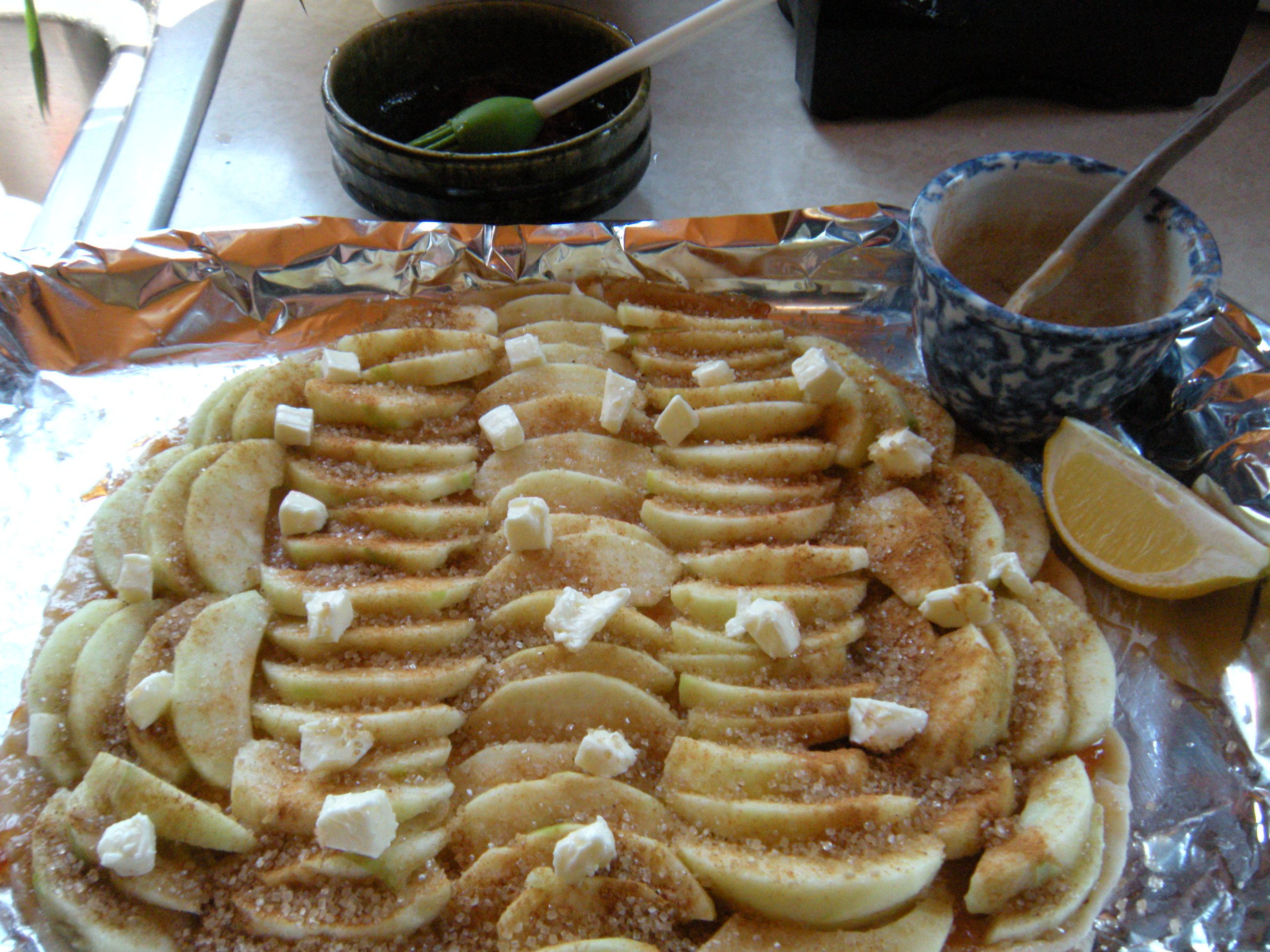
apple tart 1
In any case, I wanted to make something with what I already had on hand: one Pillsbury pie crust in the fridge; three Granny Smith apples in the pantry and some peach/cherry/apricot preserves in the door of the fridge. I’m a fan of less crust, not more, so I’ve been making French tarts with thinly sliced apples, adapting Julia Child’s recipe but simplifying it with pre-made pie crust. These thin tarts are less mushy and require peeling only three rather than eight apples to fill a full apple pie. I butter the foil on the pan before unfolding the pie crust; then brush the crust with slightly warmed preserves on which to place the apples.
apple tart 2
After the apples are peeled and cored, they’re sliced really thin and placed in opposite facing rows, a small conceit that makes the tart look more fabulous than it deserves. Then I mix turbinado sugar (a heartier sugar) with ground cinnamon and nutmeg. Sprinkle the top of the tart, dot with unsalted butter, a squeeze of fresh lemon and then place into the middle of a 400 degree preheated oven for about 20 minutes.
apple tart 5
Not quite finished, I take the tart out of the oven and then gently brush the jam lightly over the top, covering the whole thing with a kind of fruit glaze. Back into the oven for about twelve more minutes.

And voila! as the French say–a nice apple tart from a mere handful of ingredients I didn’t even remember that I had on hand.

I think we’ll serve it plain in small wedges tonight but it’s also really good with Haagen Daz vanilla swiss almond ice cream. Or a small dab of creme fraiche, come to think of it. Fingers crossed for the Bruins to win tonight!
apple tart 6

pasta plus . . .

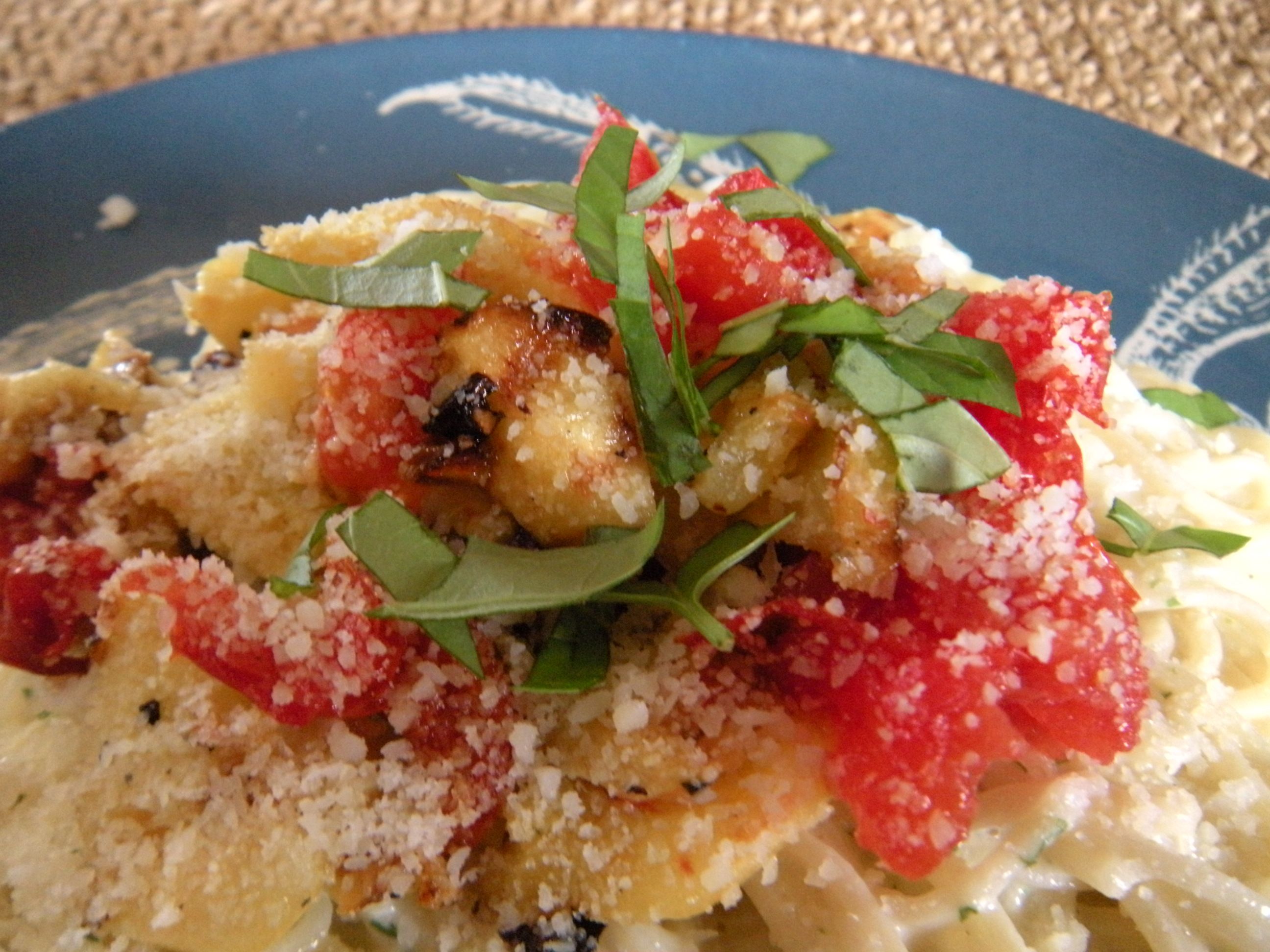
pasta plus closeupTonight, I prepared a new dish for supper which I thought would be easy to make. I had bought some summer yellow squash and some gorgeous tomatoes plus fresh egg pasta at Idylwylde Farm that I thought might be nice to make a meal together.

It took a lot longer than I had thought to prepare:

a. peel and cut the squash lengthwise, then diagonally in bite size pieces
b. rinse rectangular grill pan and heat on a rack about six inches from the broiler
c. mix with my hands the chopped squash with three cloves chopped garlic, grapeseed oil, a little Lawry’s garlic salt, sea salt and coarse pepper
d. spray heated grill pan with vegetable oil; spread squash out on the grill pan and broil until golden brown (about 15 minutes)
e. cut up a large fresh tomato in small wedges
f. after removing the squash, spray again and spread out the cut tomato pieces; sprinkle tomatoes lightly with a little sugar to caramelize and brown under the broiler (about 10 minutes.)
g. In a nice serving bowl, spoon the squash on the bottom and add the broiled tomatoes on top. Cut up some fresh basil leaves and scatter on top.

ALFREDO PASTA:
a. Boil salted water and add fresh pasta after pulling it apart before dropping it into the pot; cook for about 3-4 minutes tasting at intervals until it is soft enough and also slightly al dente
b. In a separate saucepan, melt three quarters of a stick of unsalted butter; saute 2-3 cloves of chopped garlic; when golden, add a small container of cream and heat gently. Add fresh or freeze-dried parsley
c. Vitamix a chunk of parmesan reggiano cheese; add a half cup of the grated cheese to the cream, stir gently to mix and take off the burner.
d. Drain cooked pasta well, do not rinse in cold water, just shake it a few times in a colander to extract the water. Run a knife through the cooked pasta to make the strands more manageable. In a clean large bowl, pour the parmesan cream mixture. Add the hot drained pasta and mix well with the parmesan alfredo cream.

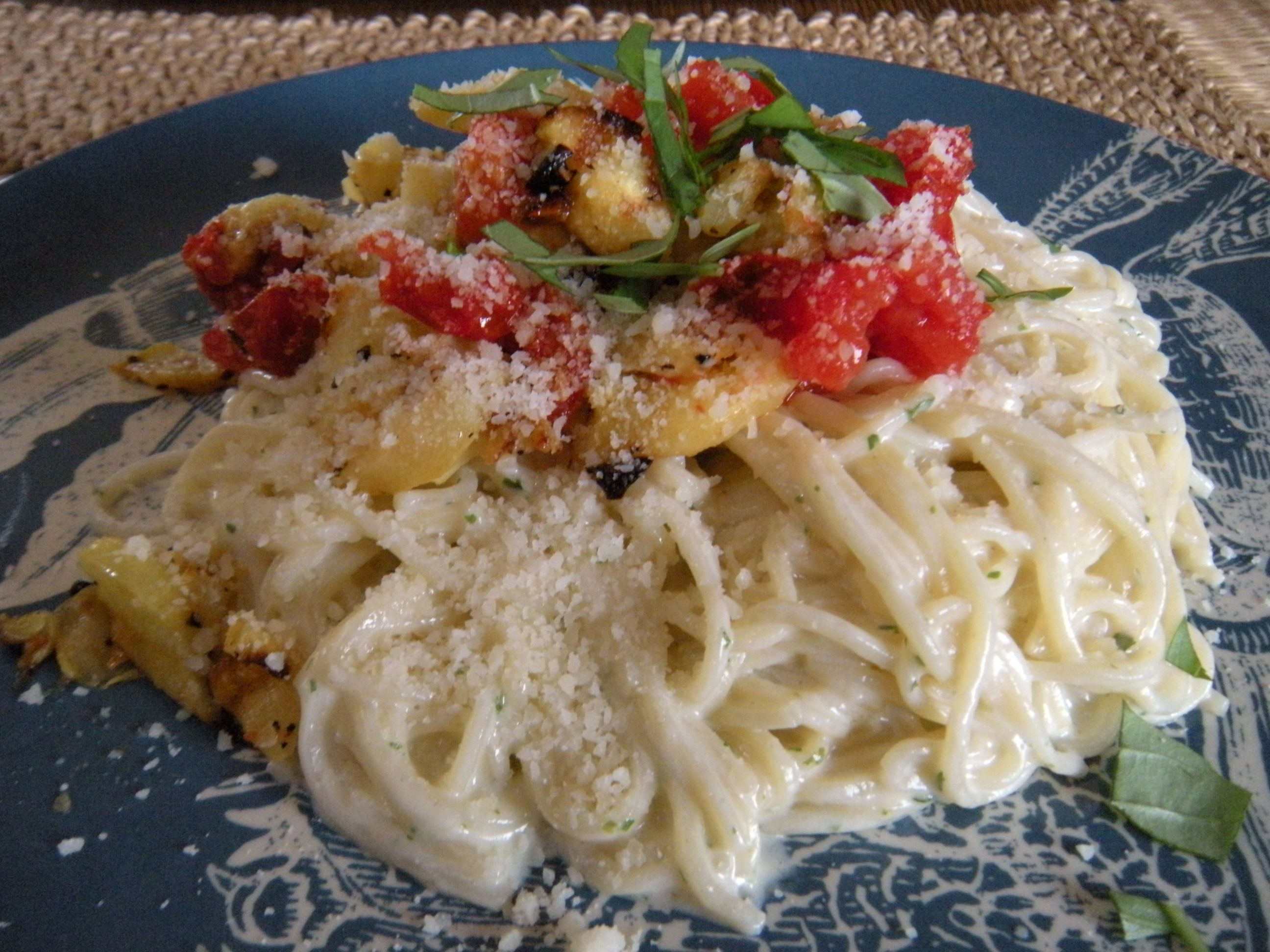
On dinner plates, serve some of the alfredo pasta in a circle; add grilled vegetables on top, sprinkle with more parmesan cheese and fresh basil leaves on top.

The dish was surprisingly tender and full of flavor. It made a big difference to dry roast the vegetables rather than cooking them in a skillet.

I have to warn you that I got a little cranky with all the broiling (once for the squash, another for the tomato); making the alfredo sauce while testing the pasta for doneness. While I was cooking in the warm kitchen, it reminded me how much simpler my cooking has become (at least most of the time!)

But it was a nice change of pace and I have to tell you, it tasted really good! Yum!
pasta 3

lemon poppyseed . . .

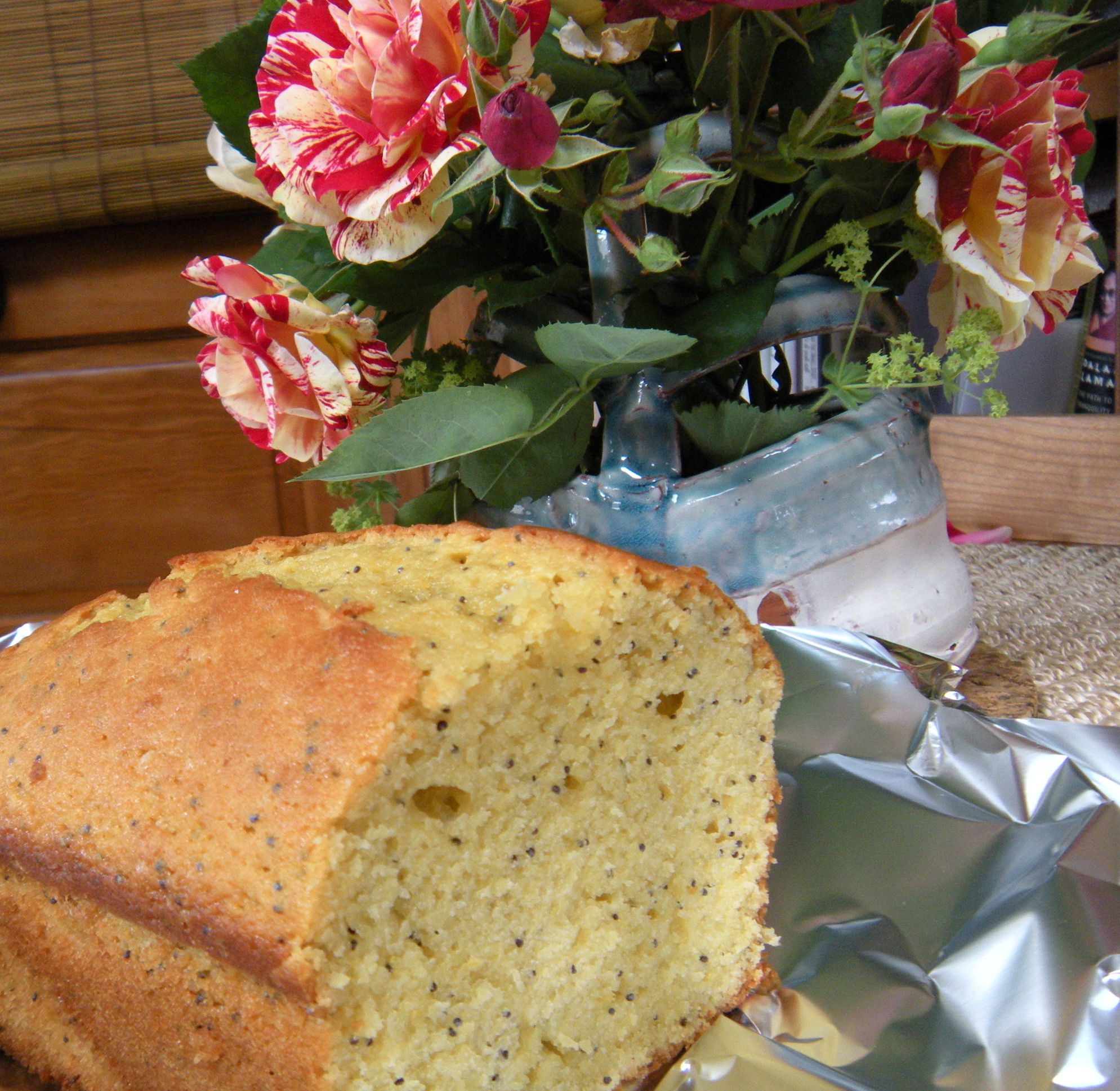
. . . lemon poppyseed pound cake in the pan

. . . lemon poppyseed pound cake in the pan


I was looking for something to have after dinner while we watch the first game of the Bruins-Blackhawks Stanley Cup Playoffs tonight. There have been times when I have reminded G. how fortunate he is that I am one of those wives who actually enjoys watching action movies and sports. Typically, we watch the Red Sox, then the Patriots, less often the Celtics (there’s something off-putting about them) and the Bruins when they put up a save like that seventh game playoff against the Toronto Maple Leafs, trailing by 3 goals in the 3rd period, tying the game and then winning in overtime. I mean, c’mon, I may be a fair-weather hockey fan but I’ve been loyal watching them beat the Rangers after the Toronto thriller, then the Penguins as the underdog team in a shutout, four games to zero! Now, we have at least four games more to watch. It’s hard to visually follow a hockey game I think–but it’s fun to watch when they win. And they have been doing that rather well, lately, barring Campbell breaking his fibula and out for the rest of the season. Since I’m usually knitting something, it’s a good combination while watching sports on TV.

So back to making the pound cake, I had the TV turned to a channel showing repeats of “Bones,” the forensic mystery cum romance which is surprisingly fun to cook by. I followed Melissa Clark’s recipe from the Times today. I wondered how many readers would know how to zest two lemons (using a microplane) but no matter. Mixing turbinado sugar and fragrant lemon zest with my hands felt really wonderful, it turns out. Adding eggs, buttermilk and then olive oil? was, well, surprising. I dutifully buttered and floured my wonderful cast iron white porcelain Le Creuset loaf pan and put the cake into the oven to bake for an hour.
lemon poundcake with flowers

As the loaf cooled, I slid a sharp knife around the edges of the pan and after a tap, the cake came out beautifully. I sliced about a third of it for G. to take next door to his mother and brother when he goes out to tune this afternoon. And of course, I couldn’t resist sharing a slice with G., just to see how it turned out. It was really delicious, a crisp edge, a moist crumb with true lemon flavor sweetened just enough.

Hope the Bruins win tonight! If not, we can still console ourselves with slices of this luscious lemon poppy seed pound cake! Thanks, Melissa Clark!

buddha’s delight . . .

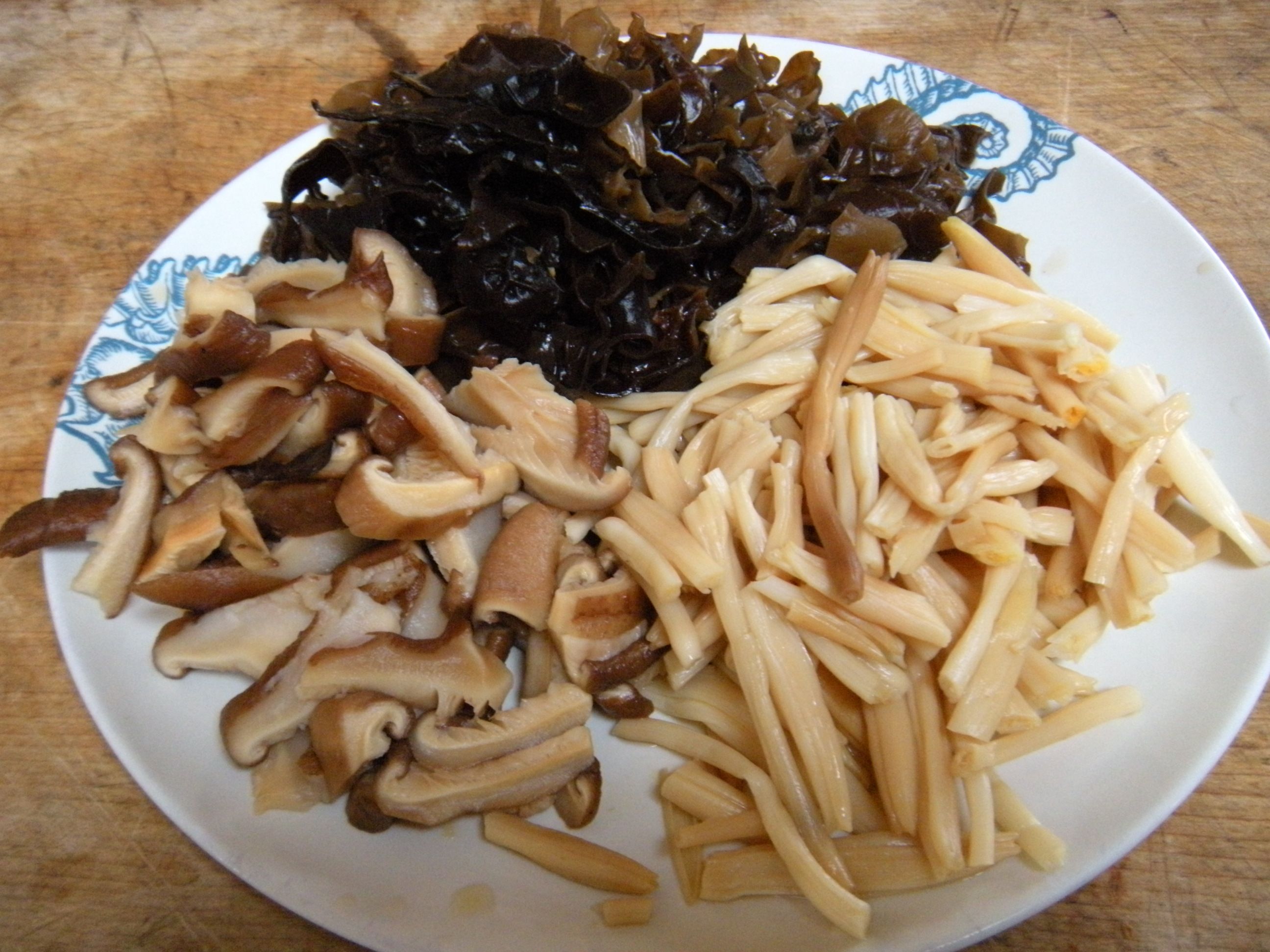
. . . soaking daylily buds, wood ear and shitake mushroom

. . . soaking daylily buds, wood ear and shitake mushroom

On Sunday, I spent all afternoon cleaning out the pantry. It was hot and the task was frustrating, having to temporarily lump disparate things in grocery bags in order to make enough space to reorganize things; then looking for where to store leftover hodge-podge goods. For once, I put food basics (rice, flour, salt, sugar) together and most often used equipment (oval gratin and baking equipment) together (DUH!) For someone slightly OCD, you might have expected I would have figured this out long ago! Better now than never.

It was also embarrassing or humorous, however you want to look at it to find out how consistent I am in my preferences; e.g., duplicates or similar ruffled pastry pans, some with removable bottoms; two extra-large cooling racks; twin muffin pans and so on.

When I consolidated the Asian foodstuffs into a white plastic three drawer storage unit on wheels (for only $11.99 at Target) there were numerous packets of dried tiger lily root ( a key component for making buddha’s delight) and wood ear (which gives texture to that same dish.) In fact, I calculated that I must have enough of these two ingredients to make buddha’s delight every week for a very long time.

Actually, that’s not really a bad idea. It was one of my cousin Pei-Fen’s favorite Chinese vegetarian dishes to cook. We shared it one last time together five years ago in her kitchen before she died this Spring. I’ve made it at home since but have as yet to come up with what made hers so definitively Buddha-ish. I think that it’s due to the fineness with which she sliced the cabbage, daylily root, tree ear and soaked mushroom pieces. The ingredients were mere slivers, resulting in a cooked melange of cabbage, aromatic with a little soy sauce and sesame oil added at the end. This dish, to me at least, is all about TEXTURE. The slightly bland flavor of the vegetables is married to their texture. It’s somehow aromatic and chaste at the same time: an ascetic aesthetic!

If you find recipes for Buddha’s Delight online, you’ll see an incredible diversity of ingredients that people use in this dish. My nirvana dish is purist and classic: no meat or shellfish of any kind; no eggs, no carrots, no broccoli florets, no snow peas, no bamboo shoots, no water chestnuts, no bean sprouts, no apple. . . nothing but a head of cabbage (not coleslaw, bok choy or napa) sliced by hand with a handful of the daylily buds, tree ear and shitake mushrooms. Graced with a little seasoning (soy sauce, mirin, oyster sauce and sesame oil) and a bit of water to steam the vegetables to a tender bite if needed. That’s it.

So today, starting little by little to use up this surfeit (glut) of ingredients, I soaked the makings in order to try my hand again at duplicating Pei-Fen’s dish. I had also cooked some brown rice the other day that I’ll use tonight to make something to eat along with the buddha’s delight: fried brown rice with edamame (soybeans), toasted nori (seaweed) and sliced scallions. The Buddha’s Delight dish will be more than enough and should last for a couple of days. Tomorrow, we’ll have it again along with buckwheat soba noodles in ginger broth.

Here are some tips for making my version of buddha’s delight:

BUDDHA’S DELIGHT:
1. Soak a half-handful of dried daylily buds, dried wood er and dried shitake mushrooms (3) in warm water until all are softened (this takes awhile to soak so just start it earlier in the day)
2. Rinse pieces and drain well to rid of any grit.
3. Trim daylilies of hard stem ends and slice into thirds
4. Trim wood ear and slice up, removing any hard or rigid pieces in the center
5. Remove stems from softened shitake mushrooms and slice into small slivers
6. Squeeze and drain all of water.

cleaned, sliced, rinsed

cleaned, sliced, rinsed


7. Heat a medium size skillet and pour in grapeseed oil to make a thin film
8. When hot, saute three scallions, trimmed, split and sliced into 1 inch pieces.
9. Add the daylily, wood ear and mushrooms; saute over medium high heat and mix together.
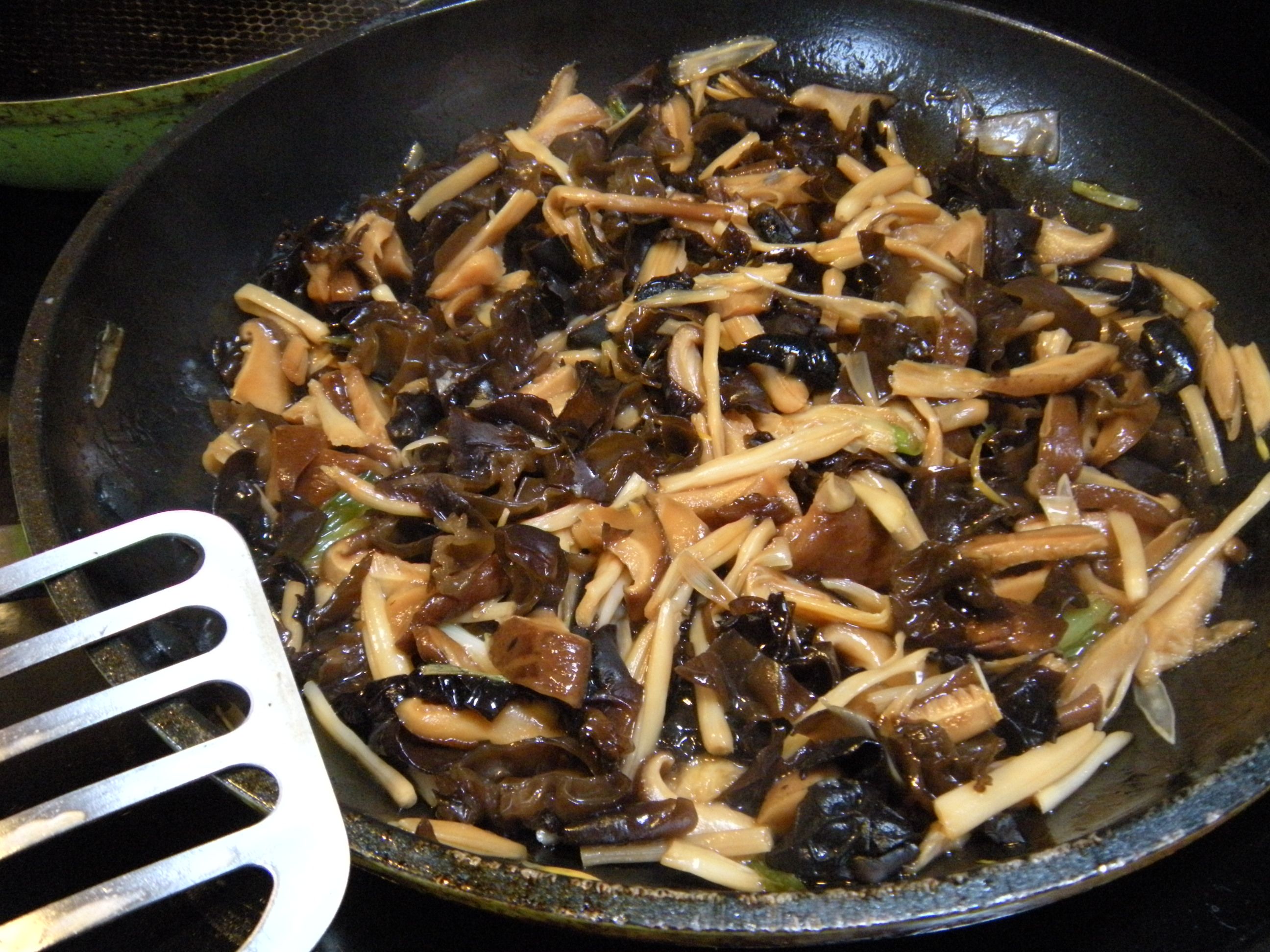
10. Add 1 tablespoon organic soy sauce (Ohsawa); 1 tablespoon mirin or cooking sherry, 2 tablespoons oyster sauce, 2 teaspoons of xylitol (sugar substitute) and mix together–the mixture will be aromatic and smell wonderful. This is a brief braising step that helps these ingredients to soak up flavor ahead of adding them to the plain cabbage.
11. Add a scant 1/4 cup of spring water, stir and mix everything together, letting the water steam and soften the mixture. Let sit on very low heat for about 20 minutes until ready to cook the cabbage.
braised daylily, wood ear and shitake mushrooms

braised daylily, wood ear and shitake mushrooms

Last steps:
1. Rinse head of cabbage clean. Slice large wedges and then cut each wedge into tiny slivers, using a cleaver or sharp kitchen knife. For the ingredients above, I used a little more than half a head of cabbage

half a thinly sliced head of cabbage

half a thinly sliced head of cabbage


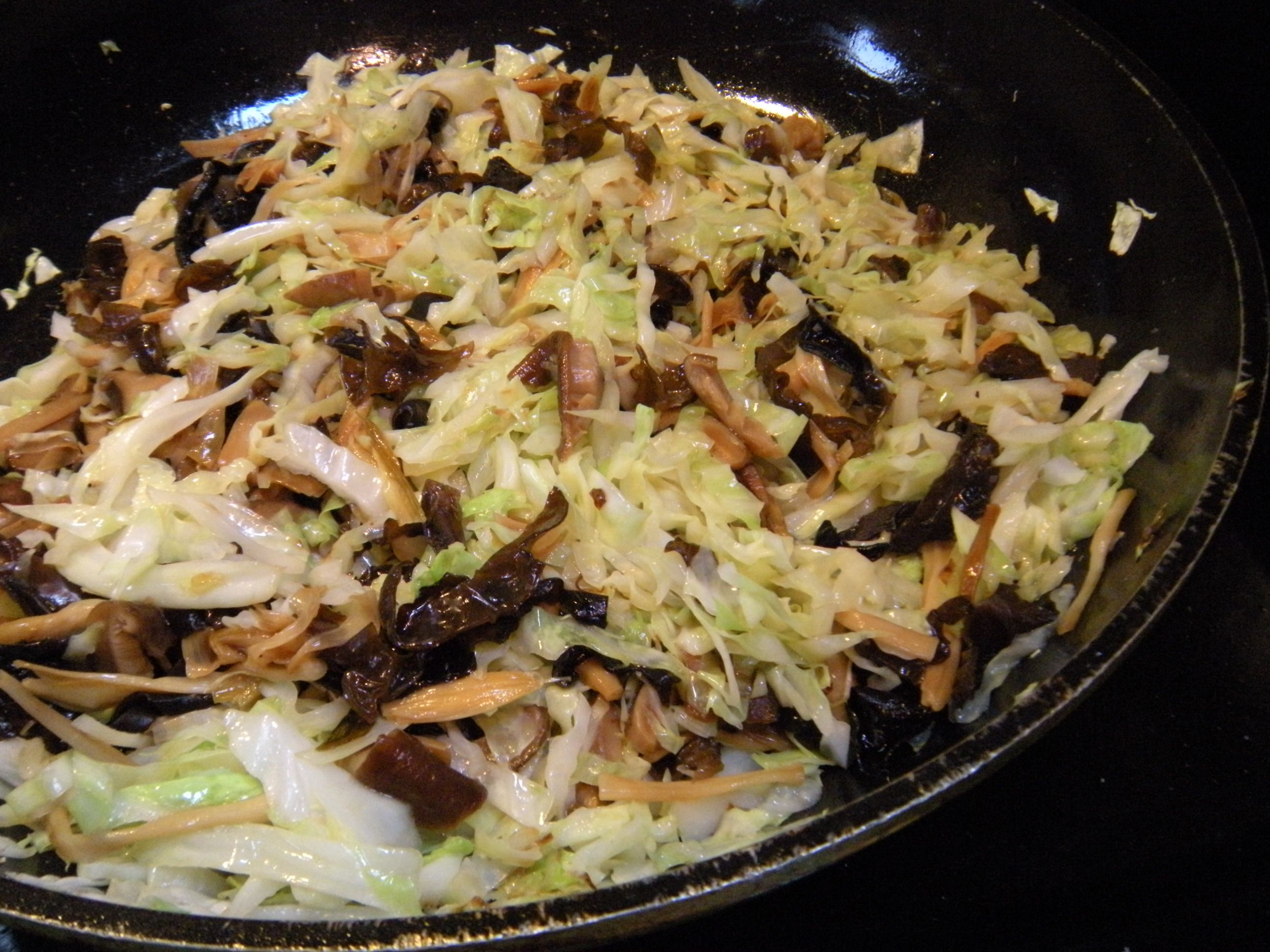
2. Use a large skillet and heat up grapeseed oil to cover the bottom. When hot, put the cabbage slivers in and saute, coating the cabbage and sprinkling with some sea salt
3. Stir the cabbage which will soften with the salt; make sure the cabbage is cooked dry
cabbage cooking in the pan

cabbage cooking in the pan


4. Add the skillet of braised mushroom, daylily and wood ear mixture to the cabbage
5. Stir it all together until well mixed
6. Remove to a serving dish
7. Add a tiny bit of sesame oil on top of the vegetables and stir to mix in the flavors
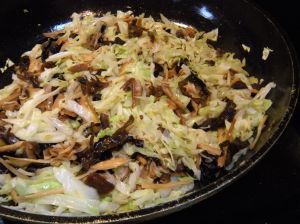
. . . Buddha's Delight

. . . Buddha’s Delight

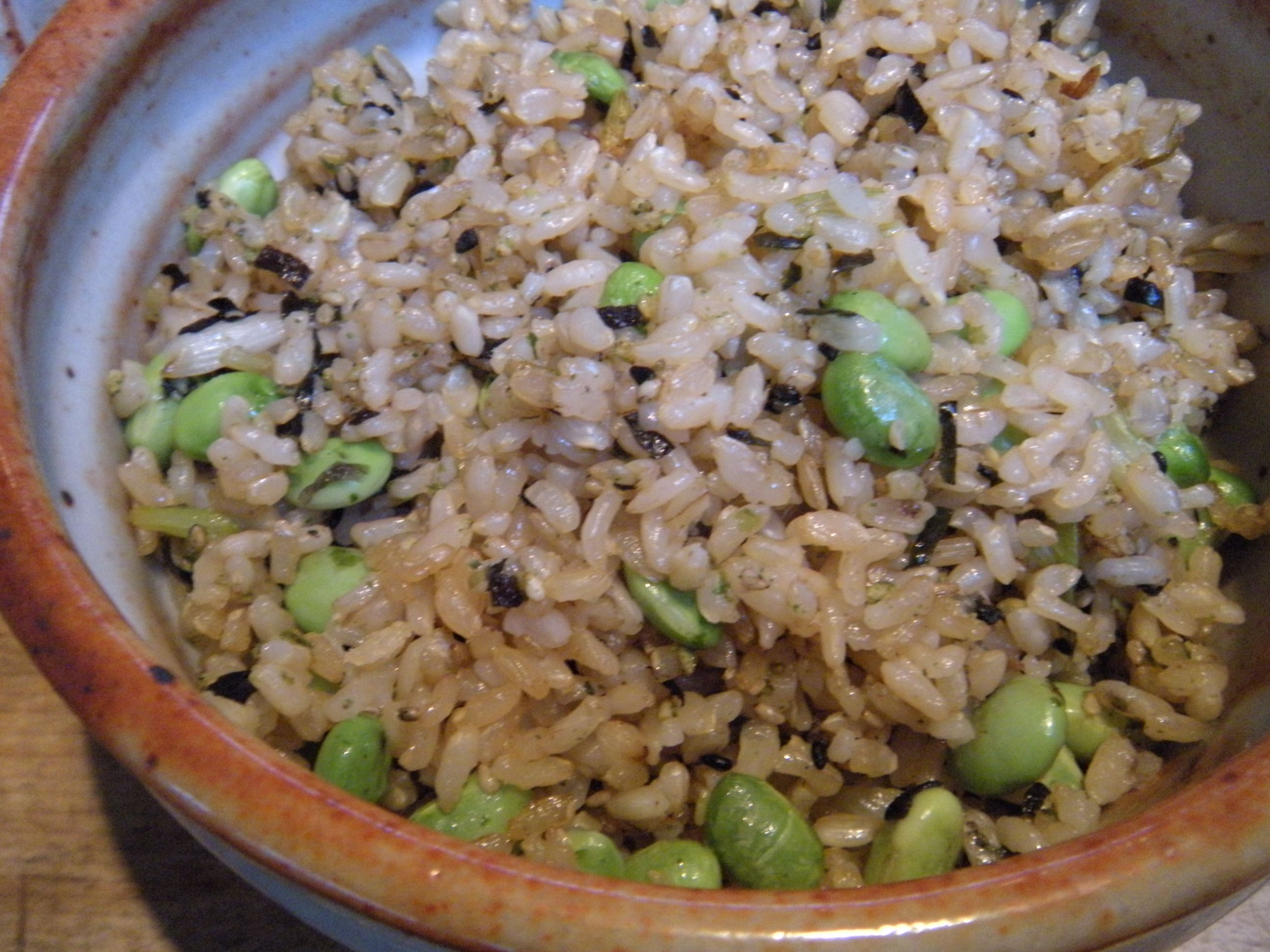
FRIED BROWN RICE WITH NORI, EDAMAME AND SCALLIONS:
1. Defrost half a bag of frozen shelled edamame (soybeans) in warm water and drain well
2. Have on hand a cup of previously cooked brown rice
3. Finely cut up three scallions at sharply angled diagonal slices
4. Heat up a clean skillet with grapeseed oil
5. Saute the green onions in the skillet, add brown rice and stir fry
6. Add edamame to rice mixture
7. Have a little dashi broth & a squirt of organic soy on hand to moisten and add a little flavor to the dish
8. Stir in nori, sesame rice condiment and mix gently.

. . . brown rice with edamame and nori

. . . brown rice with edamame and nori

Note: To enlarge photos, click once; to magnify, click twice on the image.

Postscript: We finished all but a small dab of rice and there’s half a handful of Buddha’s Delight left over. Maybe I’ll make it again next Tuesday.

greens . . .

washed watercress, kale, ruby lettuce and swiss chard

washed watercress, kale, ruby lettuce and swiss chard


While I was researching how people use their Vitamix machines on YouTube, I came across a fellow who took out a long plastic bin from the fridge filled with fresh Swiss chard and flat leaf kale that had been washed, dried and then stored. I thought this made sense because the greens would be handy to use, stay fresher longer and not languish in their plastic bags still full of grit. Besides, the bins stack easily in place of random bags piled on top of each other. The idea of an orderly fridge with space around things is a forever fantasy for me.

So, yesterday, I picked up medium and large size BPA-free plastic storage containers at the local grocery store; rinsed clean the fresh greens, let them drip dry and then placed them in the bins lined with clean paper towel.

I was a little apprehensive about using the Vitamix for the first time since it seemed to me like having a little black Lamborghini on my kitchen counter. For my first smoothie, I planned to make an almond kale mixture in the morning for breakfast, soaking some raw almonds in water overnight. The idea of a two-flavor smoothie appealed to me more than putting a Noah’s Ark full of fresh vegetables and fruit in all at once.

My thought was also to come up with combinations that appealed to my palate that were simple, clean tastes that I would want to have regularly for breakfast and lunches. Less is more feels like the right approach to develop my own vocabulary for how to use this machine. Otherwise, I’m afraid that it would just be a novelty for awhile, mixing together other people’s recipes for different sorts of things, but not with an intention to truly integrate new foods into our eating lifestyle. So, I’m developing my own “Zone” of concoctions, so to speak. The almond kale smoothie was light and tasty, thicker than just juicing and a lot less milk-shakey than some fruit smoothies I’ve had in the past.

Here are the ingredients if you’d like to try it yourself:

Almond-Kale Smoothie (adapted from “It’s All Good”, page 207)

a packed cup of kale leaves torn off the stem
a cup of almond/coconut milk (unsweetened)
1 tablespoon almond butter
1 tablespoon soaked raw almonds (let sit in water overnight in the fridge)
1 teaspoon Xylitol (sweetener, or a pitted Medjool date which I didn’t have on hand)

For lunch, I’m going to make a smoothie with fresh fruit. I peeled each of the bananas I have on hand and froze them individually, broken into thirds. My trusty little Oster juicer has worked well and I’ll make the liquid base for my lunch smoothie by juicing a pink grapefruit and two navel oranges. Then I’ll add some fresh pineapple, hemp seeds, a frozen banana and four ice cubes.

"primp"~grapefruit & orange juice, fresh pineapple, banana, hemp seeds and ice

“primp”~grapefruit & orange juice, fresh pineapple, banana, hemp seeds and ice


I began thinking I might make up names for these concoctions if I decided to keep them on my menu. Something like “Kayla” for the almond kale breakfast smoothie and “Primp” for the pineapple/citrus/banana lunch smoothie.

For dinner, I’m making leek potato soup, a (very) small lemon-grilled center cut piece of salmon, with a light green goddess dressing served on a green salad. So for today’s meals, I’ll have had a “Kayla” smoothie for breakfast, a “Primp” smoothie for lunch and one of my favorite soups with a salad and a couple of bites of fish for dinner. For dessert, there’s still a smidge of strawberry-rhubarb compote left to eat with a dollop of plain yogurt.

While I was out grocery shopping, it occurred to me that these kinds of meals might be akin to ones that are offered at those very pricey spas in Bali, the Golden Door or Canyon Ranch out here in the Berkshires. Except that having it at home was a heck of a lot less expensive than it costs for a three-(@$3000) or a 7-(@$8000) night stay (not including travel costs!) Of course, the spa experience also includes massages of all kinds, hikes and horse-riding. But massages and a walk around the neighborhood are easy to do at home–the horses, well, are more of a stretch. With this renewed perspective, I am now definitely edging towards thinking that buying the Vitamix was a BARGAIN (LOL!) rather than an extravagance!

In any case, I’m so inspired by how glowingly healthy Julia Turshen looks after losing sixty pounds that I feel I have just taken, as Lao Tzu* says, the first step in my personal journey to more radiant health and well-being!

Footnote: *A journey of a thousand miles begins with a single step.”

and it’s all good . . .

Early roses from the garden (the striped one is called "George Burns")

Early roses from the garden (the striped one is called “George Burns”)

As some of you may know, I like to cook. One of the most interesting things to me about it is that every day offers an opportunity to learn something new and to try it out right away and be able to taste it. In the last bit of time, we have been consciously simplifying what and how much we eat. At the same time, flavors, textures and new tastes emerge as our meals evolve.

The Food Network show, “Chopped” is fun to watch because the contestants take such different approaches to the incompatible ingredients in their food baskets. The judges’ comments are also instructive, critical about too little or too much seasoning, whether a dish hangs together and looks appetizing. Anyhow, “Chopped” is entertaining to watch besides the Red Sox and the Bruins (3 down, 1 to go!) As a result, G. now teases me by saying “Time’s up!” or Thank you, Chef!” when we sit down to dinner.

Another thread in my cooking lately, is searching for healthy recipes that are also compatible with our taste in food. I have been reading “It’s All Good,” authored by Gwyneth Paltrow and Julia Turshen, a cookbook that underscores non-gluten, non-dairy recipes that include many Asian ingredients. Recipes such as “Buckwheat soba in ginger broth,” “Scallion pancakes made with brown rice flour,” “Polenta with Shitake mushrooms and leek,” and “Avocado cucumber soup” are among the book’s highlights. There are before and current photographs of Julia Turshen that will tempt you to try out their food philosophy because her skin is glowing and she looks trim and relaxed after losing sixty pounds!

In any case, one of the elements in “It’s All Good” is the use of a heavy-duty blender like Vitamix although the authors are careful not to be elitist about this expensive piece of equipment. Coincidentally, my daughter, C., brought up the Vitamix last weekend when she was visiting, saying that friends of hers had raved about how versatile it was to use and also how easy it was to clean. After her visit, I took a three-hour Japanese Vegetarian cooking class at the Cambridge Adult Education Center last Sunday and my instructor, Yoko, also extolled the use of her Vitamix. She used hers to pulverize dried kombu and dried Shitake mushrooms individually to have on hand to make dashi stock or to add to a variety of dishes. I was impressed by how Yoko personalized the use of the Vitamix to suit a specific type of cuisine. These three Vitamix strands in the ether convinced me to look into it further and I ordered the Professional Model 300 in ruby red which arrived yesterday.

The first thing I noticed is that the very simple packaging mirrors the elegance of Apple computer packaging. You know what I mean if you own a Mac product. Right away, I was impressed with the foresight the manufacturer put into presenting their product. I read the manual and played the DVD of a youngish male cook (with heavily tattooed arms) who read his lines from the teleprompter rather stiffly but walked us through how to use the Vitamix. Seems like the most important thing is to load the ingredients from lightest weight first (on the bottom) to heaviest on top. The liquid and soft foods on the bottom draws in the heavier ingredients on top. Start the machine on the setting, “1” and gradually move the dial to 10 for 30 seconds or whatever amount of time is called for. (Apparently, using frozen fruits, you can make a berry sorbet in 30 seconds!) If needed, use the tamper (a pusher) which does not reach the blades to stir the ingredients while grinding. Clean by filling halfway with warm water and a couple of drops of detergent, run it on high for 60 seconds, rinse and invert on a dishtowel or drainer to dry. Simple. It all sounded good to me.

The one thing I noticed while watching the DVD, was that I instantly knew I preferred the Vitamix in black to the red one sitting on the kitchen counter. My daughter, C. has been wanting one too and so I talked to her on the phone last night about whether she’d like the red one if she was ready to purchase, or I could send it back just as easily. My other daughter, M. who lives in Minneapolis, has been sounding rather wistful whenever we talked about the Vitamix on Skype. M. said that her good friend Noemi, (whom they just visited in Winnipeg and is a real foodie,) loves her Vitamix which she has used for a long time.

I thought to myself (after paging through the very thick and heavy hardbound Vitamix recipe book that came with the machine,) that utilizing this expensive kitchen tool would be worthwhile only and if only one were able to personalize its use to make foods compatible with what we like to eat. Thus, (drumroll) the recipes in “It’s All Good” quickly morphed in my mind as an ideal companion to the Vitamix because the recipes use it a lot and the dishes mirror our palate. So, Voila! as the French like to say. I could now conceive of a rationale for owning (and paying for) one.

So here we are in the beginning of June, a day after G. and I planted our morning glory seedlings near the barn where they will climb up strings to the second floor landing and grace our days with visions of heavenly blue on foggy mornings in the Fall. Based on reactions from both my daughters, C. and M. I’m thinking maybe a Vitamix will appear in their Christmas stockings this year (counting in everyone’s birthday and anniversary gifts for a year too!)

In any case, it’s all good, isn’t it?

Addendum: Here’s a link to the book, “It’s All Good,” and if you’re interested, my review under the name Eden is titled: “It Actually IS (almost) All Good!”

best of both worlds . . .

juicing photo for blogIf truth be told, I think I live in the middle way between what some would label “new age” practice (Denise Linn) and creating the good life (Martha Stewart.) Before you laugh, hear me out on what I’ve learned from each in the last couple of weeks.

1. Denise Linn‘s 28 day program’s first week focuses on intention by creating clarity about what’s important. De-cluttering your environs and your inner self is a means to an end to rid the extras so that new things can enter. I’ve described some of the results of this process in the last two posts. A lot to do in the first seven days.

2. Martha Stewart‘s new book on how to live “the good long life” is full of practical pointers for maintaining your health and enjoying life no matter what your circumstances or your age. Despite all the jokes people make about Martha, I feel that she’s paid her dues and in this book, imparts a tone of friendly good-naturedness about aging (as she is) and how to enjoy it at the same time.

Last night, I was feeling slightly uncomfortable physically from having eaten a little too much and indulging myself a lot over mother’s day meals. I remembered that I had forgotten I was doing a two-day a week fasting regimen which had me feeling slimmer and full of energy up to a few days ago. I confess I read about the two-day fasting regimen elsewhere than these two women’s writings, but basically, it’s taking in only about 500-600 calories for a day, at least a day apart, every week. It’s easier than you think, especially when you can have 250 calories at two meals even while you are “fasting.” I like to do it by juicing on those days, drinking lots of water and having raspberry zinger tea. I also discovered that a shrimp is only about 9-12 calories, and a handful of them makes a great lunch or dinner along with salad. This kind of fasting/dieting is so easy to do a couple of days a week that then allows me to eat (judiciously) whatever else I like to cook the rest of the week (fish, chicken, vegetables, fruit.)

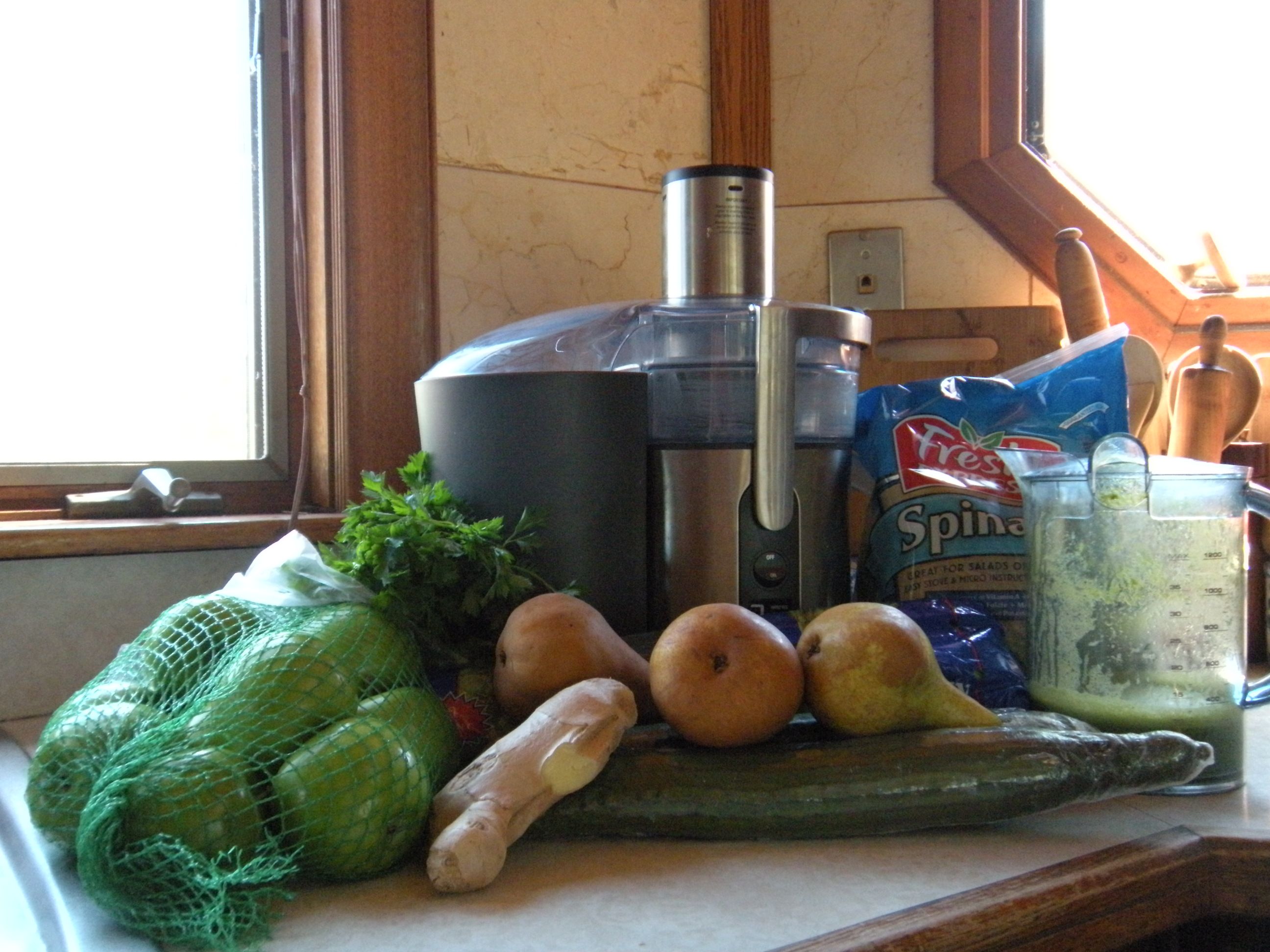
From Martha’s book, I found a recipe for green juicing that she drinks every morning and that I use during my fasting days. I have a Breville juicer that has what seems like many parts, but does a much better and faster job juicing than my old Osterizier juicer that was hard to clean.

On a fasting day, I take out and wash these ingredients, then put them into the juicer in this order:

2-3 stalks of celery
half an english cucumber
2 granny smith apples in quarters
1 pear
half a bunch of fresh flat leaf parsley
half a bag of spinach
a big knob of fresh ginger root

When the juice is made, I stir it and pour a medium size glass of it, adding a heaping spoonful of Pure Synergy, an energy/health boost that I’ve been taking for almost a decade. Taking Pure Synergy regularly, my energy level feels elevated all day without feeling hyper. I put the remaining pitcher of green juice in the fridge to drink later in the day.

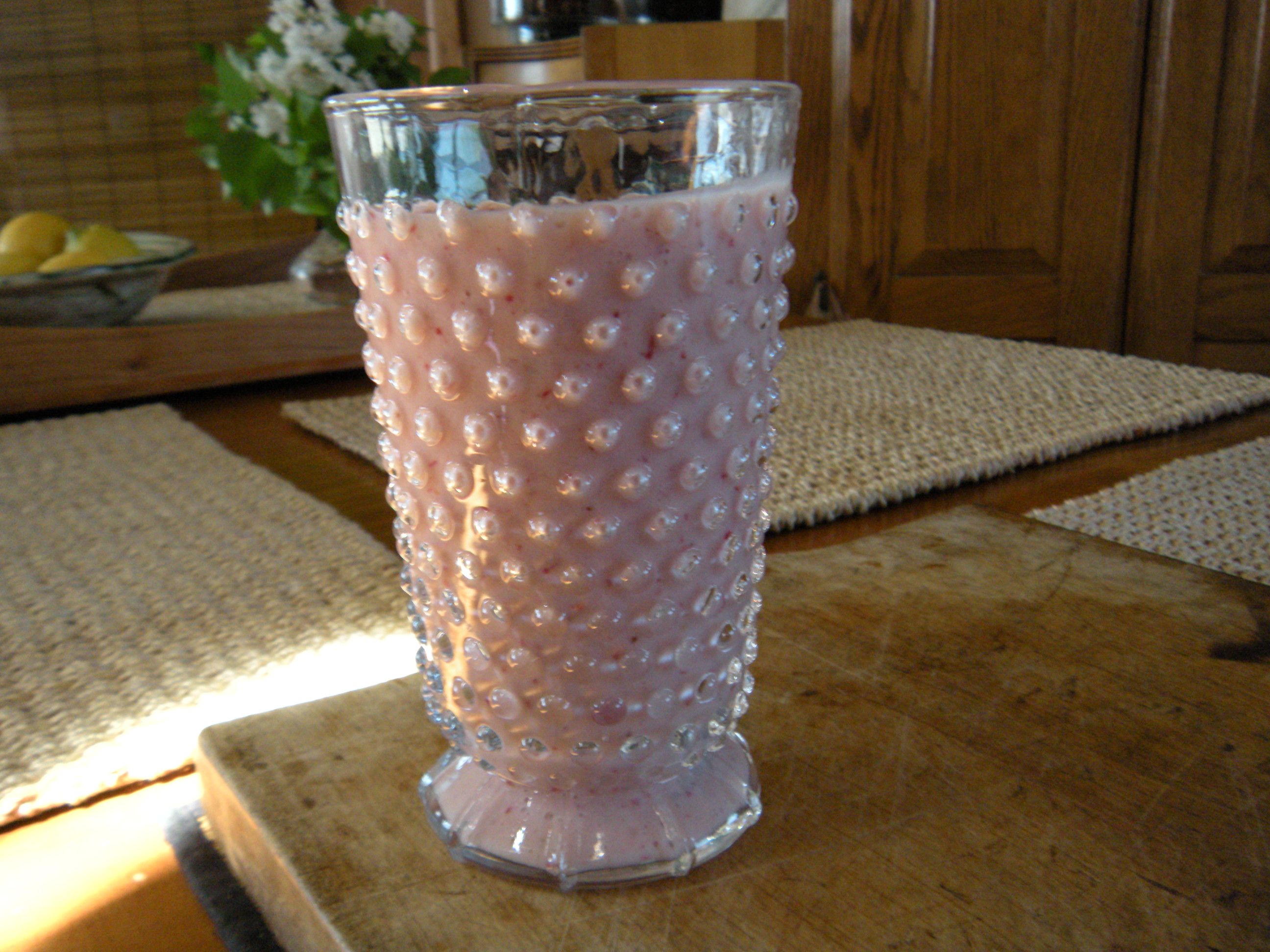
After the green juice, I’ll also drink hot coffee while reading the newspaper, drink lots of distilled water during the day and brew raspberry zinger tea to drink with honey for a pick-me-up. If I feel like it, I might make a fresh strawberry banana smoothie with soy milk as one of my “meals.” strawberry smoothie

On a fasting day, you can have up to 500-600 calories per 24 hours so it’s not like you are starving yourself, just letting your insides have a brief rest. This kind of fasting purports to improve your immune system and prolong your life. Even if it didn’t, it truly feels fabulous. And you do lose weight, or at least I have.

So, de-cluttering as Denise suggests, allowing your body and systems to rejuvenate every so often is “a good thing” as Martha would say. Besides, I can’t tell you how virtuous it feels to wash all these vegetables and fruits, lay them out on the counter and then drink the elixer of all that fresh produce throughout the day, sip by sip.

Admittedly, it’s easier to juice if you have the right equipment and Breville juicers are expensive, to be honest. But compared to the relative costs of what we might spend on some prime steaks, lobsters and legs of lamb, you could probably rationalize the cost of a juicer that will provide a means to a slimmer waist and hips as well as a glowing complexion. Instead of looking slightly puffy from too much rich food, wine and desserts, your face will look smooth and alight with health. PLUS, you can still eat all that other stuff on the days you’re not fasting. . . just in moderation.

Postscript: since I wrote this post, I received a simple electric citrus juicer that I bought on Amazon for $16. It has allowed me to quickly make fresh orange or grapefruit juice anytime that I’m thirsty. Add a couple of ice cubes and sip a cool fruit juice drink!

best oatmeal bread ever . . .

oatmeal bread rising on   the kitchen counter

oatmeal bread rising on the kitchen counter


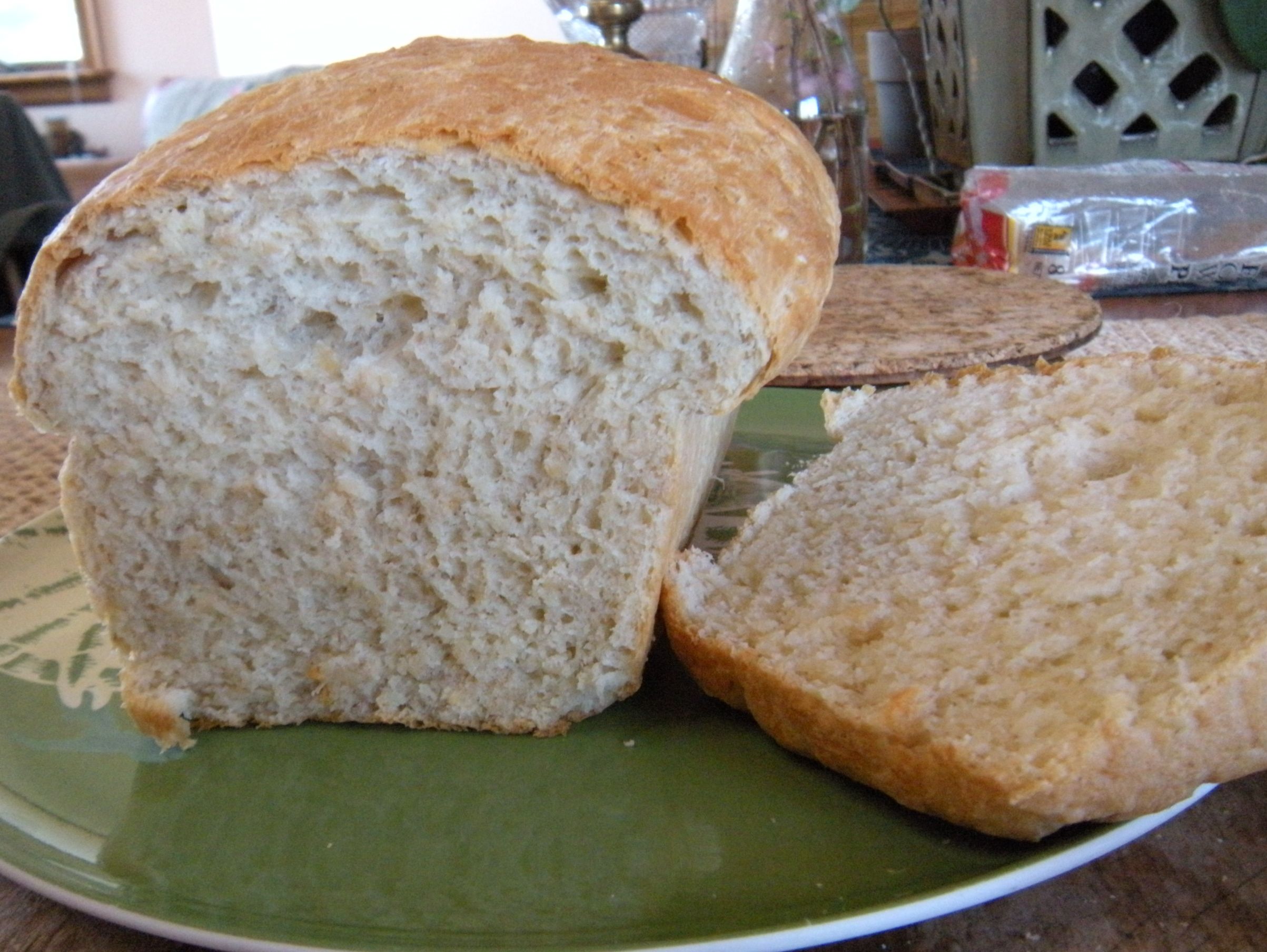
I don’t remember how I came upon this bread recipe because it’s a standard King Arthur flour recipe but I tried it out a couple of days ago and it was, hands down, the best loaf of bread I have ever tasted! And that’s saying a lot. I used to drive two towns over to Concord to buy some cracked wheat bread that was my favorite bread up to now. This oatmeal bread has a thicker crumb, is moist and toasts beautifully too–crispy on the edges and chewy on the inside. I like to eat it with unsalted Kate’s butter, drizzled with some Billy Bee honey that can be found at the local Stop and Shop (both the butter and the honey.)

If you want to fall in love with your kitchen, your house and have everyone in your family on their knees, try making this bread! It only takes about three and a half hours to make from start to finish, there’s very little kneading involved–in fact, I think that heavy kneading would just make it tougher. So this morning, around 9 a.m. I started the dough for my second loaf.

Then, I got an email from my seventeen year old granddaughter who said the bread sounded delicious and could she have the recipe? So here’s the step by step instructions I wrote out for her!

It’s the King Arthur Oatmeal Bread recipe–which you can probably download also. But here’s what I do that is slightly different and easier to follow I think!

Warm 1 1/4 cups of WHOLE milk in the microwave until it is warm to the touch of your finger but not hotter than that.
Put in 1 packet of Fleischmann’s dry yeast–the FAST RISING KIND.
Stir the yeast in the warm milk until dissolved
Take half a stick of unsalted butter and nuke it until it is soft but not melted–you can also leave a half stick in the sun on the counter before you start too. Use the paper to butter the loaf pan later on.
Put the soft butter into the yeast/milk mixture.
Add 3 Tablespoons of honey –I use Billy Bee brand from Canada that you can get at the Stop and Shop, but not at Shaw’s (it’s the BEST TASTING HONEY!!)
Add a teaspoon and a half of salt

Take a mixer and mix all of the ingredients above together until it is smooth.

Then gradually add 3 cups of King Arthur flour and 1 cup of Quaker instant oatmeal–you may have to stop the mixer and scrape the beaters and add the rest of the flour and oatmeal by hand. Put some flour on your clean hands and start kneading the dough until the flour and oatmeal is all mixed in. If it’s sticky, add a little bit more flour until you have a dough that doesn’t stick to your hands. But don’t put on too much flour–just enough so the dough isn’t sticky.

Knead it a little bit more until it’s a smooth ball. Just a few minutes and shape the dough into a ball.

Spray a clean mixing bowl with Pam. Settle the bread dough in it to rise, spray a piece of plastic wrap and put it sprayed side down on the dough and cover with a clean dishtowel. Set it on the kitchen counter (okay in light sun) and let it rise for about an hour and twenty minutes. When it has risen,

Knead the dough a little more but not a lot–and go easy on it so it doesn’t get tough–I do only about 5 minutes and I push the dough really gently.

Then butter your loaf pan or bread pan (I use a Le Creuset white porcelain bread pan that I just got on Amazon.com)–make sure it’s really clean and dry and butter all the corners. Then pat the bread dough into an oblong that will fit nicely into the bread pan, a little higher in the middle than the sides.

Then cover with the plastic wrap again and the clean dishtowel and let it rise again until the bread is about an inch above the top of the pan–about another hour or so.

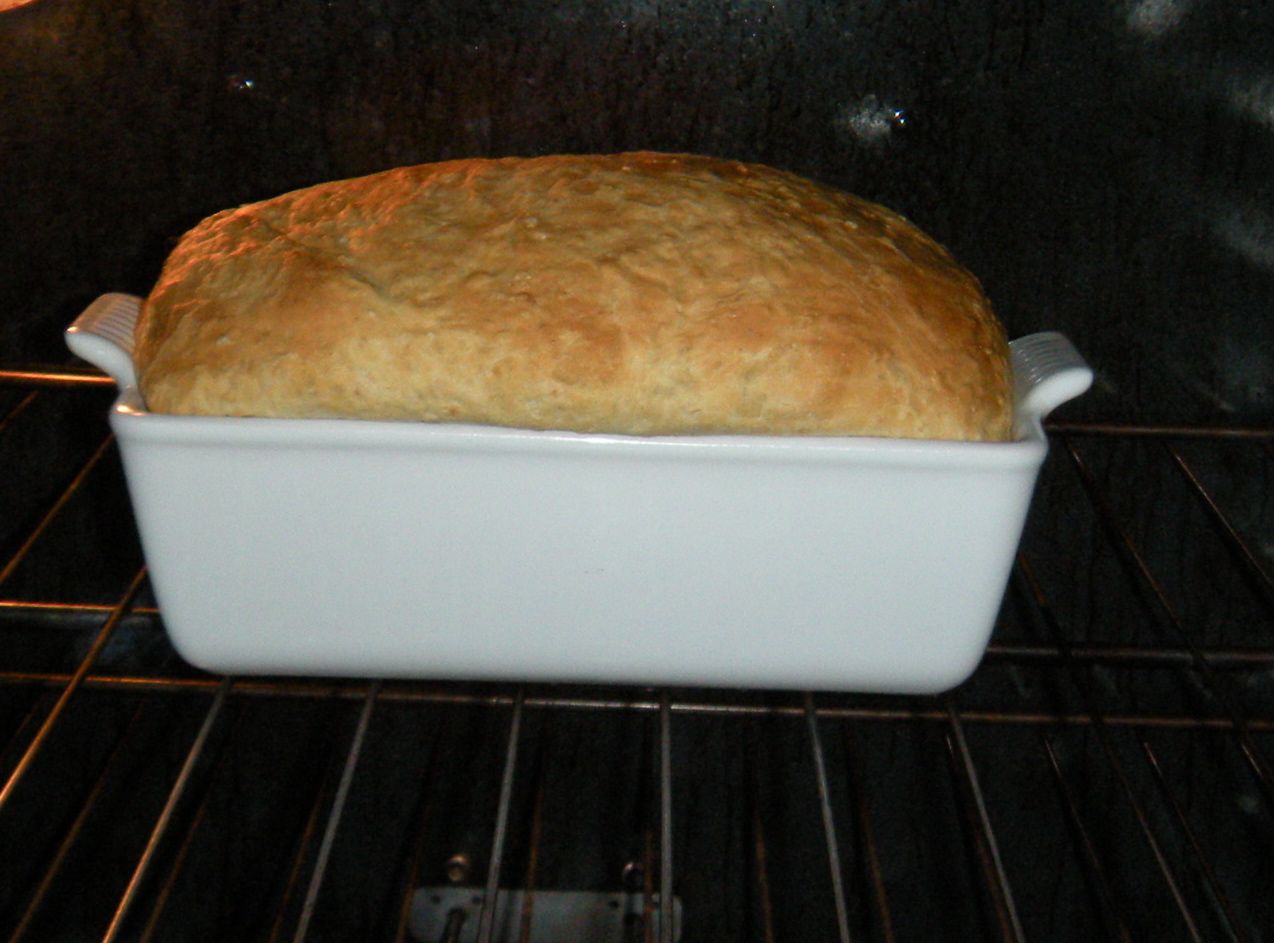
Preheat the oven to 350 degrees. When it’s preheated, gently put your bread pan into the oven and turn on the oven light so you can watch it bake without opening the oven door.

Bake for about 35-40 minutes and if the top looks like it’s getting too brown, open the oven about 5-10 minutes from the end and cover with aluminum foil. I was going to do this but the foil kept falling off and I didn’t want to burn myself so I didn’t do it.

Be sure to bake it for that long or the bread won’t be cooked through.

fresh baked in the oven

fresh baked in the oven


Your kitchen should be smelling like HEAVEN ON EARTH by this time!!!!!

When the bread is done, let it cool a little in the pan, turn it on its side and see if the bread will come right out of the pan. If not, take a sharp knife and gently separate the bread from the inside edges of the pan. Let it cool a little more before slicing it if you can stand to wait that long.

When cooler, slice it with a serrated bread knife, VERY GENTLY, holding it on its side so you don’t smoosh the bread flat as you are gently sawing it with a serrated knife.

Then slather with unsalted butter and drizzle with a little honey.

I’ll bet you could eat the whole loaf with a friend at one sitting–really good toasted later too.

Then, you’ll wish you had made TWO loaves–although I think it’s better just to make one loaf at a time. It’s SO YUMMY!!

warm bread on the table!

warm bread on the table!


So that’s today’s post about making homemade oatmeal bread with a few photos to document this delicious entity.

Just also wanted to note that I’ve been pretty conscious of avoiding wheat these days, but I don’t think a little bit of it in this form will kill me.

           the first slice!

the first slice!

a simple supper . . .

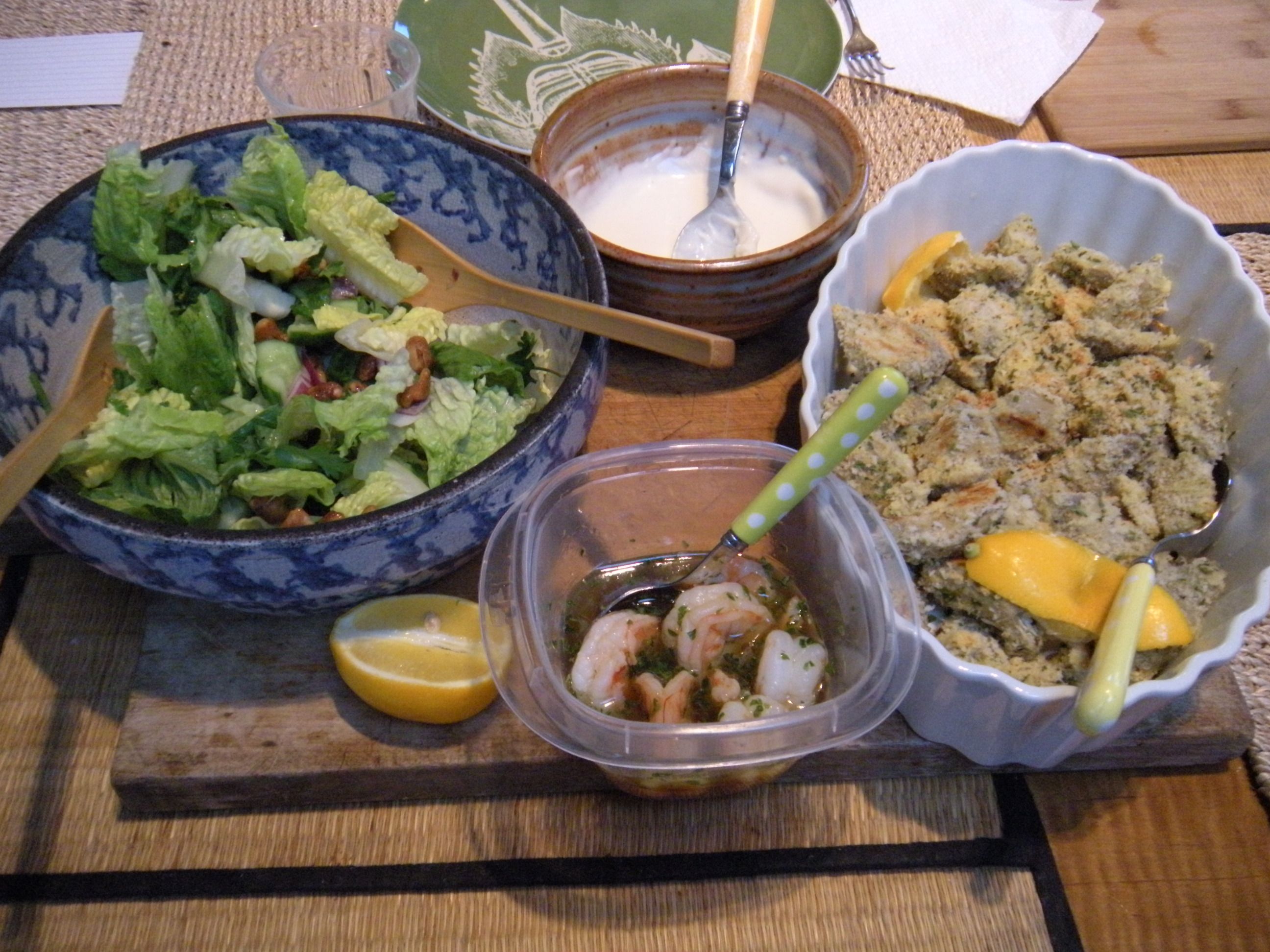
parmesan artichoke hearts and shrimp salad for supper!

parmesan artichoke hearts and shrimp salad for supper!

We’ve been running around the last couple of days and tonight was no different. By the time I got home, it was almost six o’clock. G. was still out and had to go to another appointment before starting for home. I didn’t feel like cooking but I began when I learned G.’s arrival would be delayed. I had defrosted some frozen artichoke hearts from Trader Joe’s which I lightly dredged in flour, dipped in beaten eggs and covered with panko bread crumbs, parmesan cheese, garlic salt and parsley. While they baked in the oven, I made a favorite condiment to dip them in: Hellmann’s mayonnaise with squirts of fresh Meyer lemon.

For the salad that would be our main dish, I peeled six extra-large shrimp that I had taken out of the freezer before I went to my meeting and parboiled them until tender, plopping them while they were still hot into the soy, lemon, marukan vinegar vinaigrette I had whisked up to dress the salad. I still had crisp, tender hearts of romaine that I tore up into the blue spongeware bowl, sliced up three portuguese cucumbers at a diagonal, cut up some fragrant red onion into bits and poured the rest of the maple glazed salad walnuts on top with a sprinkle of fresh cilantro leaves.

When G. arrived home, I squeezed a little Meyer lemon juice on the hot artichoke hearts which we ate, dipped in the lemon mayonnaise. I then dressed the salad and we crunched our way through sweet walnuts, crisp romaine and tender shrimp.

That’s all we had for supper. And it was good.