mulberryshoots

"Tell me, what is it you plan to do with your one wild and precious life?" ~ Mary Oliver

Category: Food

millet! . . .

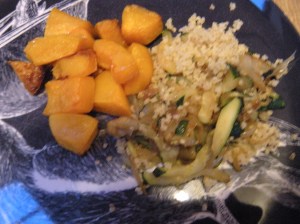
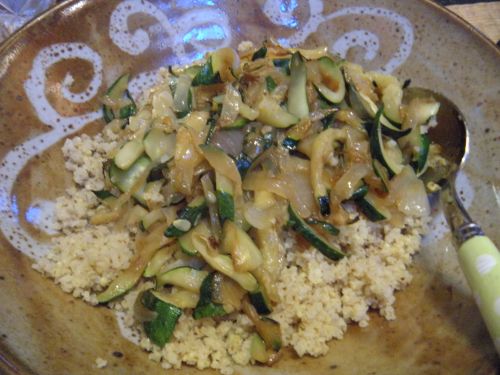
cooked millet with zucchini and onions. . .

cooked millet with zucchini and onions. . .

Well, I’ve been reading about millet for quite some time and even bought some once. I didn’t get around to trying it out though and bought a new batch this week. It’s one of those grains like barley and brown rice that macrobiotic recipes contain every once in a while. It sounded a little bland to me though, cooking it with just plain water.

All the recipes suggested that you dry toast the millet in a pan before

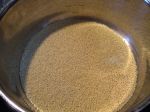
raw millet toasting in the pan. . .

raw millet toasting in the pan. . .

adding liquid to cook it. So, I did that and could smell the little particles moving around the pan that was heated to medium. I made a separate broth with instant dashi and a little soy to use as the cooking broth. After toasting for about 8 minutes, I added the broth, turned the heat down and put a lid on the pot to cook and simmer the millet.

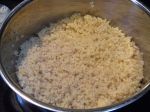
cooked millet, fluffed up in the pan. . .

cooked millet, fluffed up in the pan. . .

millet-3

Meanwhile, I cut up some onion and a medium sized zucchini, stir frying it in a little olive oil until it was cooked through, adding just a little pinch of Maldon salt. I thought this vegetable mixture might go well, served on top of the millet when the grain was finished cooking.millet-2

The other part of our meal consists of roasted butternut squash – cut pieces brushed with melted butter and maple syrup before roasting in a 400 degree oven.

butternut squash glazed with butter & maple syrup. . .

butternut squash glazed with butter & maple syrup. . .

So this is as close to macrobiotic I’m going to get tonight. I’ve been reading that it would be good to cut out all animal and vegetable oils from cooking but haven’t gotten there – at least not yet.

dscn8474All I’m hoping for is that this meal will be satisfying to eat – both with regards to taste, mouth feel and satiety of our appetites. Oh yeah, tasty would be nice too!

Postscript: Our supper was very tasty – and the flavors of the zucchini, millet and glazed butternut squash went well together. We were both pleasantly surprised!

Postscript 2: With about a cup and a half of millet left over, I’m thinking about making millet croquettes for lunch tomorrow: chopped green onion, egg, parmesan cheese, shape into balls and fry in vegetable oil until crispy on both sides.


‘stone soup’ for lunch! . . .

stone-soup

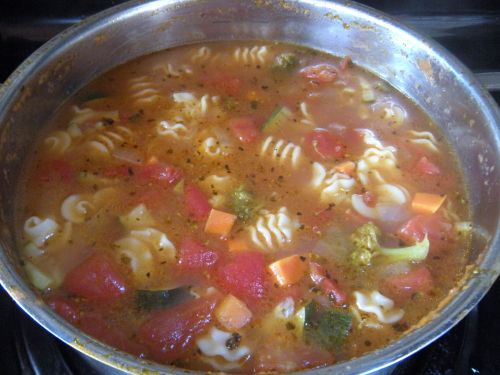
It’s gotten a little chilly out so instead of making a salad for lunch, I decided to put together a soup from whatever I happened to have on hand in the fridge and pantry. I call this “stone soup” like the folk tale about French soldiers who stirred up a big kettle of water and put some clean “magical” stones in it. Soon, curious villagers began to contribute to the “broth”: vegetables from the root cellar, grains from the barn, sides of beef until there was a hearty soup to be shared by everyone.

This soup is somewhat like that: I found a small piece of onion and zucchini in the vegetable bin which I chopped up along with half a carrot. There were a couple of still fresh broccoli florets in a pack that was ready to be thrown out. Into the pot they went along with a can of DelMonte diced tomatoes and a Knorr beef broth packet. Added water and it looked pretty thin. Poured in a handful of raditiore pasta, the crinkled, pretty pasta that quickly expanded as it cooked.

And what do you know? I soon had a soup that looked and tasted like a true minestrone soup for lunch! Nice to have a warm bowl on a chilly Fall day.


spinach souffle! . . .


souffle-5I’ll admit that making a spinach souffle sounds daunting. . . but it’s really not when you break up the process into sections. I bought some beautiful fresh spinach yesterday at the market and thought that cooking it down with onions, adding it to a bechamel sauce and then adding eggs for a souffle would be a nice dish to enjoy for supper.

I used Ina Garten’s recipe for the most part. Here are my steps:

Preheat oven to 400 degrees:souffle-1

  1.  SPINACH PREP: Rinse and clean half a bunch of fresh spinach; chop off the stems and coarsely chop the leaves
  2. Melt a tablespoon of unsalted butter, brown half a chopped vidalia onion and add the chopped spinach
  3. Stir gently as it cooks down until everything is soft and cooked through; sprinkle with grated nutmeg (yum!)
  4. Drain it of all the juices, place on a cutting board and chop with a cleaver alternately crosswise until it resembles frozen chopped spinach (just kidding!) You could also use frozen chopped spinach, draining it of all the water, but I like the idea and taste of fresh spinach!souffle-2
  5. CHEESE: Grate half a cup of parmesan cheese. I have a gorgeous chunk of it and grated it on the large holes of a box grater. It will give a nicer lift to the cheese than Ina’s recipe (cheddar and fine parmesan.)
  6. SAUCE: Making the bechamel sauce and incorporating the eggs:   Melt unsalted butter (2 Tablespoons) in a skillet; add 3 tablespoons more or less of flour and incorporate it into the melted butter. Add 1 cup scalded milk into the mixture, slowly incorporating 4 egg yolks one at a time, mixing gently. Add the grated parmesan and the chopped spinach. Combine and let the whole mixture cool.
  7. EGG WHITES: With an electric mixer, beat the egg whites until stiff. A little at a time, fold the egg whites into the spinach mixture, making sure that it remains light and airy. Butter a souffle dish well and sprinkle with parmesan cheese. Lightly fold the mixture into souffle-3the prepared souffle dish.
  8. Make a circle in the top of the souffle with a knife to encourage the souffle to rise more. When you know everyone will be ready to eat in about a half an hour, place the souffle in the oven and turn the heat down to 375 degrees (nothing is more exasperating when the souffle is done and people take 10 minutes to get to the table!)
  9. Bake the souffle for 35-45 minutes until done. Let it rest in the oven after turning off the oven with the door open; move immediately to the table when everyone is ready to eat!souffle-6

This is a truly delectable meal! . . . Bon Appetit!


mushroom barley soup for lunch! . . .

mushroom-barley-soup

I’m still on the search for a steady way to lose weight and have come full circle back to trying out some semi-macrobiotic recipes. The other thing we have decided to do is to forego sandwiches at lunch and to eat soup or salad instead.

So yesterday, I made a simple onion soup which is a tried-and-true easy recipe that is astonishingly tasty based on the simple steps below:

  1. Slice up a Vidalia onion (they’re sweeter and juicier than the yellow ones)
  2. Brown the onion in unsalted butter in a small soup pot
  3. Add a packet of Knorr’s homestyle beef broth (or a can of beef broth)
  4. Cook until the onions are soft

I used to heat up some leftover bread sprinkled with parmesan cheese under the broiler and serve it on top – but am going without it during this bread-less time.

Since macrobiotic cooking features hearty grains in the diet, I bought some millet, brown rice and barley at the store yesterday. This morning, I thought I’d parboil some barley in water to make a mushroom-barley soup for our lunch. I let the barley soak while I prepared the rest of the soup:

  1. Heat up a small soup pot and melt a tablespoon of unsalted butter
  2. Cut up half of a vidalia onion and brown in the butter
  3. Cut up a box of white button mushrooms (I had about 2/3rds of a box to work with) into quarters, not small bits and pieces. I like these big pieces of mushrooms because they give the soup a more robust quality
  4. Cut up a carrot into small pieces – stir fry the mushrooms and carrots with the onions until nicely browned.
  5. Add two Knorr homestyle beef broth (oval gelatin-like concentrate) plus water to cover
  6. Drain soaked barley and add to the soup
  7. Cover and cook very gently for an hour, checking there’s enough liquid as the barley expands in the soup. Taste that the soup is not too salty by adding more water
  8. Taste for seasoning and serve with cracked pepper for a hearty Fall lunch!mushroom-soup

Very low in calories, hearty, warming and delicious! Not that time-consuming to make either if you start early enough in the morning.

BTW, here’s a funny article about a guy in New Zealand who proved it’s the amount of calories that you consume that allows you to lose weight, not what you eat. He cut his intake by a third to 1600 calories and ate nothing but pies and low-cal beer – and he lost over SIXTEEN POUNDS in just four weeks!! Hmmmmmm


ramen bowls for dinner! . . .

ramen-bowl

For the past weeks, I’ve been making bone broth in my new Instant Pot and also reading about how to make appetizing ramen one-bowl suppers. So today, I’m combining what I’ve made and learned for our first try at a customized ramen bowl for dinner. Here’s what I have to start with:

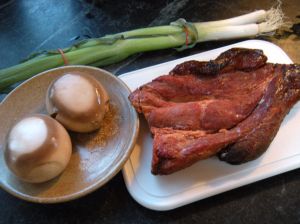
  • a lovely piece of char-sui pork (barbecued) from the Asian market that I’ll heat up in the broth before slicing and serving;
  • a container of bone broth to which I’ll add a scant spoonful of dashi powder and a spoonful of Ohsawa soy sauce for the “ramen soup base”;
  • fresh Chinese spinach – unlike Western spinach (see photo) – which I will stir fry, drain and cut up before placing with the other ingredients on the bowl;
  • 6-minute jumbo eggs with yolks that are still slightly runny, braised in a red-cooked sauce (soy, sherry, sugar) and cut in half just before serving;
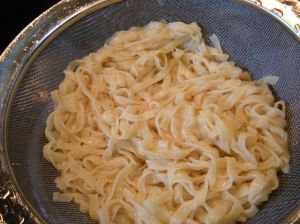
  • fresh Chinese noodles from the Asian market – boiled ahead of time, rinsed and drained before adding to the ramen broth

I happen to have all of these ingredients on hand to prepare ahead of time and assemble to make our noodle bowls for dinner.

Here are some photos along the way ~

chinese spinach and fresh chinese noodles

chinese spinach and fresh chinese noodles

Chinese spinach (raw and cooked) to add to the ramen bowl

barbecue-pork-eggs


Char sui pork (barbecued) from the Asian market & braised 6 minute eggs


freshly cooked Chinese noodles

freshly cooked Chinese noodles

penultimate ramen bowls . . .

penultimate ramen bowls . . .

ramen bowls?. . .

Okay, so we’ve all cooked a packet of ramen when we’re hungry and on the run. I particularly like the brand, “Sapporo Ichiban” which you can even find in the local grocery store (Shaw’s) nowadays. That little aluminum foil full of flavoring spices though, was pretty salty.

On the other side of the coin, there are those of us old enough to have seen and enjoyed that Japanese movie about making ramen noodle broth called “Tampopo” where the entire film seems to be made up of shenanigans instigated to discover the secret recipe for making the best broth for the noodle bowls.

Today, I received a cookbook called “Simply Ramen” from Amazon.The author is a Californian fourth-generation Japanese cook named Amy Kimoto-Kahn, who is also a Mom to three kids one finds out later. The photography of noodle nests on the flyleaves augurs well for the rest of the book.

I have a lot of cookbooks already, especially Japanese food, and so was a little dubious when I first opened the book. A pleasant surprise! Not only are the photos appetizing and gorgeous to look at; the book itself is organized in the most helpful way possible:

First chapters on how to make five core soup broths. And these aren’t just a handful of ingredients either. They’re hard core authentic recipes from Japan cookery schools and the like.

Then, the noodles and how to make them from scratch (I plan to use fresh wonton noodles from the Asian market in town – boiled first, rinsed and then slipped into the rich soup broth. )

Then, the condiments and how to prepare them: I especially liked the teriyaki marinated soft-boiled eggs that you cut in half and put on top of the ramen bowls when you’re ready to serve. Sauteeing fresh bamboo shoots with a teriyaki type seasoning sounded good too.

Then, recipes for each category of ramen bowls to try out: “pork ramen,” “beef ramen,” “seafood ramen,” “vegetable ramen” etc.

After perusing the book for awhile, I began to think about what kind of combinations I might try first. The first modification I thought of was that instead of using a slow cooker to make the broth for ten hours, that my new Instant Pot would be a much faster and handier piece of equipment to use to make broth for ramen. The ingredients and cooking steps were pretty similar to what I’ve been doing to make bone broth too.

I then searched online for other authentic ramen broth recipes and came upon David Chang’s Momofuku (yeah!) recipe for making HIS ramen broth. (Come to think of it, I have his cookbook in my bookcase and I’m going to dig it out later.) But in this online brief which he wrote for the first issue of “Lucky Peach,” Chang goes through how his cooks modified his original ramen broth to exclude pork bones and to grind up dried shitake mushrooms instead of using whole ones to save storage room and cost.

One aspect he covered though that was a little confusing to me was making “tare” – which turns out to be the seasoning/enriching sauce if you will, that is added to the broth when ready to serve it in the bowls filled with broth. I didn’t recall seeing that in Amy’s book above.

Chang makes this separately with a chicken back, soy, mirin and sake and he roasts the chicken first too. Lots of time for this version. Anyhow, back to the broth, he adds some smoky ham or bacon from a vendor that we don’t have access to so I’m wondering if that might be a piece of smoked ham hock?

I already have chicken bones/wings in the freezer that I was saving up to make a batch of bone broth – I’ll add some pork bones, dashi, ground shitake mushrooms, scallions and roasted chicken parts plus some chicken broth and run it through the Instant Pot for 75 minutes (same amount of time as making bone broth) and see how it turns out. I’ll have to figure out what to do to make the tare later.

Boy, these recipes take a lot of ingredients and time, don’t they?  But there’s nothing that substitutes for good homemade stock. Whether it’s for bone broth or for ramen noodle bowl broth, though, the Instant Pot electric pressure cooker is going to beat the band for making homemade broth in less than a fifth of the amount of time of slow cookers or on the stove!

I’ll let you know how it turns out this weekend. Want to try making it too?

Now that the weather’s getting cooler, it’s really tempting to make the base broth for noodle bowls and top it with slices of barbecued char sui (pork,) fresh Chinese spinach, seasoned bamboo shoots and soft boiled eggs sliced in half on top. Or how about soft-boiled teriyaki-marinated duck eggs? Yum!

farmers’ market ‘gold’ . . .

butter

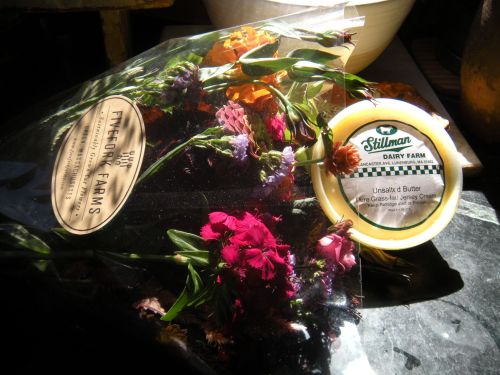
On Saturday mornings, I like to go to the farmer’s market in town because even though there aren’t that many participants, Fivefork Farms, a CSA flower farm from Upton, MA. serves as the anchor, drawing lots of customers from our town and nearby places. And I like to go to chat with Grace and her Dad while picking out some flowers to adorn the kitchen table for the week.

Today, I found this wonderful Fall bouquet of mixed flowers . . . AND walked by a new vendor from a Jersey cow farm in Lunenberg, MA. who had a few bins of freshly made BUTTER from grass-fed Jersey cows. I commented that I had never seen butter offered before and the fellow said they usually sell all of it to a local bakery and had a few bins left that he brought to the market.

Wow! – what a wonderful find! Having fresh filet of sole and asparagus for dinner tonight too! – with lemon (fresh!) butter!

YAY!


serving bone broth . . .

For anyone who might be thinking of trying this at home, I thought it might be helpful to see what the broth looks like when it is stored and served.

bone-broth-servingsThis photo shows containers holding approximately 3 cups of broth in each one. The one in the middle is fresh from the freezer where you can see a congealed layer of fat on the top. It comes out easily after running a knife around the edge and looks a little like wax.

The container on the right shows the gelatinous broth before it is thawed completely. And the cup on the left contains warm broth.

By the way, it tastes good. Enough flavor to make it satisfying to drink. It’s also not too bland. I’m waiting to see whether I go through all three containers today or not.

Probably will. Worth it too.

bone broth diet: minus day one

marrow-bones-in-the-cooker

It’s Sunday and my Instant Pot arrived from Amazon mid-morning. I’m going to open it up, rinse it out and read the directions for making beef bone broth.

But first, I read this great article which helped me to decide to ROAST the beef bones first before putting them with carrots, celery, onion, garlic and apple cider into the Instant Pot. So I took out a pack (about 3 lbs.) of beef marrow bones from the freezer which I bought yesterday and heated them up in the microwave to defrost them. Then, I put them into the oven and roasted them for about an hour, turning them over midway – smelled divine.

Then, I opened Dr. KellyAnn’s book, “Bone Broth Diet” which arrived in the same delivery as the Instant Pot. I decided the Instant Pot could wait until I read through the parts of the book that I needed to get started. I thought it was written well with lots of supporting nutritional information and anecdotes. The most important thing I noted is that her recipe for beef bone broth included beef short ribs in addition to the bones which would enrich the broth and enhance the flavor.

Since I also needed to buy carrots, I went to the grocery store and bought a pack of beef rib bones and some spring water to replenish our supply. Back home again, I turned on the oven from roasting the bones and put three pieces of beef rib bones in to roast for about 45 minutes.

With the beef bones/ribs roasting away in the oven, I sat down to read the manual for operating the Instant Pot. Looked pretty simple to me: open the lid, fill not too high, close the lid, push the right buttons to cook “soup.”

After waiting a half hour for some steam to come out, it didn’t look like the pot was heating up or building any pressure. I looked online at some Youtube videos about how to turn the pot on properly. Not much help. I then stopped the machine by pushing “cancel”, unplugged the pot and opened the lid. The liquid was barely warm. Baffled, I put the lid back on, plugged it in and pressed “soup” again. I then tried to add more minutes but suddenly, there were 3 beeps and the LED window showed “ON.” Well, that was an improvement. I then learned online from a very helpful guy that he NEVER uses any of the pre-programmed buttons like “soup” or “stew.” He just presses the manual button, adds on the time he wants and the machine beeps and turns on to what he’s programmed. Why wasn’t that obvious from reading the manual or watching the videos? Go figure.

Back to the diet book while waiting for the Instant Pot to act “instantly,” I also noted that in addition to making and mini-fasting with the bone broth two days a week, that this miracle diet requires you to do what every other diet in the world requires you to do:

  1. Drop gluten foods – breads, flour, pasta
  2. Drop glycemic vegetables – corn, potatoes, sweet potatoes, kabocha squash
  3. Drop sugar, fast food and anything that we all know is bad for us.

DO eat high-quality protein meats (grass-fed beef, organic chicken, etc.)

DO eat lots of organic vegetables. Tons!

DO eat organic eggs with bacon (yep!)

DO NOT EAT english muffins, toast, sandwich bread, rolls with hamburgers, pizza crusts, (you get the picture.)

So, outside of the bone-broth twist, (because there have been 2-day mini-fast diets around too,) this seems like most diets out there: Paleo et al. that caution low carbs, non-gluten, no sugar etc.- including getting off the couch and getting some exercise even if it’s limited to walking every day or so.

Meanwhile, I am encouraged to report that the aroma alone of roasting beef bones and ribs in the oven almost justifies making the bone broth whether you’re on a diet or not. Can’t wait to taste it after it’s had its run in the Instant Pot pressure cooker, false starts and all! If it makes the 2-day a week mini-fast endurable, it might all be worth it!

[Maybe the glitches in getting the machine to work is due to Mercury still being in Retrograde until the 22nd, eleven more days from now.]

Note: Here’s a ‘bare bones’ recipe without all the editorializing above:

  1. Take 3 lbs. marrow bones and 2-3 pieces of beef ribs; roast in 425 degree oven for an hour, turning pieces halfway thru
  2. Cut up 3 organic carrots, 3 stalks of celery, a small whole vidalia onion and 1-2 cloves of peeled garlic (I used 1 cut in half)
  3. Place bones/meat/vegetables into cooker pot
  4. Add spring water to an inch lower than “maximum”
  5. Add 1 tablespoon Bragg’s apple cider vinegar and 1 teaspoon sea salt, 1 bay leaf

Turn on Instant Pot manually to 75 minutes. See if that’s long enough once the pot pressure has vented and you can take a look at the broth. Cook longer if desired. Cool, pour through a strainer; store in quart containers and freeze.

Honestly? the aroma of it smells like this beef bone broth could be an elixir for life! I’m glad that the ‘unseen hand of the Universe’ led me to it!

 

striped bass for dinner tonight . . .

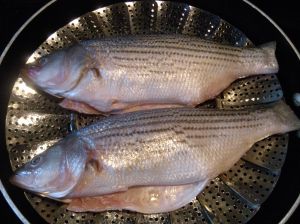
fish-3

We live in a working class town in Central Massachusetts with numerous Universities (Holy Cross, Worcester Polytechnic Institute, Mass College of Pharmacy) and Hospitals (UmassMed, Memorial and a bunch of others.) There are also a couple of Vietnamese grocery stores in town (Mekong and Ha Tien.)

What both of these specialty asian food shops have are open bins of fresh whole fish of all stripes (large to small.) One of my favorite trips is to go on a Saturday morning before the crowds hit at midday and to buy two medium size whole striped bass. The guys behind the counter then trim, scale and clean them. Today’s ‘catch’ costs less than $12 for the two fish. And you can’t get fish much fresher than this unless you catch it yourself, it seems!fish-1

For dinner tonight, I’m going to steam the striped bass in a large skillet until they’re cooked through. When done, I’ll move them to a large platter and pour a sauce over them (sauteed garlic, ginger, scallions with soy, sherry cooking wine, oyster sauce, a little sweetener, thickened slightly with a cornstarch slurry.) The sauce is heated separately in a pan until it tastes just right (sampling as we go,) and is then poured gently over the fish just when we’re ready to sit down at the table to eat. Because the fish is so tender all by itself, I like to keep the sauce/glaze light and full of flavor but not so salty as to overpower the delectable fish itself.

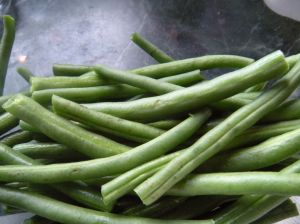
As a side dish, I’m making Chinese string beans – an experiment to replicate some of those steaming piles of green beans at restaurants that are tender in the middle but still have a bite plus a spicy hot glaze that’s piquant but not overpowering. I looked at some recipes online and I think the secret to the texture/bite is to heat up an inch of of vegetable cooking oil in a covered pot until hot and deep fry the trimmed beans (that have been rinsed but are absolutely dry before putting in the oil) as part one of a two-step cooking process.

I just finished trimming the beans and what I noticed most of all is that these are not regular bean beans like the ones you see in the super market or at the farm stand. I picked these up at the Asian food market and they’re, well, an ASIAN variety of beans. That makes sense, doesn’t it? Anyhow, they are just gorgeous: unblemished, uniformly thin, crisp to the knife. They’re dark green but not as skinny as French haricots verts!beans-2

These are going to be great! I never bought string beans at the Asian market before because I thought that all string beans were created equal! Not anymore!  So, after I rinsed the beans, I patted them dry with a paper towel before the next step of cooking them in hot oil to kind of par-fry them (as opposed to parboil.)

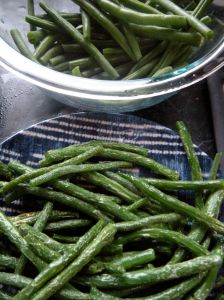
deep-fried beans (90 seconds) on bottom; raw ones on top

deep-fried beans (90 seconds) on bottom; raw ones on top

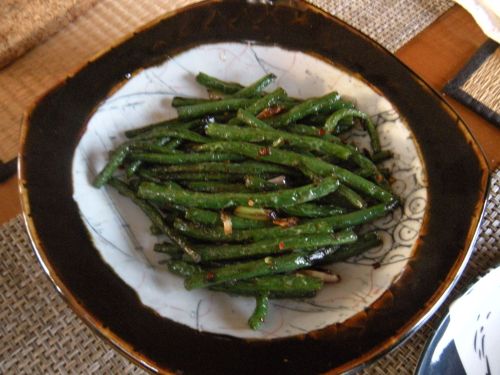
After 90 seconds frying in the oil, I removed them and drained them on kitchen towel to remove excess oil. THEN, in a skillet, I heated up some fresh oil and sauteed some crushed fresh garlic, minced ginger root, and chopped scallions. I stir-fried the beans quickly in a skillet large enough to move them around and then added some seasoning (a dab of Ohsawha soy sauce and a tiny bit of sugar (splenda).) Then, I sprinkle the cooked beans with a shake of red pepper flakes and tasted it: tender and flavorful. Here’s how they looked.

beans-4

Both G. and I thought that the steamed fish and string beans were plenty for our dinner and that we didn’t want or need any cooked rice.

So that’s our dinner tonight. I would tag this one as a healthy “foodie pick” for a Saturday night meal. Sound good?