mulberryshoots

"Tell me, what is it you plan to do with your one wild and precious life?" ~ Mary Oliver

Category: Life & Spirit

clarity . . .

anemones

Some of us, as time goes by, care less and less about appearances, schedules and bypass things that annoy us. Why bother? Others, like me, have been working on coming to some kind of understanding about what has made me tick, or at least what has accounted for the movie script of my life.

Yesterday, I had a deep-tissue massage and both my massage therapist and I were surprised at how many knots she came across and worked out. I felt sore but really good afterwards. Then, I read some stuff online that I had been thinking about while drinking lots of water to work out all that lactic acid released from the fascia lining my muscles.

Then I went to bed.

This morning, I woke up with clarity. All the moving parts of the puzzle that have been my life clicked together at once. The Theme. Variations. Repeats. and finally, the Coda.  It all made so much sense. Understanding, for me at least, has provided clairvoyance in 3-D, no longer 2-dimensional facts or events in my life.

Clarity has helped me to finally turn the page and breathe a sigh of relief.

It’s complex. It all fits. Now, I really get it.

Time to move forward and enjoy my life!


“teaching a kitten to bark” . . .

DSCN6511

“Teaching a kitten to bark. . . ”  That’s how futile it is to try to change reality, I’m told.

What is, just is.

Including everything in the past that you wish hadn’t happened. In fact, if you believe in the Universe guiding our lives as I do, it turns out that there aren’t any “should haves” or “should not haves.” Everything that’s happened did and we can’t do anything about it. Karma translates to a “meant to be” that includes not only the good–but the bad and sometimes the very ugly. In Byron Katie’s words, it lies in “God’s Country.”

Sorry about that.

Apparently, the only thing we can do about it is to stop obsessing about it, feeling bad and wanting to “make things right.” All waste of time and energy. Nobody has that power so it’s no use waiting around for something like that to happen. How about that? What an amazing amount of time and spirit energy we could save, right? Too bad it took so long to really get this.

All we have power over is “our country” — that which is under our power to live out.

The other part of “what is, is” requires acknowledging that people are also the way that they just are, Including their values and how they behave. That’s their country, not ours.

Time to live large or go home!


newspaper delivery saga . . .

chemex coffeeEvery morning, my husband G. and I have a breakfast ritual. He takes out his cinnamon and raisin bread from Crown Bakery, makes a big pot of coffee, does his stretching exercises downstairs with his orange juice and brings upstairs the Telegram & Gazette newspaper (for him) and the New York Times newspaper (for me.) I, on my part, have a half glass of orange juice, make a bowl of oatmeal or cook two soft-boiled eggs that I eat with a dab of Chinese oyster sauce (like my Dad had for his breakfast.) Our breakfast ritual is characterized by contented silence eating our breakfasts, rustling the pages of our individual newspapers and drinking cups of hot coffee.

Everything was fine until a few months before the holidays. More often than not, G. returned upstairs empty-handed. Sometimes the newspaper (which was guaranteed to be delivered by 7:30 a.m.) didn’t arrive until after eight o’clock, or sometimes not at all. I don’t know about you, but a half an hour is a long time to wait before putting slices of cinnamon raisin bread into the toaster just so you could eat and read at the same time.

It was obvious that we had a new delivery person who just didn’t care much about delivering the paper on time. For over two months and despite entreaties in person to get better service, nothing much happened to get back to a schedule that allowed us to have our breakfast and read the newspaper together. Then, a new delivery person came on board and things improved a little, even managing to get by the snow plows and deliver the paper on snowy mornings in this almost-record snowfall winter of 2014-15 here in New England. Then things started getting erratic again and yesterday, no papers arrived at all. G. called the T&G circulation line only to be put on hold for ten minutes and then spoke to someone with a foreign accent, blase as could be and not caring at all about either the wait time for being put on hold, nor G.’s complaint about missing papers. It was frustrating.

So, mid-morning, sans newspapers, I looked online and perused the “Contact Us” page of the Telegram and Gazette website. I wrote to the Director of Circulation, copying three managers working under him, describing the history of spotty deliveries and voiced a final “cri de coeur” asking for help to restore our equanimity at breakfast with papers delivered on time.

At eight p.m. last night, G.’s phone rang and it was the Director of Circulation at the T & G., a fellow with the initials A.S. They spoke for a brief time, I could hear the word, “Manila,” in response to where the complaint-line operator originated from. He gave G. his phone number in case we had future problems and offered up a two-week free extension to G.’s subscription.

This morning as I walked into the kitchen, I asked G. if the papers had come. Silence. Then, he said that there were copies of the paper that weren’t delivered yesterday, today’s paper and an extra one of the Telegram and Gazette. Plus, yesterday’s copy of the New York Times newspaper that wasn’t delivered plus today’s copy. Five newspapers in all had landed on our doorstep and lay on our breakfast table this morning.

Later, I wrote a thank-you note to A.S. for calling G. last night and for the newspapers delivered this a.m. His reply arrived immediately saying it was great to hear good news and to offer up his help if we needed it in the future.

This might seem like a long post to read about something as mundane as newspaper delivery problems. But if you enjoy the sound of newspaper pages being turned in the silence of a shared morning breakfast ritual to start the day, you’ll understand.


“the man in the empty boat” . . .

poinsettia plants still doing well on the winter windowsill. . .

poinsettia plants still doing well on the winter windowsill. . .

Okay, so I’ve already written in the past about how nonsensical some of the writings about Nirvana, Zen and Enlightenment can be. An unknown reader to that post suggested that I read “The Laughing Sutra” by Mark Salzman, author also of “Iron and Silk.”

I dutifully reserved that book and picked it up last week from my local branch library. It maintained my interest for a couple of chapters but then fell away from my stack of reading material situated on the small table near my sofa. BTW, this mound of reading increases and subsides as I add additional books to my local library’s online “hold” column whenever a book appeals to me from reading my daily junkie newspaper, the New York Times. I make a point of picking up books held for me at the branch library just down the street from where I live within a couple of days of their phone calls that let me know my reserved books are in. And I also promptly return books that I have browsed through, read or decided they weren’t for me. This rotating reading library is a godsend that has saved me lots of money and storage problems with buying used books on Amazon Prime. On average, I estimate I go through about a dozen volumes a week this way: 20% read to 80% reviewed.

After looking a bit at the “Laughing Sutra” volume, I searched online for Mark Salzman and learned he had married Jessica Yu, a third generation Chinese woman born in California and also graduated from Yale. Besides that, she produced a documentary about a polio victim in an iron lung called “Breathing Lessons” and won an Academy award for her short film made on a tiny budget. That’s right, an OSCAR!

His book, “The Man in the Empty Boat” was unavailable on the library search engine so I went ahead and purchased a used copy on Amazon Prime for a few dollars plus shipping. It arrived yesterday around midday in the mail and by suppertime, I had read most of it. My reading habits aren’t very noteworthy. That is, I don’t rest on every single word in a linear fashion. Instead, I’ll read a few chapters, skip around, maybe edge towards the back and then back and forth again. Part of my short attention span and peripatetic nature, I guess.

In any event, after I had gone back and forth a few times, his message, almost a subtext to a humorous and tragic memoir, was pretty astounding. For the first time, in plain, everyday blog-like language, Salzman makes the case for accepting that we are part of a larger Cosmos and that our role in life is not to DETERMINE what our life will be like; but instead to FIND OUT when the time is right what happens to us: hence, the empty boat of life and a way to be in it.

Honestly, this is the first time that my own experience of being greatly helped while truly being helpless due to fate or karma as a process has been described by someone else so accurately. When I look back on my life, the big moments of change and salvation were mostly out of my hands. Of course, I applied myself and did the best I could in each set of circumstances, but in the end, the outcome wasn’t really up to me.

And therein lies the message: everyone is just doing the best they can AND we’re all part of something greater that is unknowable until it becomes known to us.

Isn’t that freeing?


a life of our own . . .


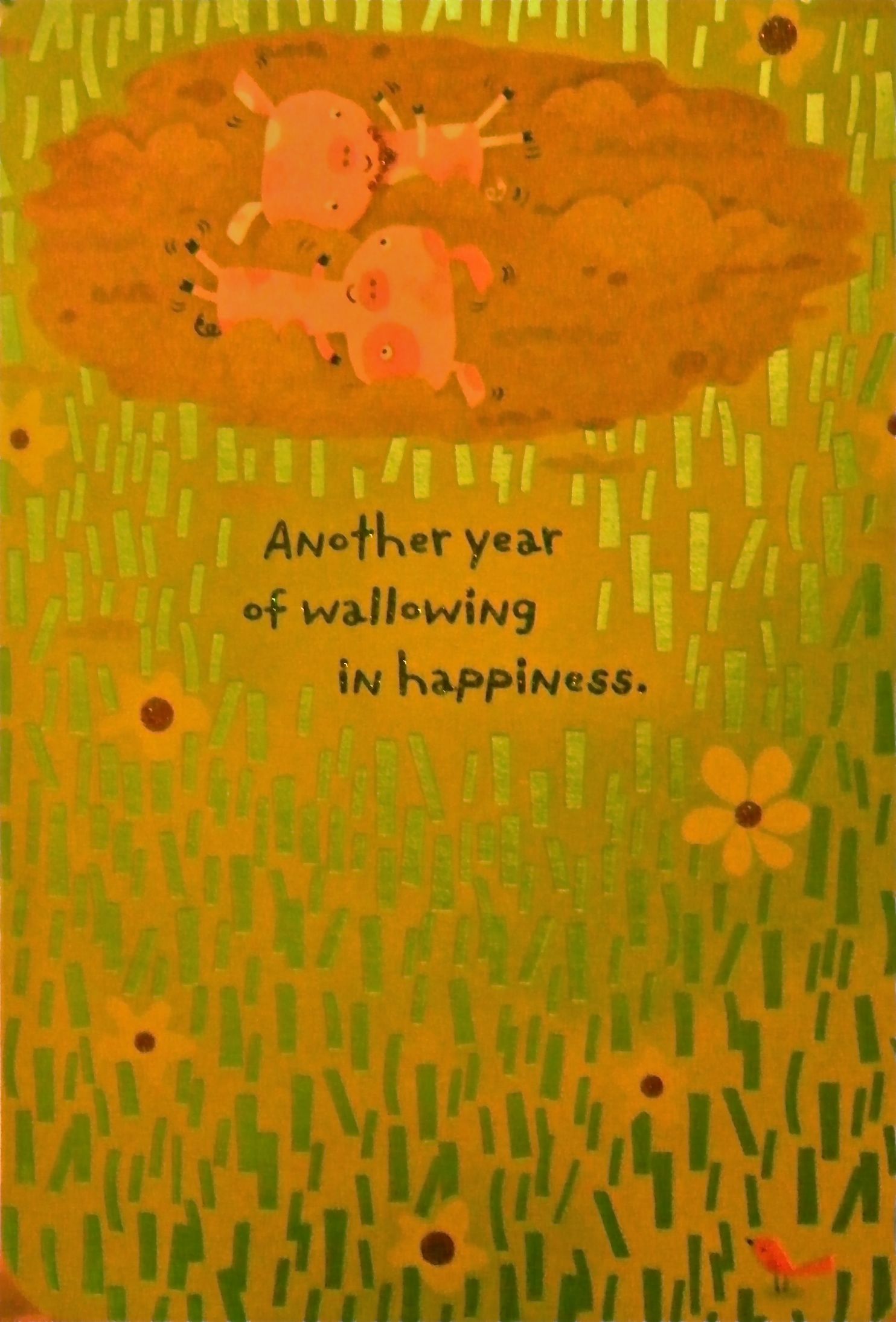
the funniest card . . .

the funniest card . . .

Fate wasn’t done with us when G. and I met over twenty-three years ago.

When I say that “life is long” it’s meant with an amazement that we would meet later in life almost past middle age, and have been together so long ever since.

Today is our nineteenth wedding anniversary from a day when we crept down the back stairs in G.’s piano shop, slipped out the door and drove to City Hall in a sudden swirl of a snowstorm where the City Clerk met us, a gentle smile behind his thick glasses. We were married with no witnesses in the courtroom of shiny golden oak, the wood grain flaming all over the place. We were quiet as we said vows that we had written ourselves.

When we drove home, G.’s workers hadn’t noticed that we had gone out. I started cooking dinner while George went out to tune a piano. I think we had duckling with an orange or cherry sauce with wild rice and braised endive on the side. He called to let me know he was on his way home and called me “Mrs.” For a fellow who had foresworn ever to get married, he was in love with the idea of it as soon as it happened. I, on the other hand, struggled vainly to maintain my independence for over a year, adjusting to marriage again after the first one had frittered itself away such a long time ago.

Today and every day herein, we acknowledge how lucky we are to be living with each other in a life of our own.

Thank you, dear Universe!


the “tao-te-ching” and my dad . . .

DSC_0720

My father translated the Tao-Te-Ching from the Chinese before he died in 2008 at the age of 88.

Today, I noticed that the last two words of the title reversed are the same as his given Mandarin name, “Ching-Te”.

How about that!

I also remembered the last time we stood together for a photograph and he took my hand and held it.

spirit stuff . . .


DSC_0003As usual in the wintertime, I’ve been pulling out my books on Taoism, Buddhism and Zen to thumb through as the snow keeps falling and falling. The book, I-Ching, stays out for me so that I may ask the Cosmos questions when I am stumped or looking for reinforcement.

Recently, I decided to read over my father’s translation of the Tao te Ching, an endeavor that took his attention for the last four or so years of his life. He died in 2008 and was well known for his research in the field of astrogeology but it was a spiritual quest that included meditation and his work on the 81 verses of the Tao te Ching that consumed him at the end of his life. He was quite deliberate about it because he felt that Western translators who were not native Chinese and unable to read the ancient texts themselves were usurpers or worse. “Interpretations,” not even translations like Stephen Mitchell’s widely acclaimed version of the “Tao te Ching” just drove him crazy.

One of his footnotes to the first page noted his disdain for Ursula Le Guin and others who had used the word “power” as a translation for the word “te” (Tao te Ching) rather than  the word/concept of “virtue.” In hindsight, it almost seems comical that someone could be that furious about something like this, but hey–isn’t that what academia is all about? They love to argue about these kinds of things all the time.

I tend to enjoy translations and writing by a writer who calls himself “Red Pine” (aka Bill Porter.) That’s because he took seriously the idea of Taoist hermits and went searching for them in the wilds of the Sian mountains and wrote a book about it. One of my favorite parts is when he writes that these hermits are not invisible nor necessarily to be found in remote shacks in the wilds but are hiding in plain sight. In other words, there are tons of such Taoist hermits but you just don’t know by looking at them straight on that that’s who they are. I love that.

The reason I wanted to read my Dad’s version of the Tao te Ching is that I wanted to see what he was about in doing this work. Some of his wording belies his training as a research scientist in that he seems to feel compelled to explain everything about everything so thoroughly that you can’t miss it. Of course, if you’ve ever read any of this stuff, it’s almost just the opposite. In fact, in reading articles in a journal called “Buddhadharma” and looking at Zen Monastery websites, I’m at a moment close to shouting that “the Emperor’s Has No Clothes On” because honestly, (and I went to college!), it seems, sounds like and looks to me to be gobbledygook most of the time.

Zen enclaves offer retreats, courses and ask for donations all the time. They are marketing their wares just as much as say, MacDonalds is hawking hamburgers. Buddhist and Zen Priests, Roshis and hangers on congregate, fall in love with each other, have affairs with others (some of the Senseis are notoriously more famous for that than their spiritual leadership.) Deepak Chopra is a rich man. They are not ego-less, that’s for sure, because they’re writing books, making audio CDs, getting published and they care very much about their reputations and how they appear to the world. What’s wrong with this picture, I wonder?

In any case, I trust the I-Ching and its wisdom helps me out all the time as long as I don’t read into it what I think I want to hear. Which brings me back to what all this Tao stuff is all about. Simply put, I believe that the Tao is the Cosmos or the Universe. It is a belief in something greater than ourselves. And to me, it has been beneficent and guiding, not harsh and punishing like some religions that inculcate the young they will go to hell if they eat pretzels during Lent or something. Or that adultery can be worked off by saying X number of “Hail Mary’s” or lighting candles at Mass, for example.

My life has been an exemplar of a greater good guiding, rescuing and helping me every time I’ve been in a difficult life situation. There have been many, and I’m not exaggerating either. I have been helped when it seemed it was fruitless to hope for a positive outcome. I remember when I gave in or up to this higher power when I realized I could not “fix” things just by myself. The rest is history, as they say.

So, whether one wants to read about Spirit in a religious context, in a philosophical context or whatever, it’s really about faith and belief. I’m not sure if that huge Cosmic force works for someone if they don’t believe in it first. I just know that its presence in my life has been constant and has had a huge influence on how my life has turned out. I don’t pray to it per se. But I do ask for guidance and for help. I believe that Helpers are available just waiting to be asked. There’s some level of activity involved in engaging with this Tao–you just can’t rely on things happening without some belief or some giving energy going back and forth. Gratitude is a big component of this spiritual engagement. Asking for help and thanking the Helpers when it arrives serves to activate the belief that one’s life has more to it than just what I can do by myself by sheer will and effort alone.

So, my father’s writing is very verbose, at least in the translation version that I have. It’s a little less so in the draft that my sister has in her possession. And it’s nothing at all like the rather sparsely poetic translations that Red Pine and Stephen Mitchell have published.

As for reading about Zen and the Buddha dharma, it’s a true mystery to me and I’m no longer interested in looking for hidden meaning when I can’t even fathom what the unhidden words are saying outright. As for meditation, my physician said to me that it’s a lot more helpful to practice it than to read about it. Point taken.

So, that’s all the mystery I can think about writing in this post today. Either you believe because you have experienced it or you don’t. Either you have faith in a beneficent Universe that looks over your life or you don’t. It doesn’t really matter to anyone else. It can be a big influence on your life or absent altogether. We’re all different, right?

“he left nothing undone”. . .

DSC_2785

The quotation title of this post is what Jill Carr said about the passing of her late husband, David Carr, last Thursday night. There has been an outpouring of anecdotes about him even though it’s less than a week since he died: intimate remembrances from friends, family, colleagues and strangers providing insight about him in the wake of his death (pun intended.)

As one writer noted, David Carr epitomized a life that illustrated second chances are possible. Redeeming himself with newborn twins, an addiction to drugs and a life of waste laid upon his body as well as on a dim future, he suffered from cancer, married, had another daughter, got a job at the NYTimes in 2002 and lived for another 13 years before he collapsed last week at his desk.

One irate reader asked why all the fuss over David Carr when she hadn’t been impressed by his writing nor his column? I guess you had to read and glean what it was from what others said about him to learn why he was so admired and not just what he wrote about. What I can gather is that he was a teacher about life as well as about writing. That he was stern and severe in his expectations coupled with empathy and encouragement towards those starting out and especially providing a way for diversity in the mix. He could fiercely compete with you and also be close friends.  I guess it might be more uncommon for people in high places like the Times to be that human and that compassionate towards others.

One commentator said that David might not have been the worst dancer, nor the best, but he was certainly the most secure when he was dancing. He lived life to the fullest no matter what he did and it seemed he must have known about his debilitating failing health for a long time and made a conscious choice to power on ahead anyhow. He died not in a hospital bed set in his living room but on the beat, working and doing his job.

I guess this is what his wife meant when she said he left nothing undone. That’s a pretty powerful message for those of us looking around ourselves to see what still needs to be done. And more importantly, what we would like to do that we haven’t yet done.

That’s a pretty powerful legacy to leave behind, don’t you think?

Long live David Carr!


valentine . . .

v card 1

v card 3It’s Valentine’s Day today and the forecast of another blizzard tonight is putting a damper on the commercial aspects of the celebration. People may stay home tonight instead of going out for dinner. Flower deliveries and shopping might be cut short due to difficulty getting out, parking and the logistics of doing normally what we might do to show our loved ones that we care.

I’ve been debating about what to have for our Valentine’s dinner because the ideas swirl around how much effort the shopping/cooking/cleaning will take instead of going out and paying the piper for a meal that we might enjoy out at a nice restaurant instead.

My first inclination was to order some take-out cooked lobster and cole slaw from our local fish market. It’s festive and easy. Just send G. out to pick it up before the place closes at 6 p.m. And we haven’t had lobster for awhile anyhow. But a quick call to the fish market was taken by an impatient fishmonger who said to call back rather than take my order. The Market Basket fish guy said they were expecting a shipment of hard shell lobsters too but they hadn’t arrived and to also call back. So much for the lobster idea.

Yesterday, when visiting with my daughter C. in Concord in the afternoon, I picked up a small fresh Bell & Evans whole chicken that I could roast in a simplified Judy Rodgers style recipe sans the overnight brining. Throw in some baking potatoes, make a salad and we’re good to go.

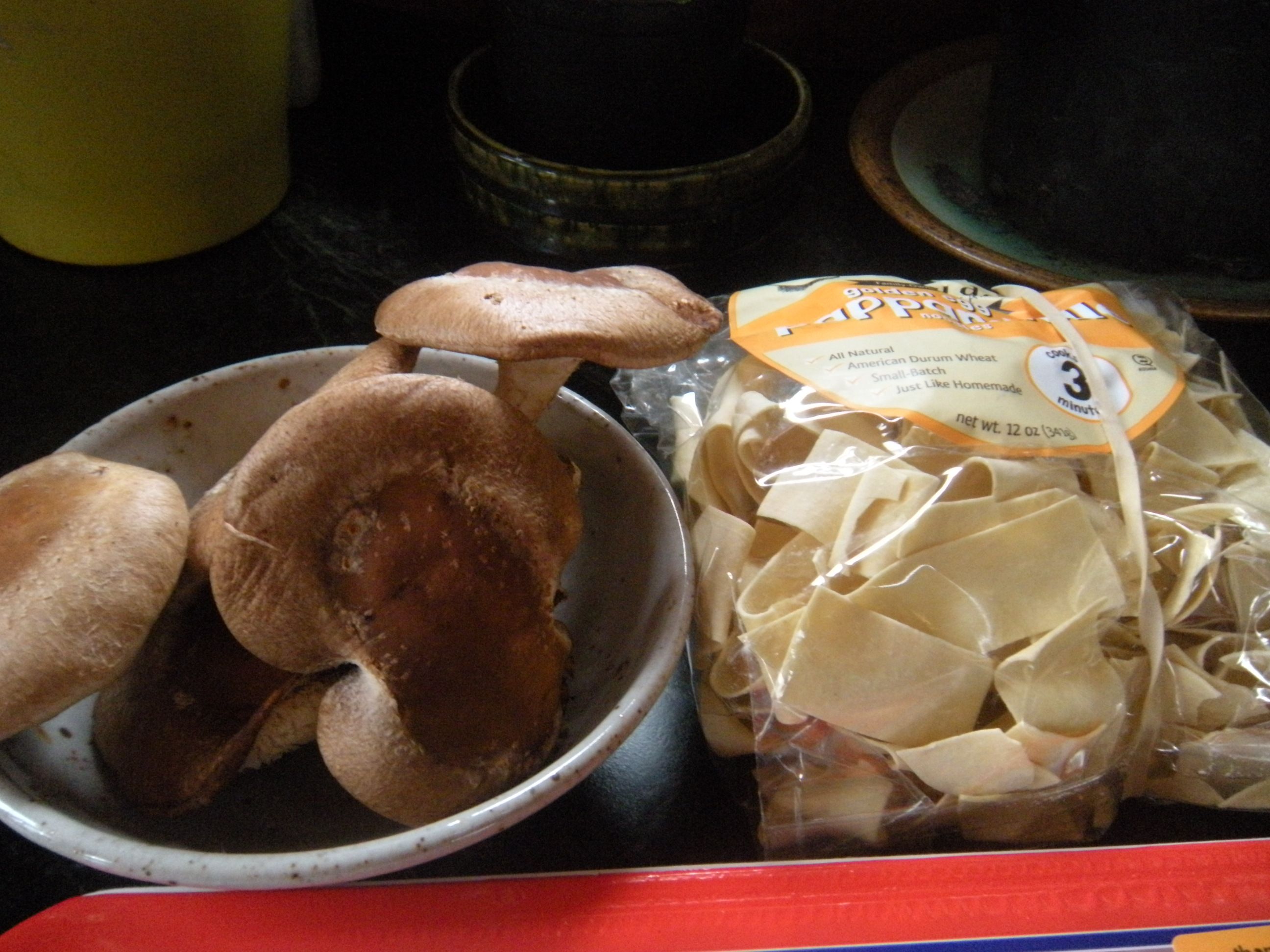
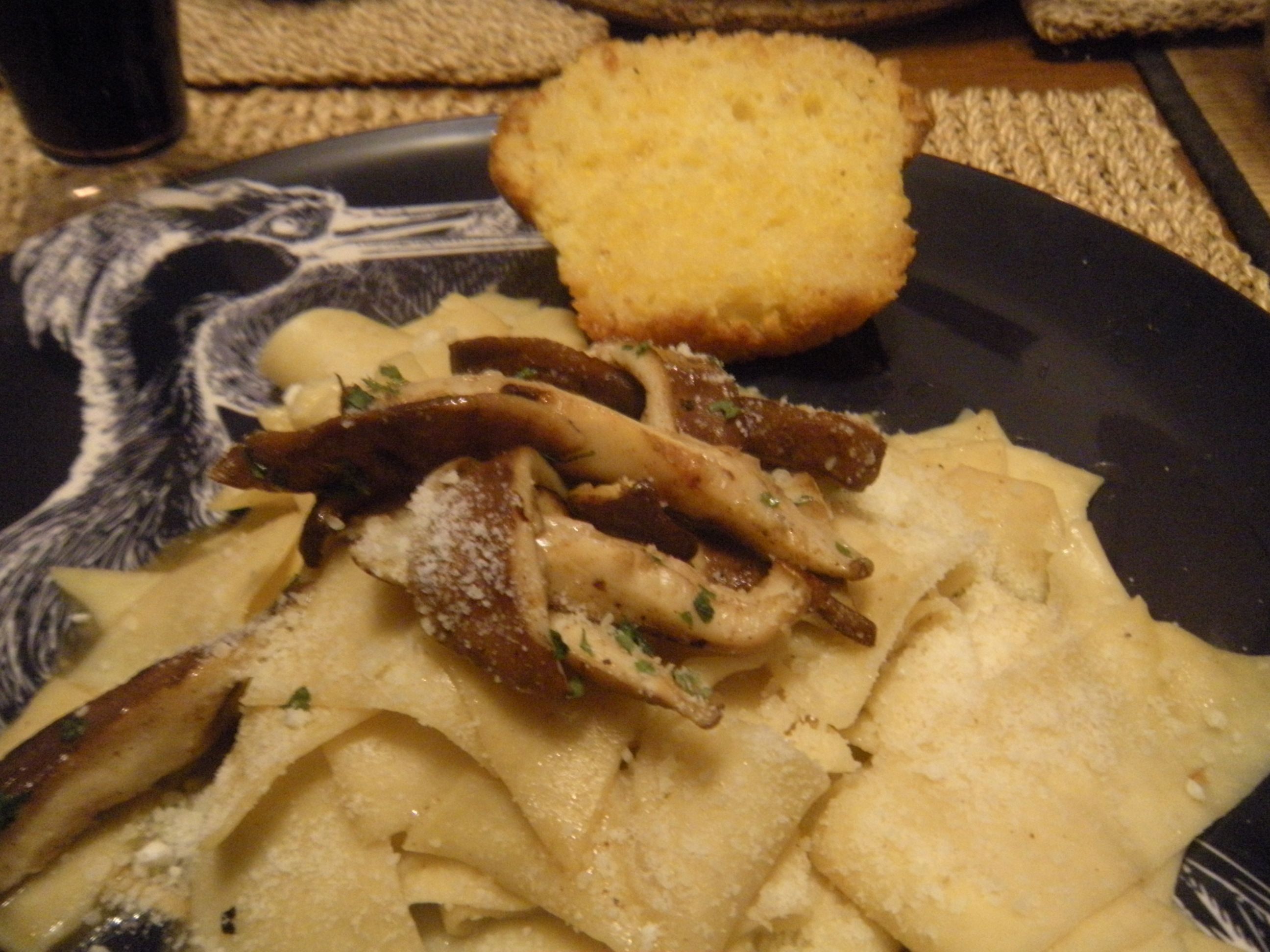
The other idea I have is to make a very simple dinner of pappardalle pasta (wide noodles) with a little braised veal and fresh sauteed shitake mushrooms with grated parmesan reggiano cheese sprinkled on top. I saw a demonstration of this dish the other day on one of those cooking shows with three chefs who bantered back and forth, the tension of their egos bubbling among them like a sauce gently basted over an entree in a pan cooking on the stove.

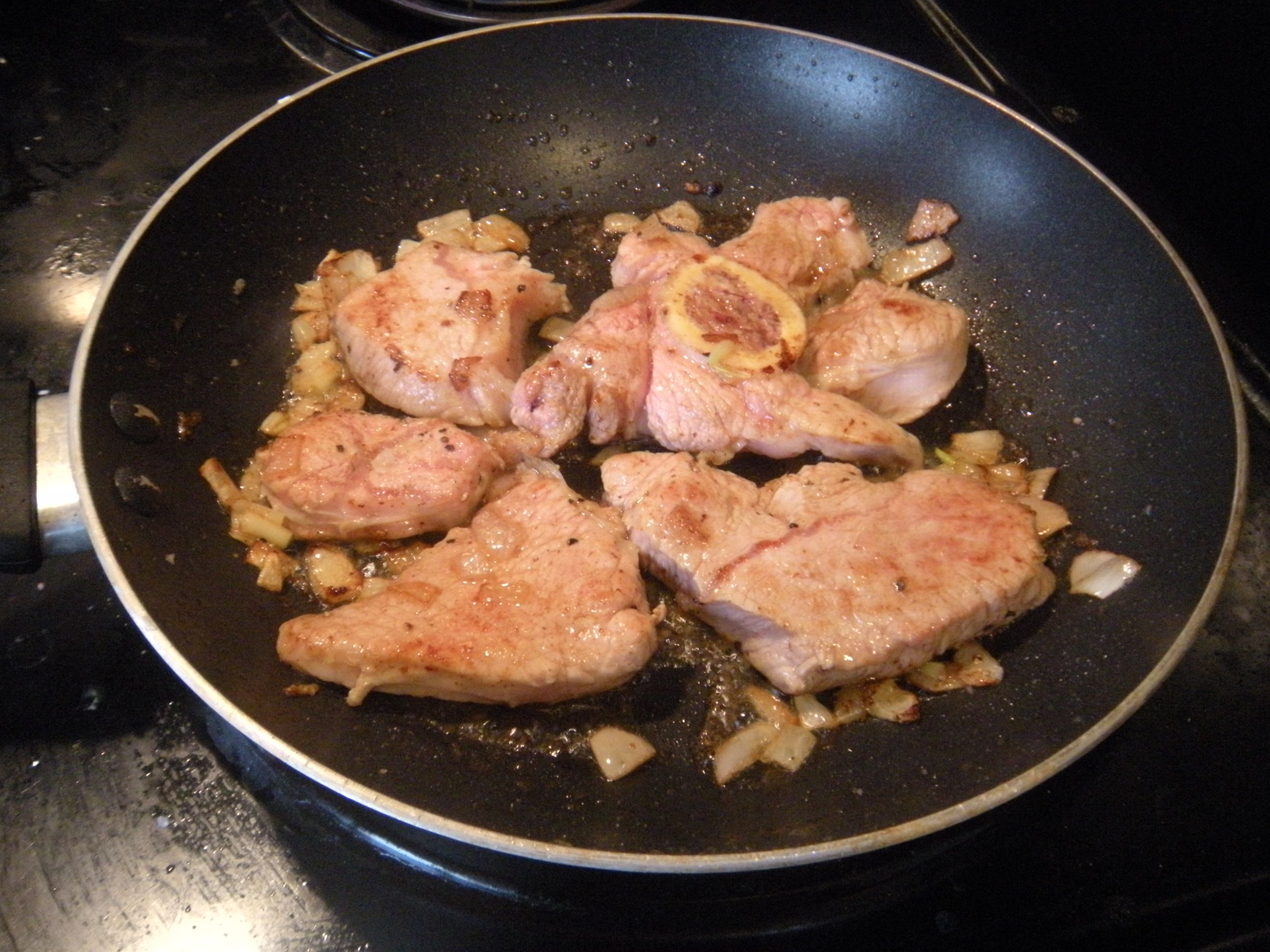
I’ve made pappardalle before because I love these wide noodles. The TV chef’s trick was to submerge the freshly cooked and rinsed noodles into a homemade stock made of veal and chicken. What a revelation! To have a wonderful base of flavor in stock to glaze the noodles before serving. That “Aha” moment was priceless. No wonder the dish looked so appetizing.veal I found a small piece of veal, cooked it lightly with some chopped shallots and unsalted butter; made a small veal stock that simmered for about an hour on the stove.

fresh shitake mushrooms and pappardalle noodles. . .

fresh shitake mushrooms and pappardalle noodles. . .

I bought some large fresh shitake mushrooms yesterday because they’d be so nice, sliced thickly and cooked in some unsalted butter with salt and pepper, then placed on top of the aromatic stock flavored pappardalle. Sprinkle with some grated parmesan reggiano cheese.

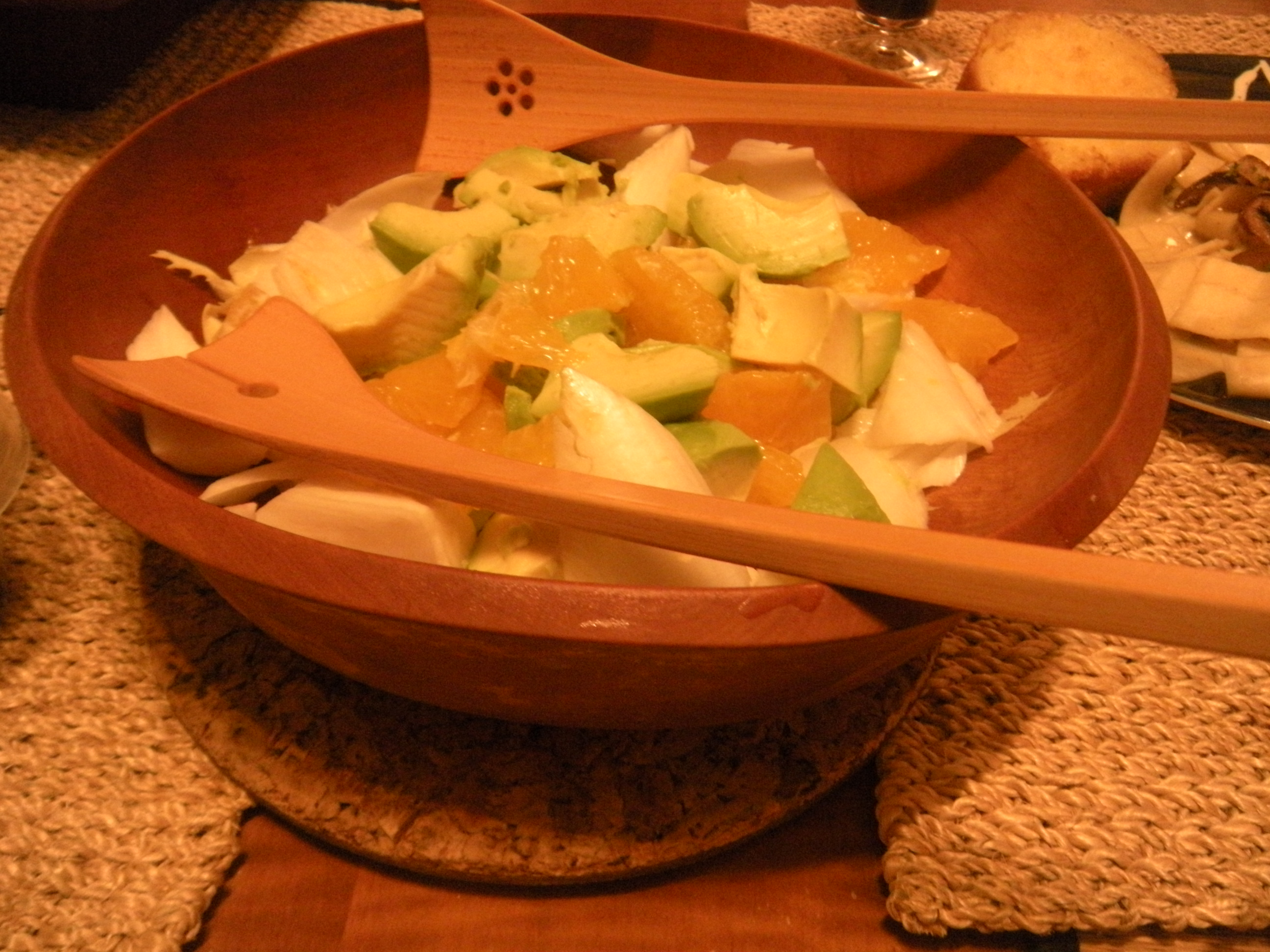
No cooked vegetable like asparagus or broccoli–too mundane, but perhaps a salad of fresh endive diagonally cut and quarter turned, the leaves separated, a large fresh Mineola orange, peeled, the segments free of skin cut into the endive, then a whole just-ripe avocado, skinned, the luscious fruit cut in generous sized chunks into the salad. Dress this fruit salad with the simplest pure vinaigrette dressing made with refreshing meyer lemon juice and toss just before eating after the pappardalle noodle dish. Cracked pepper added at the last minute before the first bite of salad. Oh, and I have a corn muffin that I’ll toast on a griddle to have alongside the pappardalle dish.


pasta 2

DSCN7721There’s just enough organic red wine for each of us to have small glass with dinner. Picked up a miniature carrot cake for dessert.

The main event of my day, besides deciding on what to make for dinner and preparing for same, is cleaning up our kitchen-living space. I’m always amazed when I wake up in the morning to see how many things have accumulated in the course of a couple of days and nights. Ingredients and cooking things litter our wonderful new soapstone countertop. Books, socks and magazines are also all over the place in our sitting area.

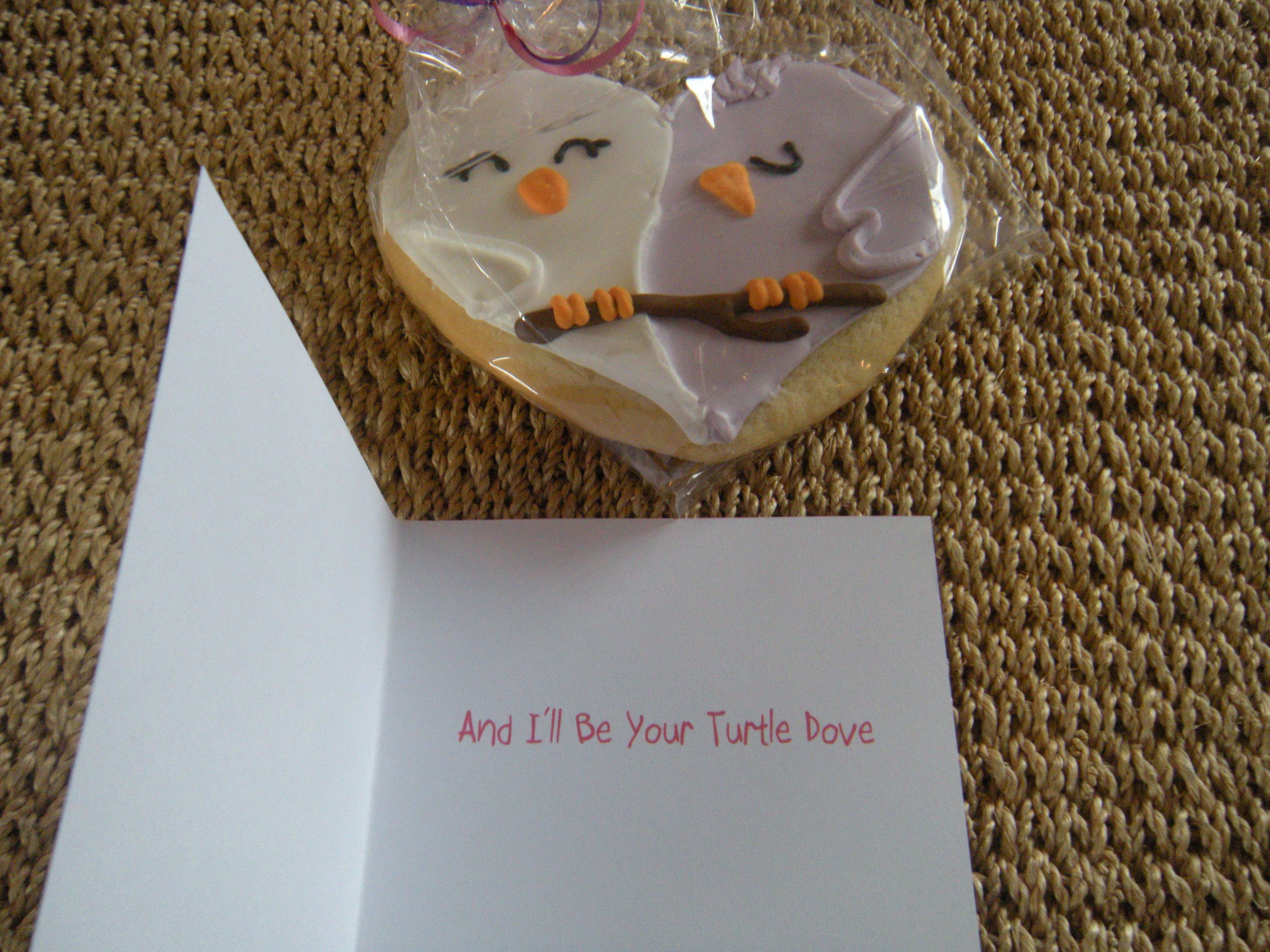
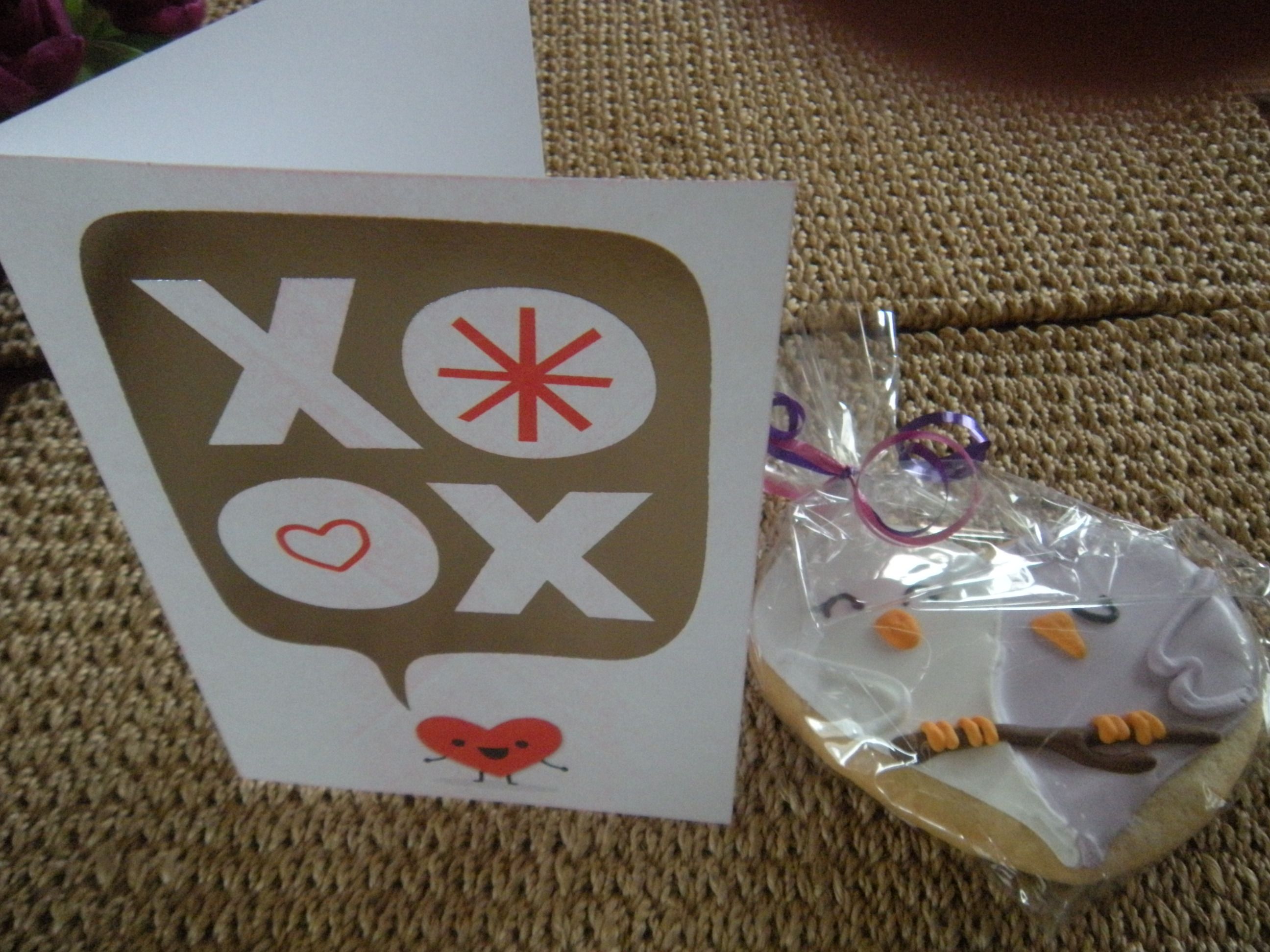
sweet V-card and cookie . . .

sweet V-card and cookie . . .

After I have my breakfast of Irish steel cut oatmeal cooked on top of the stove, I think I’ll empty everything off of the soapstone counter in order to apply a fresh coat of wax on it to renew its surface. Put things away, clear off our kitchen table; reduce piles of books and paperwork away and then vacuum all around. Our new dark blue plaid flannel sheets are washed and in the dryer. Having our home refreshed is a good thing to do before having dinner and exchanging cards tonight. As usual, most of the preparation for a special celebration occurs behind the scenes.

flower valentine from family living in Minneapolis!

flower valentine from family living in Minneapolis!

There’s lots to do so I think I’ll turn on the “Law and Order” channel and play it until the place is clean. These are old re-runs with Benjamin Bratt and Carey Lowell among the key characters: that was a long time ago! They’ll keep me company while the magic elves go to work!  Fun!


‘being mortal’ . . .

DSC_0009_2

Atul Gawande’s recent book, “Being Mortal” was highlighted by a documentary on “Frontline” (PBS) that aired this past week. It became more ironic as the week wore on because four men in journalism have either fallen from grace, retired or died unexpectedly. Unless you have been living under a rock, Brian Williams (NBC) was suspended on Tuesday without pay for six months. The ensuing wait-and-see will take place before our eyes on NBC’s evening news if you haven’t changed channels yet.

At least Jon Stewart is still alive and kicking even though he abruptly announced that he would be leaving his show on Comedy Central on the same day NBC announced it was placing Williams in TimeOut. There’s buzz about Stewart being on his own syndicated show as an alternative to his current gig. But that can wait.

Two days later, Bob Simon of CBS had the bad luck to get into a Lincoln Town car driven by an aberrant driver whose license was suspended numerous times. That driver speeded up, then crashed the car so badly that Simon, in the back seat without a seatbelt, was injured and killed. Eulogies for him began playing right away on CBS with Scott Pelley in tears.

The day after, late on Thursday night, there’s shocking breaking news that David Carr, the media columnist for the New York Times had died. Apparently he collapsed at his desk around 9 pm after completing an interview discussion of Edward Snowden’s big reveal and aftermath. I’ve been worried about Carr for awhile because in the last six months, he had lost so much weight that he looked anorexic. Turns out he had Hodgkins Lymphoma earlier which has unexplained weight loss as one of its symptoms. Perhaps Carr had a recurrence of cancer and worked through it to the end.

So, back to “Being Mortal” and Gawande’s thesis/theme that both doctors and patients have a hard time talking about next steps when there’s nothing else medically to be done. In the “Frontline” documentary, there are a number of case studies of people holding out hope, wives crying (and apologizing for crying) not acknowledging that they’re incredibly fortunate to have the foreknowledge of their last days so that they can take care of things, see their families and lie in hospital beds in their own living rooms before they die.

For people like Bob Simon who’s death occurred so suddenly and seemingly needlessly, it’s a different story. After over fifty years on the beat, exposed to great danger in war zones and the like, he didn’t have a chance to say goodbye to the droves of people who were shocked by his sudden death and who mourned him without having a chance to compliment him to his face as a final adieu. It’s all the more frustrating because had he just taken a regular cab, he’d probably still be alive.

David Carr, it seems, may have been the most courageous one of all by so blatantly motoring on to the end of his life doing exactly what meant the most to him. He wrote a piece about the Oscars coming up next weekend that I read on Wednesday. He went to the big event interviewing Laura Poitras and others responsible for outing Edward Snowden. He then returned to his desk at 9 p.m. and collapsed, either dying there or shortly thereafter at Roosevelt Hospital. He put his body through the wringer with years of drug addiction. He then survived one bout of Hodgkin’s Lymphoma. He was surely wasting away at the end. But he kept going. There was none of the precious denial or being afraid of facing death as depicted in the Frontline documentary of those who retreated into their affluent homes to die.

Maybe I’m being too harsh about all this mortality stuff but I don’t think so. I’d be surprised if Brian Williams’s career has a chance of surviving. And he’s not that old either; what will he do with himself?

Jon Stewart has a reputation for integrity so he’ll be fine.

Poor Bob Simon drew the wrong car driver and didn’t use his seatbelt.

And David Carr. Somehow, his pushing himself to do the Snowden piece and to die by collapsing at his desk (instead of in a rented hospital bed in his living room) is completely in character with his personality and with his incredible life. It’s unimaginable to make such a rise to the pinnacle of writers at the NYTimes after being an addict with newborn twins in the car, looking for a score.

So, in the end, because that’s what we’re talking about, right? In the END, it’s who we are, personal integrity, professional dedication and being trustworthy as a parent and spouse that matters most. Not feeling sorry for ourselves helps. Everybody, every one of us will die. Having a good death is within our grasp: that is, to be relatively free of pain, to have enough time and spirit to make peace within ourselves and with those who matter, not torturing our bodies with treatments that have no chance of prolonging life but instead destroys whatever quality of life and time that’s left. That’s a good death.

David Carr had a good death even though he may have been in pain at the end*. Bob Simon’s death was a pitiful twist of fate. Jon Stewart still has time to live his life the way he wants to, whatever that is. And Brian Williams? I don’t think any of us wants to speculate what will happen to his life when he has already sacrificed the most important thing there is: honesty and integrity. And so it goes.

*Footnote: An autopsy of David Carr showed that he had metastatic small cell lung cancer exacerbated by heart disease. Even though he’s looked ill for a number of years, he chose to write and work to the very end.