mulberryshoots

"Tell me, what is it you plan to do with your one wild and precious life?" ~ Mary Oliver

Category: Life & Spirit

how we met . . .


If my husband and I had met when we were younger, we wouldn’t have paid that much attention to each other. I was a goody-two-shoes dean’s list student at an ivy league school. At the same age, G. had hair down to his shoulders and played keyboard in a local rock band that is still well known in this town to this day.

We were both pianists: I started at the age of three, trained the Lechetiszky method by a renowned Russian pianist, Professor Basil Toutorsky (see basil toutorsky) who had 22 pianos in a mansion on 16th Street in Washington. G. was virtually self-taught, went to Berklee School of Music for awhile and played rock and roll, jazz and rhythm and blues. He didn’t get interested in classical music until he was in his 20’s and then shifted his interest to the complete works of a 19th century French composer named Charles Valentin Alkan. Alkan’s piano works are so difficult that very few pianists can play them. Marc Andre Hamelin, a Canadian pianist, has recorded most of his works. Recently Hamelin composed and recorded his own variations of Alkan’s compositions, if you can believe it.

This is all by way of describing how different and how similar we were at the same time. We both loved pianos. We courted to Alkan’s music played by Marc Andre Hamelin. And we met over a piano.

Although I loved the piano, my professional career was in the field of biotechnology (eggs in one basket). Offered a new job, I had just moved to central Massachusetts to a pristine modern condo facing the lake that ran through the town. When the movers put the piano in the living room, they attached the lyre which holds the pedals but forgot to tighten the surrounding hardware.

I looked in the Yellow Pages and found an ad with a handsome logo of a grand piano with the description, “Specializes in Steinways.” When G. arrived at the door of my new condo, I was distracted, on the phone with someone at the office. I was also not interested in getting involved with anyone, having just gotten divorced from my first husband whom I was married to for 26 years.

When we had a cup of tea after he adjusted the lyre, I said, “Let’s just be friends, okay?” He smiled and said, “We already are.” A few months later, I invited a pianist named Ken that I met at a gallery opening to give a piano recital at my house because I was new in town and thought it might be a good way to meet people. It turned out that Ken had been G’s client for over 20 years. The two fell busily to discussing and deciding what to do to improve my Steinway piano for the recital!

Long story short, the recital took place in May. I had put a deposit to buy the condo on the lake when G asked me to think about renting the 2nd floor apartment in his Queen Ann Victorian house. I thought about it for awhile and decided that if there was going to be a chance for a future between us, moving into the house would tell the tale. If it didn’t work out, I could always move somewhere else afterwards. He and his men helped me move out of the condo and got me settled into rooms with a view in the gorgeous house that he had restored for the past twenty years. During this time, an elderly woman who attended one of our piano groups commented enviously to me that living in two apartments a floor apart was ideal–independence and privacy along with the intimacy of being a footstep away from each other.

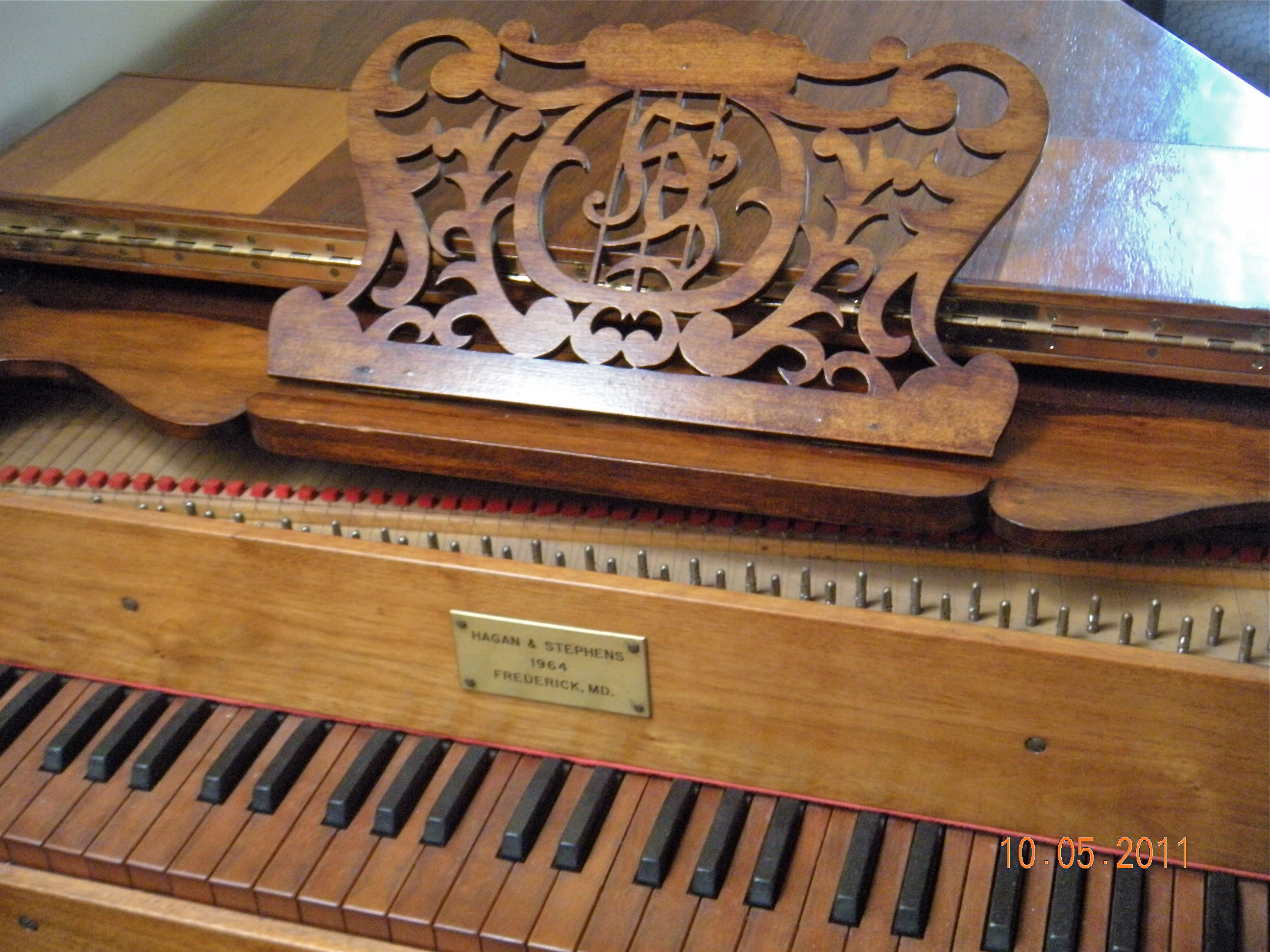
One day in August, a month after I had moved in, I walked hurriedly into the kitchen, my arms full of groceries. When I turned around, I gasped in surprise because there, in the living room, was a small vintage harpsichord with cherry keys and applied carving on the legs. To paraphrase what Renee Zellweger said to Tom Cruise in the movie “Show Me the Money”: “He had me at the harpsichord.”

We took our time and got to know each other for four years before we married. Once decided, we wanted to marry privately at City Hall, just the two of us. Flowers were delivered to the shop on the first floor of the house. Wedding rings were Fed-Exed from Tiffany’s. Downstairs, none of G’s workmen in the piano shop suspected a thing.

It was a snowy day and I called the Town Clerk to see if he was still there. We read our own vows and returned home; changed our clothes and still the guys were clueless. G. went out to tune a couple of pianos in the late afternoon while I cooked our wedding supper.

Later in the year, we threw a big party with a formal ceremony for family and friends on May 11th. The only way we could keep track of these two anniversaries was to remember that it was the 7th of March and the 11th of May or,. . . seven/eleven.

G had never married and I had been married for a quarter of a century to someone else by the time we met. Whenever I say to G. that I should have left my marriage earlier due to all the trials and tribulations, he quickly disagrees. He believes, and I concur, that had even one thing been different in our pasts, that we might not have met each other at all.

Timing is everything, it seems, even if it takes awhile. We just celebrated our fifteenth anniversary. Together with the four years we knew each other before we were married, we are going on being together for twenty years. Life is long, and we are grateful to share ours together.

“don’t worry, be happy!” . . .

I noticed it’s hard to let go of hurt or frustration when relationships are wanting.

Someone said to me that he can only apply himself to what he has control over. I take it that excludes how others behave and what they might want that is different from what we hope for.

Speaking about the process of ‘forgiveness’, someone else said, “No matter what the offense is, the process of forgiveness is the same: You let go of anger and hurt by being mindful and focusing on gratitude and kindness. …Forgiveness concepts are simple,” he says. “It’s the execution that’s hard.”

Amen.

odd fellows . . .

    An observant person who reads my blog said to me yesterday, “you’re a combination of scientific inquiry and mysticism.” I was taken aback because I hadn’t put two-and-two together about myself exactly like that. It seems true, though, the more I think about it.

    I look at everything that happens in my life or around it or what I randomly see as “data” gathered in a scientific experiment. What’s missing sometimes is the “hypothesis” part of the experiment–the “what am I trying to find out?” As I think about this process, it’s probably fair to say that it’s an inverse kind of experiment. That my looking at or listening to data then “shows” me what the hypothesis might have been. Much of the time, the conclusion was not hypothesizable but something unexpectedly interesting and novel that lay outside what I might have conjectured to begin with. So it’s a kind of rolling experiment, gathering data, dare I call them ‘stones’?

    The mysticism part is strong. I looked up the word in wikipedia and couldn’t get through the myriad of definitions. I find it’s much easier to live it than to talk about it. When I look back,(“eggs in a basket“) I think that mystical energy grew in my life when I surrendered and gave up my fear to a higher power. Although I continued to apply myself to resolving the burdens of my life at the time, there were many things that occurred later, outside of my control that fell my way (“life is long“, “stirring the pot“.)

    Last Sunday, with no garages open anywhere, we had car trouble and had a long way to drive in order to reach home. During this uncertain journey, I silently asked the helpers to ensure we would be unharmed and be taken care of as best the circumstances might allow. Sure enough, just as the car’s electrical system failed altogether, we were able to safely exit the highway and coast to a nearby gas station. A brand-new flatbed rescue truck from Triple AAA appeared in less than 20 minutes to drive us home, 40 miles away. The tow was covered under our AAA “Plus” plan, something I had added just a few weeks earlier, thanks to a conversation with one of G.’s workmen.

    During my career in biotech managing scientists, I had a chance to observe how they think, draw conclusions, act on what the data might be or not be. Many times they were wrong. Sometimes they were right. In my little crucible, there is no right or wrong. Just the raw data of my life. I want to thank that person for the observation about my process because I think he nailed it.

‘lessons learned’. . .


People talk about ‘lessons learned’ all the time. What that seems to mean is that when something bad happens, sum up what you could have done differently to prevent that bad thing from happening again. When did this start?

In a way, jumping to make a list of ‘lessons learned’ can substitute for looking hard at what actually happened and process it before moving on to make things better the next time. Sometimes ‘lessons learned’ won’t help at all. When a biotech company I worked for found that clinical trials didn’t give the hoped-for results, none of our ‘lessons learned’ would have made a critical difference.

What about one’s life? What are the top three ‘lessons learned’ about your life up to this point? Here are mine off the top of my head while I am composing this post:

a) I’m not very sociable and have trouble trusting people; maybe because as a child, I was different from people around me and they gave me a hard time about it.

b) I like to explore the world every day. Cook new recipes, read, follow my curiosity to where it leads me. Pay attention to random things that happen and listen to the Universe. Maybe this is an antidote to a) above that began way back when.

c) I still have a lot to learn. I learn this lesson every time I am satisfied with something that I have done and it turns out to be disappointing in some way. Or, when I am down and out and help comes from an unseen source, cosmic or otherwise. That’s probably the biggest lesson that I have learned so far: that I am not alone after all. I guess that makes four big ‘lessons learned’ for me right now.

Plus, I am happier than I have been for most of my life so that’s a real learning experience that’s ongoing all the time.

So much for ‘lessons learned.’ What are some of yours?

‘autumn of our years’ . . .

I’ve been hearing lately that “40 is the new 30!”, “60 is the new 40!” We seem to be healthier and staying viable for (much) longer than our parents’ generation. What is the new 70, the “new 55?” or renegotiate at 80? Then there’s U.S. News and World Report’s special edition of “How to live to be 100”!! So when a comment for ‘Uncommon Hours’ talks about the ‘autumn of our years’ when the kids are grown and have left home, our parents have passed on and now we are free to live (finally) for ourselves, when is that exactly? And how long will it last before winter sets in?

Autumn is one of the most beautiful seasons of the year, especially in New England. In fact, it’s my personal favorite time–memories of getting ready for school to start, the beauty of leaves changing color in October, crisp morning air, picking apples and heating up cider with cinnamon and nutmeg. Winter doesn’t have to be cold and lonely either. At least, that’s not my plan.

I think of winter as one of my favorite times, having cozy breakfasts while the snow falls outside my window. Tea set out in the afternoon and maybe a cookie or two. Roasts in the oven with grilled vegetables, apple pie and ice cream for dessert. What I mean to say is that we may want to hold on to Autumn for awhile because we’re afraid what being older will mean, edging into the winter of our years. Every season has its virtues, so that one will too. It occurred to me that if we still have two seasons left, that’s still almost half of our lives to go, right?

being happy enough. . .

Here in America, the land of opportunity, we work harder than anyone else, strive to change ourselves from the outside in or from the inside out. We are encouraged to improve, to eat better, work better, make things better, BE a better person. Constantly. Everywhere you look.

I have been there.

Today, I thought about being happy enough. We have so much when we think about it. I now have time, which is the biggest luxury of all. There have been periods in my life when I had no time at all (stirring the pot) or when I had time but found myself without anything else: no job, no future, living in a strange town (eggs in a basket).

The DNA in my family, especially on my father’s side (my father, myself) is pretty driven. What might have been missing was an ability to relax and to enjoy life for its simple pleasures.

To be rather than to do.

When we have what we need in a basic sense, what do we still have to have before we are happy enough?

full circle. . .

coming full circle. . .

From an oft-quoted T.S. Eliot poem:
“We shall not cease from exploration, and the end of all our exploring will be to arrive where we started and know the place for the first time.”

How long does this take to come around to finally understanding who we are? How many rounds does it take before we come full circle? Or maybe life is a series of ever expanding circles?

Another quote that comes to mind is “Utopia is in our own backyard.” But I don’t know who to attribute that to.

a measured approach. . .

How do we measure ourselves? If we create something and nobody notices, does it matter? Or is the act of creating and satisfying oneself what’s important? If you write a book and it isn’t published, is it still a book? What if it is published and nobody reads it anyhow?

I have to do what I am doing. Or I wouldn’t be doing it. And if no one else reads it or when they do, they misunderstand or disagree, I still have to do what I am doing.

If a tree falls in the forest and nobody is around to hear it, does it still make a noise? I say YES!

‘wet hen’ syndrome. . .

"you've got to be kidding me. . ." photo, m. steverson

Do you know where the saying ‘madder than a wet hen’ comes from? One version gives a farmer’s take on it:
a) hens will sometimes sit on a nest to hatch eggs that aren’t there anymore;
b) she gets dunked in a bucket of water to shock her out of this mode;
c) the hen may return to the empty nest again;
d) another dunking in a bucket of water ensues.

By this time, she’s not a happy camper. That’s where ‘madder than a wet hen’ comes from.

After a few dunkings, the wet hen eventually returns to the empty nest to lay more eggs rather than trying to hatch phantom eggs.

So this little metaphor is for all of us out there who find ourselves acting like ‘helicopter’ Moms to grown children. (Notice I didn’t say ‘adult’ children–because that’s a matter of individual development or perception and I’m not going there.) The empty nest can also represent careers, jobs, and marriages that have flown the coop. Time to hatch new plans.

I don’t know about the “madder” part of that phrase though. We don’t have to be frustrated or angry because we can’t go back to what we’re familiar with. Do we?

What do you think?

handwriting on the wall. . .

A few years ago while I was writing a non-fiction book about change, I woke up one morning and saw handwriting on the wall. Seriously.

It was in cursive, about 3 inches high in dark blue ink. The message travelled around the off-white wall at about shoulder height. It reminded me of the calligraphy that was stencilled on the walls of Thomas Jefferson’s home in Monticello. It was beautiful. It was there. And this is what it said:

“The more we are at one. . . the more we are All One.”

I remember the initial caps used in “All One.” I reflected about this and even wrote down some notes about what it might mean at the time. The “at one” seemed to suggest that if we were “at one” that we would be more at ease and comfortable with who we are in our own skin. At peace with our lives and who we are in it. That’s what I thought ‘at one’ might mean.

The “All One” I thought was more complex. If we’re together and at ease with ourselves, that reduces conflict that we might have with others, right? Or, if we are all doing our own thing and happy about it, and let others do their thing as long as it doesn’t conflict with our doing, then each of us would be feeling a similar peace of mind and with those around us, right? More brotherhood, sisterhood, peoplehood.

I don’t know. Maybe it isn’t a formula for world peace.

What do you think it means?