mulberryshoots

"Tell me, what is it you plan to do with your one wild and precious life?" ~ Mary Oliver

millet! . . .

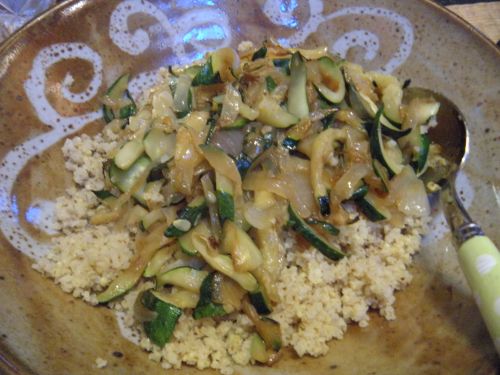
cooked millet with zucchini and onions. . .

cooked millet with zucchini and onions. . .

Well, I’ve been reading about millet for quite some time and even bought some once. I didn’t get around to trying it out though and bought a new batch this week. It’s one of those grains like barley and brown rice that macrobiotic recipes contain every once in a while. It sounded a little bland to me though, cooking it with just plain water.

All the recipes suggested that you dry toast the millet in a pan before

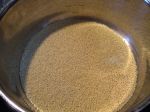
raw millet toasting in the pan. . .

raw millet toasting in the pan. . .

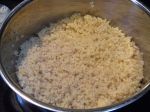
adding liquid to cook it. So, I did that and could smell the little particles moving around the pan that was heated to medium. I made a separate broth with instant dashi and a little soy to use as the cooking broth. After toasting for about 8 minutes, I added the broth, turned the heat down and put a lid on the pot to cook and simmer the millet.

cooked millet, fluffed up in the pan. . .

cooked millet, fluffed up in the pan. . .

millet-3

Meanwhile, I cut up some onion and a medium sized zucchini, stir frying it in a little olive oil until it was cooked through, adding just a little pinch of Maldon salt. I thought this vegetable mixture might go well, served on top of the millet when the grain was finished cooking.millet-2

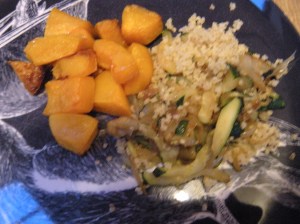
The other part of our meal consists of roasted butternut squash – cut pieces brushed with melted butter and maple syrup before roasting in a 400 degree oven.

butternut squash glazed with butter & maple syrup. . .

butternut squash glazed with butter & maple syrup. . .

So this is as close to macrobiotic I’m going to get tonight. I’ve been reading that it would be good to cut out all animal and vegetable oils from cooking but haven’t gotten there – at least not yet.

dscn8474All I’m hoping for is that this meal will be satisfying to eat – both with regards to taste, mouth feel and satiety of our appetites. Oh yeah, tasty would be nice too!

Postscript: Our supper was very tasty – and the flavors of the zucchini, millet and glazed butternut squash went well together. We were both pleasantly surprised!

Postscript 2: With about a cup and a half of millet left over, I’m thinking about making millet croquettes for lunch tomorrow: chopped green onion, egg, parmesan cheese, shape into balls and fry in vegetable oil until crispy on both sides.


‘stone soup’ for lunch! . . .

stone-soup

It’s gotten a little chilly out so instead of making a salad for lunch, I decided to put together a soup from whatever I happened to have on hand in the fridge and pantry. I call this “stone soup” like the folk tale about French soldiers who stirred up a big kettle of water and put some clean “magical” stones in it. Soon, curious villagers began to contribute to the “broth”: vegetables from the root cellar, grains from the barn, sides of beef until there was a hearty soup to be shared by everyone.

This soup is somewhat like that: I found a small piece of onion and zucchini in the vegetable bin which I chopped up along with half a carrot. There were a couple of still fresh broccoli florets in a pack that was ready to be thrown out. Into the pot they went along with a can of DelMonte diced tomatoes and a Knorr beef broth packet. Added water and it looked pretty thin. Poured in a handful of raditiore pasta, the crinkled, pretty pasta that quickly expanded as it cooked.

And what do you know? I soon had a soup that looked and tasted like a true minestrone soup for lunch! Nice to have a warm bowl on a chilly Fall day.


spinach souffle! . . .


souffle-5I’ll admit that making a spinach souffle sounds daunting. . . but it’s really not when you break up the process into sections. I bought some beautiful fresh spinach yesterday at the market and thought that cooking it down with onions, adding it to a bechamel sauce and then adding eggs for a souffle would be a nice dish to enjoy for supper.

I used Ina Garten’s recipe for the most part. Here are my steps:

Preheat oven to 400 degrees:souffle-1

  1.  SPINACH PREP: Rinse and clean half a bunch of fresh spinach; chop off the stems and coarsely chop the leaves
  2. Melt a tablespoon of unsalted butter, brown half a chopped vidalia onion and add the chopped spinach
  3. Stir gently as it cooks down until everything is soft and cooked through; sprinkle with grated nutmeg (yum!)
  4. Drain it of all the juices, place on a cutting board and chop with a cleaver alternately crosswise until it resembles frozen chopped spinach (just kidding!) You could also use frozen chopped spinach, draining it of all the water, but I like the idea and taste of fresh spinach!souffle-2
  5. CHEESE: Grate half a cup of parmesan cheese. I have a gorgeous chunk of it and grated it on the large holes of a box grater. It will give a nicer lift to the cheese than Ina’s recipe (cheddar and fine parmesan.)
  6. SAUCE: Making the bechamel sauce and incorporating the eggs:   Melt unsalted butter (2 Tablespoons) in a skillet; add 3 tablespoons more or less of flour and incorporate it into the melted butter. Add 1 cup scalded milk into the mixture, slowly incorporating 4 egg yolks one at a time, mixing gently. Add the grated parmesan and the chopped spinach. Combine and let the whole mixture cool.
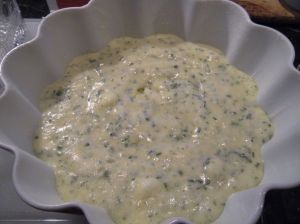
  7. EGG WHITES: With an electric mixer, beat the egg whites until stiff. A little at a time, fold the egg whites into the spinach mixture, making sure that it remains light and airy. Butter a souffle dish well and sprinkle with parmesan cheese. Lightly fold the mixture into souffle-3the prepared souffle dish.
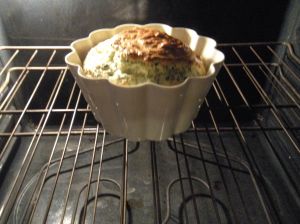
  8. Make a circle in the top of the souffle with a knife to encourage the souffle to rise more. When you know everyone will be ready to eat in about a half an hour, place the souffle in the oven and turn the heat down to 375 degrees (nothing is more exasperating when the souffle is done and people take 10 minutes to get to the table!)
  9. Bake the souffle for 35-45 minutes until done. Let it rest in the oven after turning off the oven with the door open; move immediately to the table when everyone is ready to eat!souffle-6

This is a truly delectable meal! . . . Bon Appetit!


mushroom barley soup for lunch! . . .

mushroom-barley-soup

I’m still on the search for a steady way to lose weight and have come full circle back to trying out some semi-macrobiotic recipes. The other thing we have decided to do is to forego sandwiches at lunch and to eat soup or salad instead.

So yesterday, I made a simple onion soup which is a tried-and-true easy recipe that is astonishingly tasty based on the simple steps below:

  1. Slice up a Vidalia onion (they’re sweeter and juicier than the yellow ones)
  2. Brown the onion in unsalted butter in a small soup pot
  3. Add a packet of Knorr’s homestyle beef broth (or a can of beef broth)
  4. Cook until the onions are soft

I used to heat up some leftover bread sprinkled with parmesan cheese under the broiler and serve it on top – but am going without it during this bread-less time.

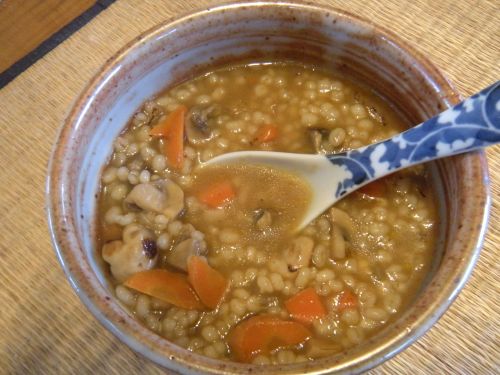
Since macrobiotic cooking features hearty grains in the diet, I bought some millet, brown rice and barley at the store yesterday. This morning, I thought I’d parboil some barley in water to make a mushroom-barley soup for our lunch. I let the barley soak while I prepared the rest of the soup:

  1. Heat up a small soup pot and melt a tablespoon of unsalted butter
  2. Cut up half of a vidalia onion and brown in the butter
  3. Cut up a box of white button mushrooms (I had about 2/3rds of a box to work with) into quarters, not small bits and pieces. I like these big pieces of mushrooms because they give the soup a more robust quality
  4. Cut up a carrot into small pieces – stir fry the mushrooms and carrots with the onions until nicely browned.
  5. Add two Knorr homestyle beef broth (oval gelatin-like concentrate) plus water to cover
  6. Drain soaked barley and add to the soup
  7. Cover and cook very gently for an hour, checking there’s enough liquid as the barley expands in the soup. Taste that the soup is not too salty by adding more water
  8. Taste for seasoning and serve with cracked pepper for a hearty Fall lunch!mushroom-soup

Very low in calories, hearty, warming and delicious! Not that time-consuming to make either if you start early enough in the morning.

BTW, here’s a funny article about a guy in New Zealand who proved it’s the amount of calories that you consume that allows you to lose weight, not what you eat. He cut his intake by a third to 1600 calories and ate nothing but pies and low-cal beer – and he lost over SIXTEEN POUNDS in just four weeks!! Hmmmmmm


october table . . .

leaves from the front and back gardens

leaves from the front and back gardens

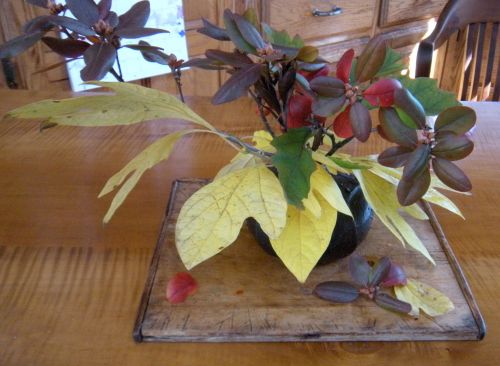
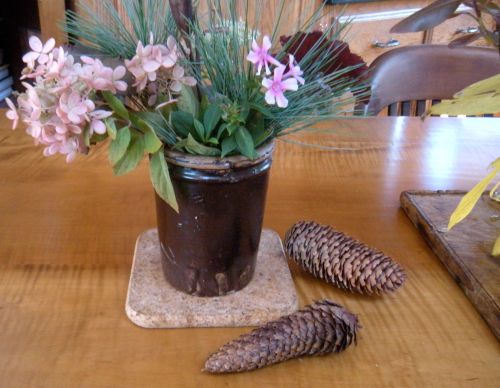
Instead of buying bunches of flowers at the Farmers’ Market today, I remembered a very simple arrangement I saw years ago at a Zen retreat in Western Massachusetts where leaves and pods from the garden were arranged on a bare wooden table.

Here’s my version from our garden today. Feels so good to clear off the entire table and clean the curly maple surface! Almost like taking a deep breath and clearing the air in our lungs and in the visual space around us!

picked-from-the-garden-2


‘being taoist’ . . .

the rock signifying "yin-yang" which I found on the beach . . . and "buddha babes" laughing about life . . . plus love remembrances from C.

the rock signifying “yin-yang” which I found on the beach . . . and “buddha babes” laughing about life . . . plus love remembrances from C.

A few weeks ago, I was in a bookstore called ‘Taproot’ and came across a hardbound copy of the “I-Ching” called “The Book of Changes and the Unchanging Truth” by Hua-Ching Ni. As a student of the I-Ching for over twenty-five years, I was intrigued and came home to purchase a used copy of the book.

It arrived a few days ago. And during the interim time, I also ordered a book on Amazon called “Being Taoist – Wisdom for Living a Balanced Life” by Eva Wong. It arrived yesterday and I read a few chapters last night before going to bed early. Made all the sense in the world to me and I also relayed some of these ideas to G. this morning and as I will sum up herewith:

Everyone is born with life energy. How we use it throughout our lives accounts for how long it lasts. If we strive for fame and fortune comparing ourselves to others; or rail against what life’s vicissitudes puts us through with anger, rage and vengence; if we live with envy of our neighbors and resent what we don’t have rather than being grateful for what we do have; and if we take it out on ourselves by overeating, being slothful, indulging in excesses, physical and otherwise, we use up our life energy without knowing it. We perpetuate this never-ending struggle upon ourselves. Everyday, without knowing it.

Instead, if we know that we can live simply and with moderation in all things: eat well but stop before we are full, drink lukewarm water when we are thirsty, walk when we have been sitting too long; sit when we are tired and get enough sleep, our life energy will be conserved and we will be at peace and experience contentment. This is the simple truth about longevity and quality of life.

Well, I thought – this kind of balance is within our own intentions and actions. When we overreact, are frustrated and disappointed, we’re using life energy more than we have to. When we strive for or resent what others may have but we feel we don’t have but want, we are using life energy more than we have to.

I’m old enough to know how lucky I have been to end up where I am now, having gone through lots of turmoil in the past. Leaving it all behind me now, I feel no need to “fix” what is unfixable and to leave those matters to others. And I drop them without rancor or regret. It’s just gone. Not worth any life energy to speak of, it seems to me, and certainly not worth talking about anymore.

Although I was born in China and am innately Asian in my outlook on life – thus the study of Taoism and the I-Ching – I also grew up in America and am aware of the bilateral way of Western thinking: “it is or it isn’t;” “it’s yes or no;” “it’s black or white;” “they’re wrong and I’m right.” But Taoism is not bilateral. It’s holistic and a way of eschewing or taking off this hairshirt of conflict: “right or wrong and that’s the only outcome.”

We don’t have to figure it out. We can choose at this very moment to discard all these “shoulds” “have-nots” and “unfixable disappointments” in one fell swoop – and thereby choose to preserve our life energy in a better way ~ starting now, in this very moment.

At least, that makes a lot of sense to me. Plus I feel so much better!


ramen bowls for dinner! . . .

ramen-bowl

For the past weeks, I’ve been making bone broth in my new Instant Pot and also reading about how to make appetizing ramen one-bowl suppers. So today, I’m combining what I’ve made and learned for our first try at a customized ramen bowl for dinner. Here’s what I have to start with:

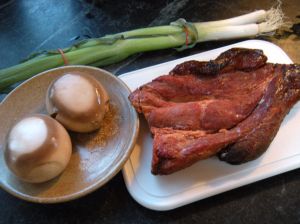
  • a lovely piece of char-sui pork (barbecued) from the Asian market that I’ll heat up in the broth before slicing and serving;
  • a container of bone broth to which I’ll add a scant spoonful of dashi powder and a spoonful of Ohsawa soy sauce for the “ramen soup base”;
  • fresh Chinese spinach – unlike Western spinach (see photo) – which I will stir fry, drain and cut up before placing with the other ingredients on the bowl;
  • 6-minute jumbo eggs with yolks that are still slightly runny, braised in a red-cooked sauce (soy, sherry, sugar) and cut in half just before serving;
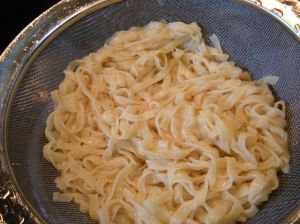
  • fresh Chinese noodles from the Asian market – boiled ahead of time, rinsed and drained before adding to the ramen broth

I happen to have all of these ingredients on hand to prepare ahead of time and assemble to make our noodle bowls for dinner.

Here are some photos along the way ~

chinese spinach and fresh chinese noodles

chinese spinach and fresh chinese noodles

Chinese spinach (raw and cooked) to add to the ramen bowl

barbecue-pork-eggs


Char sui pork (barbecued) from the Asian market & braised 6 minute eggs


freshly cooked Chinese noodles

freshly cooked Chinese noodles

penultimate ramen bowls . . .

penultimate ramen bowls . . .

constant change . . .

my miniature maidenhair fern plant on the kitchen counter. . .

my miniature maidenhair fern plant on the kitchen counter. . .

The only predictable thing in life is change. Many of us don’t like it. Some of us welcome it. I’m one of the latter.

Maybe because while observing life’s vicissitudes I see patterns that I didn’t notice before. Or, reading books that offer limited points of view that are either-or, black-and-white or some other bilateral nonsense – such as a) if you don’t like it; b) leave.

Being Asian, a student of Taoist thought and reading the I-Ching, Or Book of Changes,  I’ve been introduced to holistic thinking that isn’t bilateral or even 3-Dimensional. It’s not as simple as Western either-or approaches to everything and I highly recommend it as an alternative way to live one’s life. I know it has profoundly impacted my own for the past twenty-five years.

The other day, I consulted the I-Ching about what outcome there might be regarding a family situation that I’m experiencing and I laughed out loud when the line it gave me was number 5 in the Hexagram #12 called “Standstill.” Here it is:
“Standstill is giving way.  Good fortune for the great (wo)man. ‘What if it should fail, what if it should fail? In this way s(he) ties it to a cluster of mulberry shoots.”

The time undergoes a change. The right man/woman, able to restore order, has arrived. Hence ‘Good fortune.’ But such periods of transition are the very times in which we must fear and tremble. Success is assured only through greatest caution, which asks always, “what if it should fail?” When a mulberry bush is cut down, a number of unusually strong shoots sprout from the roots. Hence the image of tying something to a cluster of mulberry shoots is used to symbolize the way of making success certain. Confucius says about this line:

Danger arises when a (wo)man feels secure in h(er) position. Destruction threatens when a wo(man) seeks to preserve h(er) worldly estate. Confusion develops when a (wo)man does not forget danger in h(er) security, nor ruin when (s)he is well established, nor confusion when h(er) affairs are in order. In this way (s)he gains personal safety and is able to protect the empire.”

I guess that says it all. The Universe is here for us to learn from if only we will pay attention to it before it is too late. This reading from the I-Ching has also relieved my feelings of disappointment and replaced them with a neutrality about what the future might bring. And that, my friends, is a really big deal!


a pair of ‘mums’ . . .

a pair of 'mums' in our kitchen . . .

a pair of ‘mums’ in our kitchen . . .

Finally, we’re getting a few days of rain this week. After a summer of dry, hot weather, it’s a real shift to grey days with intermittent rain.

I like it.

It makes me think about what is truly meaningful in one’s life . . . And it’s pretty simple it seems:

A home that is a haven from the vagaries of the external world.

Meals that are easy to prepare and enjoyable to share with someone you love every night for dinner.

Not watching the news on television when the harpiness of it all gets to be too much.

Not chasing after what’s unavailable or can’t be changed – not in the past and not in the present either.

Being content with who we are and what we have – and being thankful for it all.

A couple of chrysanthemums from my favorite florist that cost me $2 a stem.

Beautiful!


ramen bowls?. . .

Okay, so we’ve all cooked a packet of ramen when we’re hungry and on the run. I particularly like the brand, “Sapporo Ichiban” which you can even find in the local grocery store (Shaw’s) nowadays. That little aluminum foil full of flavoring spices though, was pretty salty.

On the other side of the coin, there are those of us old enough to have seen and enjoyed that Japanese movie about making ramen noodle broth called “Tampopo” where the entire film seems to be made up of shenanigans instigated to discover the secret recipe for making the best broth for the noodle bowls.

Today, I received a cookbook called “Simply Ramen” from Amazon.The author is a Californian fourth-generation Japanese cook named Amy Kimoto-Kahn, who is also a Mom to three kids one finds out later. The photography of noodle nests on the flyleaves augurs well for the rest of the book.

I have a lot of cookbooks already, especially Japanese food, and so was a little dubious when I first opened the book. A pleasant surprise! Not only are the photos appetizing and gorgeous to look at; the book itself is organized in the most helpful way possible:

First chapters on how to make five core soup broths. And these aren’t just a handful of ingredients either. They’re hard core authentic recipes from Japan cookery schools and the like.

Then, the noodles and how to make them from scratch (I plan to use fresh wonton noodles from the Asian market in town – boiled first, rinsed and then slipped into the rich soup broth. )

Then, the condiments and how to prepare them: I especially liked the teriyaki marinated soft-boiled eggs that you cut in half and put on top of the ramen bowls when you’re ready to serve. Sauteeing fresh bamboo shoots with a teriyaki type seasoning sounded good too.

Then, recipes for each category of ramen bowls to try out: “pork ramen,” “beef ramen,” “seafood ramen,” “vegetable ramen” etc.

After perusing the book for awhile, I began to think about what kind of combinations I might try first. The first modification I thought of was that instead of using a slow cooker to make the broth for ten hours, that my new Instant Pot would be a much faster and handier piece of equipment to use to make broth for ramen. The ingredients and cooking steps were pretty similar to what I’ve been doing to make bone broth too.

I then searched online for other authentic ramen broth recipes and came upon David Chang’s Momofuku (yeah!) recipe for making HIS ramen broth. (Come to think of it, I have his cookbook in my bookcase and I’m going to dig it out later.) But in this online brief which he wrote for the first issue of “Lucky Peach,” Chang goes through how his cooks modified his original ramen broth to exclude pork bones and to grind up dried shitake mushrooms instead of using whole ones to save storage room and cost.

One aspect he covered though that was a little confusing to me was making “tare” – which turns out to be the seasoning/enriching sauce if you will, that is added to the broth when ready to serve it in the bowls filled with broth. I didn’t recall seeing that in Amy’s book above.

Chang makes this separately with a chicken back, soy, mirin and sake and he roasts the chicken first too. Lots of time for this version. Anyhow, back to the broth, he adds some smoky ham or bacon from a vendor that we don’t have access to so I’m wondering if that might be a piece of smoked ham hock?

I already have chicken bones/wings in the freezer that I was saving up to make a batch of bone broth – I’ll add some pork bones, dashi, ground shitake mushrooms, scallions and roasted chicken parts plus some chicken broth and run it through the Instant Pot for 75 minutes (same amount of time as making bone broth) and see how it turns out. I’ll have to figure out what to do to make the tare later.

Boy, these recipes take a lot of ingredients and time, don’t they?  But there’s nothing that substitutes for good homemade stock. Whether it’s for bone broth or for ramen noodle bowl broth, though, the Instant Pot electric pressure cooker is going to beat the band for making homemade broth in less than a fifth of the amount of time of slow cookers or on the stove!

I’ll let you know how it turns out this weekend. Want to try making it too?

Now that the weather’s getting cooler, it’s really tempting to make the base broth for noodle bowls and top it with slices of barbecued char sui (pork,) fresh Chinese spinach, seasoned bamboo shoots and soft boiled eggs sliced in half on top. Or how about soft-boiled teriyaki-marinated duck eggs? Yum!