mulberryshoots

"Tell me, what is it you plan to do with your one wild and precious life?" ~ Mary Oliver

soup for lunch . . .

soup photo

The other day, I posted a piece about umami taste and in particular about making a fragrant vegetable broth from scratch that I froze to use as a base for when I make soups or sauces.

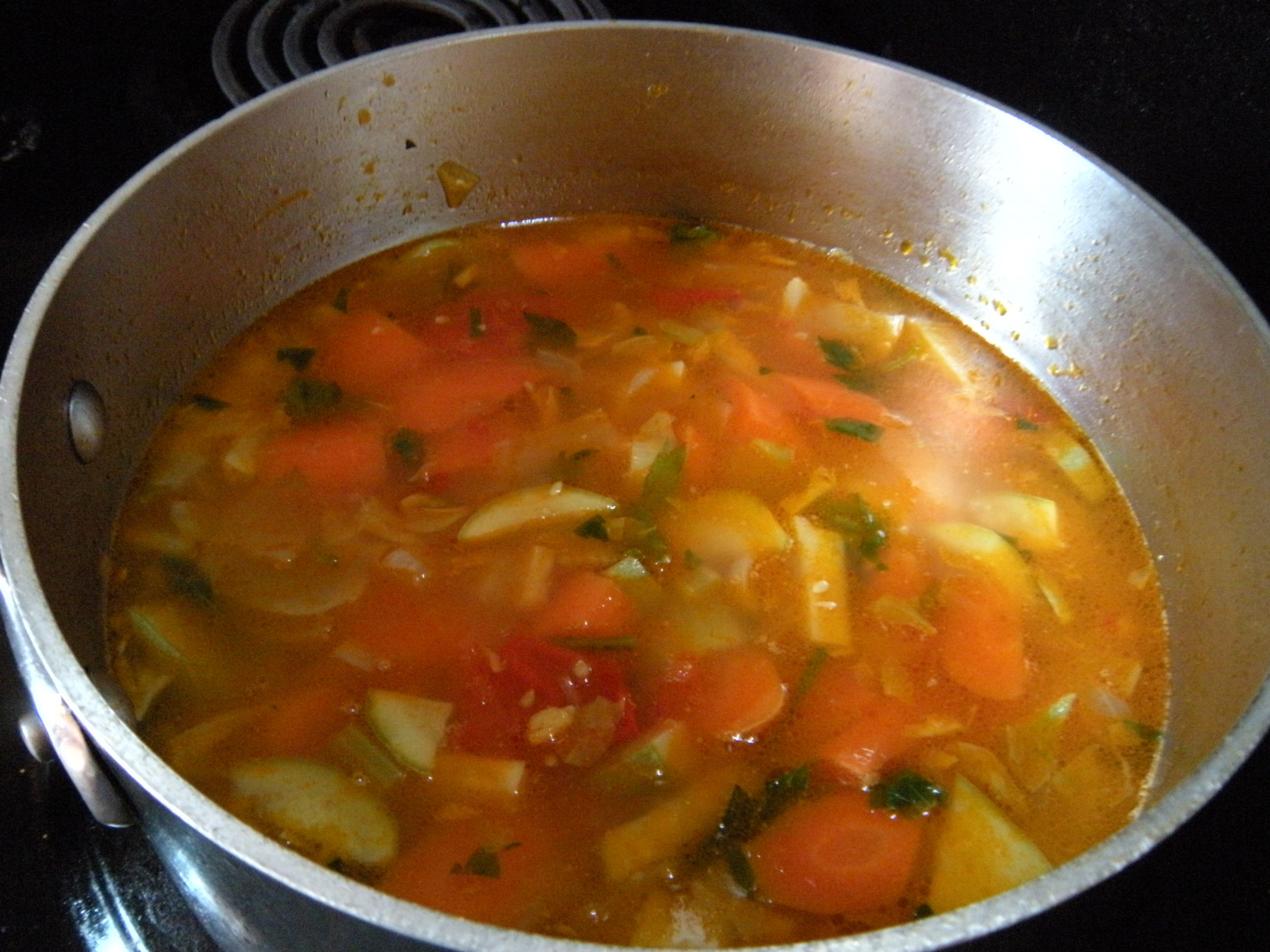
Today, when I returned from my physical therapy appointment for my ankle, broken in February, I thought I’d make a small batch of soup for our lunch. I’ve been thinking about composing a vegetable soup recipe that would become a constant companion drawn from ingredients that I have on hand most of the time. Here’s what I cooked up:

1/4 Vidalia sweet onion, chopped and browned in extra virgin olive oil;

added:

3 stalks of celery hearts with leaves, chopped

3 carrots, peeled and quarter cut*

(*hold the carrot (ends trimmed) perpendicular on the cutting board and make a small diagonal slice; turn the carrot a quarter turn; diagonally slice again; turn a quarter turn, slice again–keep doing this until it is cut up. This also works beautifully on fresh asparagus and parsnips too where you want irregular shaped but diagonally uniform cuts of vegetable.)

2 small cousa squash, cut in pieces (slice lengthwise; stack together and then cut diagonally to make bitesize pieces.)

1 small garden tomato cut in wedges

Stir-fry while browning vegetables and then add:

3 cups homemade vegetable broth

Cover pot and simmer until vegetables are tender but not overcooked.

Add a few stalks of chopped fresh parsley towards the end.

Serve with cold sliced ham, corn muffins and dark rye crackers with blue cheese.

It’s supposed to be hot today, but this soup tastes sublime and is so easy to make on a slow summer day. I think it’s also a good candidate for repeat performances!

When I make it again, I think I would keep everything the same except for reducing the celery and carrot to two instead of three. That would make the batch just right for two people to have a bowl and a half each of this delicious soup.


“Hoosiers” . . .

Have you ever seen the movie called “Hoosiers”? It’s a story based on a small Indiana town’s basketball team winning the Indiana State Basketball Championships against all odds in the 1950’s. It’s one of my all-time favorite movies. Part of it is due to the fact that nobody’s perfect in this film: not the unpopular basketball coach played by Gene Hackman, not the spinster acting principal played by Barbara Hersey nor the town drunk played by Dennis Hopper.

The real hero of this movie in my mind is Jerry Goldsmith who composed the film score. That’s right, you heard me right. It was nominated for an Oscar but didn’t win despite music that can almost bring you to tears–even if you don’t know the story that the score is supposed to illustrate.

It’s a movie about losers. The coach is a loser because he has a history of anger management problems, hitting one of the basketball players. The town drunk is a loser because, well, he can’t stop drinking. The boys don’t play that well, actually. Except for Jimmy, who not only joins them late but makes the very last minute shot at the state championships. They are all people who have problems, are shy and say and do all the wrong things. That they turn out a winning team is, well, a fairy tale of sorts. But it’s more than that, I think. It’s the idea of believing in people, an idealism that is seldom realized nor rewarded in real life.

When they arrive in the huge Indianapolis stadium for the final playoff game and look around, the boys are obviously awed and intimidated by their awe. Hackman takes out his measuring tape and asks the boys to measure the court. It’s fifteen feet. He then gets them to measure the distance between the hoop and the floor. It’s ten feet. Those measurements are exactly the same as those of their court back home he says to them and the boys smile and visibly relax. The more things change, the more some things remain the same.

“Hoosiers” was made on a low budget and has surprised people with its 13th ranking in the top 100 films of all time. The movie soundtrack may have a lot to do with its staying power. I was thinking that if more people knew about it and played it going to and from work or doing errands, it would be hard to be in a bad mood.

Music can be an antidote to much of what ails us. If you want to listen to a sample and have a Mac, go to I-Tunes and type in “Hoosiers Soundtrack.”

After many years of only a partial soundtrack being available, there is now a full soundtrack provided by Integra:

Enjoy!

umami taste . . .


DSCN6616_2

Earlier this summer, I came across the words “umami taste.” I read a book about it and still wasn’t sure what it was supposed to be. Traditionally, there are four tastes in cooking: sweet, sour, bitter and salty. Umami taste is considered the fifth taste and is based somewhat on glutamate (as in monosodium glutamate but from naturally occurring glutamate in foods.) The more I read about it online and in cookery books, the impression I managed to describe it is a Chinese Mandarin adjective, pronounced as “hsien” (not sure of the spelling.) I remember that word spoken when a fresh sea bass steamed with fresh green onions and sliced ginger with salt, fragrant with umami was set on the table. I can’t really translate umami taste into words but I can tell when I taste it or smell it in a dish.

Yesterday, my daughter C. and I had a late, leisurely lunch at the Harvest Restaurant in Cambridge. This restaurant, along with Maison Robert in Boston, were my favorite places to eat while living in Lexington when the children were young. I ordered two courses: a fresh corn soup which appeared not as a corn chowder but a puree that was just thick enough to coat a spoon. Its taste and texture were unctuous. For my entree, I ordered fresh pappardelle (handmade pasta) with a garden-fresh sauce, fresh corn and herbs on top with small cooked tomato pieces in the sauce. Both dishes, but especially the pappardelle had a strong umami taste which was just delicious.

I asked our waiter (who was from Brazil) to compliment the chef on the delicious “umami taste” of my meal and to ask what kind of stock was used in the pappardelle dish. He came back smiling and reported that the chef had used a little garlic, fresh thyme, vegetable broth and canned tomatoes for the sauce. I was surprised by the use of canned tomatoes but it made sense because the tomatoes were subdued, not flagrantly farmstand sharp in taste. The other surprise was vegetable broth as the base for the light sauce.

When I got home, I looked online at vegetable broth recipes and alighted on one that actually talked about incorporating an umami taste by adding sea vegetable or nori (laver) into the stock! Nosing closer, I speculated that perhaps making my own vegetable broth might serve as the base for unctuous corn soup and pasta, a milder, lighter tasting broth than either chicken or beef broth.

I’ve made vegetable broths before that were mildly sweet and delicious during the time when I attended a macrobiotic cooking week at the Kushi Institute here in Western Massachusetts. It was at least a decade ago when I was recovering from viral meningitis and thought a macrobiotic diet might help. It did.

Lately this summer, I’ve been finding that my cooking attempts have not been as appealing as usual. I couldn’t tell if it was because I was fatigued from the recuperation of both my broken ankle and G.’s back injury or what. But more than a couple of meals have fallen flat for some reason.

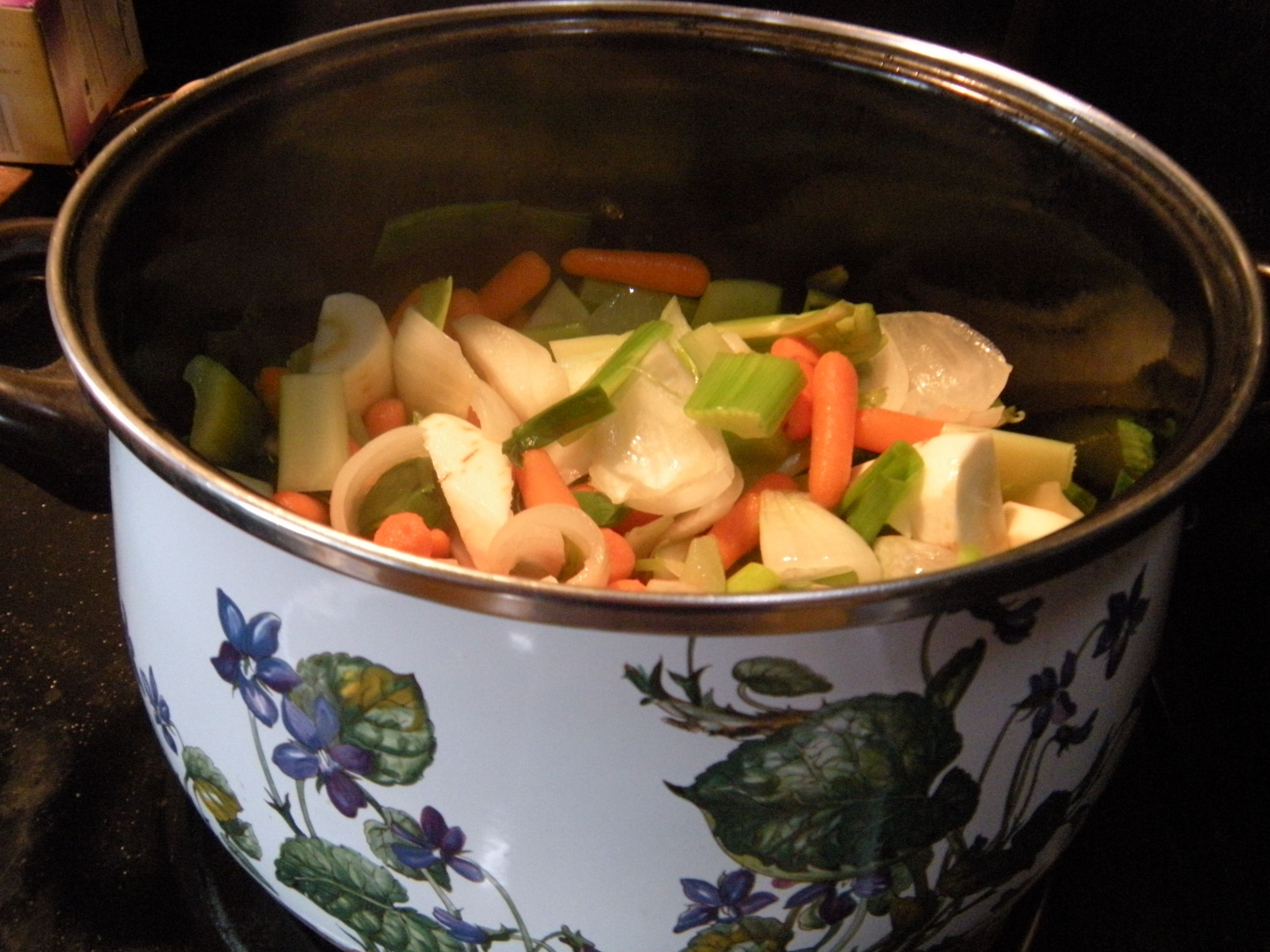
Today, following my intuition that a)a restaurant like the Harvest would make its own vegetable stock; and b)making vegetable stock myself and trying it out as a new base flavor for my cooking efforts might be an adventure worth trying. Especially since the vegetables I planned to use didn’t cost a lot.veg broth 1

Here are the ones I used, selected for sweetness, saltiness and robustness. In the recipes, I was warned against using potatoes that absorbed flavor and cabbage which didn’t add good flavor (which surprised me.) In a large enamelled stockpot which I haven’t used in years, I put in a little olive oil, heated the pot and added:

2 vidalia onions (sweet) cut up in large chunks

2 medium leeks, carefully washed to rinse grit and dirt out from the closely spaced leaves, esp. the green parts; chopped up in 1 inch pieces

3 small cloves of garlic–smashed and browned with the onions and leeks

Only the onions, leeks and garlic were sauteed in olive oil until they softened and browned a little. Then, I added:

6 ribs of celery hearts; the lengths sliced and chopped into one inch pieces

a whole pack of baby carrots, peeled and just the right size for sweetness

2 large parsnips, peeled and cut into chunks for sweetness

1 bay leaf

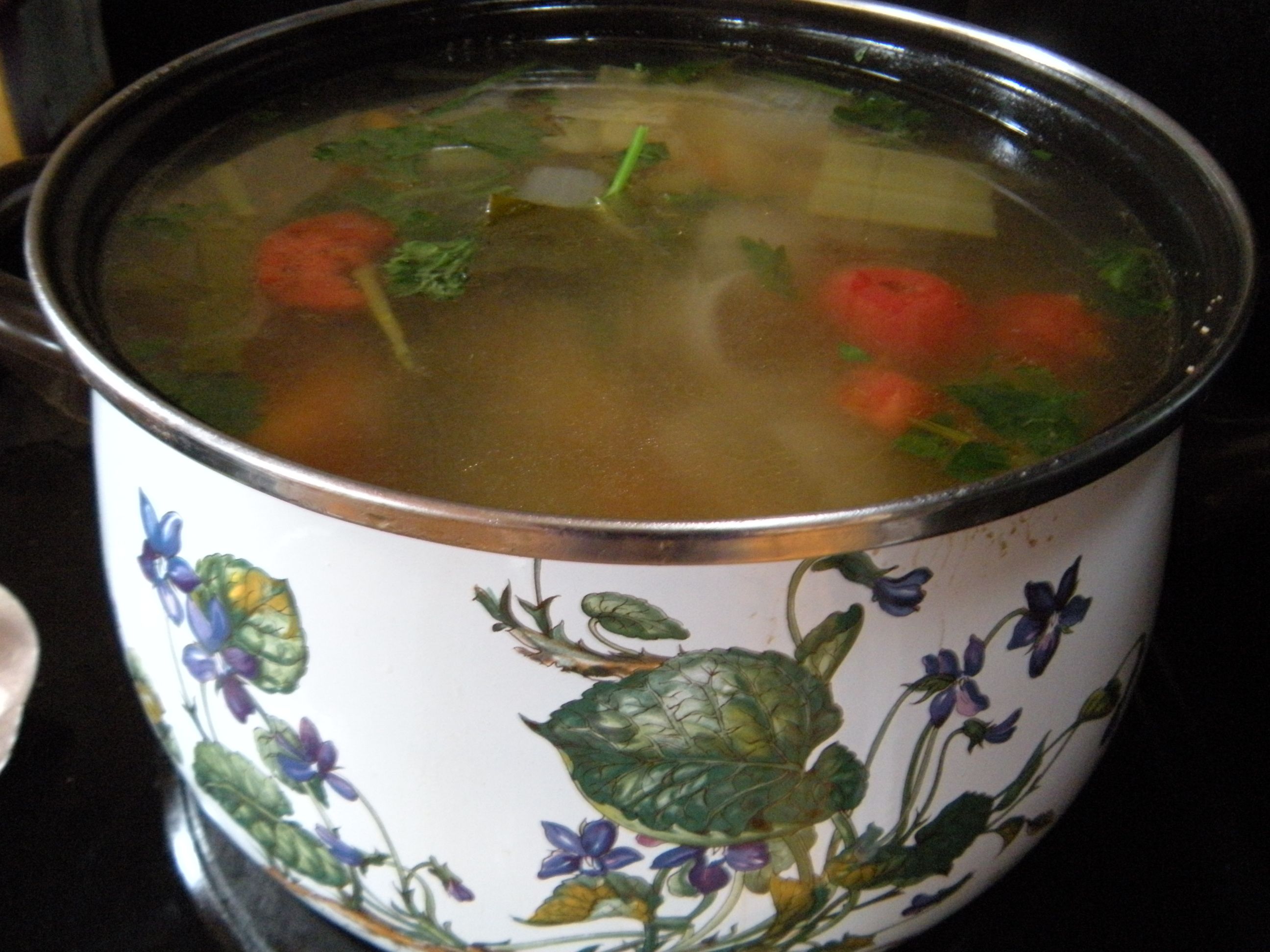
I added spring water to the top of the pot and slowly brought it to a simmer–not a boil. Simmered covered for over an hour. Then added:

1 bunch of fresh flat leaf parsley–very well washed of grit and cut up coarsely (added in the last half hour)

1 can of stewed tomatoes (added in the last half hour)

1 tablespoon of instant dashi (Umami flavor to the max)

After adding the parsley, tomatoes and dashi, I simmered the broth for another half hour or so with the lid off. Tasted the broth before and after adding the tomatoes, parsley and dashi. MUCH better afterwards. I didn’t add any salt at all, figuring that I could add it to taste each time that I used the broth in various recipes.

veg broth 2

I let the vegetable broth cool completely, then strained it through a large sieve. I emptied an ice cube tray and ladled cooled broth in it. When frozen, I’ll store them in a Ziploc bag and use them without having to thaw out a larger amount. I had bought some soup size plastic containers a few months ago like the ones Ina Garten uses on her TV show for homemade chicken broth. I’ll use those to store soup recipe size broth and keep them in the 2nd floor freezer.

I’d like to mention that making the vegetable broth created a light cooking fragrance throughout the kitchen. And unlike Ina Garten, I didn’t have to use two whole chickens and all kinds of strong herbs. The vegetable broth-making process was incredibly satisfying to make because it was full of freshly washed, chopped up vegetables and water, that’s all.

Whether I’m right or wrong about vegetable broth being the basis for creating soups and sauces that have an umami taste, my kitchen right now smells like an umami factory so maybe I’m on the right track. It tastes incredibly delicious and robust for a vegetable broth too.

Come to think of it, I’m remembering the exquisite small roast chickens with bread salad that we made last Christmas Eve to salute Judy Rodgers, the chef of the Zuni Cafe in California who died just a few weeks before Christmas Eve roast chickensjpgChristmas at the age of fifty-seven. The taste of that dish had an “umami-ness” to it too–and we all noticed it as being extraordinarily delicious.

Ummmmmmmm.


good advice . . .

  Today, I noticed a quotation by a venerated Japanese painter, Katsushika Hokusai (1760-1849). Hokosui was a late-blooming artist who was remarkably well-traveled and turned out more than ten thousand woodblock prints.

 “All that I made before seventy is insignificant. At seventy-three, I began to understand how animals, plants, trees, birds, fish, and insects are constructed. At ninety, I will enter into the secret nature of things. . . and when I am one hundred and ten, everything–every detail–will live.” 

I was happy to come across this perspective and to learn that instead of feeling marginalized as you get older, that there’s still time to be creative–and moreover, that it need never stop.

Later this morning, I noticed an interesting observation made by James Schiro, a lead director of Goldman Sachs who passed away recently from multiple myeloma.

“Shortly before he left Zurich Financial, Mr. Schiro was asked by The New York Times to cite the most important leadership lesson he had learned in his career as an executive. He quoted Colin Powell who said:

         “People don’t like change, but they can manage change,” he said in part. “They can’t handle uncertainty. I think it is the job of leaders to eliminate uncertainty.”

So I guess for people like you and me, we can manage change, like growing older and being creative; what’s harder is feeling certain that we can still find ways to be creative.

generations . . .


 "tempus fugit!"

“tempus fugit!”

In the Sunday New York Times today, there’s a feature article about the “Millennial Generation,” those born after 1980 and before 2000, “a giant cohort now estimated to number at least 80 million Americans.” Wow. That’s hard to imagine. I’ve considered myself to be of the Baby Boomer generation more or less (74.6 million born between 1946 and 1964.) Then there’s the generation in between called Gen-X (84 million people born between 1961 and 1981.) I read online that Gen-X is considered the “middle-child” of our population right now. With that kind of perspective, Baby Boomers represent the eldest child, Gen-X the middle-child and the Millennials are the youngest kid in our American family, at least sociologically and culturally speaking.

That’s an interesting way to look at things if you realize we’re talking about 240 million people here (80M+75M+84M) in these three generations. For me, it also offers some insight into why I feel I may not have much in common with people these days–especially if it turns out to be with younger generations (Mills & X-Gen) who are on Facebook, have I-Phones or their equivalent and Tweet besides. To draw these distinctions further, what kind of music do they like? or is it indistinguishable among these generations? How about eating preferences?: non-gluten, vegan, vegetarian, locavore, fusion, paleo, fast-food? What about reading? on-line, books, sci-fi, kindles, newspapers, magazines? If you think about it, trends are all over the place and are not easily categorized by age either.

But when you watch cooking shows like “Chopped” and somebody says, “oh, that presentation is so ’80’s” –you know the fresh raspberry cluster with a fresh mint leaf or two–, you realize that there’s also a generation gap in food trends. My reaction to the explosion of easy demolitions on TV is that many of the kitchens are still serviceable if you didn’t have money to “update” them. So, there seems to be a distinction between attitudes of efficiency and economy versus trends for granite countertops and state of the art sinks and faucets. Of course lots of people want granite countertops, even baby boomers with empty nests and money to finally spend on themselves instead of college and graduate student tuition payments. (I’m partial to soapstone myself but not sure if I can finagle that for our kitchen!)

I guess before I read the article about “Millennials” I thought we were all the same: human beings that is. Ones who go to school, some who get married and some don’t, some who have children and some don’t, raise them and send them to college while working jobs that are demanding in an economy that is not thriving as much as it used to. It isn’t that simple, apparently. The Millennials have more of a social conscience and are more empathetic towards others and doing good than the other generations, as noted in the article. Gen-X has been caught in the middle and is still wondering about its identity. Baby Boomers have been through it all, at least up to now and are savoring retirement if they can afford it and crossing off items on their bucket lists if they are healthy enough to try out what’s on them.

Honestly, I’m content to stay at home, clean up my kitchen with its outdated formica countertop, put the remaining bag of mulch around the hydrangea bush near the front door and water the the Montauk daisies that I planted yesterday with $5 dollar plants I found at Lowe’s. G. and I ate a roasted Peking Duck last night for dinner that I bought from the local Vietnamese market in town on Saturday. I made the wrappers from scratch which we spread with hoisin sauce, fresh green onions pulled apart nestled with crisp duck skin and fragrant roasted duckling pieces folded together. What a feast it was! We could hardly move afterwards.

Reflecting about the huge numbers of people in each of these three generations (@80M each) is interesting though, because it helps me to understand at least why some things seem so far removed from my consciousness (like Twitter, although tons of people of all ages use it–especially actors and celebrities) but other things don’t seem to separate generations at all. For example, my granddaughter is leaving to start her freshman year at college in Baltimore next week and it seems that there are universally true things that repeat themselves: finding nice dorm room furnishings and shoes that fit, saying goodbye to friends from high school who are going separate ways, hoping that you get along with your roommate and moving into a different level of learning and experience. That doesn’t change much from generation to generation. Love doesn’t either:  for my children who are “Gen-X” and my granddaughters (ages 4 and 18) whose generations aren’t even labelled as yet.

As the old adage goes: “the more things change, the more they stay the same.” Some stay the same while everything else around us spins off in amazingly different directions. C’est La Vie, I guess.

. . . "time and tide wait for no man."

. . . “time and tide wait for no man.”


zen . . .

IM000281_2I was musing today about the last two posts on this blog: the one from all-American Dale Carnegie who succeeded at convincing people that the way to be popular and to be successful was to be genuinely interested in other people and not promote yourself in a vacuum.

The post I uploaded last night was the unhappy tale of a woman whose life was dedicated to writing poetry, novels and other books. Her struggle to achieve what she wanted was wracked by her unwillingness to consider that her talent was minor (needing more work and discipline.) All her life, she chased potential lovers, infatuated with more than one person at a time, wearing out her friends and lovers alike, dying in her eighties unsatisfied.

Then today, as I enjoyed an iced green tea latte looking through magazines at Barnes & Noble, I leafed through Shambhala Sun and Tricycle, Buddhist periodicals which both featured articles about anger on the front cover. Inside were glossy pictures of articles about how to deal with anger and how to “escape the prison of your own self-image” (don’t have one!) I brought both of them home and have been reading a few articles slowly because you can’t read that stuff quickly and expect to process it, at least I can’t.

What struck me was how these Buddhist articles contained a completely different way to think about life than what we are used to (as described above.) Many of my shelves are filled with books about Zen and Taoism written  or translated by Alan Watts, D.T. Suzuki, Stephen Mitchell and John Tarrant. There are also numerous volumes of ancient Chinese poetry written by Taoist monks translated by Bill Porter whose pen name is Red Pine.

Even so, I haven’t yet absorbed or understood enough from those writings to feel that I’m living the way I’d like to under Zen or Taoism. I’m too Western or not Eastern enough. Or perhaps it’s because I am so deeply inculcated with Western materialism and its easy values. After all, it’s fun to buy things for my granddaughter for her dorm room when she starts college at Johns Hopkins University in a week or so.

Well, I think I’ve got it. I can give up a self-image that requires me to keep striving: to do something or be something that I still haven’t achieved. I can give up anger and being annoyed about a myriad of things that won’t change. I can stop jousting with my ego and be frustrated about how it spills over to other relationships in my life. I don’t have to keep collecting things or searching for something elusive that I thought I always wanted.

Sound good?

I’ll let you know how it goes. My father was a research scientist with a strong personality. In the last years of his life, he took up translating the Tao te Ching himself, eschewing translations by Westerners whom he thought were incapable (because they were not Chinese) of understanding the language of ancient Chinese texts.

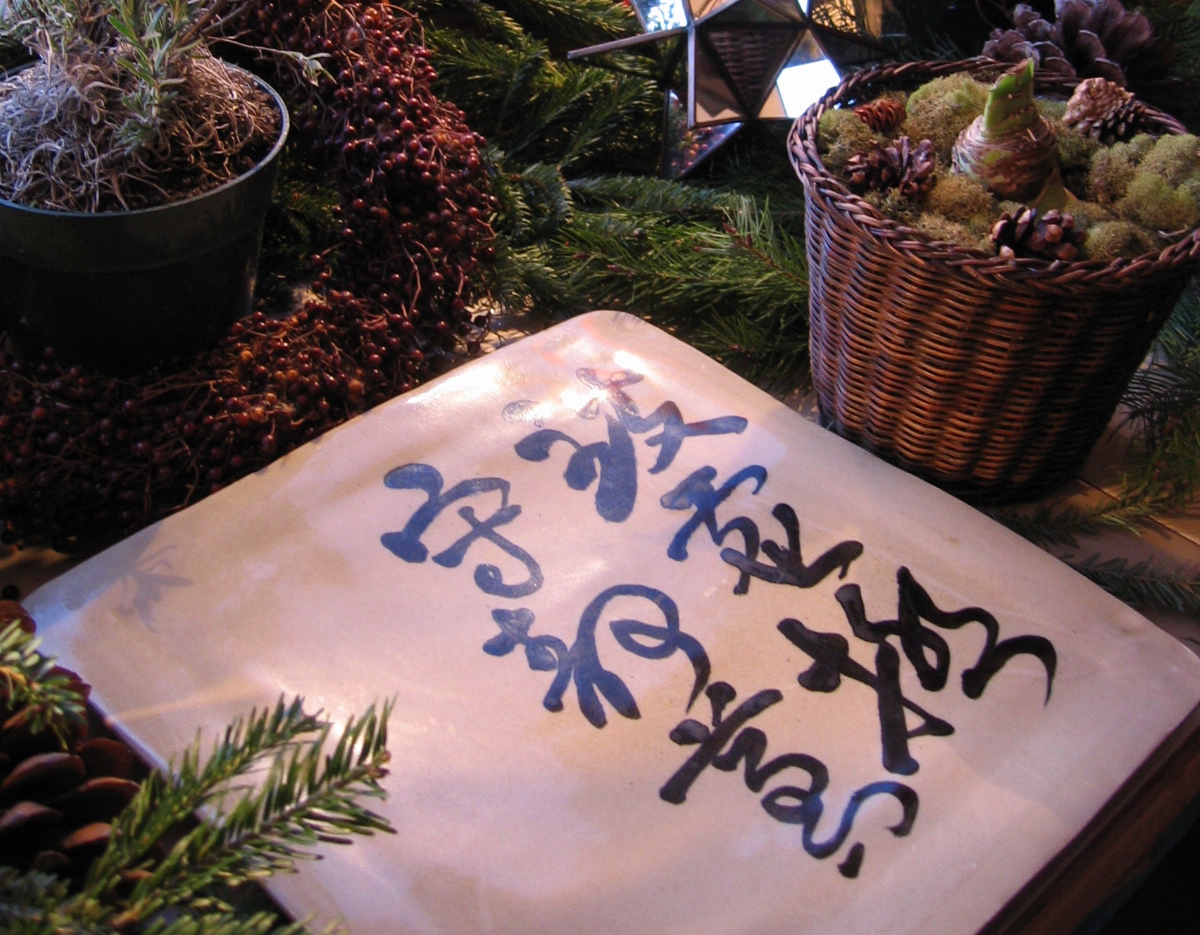
He taught himself ancient calligraphy, producing scrolls that my brother had professionally mounted when he was living in Shanghai on business. My Dad also tried to meditate, sitting at zazen and holding sessions with a handful of volunteers on a weeknight at a local church which offered a free space to meet. I give him credit for trying to live his own spiritual approach to Buddhism or Zen before he died. It kept him engaged and challenged, exploring the ways of the Sage or maybe even learn how to become more like one.

Sounds like a good idea to me too.

a pottery plaque with my father's calligraphy . . .

a pottery plaque with my father’s calligraphy . . .


“mirror, mirror” . . .

DSC_0412 Who is the fairest of them all?

Whilst  (love using that word!) I was looking through more books yesterday, I came across a thick paperback, a biography of May Sarton, a writer of books that had almost a cult following by women during the years when I was a housebound mother of three daughters, living in a suburb of Boston.

Her book, “Plant Dreaming Deep” about moving and settling into a small house in Nelson, New Hampshire and “Journal of a Solitude” fed my fantasies of domestic bliss by a woman writer who described poignant scenes of rooms, furnishings from her family, plants of all kinds on the windowsills, bouquets of seasonal flowers from the rich garden outdoors and delicious meals served with friends and visitors from diverse places. Christmas was a generous preoccupation of decorated trees, loads of presents, bountiful drink and carefully prepared meals with polished silver and napery on the dining table. I loved all that stuff.

Yesterday, while I was reading the biography, I was surprised but not shocked by the portrait of May Sarton’s actual life. She was ignored by her parents, an only child and a spoiled one even though not given much actual attention. Her personality was dramatic and her demands were many. She was often met with disappointment as her temper tantrums and tirades at people gradually and oftentimes put them off from helping her, although a few loyalists pitched in for a long time with housesitting, plant tending and doing chores, even when met with Sarton’s criticism and ingratitude.

Most interesting of all, was the way that she used her environs and the people around her in an idealized way that served as props for her most well-received book, “Plant Dreaming Deep.” I was astonished to read that buying the small house in Nelson, New Hampshire, was meant as a venue for a love tryst with someone who was already involved with someone else in Cambridge. So, this melodramatic back story was going on in parallel to writing “PDD”, an incredible real-life contrast to the beautifully written domestic memoir that inspired legions of women at the time, myself included.

She sought out situations where she fixated on a potential lover in order to stoke her writing, using the projection as a “muse” for writing poetry. The most astonishing example was her pursuit of Margaret Clapp, President of Wellesley College where Sarton taught on a yearly contract until it was not renewed. Flowers, elaborate engraved gifts, incessant phone calls and poems about her were sent by Sarton to Clapp for FIVE YEARS to no avail.

By the end of the book and her life, she hadn’t changed at all. Still complaining and full of self-pity, still searching for a fulfilling love affair according to her terms, there didn’t seem to be much difference between the May Sarton in her twenties from the one who died in her eighties. Granted, she wrote many books and had them published. She had a following of readers whom she wanted but also decried for the attention that they sought from her. She wanted fame but not what came along with it.

She also had a better opinion of her writing than any of the critics and academic writers she knew (serious writers such as the poet, Louise Bogan and teacher, Carolyn Heilbrun.) She refused to learn from comments that her work was “sloppy, casual, not rigorous enough and often too sentimental.” Instead, she felt that critics did not understand her work nor appreciate it enough. She once said, “If I won the Nobel Prize this year, it wouldn’t make up for the years of bad reviews I have received!”

What a revelation reading this biography was yesterday on the heels of the Dale Carnegie golden rules post the day before. For whatever cause in her childhood, she cared about nobody but herself throughout her whole life, criticizing almost everyone she came across, friends, lovers, fans and critics. She did have a long-term relationship with Judy Matlock who was patient, caring and loyal while Sarton pursued other lovers. Sarton’s callous treatment of Judy during her weakened state was something she regretted afterwards but which she didn’t avoid while Matlock was still alive.

May Sarton’s biography is an ironic case study of how not to live your life or treat those who care about you. She travelled the world, had sophisticated friends in different social and literary circles. Her friends helped her afford the luxurious lifestyle that she felt she was entitled to, like renting the Maine house with an ocean view that she let readers think she owned.

I wonder if we lived in parallel universes and if she had a chance to read this biography of herself whether she’d do it differently the next time around.


(still) good advice! . . .

simplicity itself . . .

simplicity itself . . .

If you read the last post, you’ll know that I’m in the throes of cleaning out books. The piles of cardboard boxes are now diminished by half. I have resisted keeping books that I might read again, and only saving those I KNOW I’ll want to read again.

Anyhow, in the back of one row of books in the side shelf, I picked up Dale Carnegie’s bestseller, “How to Win Friends & Influence People.” I thought about tossing it into one of the boxes but as I flipped through it, yellow highlighted sentences sprang out at me and made me laugh out loud. I think his simple handbook of how to get along with people is still worth its weight in gold. Here’s some examples of why.

“If you want to gather honey, don’t kick over the beehive!”

1. People aren’t interested in you. They’re interested in themselves.

“We are interested in others when they are interested in us.. . you can make more friends in two months being interested (sincerely) in them than you would in two years trying to get them interested in you.”

2. Smile often at people from the time you get up to the time you go to bed. Watch how this changes your outlook and everyone else’s towards you.

3. What and how you think about things determines your attitude and outlook on life. If you are unhappy, it’s because of your inner thoughts.

“Everybody in the world is seeking happiness–and there is one sure way to find it. That is by controlling your thoughts. Happiness doesn’t depend on outward conditions. It depends on inner conditions. . . . It isn’t what you have or who you are or what you are doing that makes you happy or unhappy. It is what you think about it.” (my emphasis) 

4. Stop criticizing. Criticism is futile, no matter what.

“Criticism is futile because it puts a person on the defensive and usually makes him strive to justify himself. Criticism is dangerous, because it wounds a person’s precious pride, hurts his sense of importance and arouses resentment.” 

5. Be sincerely interested in others; let them think they came up with an idea and remember their name.

“People are not interested in you. They are not interested in me. They are interested in themselves, morning, noon and after dinner.”

That’s about it in a nutshell. Practical and wise advice. It doesn’t say much for human nature, though, does it? And if you’re stubborn like me, it’s sometimes hard to remember these adages that will work 100% of the time, but only if you can genuinely apply them in a sincere manner.

Still worth thinking about and experimenting on the people around you, don’t you think?  I wonder what tomorrow’s batch of books will turn up.


sorting things out. . .


pink phlox from the garden. . .

pink phlox from the garden. . .

For awhile now, maybe a few years even, I’ve been having a tough time finding books that I enjoy and read all the way to the end (without skipping to the end.) I wondered why that was. As we all know, there are trends in writing, just as there are in films, movies and TV shows. There seems to be a kind of lemming-like aspect to lots of things that are trendy so if you don’t necessarily buy into nor enjoy what’s offered, you’re often out of luck. . . big time.

Enough complaining about that. What has happened to me today is that I started to sort out my books in earnest, pushing the flaps down on a dozen package store cardboard boxes and lining empty ones along the bookcase by the far wall in the room where the orchids thrive most of the time in the winter. The plants are flourishing now on the back wrought iron deck (that’s flooring, not railing) and watered well throughout the summer, much easier to do than dripping water all over the shelves inside.

The thing that has stymied me for awhile is getting enough shelf space opened up in order to start reorganizing the books I want to keep. Today, that process began as I was delighted to rediscover treasured books that I have owned and read in the past: books by writers like Alix Schulman, Iris Murdoch, Anne Morrow Lindbergh, Paul Auster, Ursula Le Guin and Haruki Murakami. For an hour or two, I have been immersed in paging through some of these volumes, setting aside a stack that I’m going to read/re-read during breaks from cleaning out the house during the dog days of August. It has restored my faith in reading for pleasure while reinforcing the notion that “utopia is (already) in your own backyard.”

I managed to transport the heavy cartons of books by putting them on my handy, compact wheelchair that is still up here and stage them to an area waiting to be carried downstairs. Some fellows are coming by this week to help move our Steinway concert grand piano back from a rental to Nantucket. When the “guys” are in, I will ask them to carry the books downstairs and load them directly into the back of my Subaru Outback. Then, I’lll deliver them to the public library loading dock where someone with a dolly will help me unload them. Easy Piece-y.

I can already see the benefit of this book reorganization because now my favorite books are consolidated into a bookcase in the anteroom to my bedroom where I can see them shelved together, rather than being strewn here and there, all over the place. Having filled five boxes of discards already, I’ve made enough headway to keep going. It’s interesting also to note, not only the books that I want to keep and re-read, but the ones that I quickly decide to discard: novels that didn’t take, some self-help. energy and philosophy books that aren’t as good as the ones I’m keeping.

Meanwhile, I also have a couple of cartons, flatter and bigger than the book boxes to put kitchenware that’s obsolete or too worn to keep using (those skillets where food ALWAYS sticks, no matter what you do!) And, a new category of things too good to give away that someone might make a profit from (not me!) selling in their consignment shop. There’s a place down on Canal Street adjacent to a nascent farmers’ market (3 tables) that I walked through last weekend. There are vintage, everyday wares on display that young couples might want to furnish their first apartments with. Finding a new home for kitchenware would ease my conscience for having so much stuff!

So, stagnation seems to be moving along a little bit. (Hey, it’s the extra-big full moon today, isn’t it?) Sometimes a task seems so daunting that even after I’ve fetched all those empty boxes, it feels too burdensome to get started.

Now that it’s midday on Sunday, I feel like I can take a break and steam up some Asian roast pork buns for lunch. And have a tall glass of iced green tea with honey and ginseng. Then, I can settle down to reading books to my heart’s content.

zucchini souffle! . . .

souffle 6Have you ever made a souffle? It’s one of those things that people sometimes think is so hard to pull off that it ranks right up there with learning how to dance the tango or something, right? Well, anyway, I’ve been experimenting with making zucchini souffles, using a French Charlotte mold with heart-shaped handles. The bottom is slightly smaller than the top, making it easier for the souffle to rise.

To make it less daunting, I make the souffle in different steps, spaced a couple of hours apart on a leisurely Sunday afternoon. Each step takes little time and allows for the souffle components to reach the right temperature (tepid) before finally folding in the beaten egg whites right before you’re ready to bake it in the oven. Here are a few easy steps if you’d like to try it yourself for a classic and tasty supper.

1. Trim the ends of a medium sized zucchini, wash, dry and hand grate on a box grater (medium hole side.) Melt two tablespoons of unsalted butter, wash and cut up two green onions and saute in the butter. Add the shredded zucchini, toss and add salt, browning a little until golden. Let it rest (cool.)

sauteed grated zucchini, scallions. . .

sauteed grated zucchini, scallions. . .

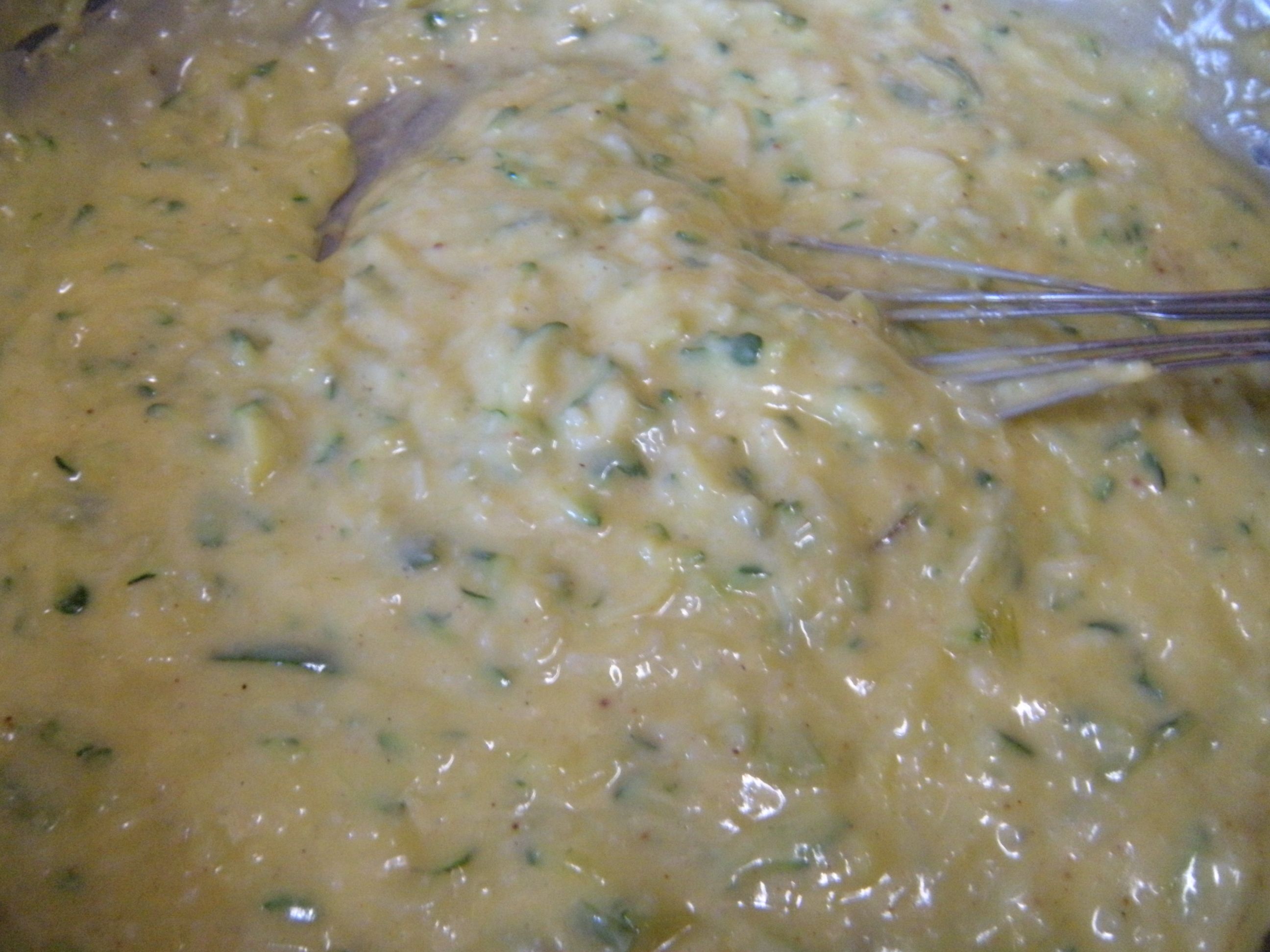
2. In a clean skillet, melt 2 tablespoons unsalted butter, add 2-3 tablespoons of flour and mix in quickly. Stir in a cup of whole milk and whisk together until it starts to thicken. Separate 4-6 eggs depending on size (room temperature) and add one yolk at a time to the bechamel sauce. Add one cup of shredded cheddar or gruyere cheese. Let it melt. Whisk together and add the zucchini mixture from step one. Season with Maldon sea salt, and a little nutmeg if desired. Let cool. Preheat oven to 400 degrees.

bechamel sauce with cheese and zucchini with some nutmeg. . .

bechamel sauce with cheese and zucchini with some nutmeg. . .

3. Using an old-fashioned hand egg beater (I have two) or a hand mixer,  beat the egg whites until peaks form. Add about a cup’s worth to the zucchini cheese sauce and fold gently, using a paddle motion (down, up, over and back down into the mixture, folding air in all the while.) When blended, add the rest of the beaten egg whites and do the same thing, being very careful to allow air volume to be folded in along with the egg whites.

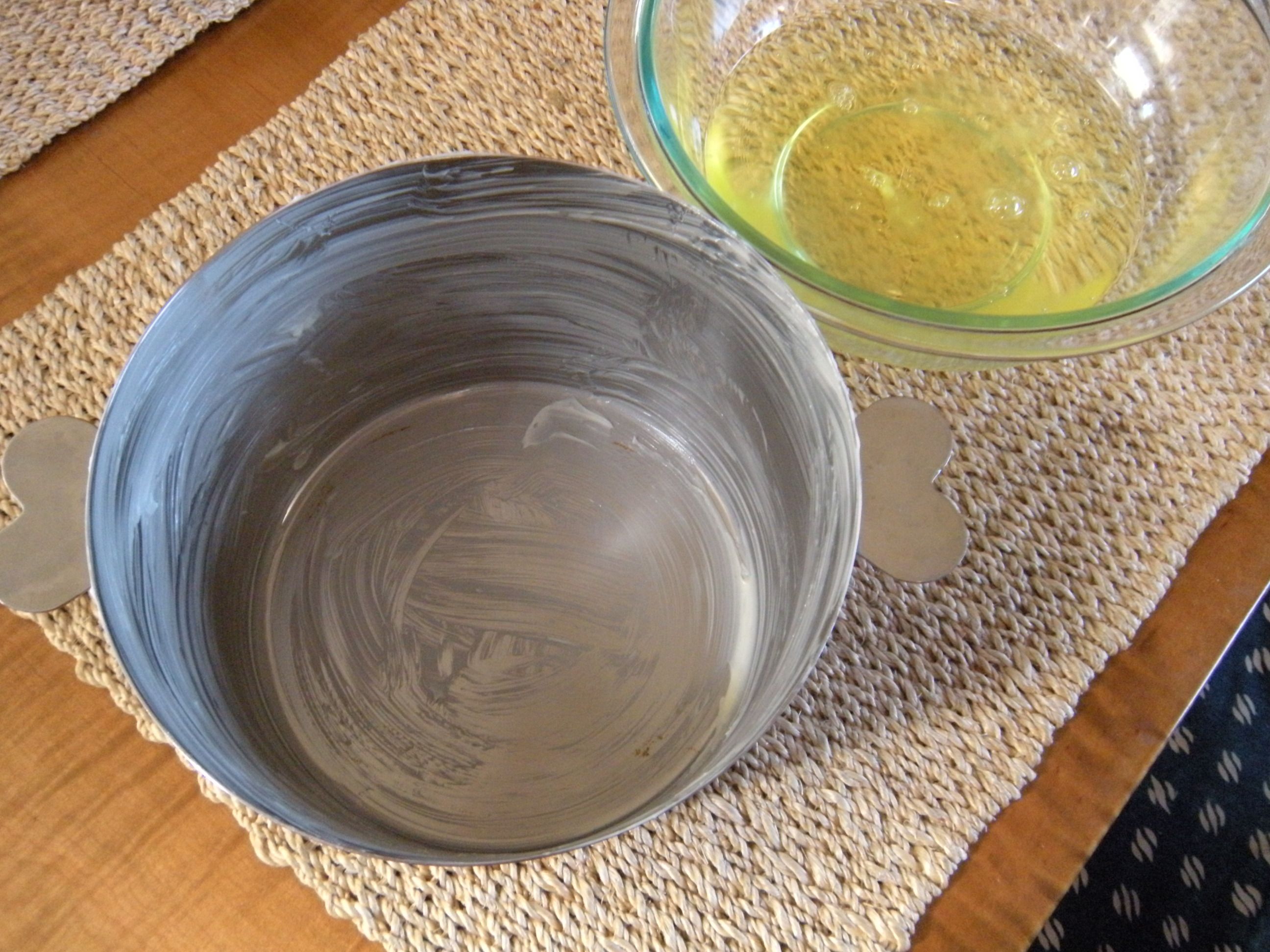
4. Butter your souffle dish and sprinkle the

buttered charlotte mold and egg whites that will be beaten until stiff. . .

buttered charlotte mold and egg whites that will be beaten until stiff. . .

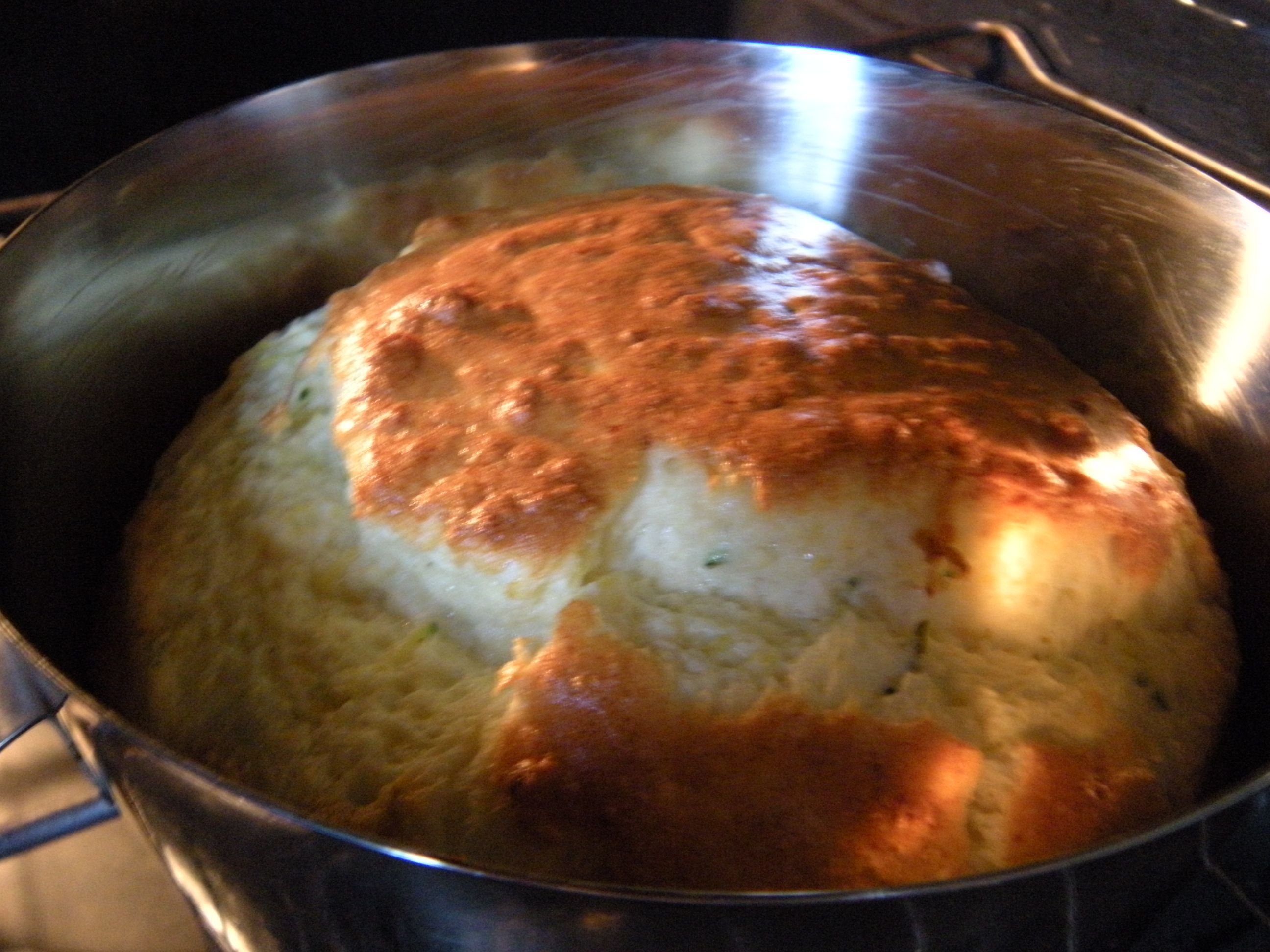
inside of the mold with parmesan cheese. Gently fill the souffle dish with the soft, souffle mixture. Slide into medium rack of the oven and immediately turn down the temperature to 375 degrees. Turn on the oven light if you want to peek at the souffle without opening the oven door. Bake for at least 30 minutes and up to 45 minutes until top is golden brown and the inside is cooked. Don’t despair if at half an hour, it looks like it’s not going to rise. Wait a few more minutes and it will. When done, the souffle will look gorgeously poufed and the center should look as if it’s cooked even if it is slightly jiggly. Turn off the oven, open the door and let the souffle sit on the rack for a few minutes while the oven temperature drops.

Dress a fresh cress salad with a simple lemon/Japanese vinaigrette. Seat yourselves at the table and place the souffle in the center of the table. Using an elegant silver serving spoon, serve the souffle, pass the salt, coarse pepper and enjoy!

souffle 5

There’s something satisfying about eating a healthful and modestly economical dish for our Sunday night supper. It might take a little practice (the lightness of the sauce matters!~) but the golden appearance and savory taste of this souffle is definitely worth it.