mulberryshoots

"Tell me, what is it you plan to do with your one wild and precious life?" ~ Mary Oliver

doubled and re-doubled. . .


He was the King of Hearts

I don’t know why I am remembering so much about my Dad these days. This is one anecdote that I am posting because it’s so typical of him and how he behaved.

When I was in high school, I was pretty much a wallflower, a nerd, a geek. In fact one of my best friends in school whom I knew from the 6th grade nicknamed me “braintube”. He still calls me that and I call him “Jimmie” to this day in our emails even though we are both grandparents.

Anyhow, it was the 60’s and my high school friends and I played bridge pretty seriously. At our parties on Friday nights during junior high school, a bunch of us would get together to play bridge. Our parents also played. My best friend, Martha, used to invite me over for sleepovers and her parents would play cribbage or gin rummy by themselves, and bridge when the two of us made a foursome. Sometimes Martha’s brother Joel would spell one of us off. Her parents chain-smoked like chimneys while we played.

My brother, D., is eight years younger than I am, so when I was a junior in college, he was still in junior high. But he played bridge too. One weekend, my parents invited some friends over for dinner. While we were waiting to eat, my Dad asked if anyone wanted to play a couple of hands of bridge with him and one of the guests. My brother and I were partners as we sat down opposite my Dad and his partner. That my father barely deigned to play with me and my brother was pretty obvious. But as the play went on, my brother and I were dealt a lucky hand of cards. We bid a small slam. My father looked at us as if we didn’t know what we were talking about. I saw two tricks that we could lose, one sure one, and one depending on who had the high card for a finesse.

Dad doubled the contract. My brother, who is no slouch at being strong-willed either, redoubled. For those of you who don’t play bridge, what that doubling and redoubling meant was that: a) my father basically challenged us that we did not have a prayer of making the small slam contract; and b) my brother’s redoubling was like saying, “oh yeah, just watch us.” If my father won his double and we lost the contract, his side would have gotten 50 more penalty points. If we did make the contract redoubled, then we would get 100 more points than we would have without all this macho challenging stuff going on.

You know what happened, right, or I wouldn’t be writing about it. My kid brother and I won the small slam contract. The crucial finesse worked to our advantage so we only lost one trick. We got the redoubled score. And my Dad, bless his heart, never played bridge with us again.
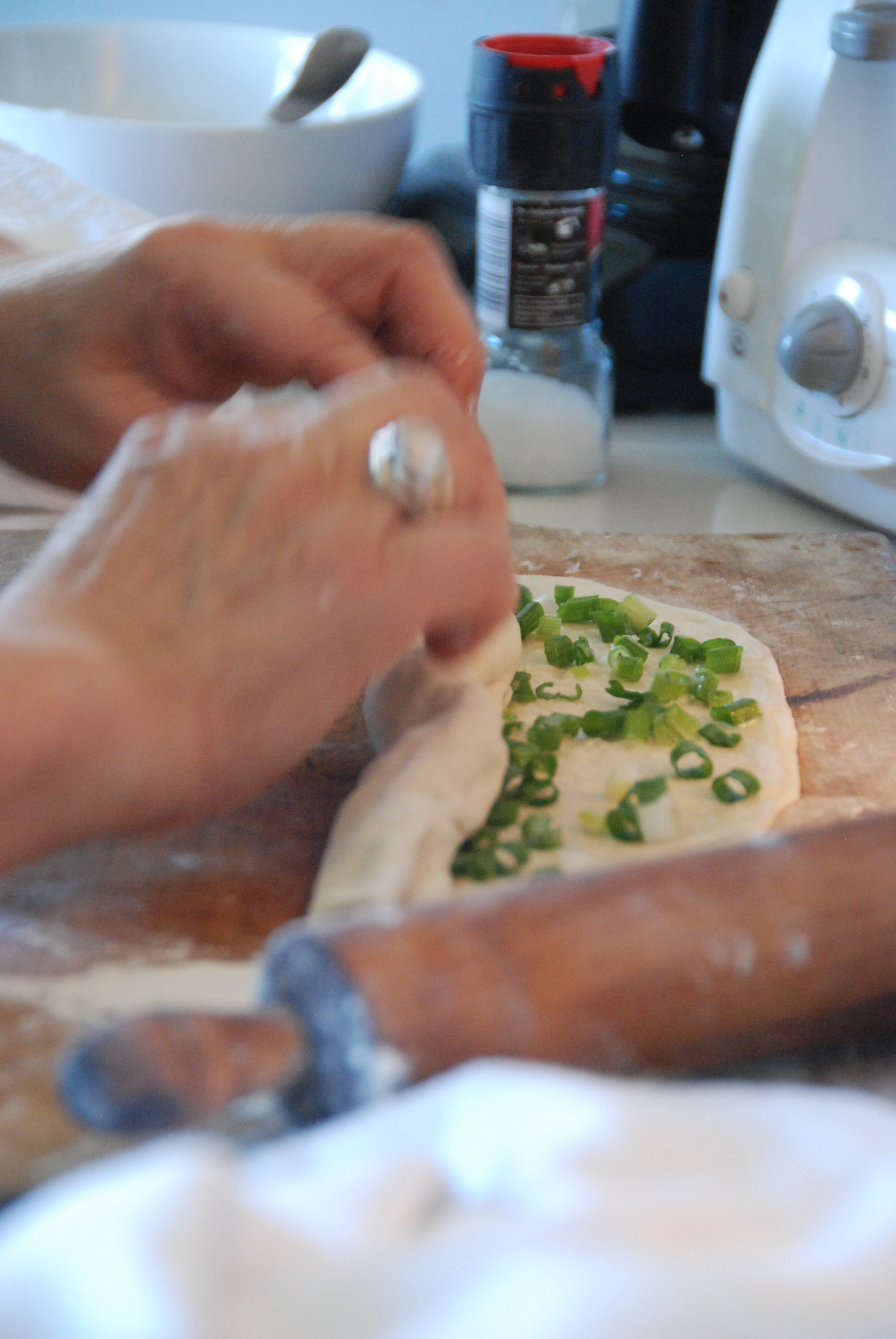
scallion pancake recipe. . .


1.  Mix 2 1/2 cups flour with 1 cup warm water. Mix well and knead gently. If it is too sticky, add a little more flour. Knead gently until smooth; cover with a clean dishtowel and let rest 15-20 minutes.

2.  Wash and chop up a small bunch of young green scallions–slice them lengthwise, then chop and mix white with green parts; set aside.

3.  Take a fresh package of lard (manteca) and heat about 1/4 cup of it in the microwave until it is soft and spreadable but not liquified. Add in 2 tsp. of sesame oil and mix well; set aside. This should be the consistency of sour cream.

4.  Flour a board; divide the dough into 3 parts; roll out one part to about 6-7 inches–spread with lard/sesame oil mixture–not too thin, not too thick.

5.  Sprinkle the surface with coarse sea salt or kosher salt.

6.  Divide onions into three parts and sprinkle one onto the first pancake. Roll up securely and then, taking one end, curl it into a snail on itself. Pinch together, pat and roll this snail out into almost the same size as before.

7. Use a clean skillet and heat up some canola oil or Wesson oil–when the oil is warm, slip in the pancake and cook it gently (mildly sizzling but do not burn.) When it is golden brown, turn it over and cook the other side.

8.  Drain onto paper towels and cover with clean towel; wipe out the skillet each time, add fresh oil and cook the 2nd and 3rd pancakes.

9.  Drain each one separately on paper towels to soak up any excess oil.

10. When all 3 are cooked, put them on top of each other and cut in half with a cleaver, then crosswise, then in wedges.

11. If you want a dipping sauce, make one with lite soy, rice or Chinese black vinegar, sesame oil, sugar and a little water–grate some fresh ginger root into it if you want.

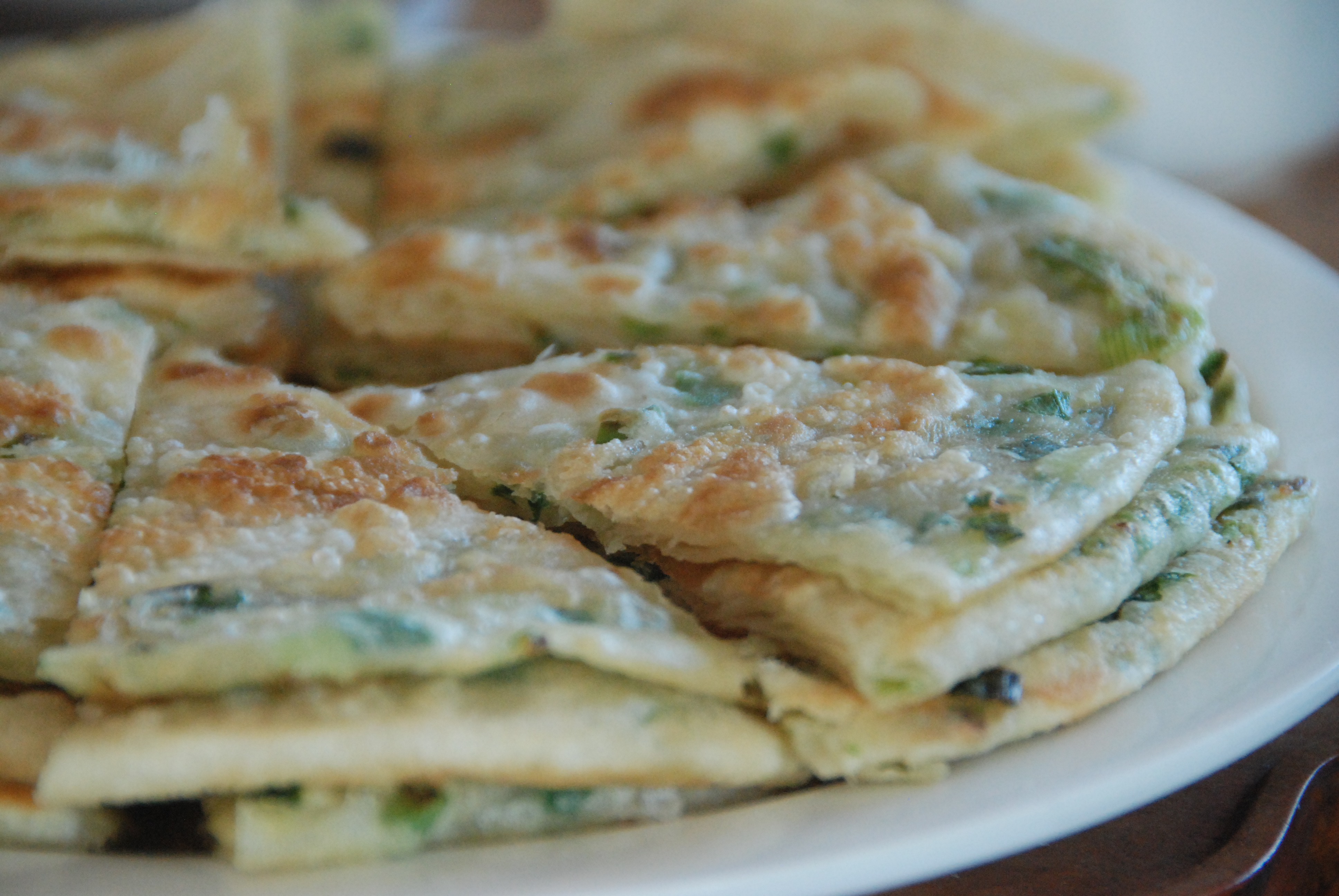
THESE were the best scallion pancakes that I have ever made.

making scallion pancakes . . .


hands down "the best EVER"

I was very good in chemistry and almost majored in it in college, at least when I was a freshman. What I mean is that I can follow experimental directions and also have an intuitive sense about mixing things together to see how they will react. In large part, that’s the process by which I approach cooking most of the time. The rest of being a cook for me is also intuitive but more free form, the reason a dish will turn out slightly differently each time even though you are following the same basic steps.

My Dad’s primo cooking dish was making scallion pancakes. He was absolutely rigid about how to make them and that his way was the only way. I watched as he chopped the green onions and put them in a bowl, made the flour dough with hot water and let it rest, shape the dough into a long snake and cut up portions, then roll each one out, spread with soft lard, sprinkle with salt, then onions, roll them up, then make a snail from the rolled up pancake, flatten the snail out again. Then cook carefully in a skillet, pile the cooked ones one on top of the next and then with a large cleaver, cut through all of them to serve them as fragrant, warm, savory wedges of salted heaven.

Recently when family was visiting, I impulsively decided to make them. But I didn’t have Dad’s exact recipe with me so I was a little dubious. I found a recipe online that sounded about right. It didn’t have a leavener like baking powder, which I distinctly remembered was Dad’s “secret ingredient.” I also remembered the last time I had included it that the pancakes were a little spongey to roll out.

I decided to follow the online proportions for flour and water and then go with my instincts. Instead of spreading lard on the surface of the pancake, I warmed a little in the microwave with a dollop of sesame oil. Then I mixed the softened but not liquid lard and sesame oil, spreading it thinly on the pancake. I used sea salt from a grinder. The green onions were washed carefully, slit down the lengths and then chopped finely, the white and the green parts. The fragrance of the raw onions filled the small galley kitchen I was working in. The dough without baking powder was easier to work after resting.

Everyone agreed as we wolfed them down that these were the best ever, Dad’s sacrosanct recipe notwithstanding. I wonder what he would have thought about such delicious scallion pancakes made from a recipe available on the internet. I also wonder if they’ll ever come out as well as this batch the next time I make them. The photo tells the whole story.

If you would like to try the recipe, I will post it next. One word of caution though: don’t try to make them if you are averse to using fresh lard (manteca at any super market) because actually, that is the true secret ingredient!  Let me know how they turn out for you.

ashes to ashes . . .

My father died at the age of 89 in February 2008. My mother died at the age of 89 in November 2008. By that time, they were no longer married. And had lived apart for quite some time before they died. Nevertheless, my mother was there when a Tibetan monk was chanting Prayers for the Dead for my Dad. He had his eyes closed towards the end. My mother walked up to his bedside and his eyes flew open. She looked at him and nodded. He seemed to nod back, closed his eyes and died.

My mother died painlessly in November the same year after being diagnosed with abdominal cancer in August. She had little to say as well. Both of them were cremated according to their wishes. That year, we had ashes from both of them that we took home. For awhile, I held onto them, not knowing where, exactly, to release them into the world. After awhile, I thought that it was not a good idea to keep them wrapped up, and that in order to release their spirits wholly, our little packets of dust needed to be dispersed in a kind fashion.

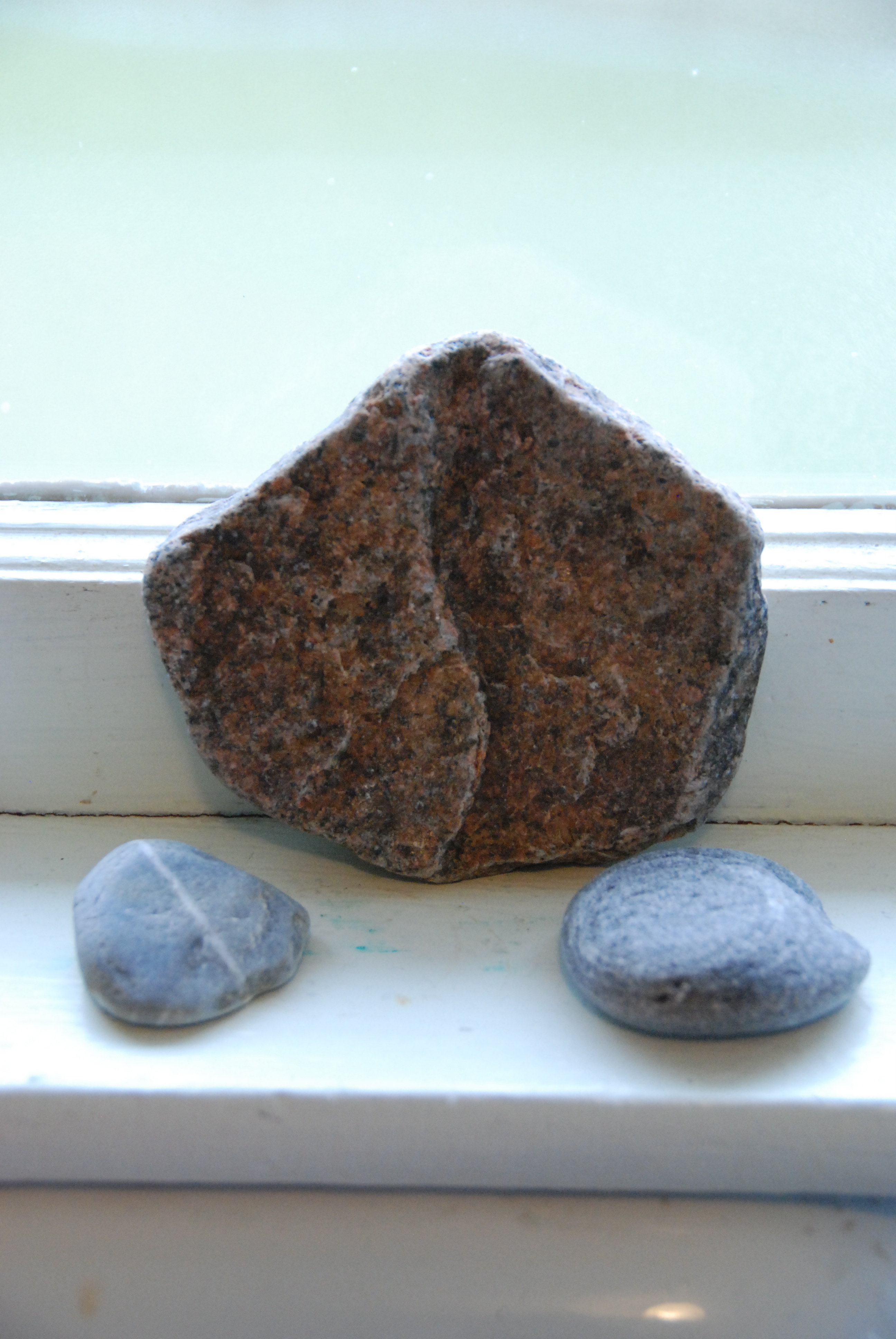
I finally decided to go to a nearby beach on the Atlantic coast of New England. It was twilight, my favorite time of day. Nobody else was there and it was low tide. I walked to the water’s edge and said goodbye as I released each packet of ashes. They swirled in the cold sea water, the dust settling as I carefully shook out the bags. I felt that it had been an okay kind of ceremony. As I turned around to walk back to my car, I took a few steps and looked down on the rocky beach. Not two minutes after I had finished releasing the ashes than there appeared two small rocks that stood out, one next to the other. One had a white straight line through it, and the other, a white circle. I felt that this symbolized my father (the straight line) and my mother (the circle.) I picked them up, feeling that it was an affirmation from them, or from the powers that be.

In about four more feet up the beach, I looked down again and saw a large flat rock with a wave indentation on it. It looked to me like an I-Ching hexagram, or a symbol of Yin and Yang. It felt to me like the Universe was giving me comfort that this release of my parents’s ashes was appropriate and well-received, in some way–or maybe it was just their way of saying a last goodbye.

fitting a puzzle together . . .

Putting jigsaw puzzles takes patience, an eye for shapes, colors and design. Some people are good at it and can spend hours poring over a myriad layout of tiny pieces, sorted by color, the edges already formed, at least if you are experienced at this kind of thing.

I have patience to knit, a sometimes tedious-looking kind of activity, repetitive, requiring counting and the willingness to go back and pick up a dropped stitch, or one that stands out from the tension of the piece you are working on.

My husband, G, could no longer knit than I could do jigsaw puzzles.

knitting without a pattern. . .


knitting the past into the present. . . and then, letting it go free

I went to the fish market tonight to pick up some Nantucket Bay Scallops–the last of the season, it seems. They were tiny, succulent and briny. I dusted them with barely any flour, salt and coarse pepper. Melted a little unsalted butter in a skillet, threw in a couple of cloves of peeled and chopped garlic. Quickly cooked the scallops until they were barely cooked, light brown and only slightly crispy. I took them out of the skillet and plated them because they kept cooking after they were off the heat. Fresh Meyer lemon juice squeezed on top.

A few handfuls of farm fresh spinach–very young–from Verrill Farm, washed and cooked quickly in some olive oil. When it was just wilted, added a little light cream–the real thing and let it thicken. Scooped into a small bowl. Along with the Nantuckets, as they are called around here, the creamed spinach, we had a slice of pumpkin-apple bread.

For dessert tonight, I made some Sioux Indian Pudding that we serve heated up a little, then topped with Haagen Daz vanilla bean ice cream. The pumpkiny-pie flavor of the cornmeal with the smooth cold ice cream is one of our favorite desserts. G liked it from when he was young so I started making it when he told me about this favorite memory.

So far, this post has been about food.–so why is the title about knitting?  Because I knit the way that I cook. Find something fresh and appealing. Make it into something that suits your imagination. That’s how I knit without a pattern. I am writing about knitting because the lady at the counter at the fish store (see above) complimented me on the sweater I had on. Her name was Darlene. I thanked her for the compliment and told her that I used to have a sweater like it which I wore all the time when the kids were growing up. I wore it with a black and white feather patterned cotton skirt and a magenta V-neck t-shirt. They all said that they remembered that sweater. There’s a photo of me in that outfit with Jackie-O sunglasses on.

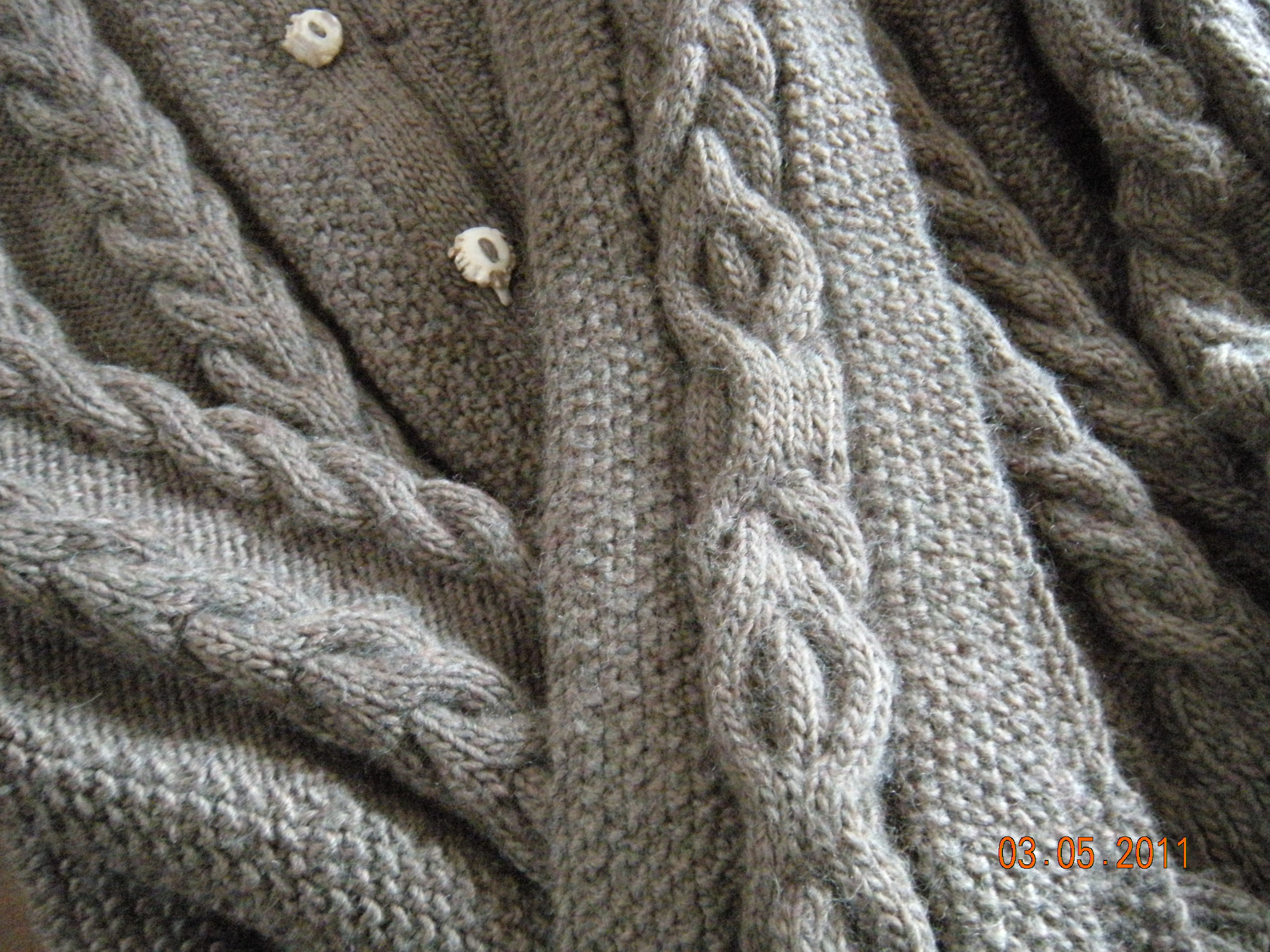
Alas, I had grown out of it and also lost track of it somehow. Then, about a year ago, I decided to knit myself a replica of the treasured sweater. I didn’t need a pattern because I had a picture of it in my mind that was more clear to me than if had been printed on paper. This 2nd generation version of the most treasured cardigan I had had early in my life turned out even better than the first. Which doesn’t always happen later in life when you try to recapture something you loved a long time ago. I used panels of seed stitch and cable stitch. Instead of an ordinary cable pattern, I made this one in the shape of a staghorn cable. The yarn was from Peru: a yummy taupe alpaca yarn. To finish it, I splurged on hand-carved deer antler buttons with brown scalloped edging. Darlene especially noticed the buttons. She said that when she travels, she picks up interesting buttons that she might use someday. She hasn’t knitted anything  since they bought the fish store, she said. But she can appreciate a nice handknit sweater. Her words were a nice surprise that lightened my day as I drove home.

I also knitted a scarf from the sweater’s leftover yarn that has a cable that wanders all over the place. I decided there were no rules to say that cables had to come back together symmetrically all the time. It was an interesting experiment where not only did I not use a pattern, but the knitting also took on a direction of its own. Go figure.

playing it “Bach’s way” . . .

Sometimes I go on music playing binges. Right now, it’s listening to Rosalyn Tureck playing the Well-Tempered Clavier Preludes and Fugues of Bach. She was born in Chicago in 1913 and died in 2003. Glenn Gould, the infamous piano interpreter of Bach hailed Rosalyn Tureck as the only pianist that he revered, which she acknowledged graciously since she never achieved the stardom that he did emulating her playing style. Here are excerpts from an obituary that appeared in the British newspaper, The Guardian, written by Jessica Duchen and published Saturday 19 July 2003.

“You play it your way; I play it Bach’s way.” Addressing the indomitable harpsichordist Wanda Landowska, the equally indomitable Rosalyn Tureck, who has died aged 88, made one of her most famous and characteristic statements. For JS Bach was the composer to whom this strong-willed, demanding and fearsomely intelligent American keyboard player dedicated her life, both as performer and scholar.

She was born in Chicago, the granddaughter of a famous Kiev cantor; she related, with great pride, her father’s tales of a carriage, pulled by eight white horses, taking her grandfather on tour for the high holy days. Her main teachers were Sophia Brilliant-Liven, Jan Chiapusso and Olga Samaroff (the American wife of conductor Leopold Stokowski) and, for harpsichord, Gavin Williamson.

Her talent showed itself early, and she made her public recital debut in Chicago at the age of nine. When, at 16, she auditioned for the Juilliard School of Music, New York, she startled the panel by offering to play most of Bach’s 48 preludes and fugues from memory.

Shortly afterwards, she settled on her future direction during a strange episode in a Juilliard practice room. While working on a Bach fugue, she blacked out for a short time; she came round with an inner revelation that she needed to create a different type of keyboard technique specific to the playing of Bach. Her teacher told her it was a wonderful, but impossible, idea; in response, she changed teachers. She never stopped perfecting this apparently elusive notion.

Tureck’s pianistic style, which (unfairly enough) was a huge influence on the more celebrated Glenn Gould, was uncompromisingly rigorous, intelligent and full of attention to detail: she took, for example, great care over the appropriateness of ornamentation. But what always convinces the listener is the compelling, incandescent, almost evangelical spirit that shines through that detail. She was hailed as “the high priestess of Bach” – and that is how she will be remembered.”

She was the “High Priestess of Bach.” If you have not had a chance to listen to her Bach recordings, you are in for a treat. I introduced them to one of my daughters who wrote back that she had two words to describe her listening experience: “Hubba, Hubba.”


why i love wednesday and thursday mornings. . .

I read the New York Times seven days a week. My favorite days are Wednesdays because of the scrumptious food   described in the “Dining” section and Thursdays for thought-provoking expositions of lifestyle in the “Home” section. Once, there was a full page description of a woman who came across an exotic rooster in the woods on her land. She was an artist and began to raise these creatures with huge sprouting crowns of feathers on their heads. To protect them from hawks, she planted unusual grasses and plants whose appearance mimicked the cockerel headdresses. One shadowy photo of an interior room showed a huge medieval press cupboard, carving all over it, majestic turned turnip legs and bun feet. “Who lives like this?” I asked myself as I sipped my second and third cups of coffee, the sun streaming in the kitchen windows, my bare feet on the floor.

In the food section, there’s usually at least one recipe or a description of a dish in a restaurant that I will adapt for our supper, if not that same night, by the weekend when I’ve had a chance to find the ingredients. It might be a simple cheese souffle recipe by Mark Bittmann, the Minimalist Cook, a title I have always thought to be slightly ironic. Then, there are the rampant stories of chefs who cook outrageously, making their own rules as they go along. It’s also amusing to speculate about the competitive camaraderie among the food writers.

As I write this post, I see that what appeals to me most are the stories about mavericks, non-conforming, devil-be-damned expos that feature what seems to make people happy. The ones who don’t paint their walls and leave the plaster cracked, full of character to them, if not for everyone. Those cooks who have a hard time working for anyone else and who cook what pleases them most, not just the customers who flock to their restaurants.

These portraits and vignettes are my weekly bread. Especially on Wednesday and Thursday mornings.

“life is long” . . .

thankful every day

“Life is long”. . . a woman speaker told us at one of the Wednesday morning assemblies when I was a scholarship student at Smith College in the ’60′s. She talked about how important this idea was because as women, we might have to put the care of others ahead of ourselves. And that there might still be a chance to do something or be something that was really important to us. Later on.

It was a turbulent time. Joan Baez, Pete Seeger and others sang to protest the Vietnam War. Women’s Lib was at its peak, American astronauts walked on the moon, and the Beatles rocked everyone, singing “I Want to Hold Your H-A-N-D…” Being somewhat shy, I was too naïve to know what I really wanted out of life, never mind whether life was short, or whether it was long.

My first marriage lasted for over a quarter of a century and the best thing that came out of it was our children. The one thing we did well together was raising them to be independent, to be curious and to give them experiences and tools to find their way in life.

Preferences in the way he and I wanted to live were in stark contrast to each other: he wanted to travel the world and live in exotic cultures–the Wanderer. All I wanted to do was to be at home. In my own home in comfort of my own making: to read, play the piano, knit, cook meals, listen to music. We couldn’t have been farther apart in terms of what we each wanted to do at the middle-aged period in our lives.

The divorce was lengthy and painful, lots of to- and fro-ing. Worries about finances. I moved three times in two years, including cleaning out the Victorian house that our children grew up in for twenty-two years, virtually by myself. The first week in my new apartment, the family dog slipped out from the back yard, even though the iron gates looked secure. When I searched but could not find her, I found solace in the I-Ching reading which said, “peace.” I figured that either I should chill out because she would turn up, or that she was already at peace. The next morning, the phone rang and a dog Samaritan said she found Bridget on the causeway in the next town. Two degrees  of separation, the Vet’s number on Bridget’s rabies tag and my new phone number left with the Vet during the move coincided to reunite us once again. I didn’t have a job at the time, although by then, I had worked for seven years in a biotech start-up and had a track record for making decent money. Three months later, I got a call that led me to a new biotech start-up company sixty miles away.

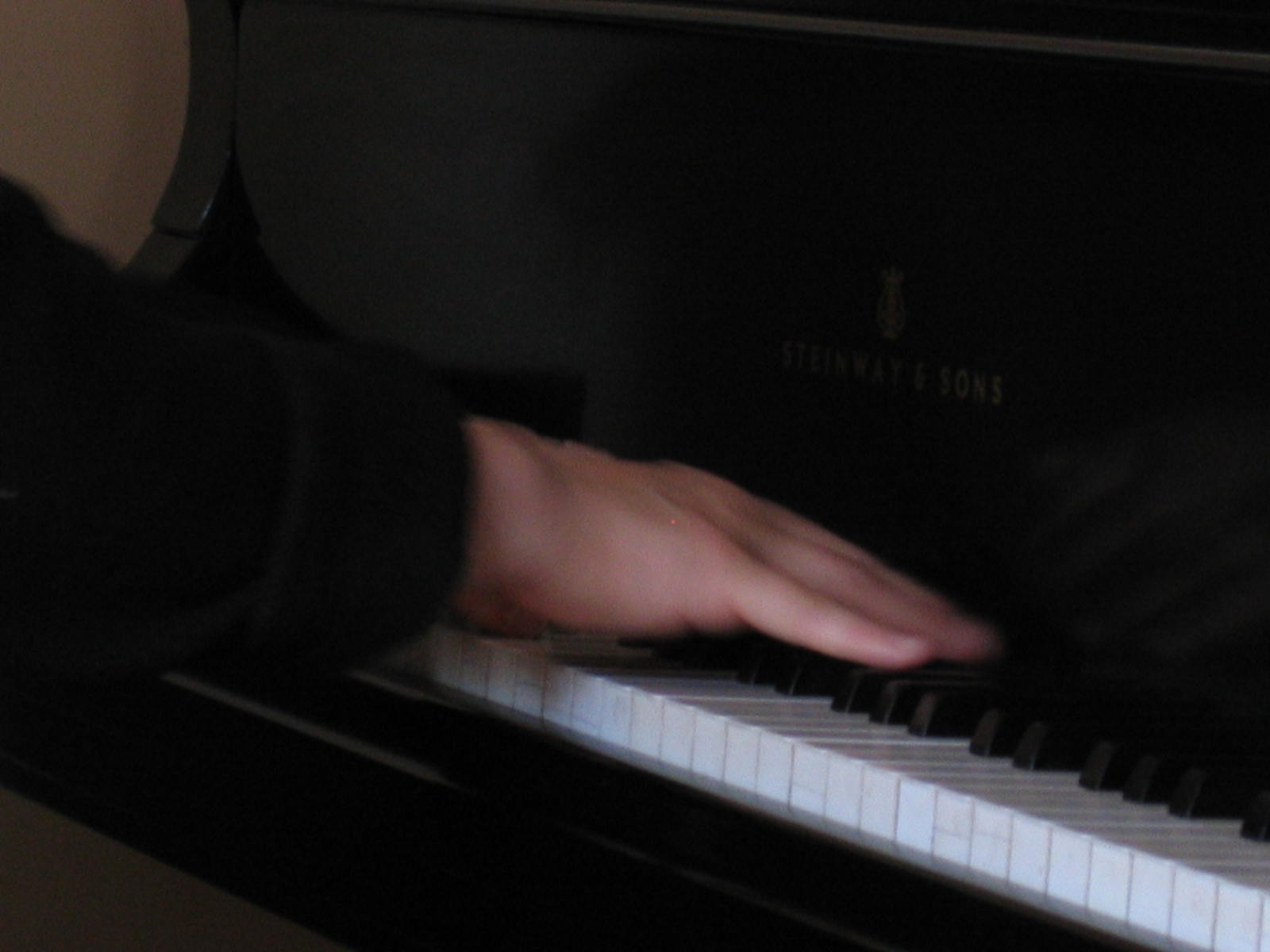
The movers, in their haste, forgot to tighten the lyre on my Steinway grand piano. I looked in the phone book for someone specializing in Steinways to come and take care of it. That person turned out to be my future husband. We were friends for four years when we decided to marry. This year, we celebrated our 16th wedding anniversary and have been together now for almost twenty years. I never thought this might happen during the turbulent unsettled time in my life.

We are both pianists, grateful that we are together to share our lives. Whenever I say that I should have left my first marriage earlier given all the trials and tribulations, my husband quickly disagrees. He feels that had even one thing been different in our pasts, we might not have met each other at all. Timing is everything, it seems, even if it takes awhile.

As a postscript, my ex-husband married within a year of our divorce being finalized. He and his wife travel and live all over the world. All’s well that ends well, it seems.

That’s how I came to understand what I heard when life was still innocent and full of promise, “Life is long.”

music and memory . . .

Last night, I downloaded songs from the ’40’s and ’50’s for my Uncle Tim in Beijing, making a CD that my brother, Dan, wanted to send to him. Our uncle is now 92 and likes to listen to romantic ballads sung by Andy Williams and Tony Bennett.

Tim learned English at an early age and served with the U.S. Army during World War II as a translator, stationed in Hawaii. My father joined up also. After the war, my father came to the States to get his PhD in geology at the University of Chicago. My Uncle Tim returned to China and the Cultural Revolution which would soon unfold thereafter. Luckily, Dan is still able to visit Tim and his wife Dora on frequent business trips to China.

During this nostalgic search down memory lane on behalf of Tim and Dan, I also found myself seeking out music that I hadn’t listened to in a very long time: piano jazz by George Shearing and Don Shirley. Each played introspective arrangements of songs like “It Could Happen To You” and “It Never Entered My Mind” interspersing song melodies with riffs from classical music. I remember how “neat” I thought that was when I was in college since I’m a classical pianist myself. I used to go to sleep with this music playing softly on my phonograph (that’s what they were back then.)

These piano sounds have had such a Proustian effect on me! Whole scenes of my life back then, from the very poignant to the mundane, flash in and out of my consciousness. You know how when you come upon a favorite pair of earrings that you wore a long time ago and love how they look when you put them on again? That’s how listening to this music makes me feel, uncovering that true self again…it’s still me.