mulberryshoots

"Tell me, what is it you plan to do with your one wild and precious life?" ~ Mary Oliver

Category: Life & Spirit

the tribe . . .

5888374b3d6e88fab9e61f1f19e50ca9

Have you ever wondered about the difference between men and women in terms of how they interact with the world and with each other? Ever since that seminal book, “Men are from Mars and Women are from Venus,” was published over twenty years ago, contemporary life has altered and changed (including more women in the workplace and greater sharing of household/childcare by men.) Or, maybe not so much.

My husband, G., has a network of men who work together on a daily or weekly basis, have known each other, some for decades and have one trait in common. They don’t talk about anything personal to each other: not when a family member dies, not when they’re going in for serious surgery, not when they lose a job, don’t have enough money, or their refrigerator dies. They just don’t do it much. I’m amazed when I hear this because women talk about these kinds of things, even with other women that they don’t even know very well! Men seem to have a shorthand code about what they’re willing to talk about. It seems that the most meaningful way to get through to a man is to ask him to do something to help you. Usually, though, you just want him to listen, and not to do anything. Nor do you want him to give you advice about what to do. Usually, he wants to fix it, not listen to a problem. Men are hunters, trackers and warriors. It’s in their gene pool, their DNA, whatever it is, it seems to be the most powerful trait that drives them and makes them tick.

That being said, I also want to tell you about something else that happened yesterday that made me think about men as belonging to a tribe. To make a long story short, I was looking at a 2005 Subaru Outback to buy yesterday as a replacement for my 2003 car that has over 150,000 miles on it. The fellow, Joe, who drove the car over to have it inspected by my mechanic was young, affable and easy going. We talked about family (he has a four year old) and sports, mostly. He thinks that Bill Belichick will keep Tim Tebow for awhile just to show the world that he can turn him into a great quarterback by the time Tom Brady retires in a few years.

Back at the dealership, I met the Sales General Manager, a brisk fellow who was willing to negotiate the selling price on the car, but then added up a laundry list of other costs: sales tax, dealer fee (?); registry costs, new plates, etc. etc. As I waited for the numbers to be run, I asked Joe if he was related to the GM because they joked around as though they were. “No,” he said, “but I get teased for being a bad influence.” It turns out that Joe introduced the GM and then the car dealer staff to join him for chicken wings (25 cents/wing) after work 8 p.m. on Monday nights to watch football games on the big screen at a neighboring restaurant/bar.

The GM returned with the paperwork and I casually mentioned something about “chicken wings.” He spun around and said, “Who told you that? We don’t even tell our wives about chicken wings!” and when I asked him what they told their wives, he said, “We just tell them that we had to work late.”

Okay. So a tribe of men go out for chicken wings to watch Monday night football after work. No big deal. Except that this is what they do on their own. And they don’t TALK about it to anyone, especially their wives!

See what I mean?
‘prime’. . .

K & G

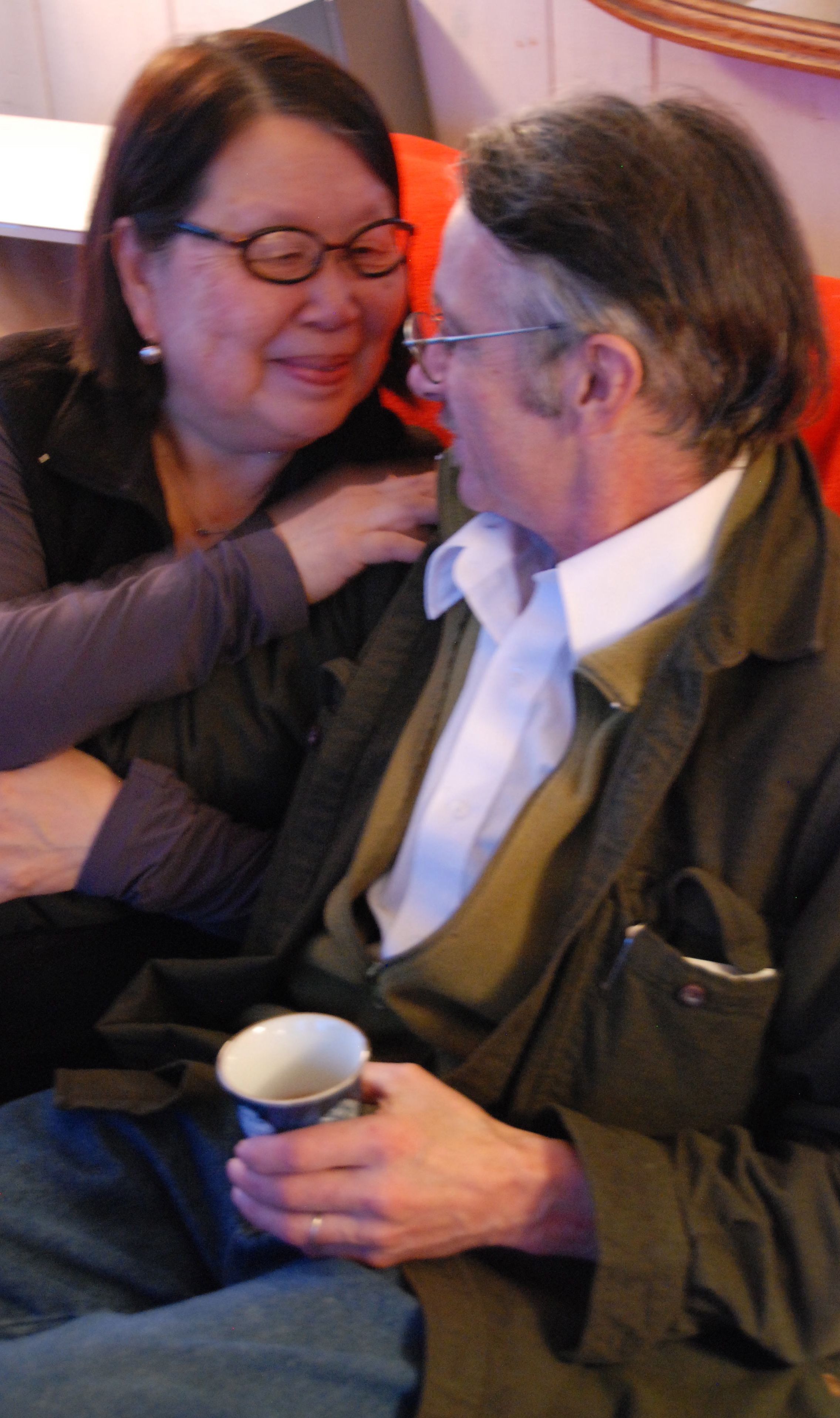
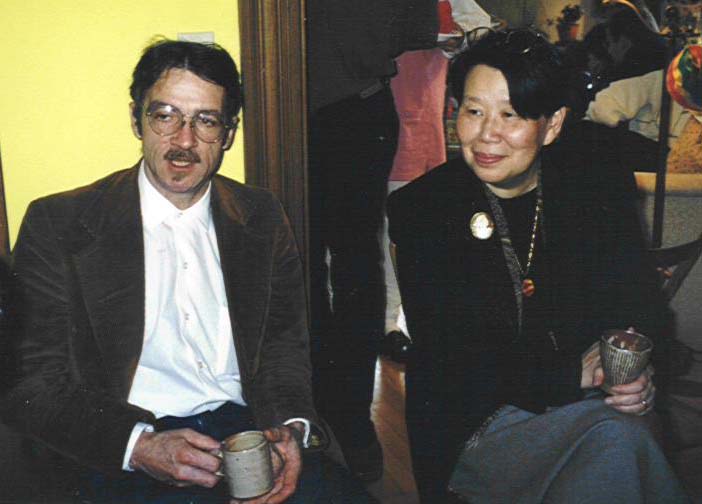
I came across this photograph a little awhile ago and was struck by how relaxed and happy G. and I looked when we first met. A lot of water has gone under the bridge since then.

It occurred to me to say that we were in our prime then. I headed up strategic and operational planning at a biotech start-up company in Central Massachusetts at the time. G. expanded his piano business to mostly Steinway and Mason-Hamlin grand pianos from restored antique uprights while continuing to service academic institutions in the area.

On second thought, I hesitate to make that call because I think the notion of being in one’s prime at some arbitrary point in time is shortsighted while one is still breathing. What I know now about life compared to those younger days has been hard-won. More important, what I know about myself from those halcyon days is so different that I might venture to say, it’s like night and day.

When I think back to that period of time, I remember that I was still optimistic and ambitious too. With the world what it is now, the economic vicissitudes that have occurred worldwide have set everyone scrambling, changing habits of easy expectation. Another thing that has shifted for lots of people is the loss of “the American Dream,” the idea that fairy tales do come true, people will succeed if they just work hard and children will love their parents even after they grow up and leave home.

It’s been hard. We have been fortunate because we had good work. Now, I don’t have to work as hard but the drive to learn and be productive is still there. I haven’t lost my memory although I rely less and less on memory anymore as a way of life. Thinking back doesn’t really do much good except to wonder how I managed to do all that stuff. There are many things I wouldn’t do again because I am now more clear about what I want my life to be: peaceable. Synonyms for peaceable include: harmonious, mellow, calm, tranquil, amiable and kindly.

Being able to provide what we need for ourselves is good fortune. Having a peaceable life is priceless. It’s hard to get there and we’re still working on it. But if there’s a prime time in life, perhaps it’s getting to a place where we realize we don’t need as much and that we’re lucky to be together. I wonder why it’s taken so long to get here.

K&G closeup

Yin, not yang . . .

I-Ching rock photo

You may have heard of Yin and Yang or at least seen the image of two halves making a whole: the dark and the light. Yang energy is excess in all things, pushing things beyond the limit outside of oneself. Yin is shy, reserved, quiet, drawing energy from within.

The truth of the matter is that my whole summer has been so yang that I’m “yanged” out, if that’s a word I can coin here. Too much running around, reaching out for lots of things, driving a lot, experiencing strong feelings, all of which have taken place in long summer days of intense heat and humidity.

Now that the light is changing and the air cools at night, I’m definitely ready for the pendulum to swing back the other way. Yesterday for some reason, I was drawn back to thinking about macrobiotics as a way of eating and living. Years ago, I spent a week at the Kushi Institute in Becket, MA. learning how to cook macrobiotic food. Armed with a pressure cooker, heat mat, premium brown rice, spring water, collard greens and kinpira recipes, I came back, ready to combat the viral encephalitis that still had a grip on my brain. Even though Western doctors said there was nothing wrong with me besides exhaustion, I knew something was up when I ordered an “ice cream sundae with mushrooms on top” at Friendly’s.

Thinking back on it, I remembered making rice balls and tiny lunches packed in bento boxes to take to work with me. People marvelled at how little it looked like I ate and at the same time, complimented me on the glow of my skin. I lost weight then too. Remembering that has reminded me now that I have a chance to regain my center, calm myself down, eat less but nutritiously and lose the remaining weight I’ve been aiming at once and for all, say, by Christmas.

The other long-held goal of mine to truly clean things out here and live a spare, although not spartan lifestyle also seems close at hand. The dumpster was taken away as quietly as it appeared, holding three and half tons of debris. In a month’s time, another container will appear for us to go through things that are still left. Just thinking of how much lighter living will be by then has me feeling giddy with anticipation.

For me to stay on something like a macrobiotic pathway it may also be helpful to think about life a little differently than in the past. I find myself wanting to shed the extravagances of the past: over-the-top Christmas holidays; gifts for the children they might not want or need; here-or-there things that are nice but add to the stuff that eventually will be sorted out and then given away again. The Buddhists say that craving is the source of human suffering. Taoists say something a little less judgmental. In any case, you can’t make desires go away. Something has to happen so that they don’t seem important anymore. Or set things up so that desires won’t surface as often. Tempting places like Amazon.com, Etsy, eBay and Nordstroms have been deleted from my Bookmark Bar. Oh yes, and I forgot to mention Pinterest, which is a most beautiful way to absorb other people’s cravings while increasing your own! I’ll have to get my thrills from going to the market a few times a week with cash, not a debit card.

Another thing that I learned about having less is the joy of an almost empty refrigerator. To me, nothing is worse than figuring out what to cook so that the refrigerator contents don’t spoil. I’d rather shop more often and buy two days worth, eat it ALL, and then start over again. So much food is wasted otherwise. I find that I can never rely on what I thought I’d like to eat, then three days later cooking it with the same kind of relish as when I first bought it.

So that’s where Yin is taking me these days. I’m exhausted from all the Yang. Depleted. I just need to stay quiet for awhile. Sit quietly. Read. Keep the TV off, especially the news.  And turn off the cooking show where Ina Garten pours a quart of cream into six egg yolks swimming in two sticks of butter. Now, that’s Yang.

books . . .

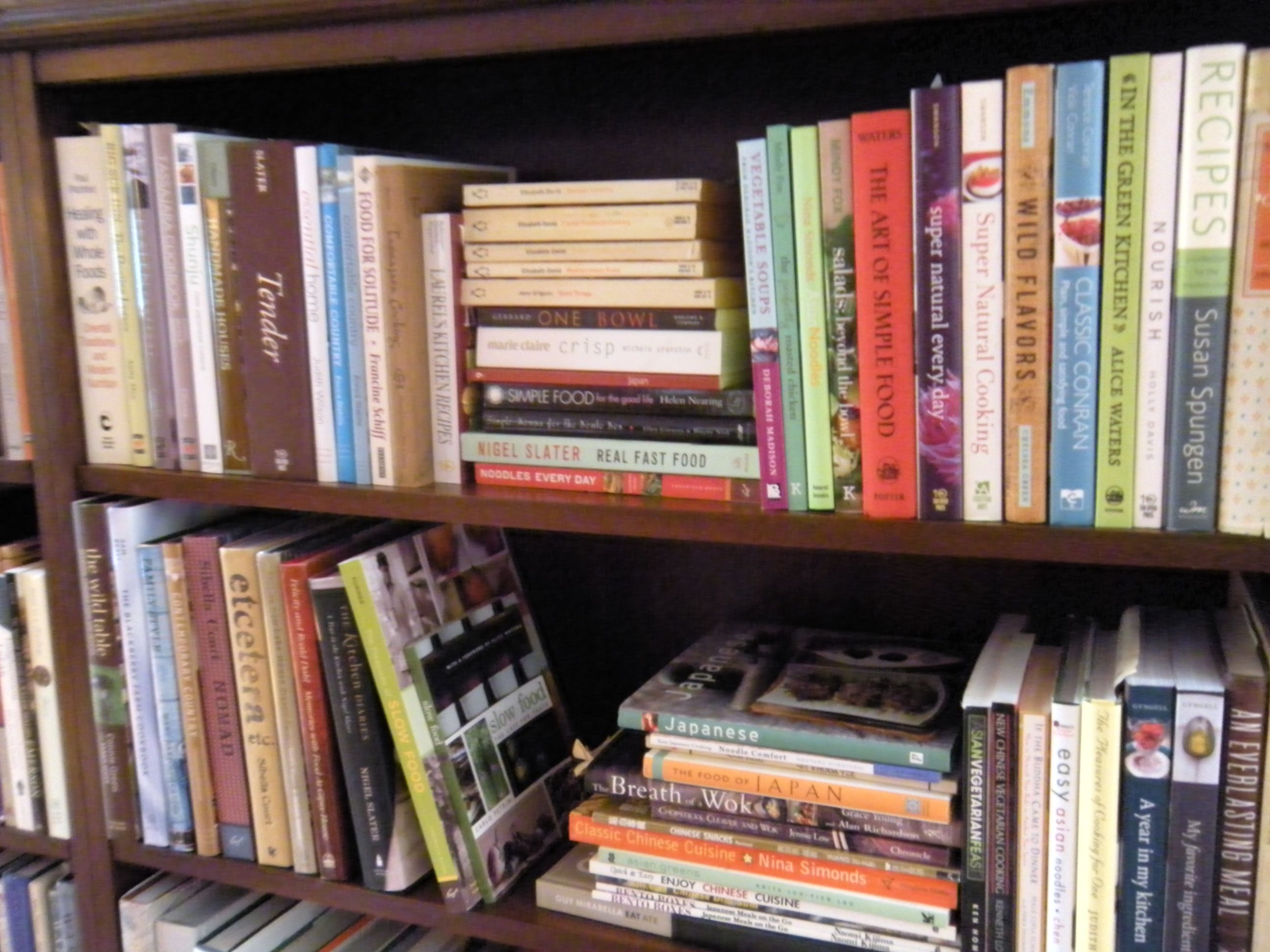
bookcase 1Although I didn’t think ahead of time that I was going to do it, I am finding myself in the midst of my semi-annual (twice a year) bookcase clean-out. Or I could just say book clean-out because I seem to have them stacked in all sorts of places, waiting to go to the library as donations, or finding a place to remain. This time, I’m even donating some large format books. It’s an interesting exercise because it’s a little like looking at a mini-“this is your life” video as the books get sorted or discarded, noticing how my interests and tastes have evolved.

The first section of bookshelves nearest the kitchen is prime real estate for books I love and use the most: cookery books by hip, healthy cooks such as Andrea Reusing, Nigel Slater, Alice Waters, Deborah Madison, Holly Davis, Heidi Swanson. Bookending them are Julia Child, the Conrans, Ronald and Felicity Dahl, the River Cottage guy and the River Cafe in London cookbooks. A dozen each of Japanese and Chinese cookbooks, dim sum, bento box, asian grill, noodles galore, tofu and soba paperbacks are now grouped together on the third shelf down. This reorganizing and culling out has inspired me to look through some of my favorites (Holly Davis and Andrea Reusing) once again.

In the middle section are two shelves of Taoist and Zen poetry, writings, translations and books about the I-Ching, including half a dozen translations of that venerable book. There’s a mini-library of books about Cape Cod and the North Shore:  National Seashore volumes featuring towns of Eastham, Wellfleet and Truro; books about the stone quarries in Rockport. New England Transcendentalists, Ralph Waldo Emerson’s writings and Henry David Thoreau’s journal of his time on the Cape meet halfway on a shelf with Taoist poetry translations by Red Pine and Zen writings by Alan Watts.

I-Ching emerson bookshelf

Finally, there’s enough room without having to lay books flat onto vertically shelved books (except for my two-volume boxed set of the I-Ching at the ready whenever it’s needed.) Whenever that kind of cramming has overflowed, it’s time to cull them out. It happens often in August, for some reason: must be because it’s so hot and one of the most uncomfortable times to do it.

There are five cartons of books to load into the car and take down to the public library today. Wednesday is their donation day and I’d just as soon have them out of the house so that I can enjoy the books that now have more breathing room. I’ve been remonstrating with myself lately about continuing to buy books when there’s no more room, but am glad to see how much richer my library is now than it used to be.

At the library, I’ll have a chance to look up and borrow some of the books that were suggested at the memoir writing class last week. It’s an opportunity to broaden my reading without buying more volumes, at least not today.

“art” . . .

butterflyToday, I asked the memoir workshop leader for advice on improving my writing. He said, “You are fine. But you have to be more intimate.  Even if it’s not in your culture’s mindset!” Then I looked up the meaning of “intimate” on line and it said “to be personal, private.”

This is interesting advice. Especially since I’ve been told many times that I am too direct, hitting the marrow in the bone as it applies to others. Perhaps I am not exposing my own bone marrow enough when I’m writing. And that it might be culturally Asian to avoid revealing one’s emotional depths except INDIRECTLY. I didn’t think I was that Chinese after spending most of my life in this country. But maybe that’s what I learned last week at the workshop: that describing pain indirectly doesn’t hack it.

I wonder if being in a deeper place, describing more detail and feeling to the reader would make my writing more intimate? If that is a prerequisite for “good writing,” or “making writing into art” then I’m not sure that I want to do that.

So, my question then is, what is art? And why does writing have to be art to make a difference? Here’s a definition of art on Wikipedia:

Art can connote a sense of trained ability or mastery of a medium. Art can also simply refer to the developed and efficient use of a language to convey meaning with immediacy and or depth. Art is an act of expressing feelings, thoughts, and observations.

The operative words are “with immediacy and or depth.” That’s where a more intimate look might enter in, I think. More detail, slower pace, not just skirting the pain.

“after” . . .

ImageYou know how people like to show “before” and “after” in order to illustrate transformation? The problem is that transformation is not always visible in photographs. It’s actually even hard to describe unless and until you feel one all by yourself.

For me, the “before” was feeling over-responsible, along with an ever-present fear that unless I did something or took care of something that things would just go to pot. Thankfully, I discovered last week the source of my  life-long fear (almost falling into the ocean when I was five because no one was looking after me.) And, most important, I discovered that I was carrying around a load of anger that I had carried that fear for so long. Okay, so I’ve  put that motherlode of fear down just last week. Get it off my shoulders. Give it a kick so it slides down the mountain or wherever it’s gone.

Second, look around and take a look at who has taken the brunt of my anger for so much fear? Ah, it’s the people I want least to hurt. Better late than never, as they say. So, now that the scales have fallen from my eyes and I can see how I have both protected myself and fought the untellable times when my fears might have come true, I am now fear free.

Being free of fear also means I can let go of all those things I cared about that produced the fear. It’s incredibly free-ing. I have merrily been cleaning out closets, going through old photographs, admitting fault, not taking on more fault than belongs to me, and feeling free. It’s incredible how feeling free feels. You should try it sometime. If you can.

dumpster . . .

It’s finally here.  G. rented a dumpster to haul away piano wreckage and stuff from the barn and cellar. It’s sitting in the driveway now off the street and I look at its cavernous insides with visions of clean closets floating in my head. We have until next Thursday to fill it up. I plan to go through all the closets and the crawl spaces behind them to clear things out. We’ll be able to move out without having to move away!

Yesterday, I returned from a week away on Cape Cod where I took a memoir writing workshop in Truro at Castle Hill. I drove early in the morning to the workshop from a spartan motel in Yarmouth, an hour away. In the afternoons, I returned on one of the major three thruways (Rt. 6, 6A and 28) to orient myself to the towns and neighborhoods of the Cape. That this occurred during the height of the tourist season was high folly, jammed with bumper to bumper traffic once the day got underway. Some weeks earlier, I had contemplated the idea of a second home on the Cape, a romantic notion of a quiet place with the ocean nearby enough to be “near the water.” What I came away with after my memoir sojourn is how fortunate I am to be living here in the Queen Anne Victorian piano place we call home not anywhere even close to water.

home, sweet home . . .

home, sweet home . . .

I was surprised to notice the huge population of workers servicing the Cape and the tourist industry: restaurant workers, motel workers, cleaning staff, workers in the souvenir shops by the side of the road. Hordes of workers in seafood restaurants and seafood shops. There seemed to be more fried seafood places than probably anywhere else on earth, and for sure in the state of Massachusetts.

These workers were a real contrast to some of the people who attended the workshop. Some stayed in Wellfleet and Truro homes, passed down or owned by their families for generations. Cars were parked with New York license plates. Some flew in from California. Everyone was well educated and able to afford spending five mornings and the cost of the class to attend. From my Yarmouth motel to Truro and back again each day, I got to see both worlds everyday.

Part of the reason this post is called “dumpster” is that the experience of the class which required writing memoir, allowed me to finally write about parts of my early childhood that were very painful. I knew objectively that it was painful, all right, but actually writing about it as a creative exercise, to dig down into it allowed me to feel the pain afresh. AND more important, it allowed me to finally get rid of it. I didn’t come away from the workshop wanting to dig even deeper and revise the essay further. I knew right away that it didn’t interest me, feeling like why would I want to do that in the name of what people call “art?” Nope, that kind of suffering for art’s sake is not my idea of art, for one thing. And for another thing, events occurred all week that quickly shuffled out those and other stale feelings once and for all. To say that it was cathartic is an understatement. This kind of pain was a path to feeling better. But I don’t have to keep feeling that pain to keep getting better. I got it. Now, that that slate is so much cleaner, the actual physical part of cleaning up the environs here will be, well, almost a pleasure.

So, after a week of listening to others talking about and actual dumping of old memory, old pain, old grudges, old regrets, old images of ourselves in high school, in college and long afterwards, through marriage, divorce and lost love that was finally gone rather than imagined still to be lurking somewhere in the back of my mind. Seeing things in a truer light by being away by myself with time to process was better than ten years in therapy (although I don’t know what that would be like, not having gone there.)

I don’t think the big dumpster outside in the driveway could figuratively hold as much emotional baggage and leftovers of memory that clogged my sensibility of myself for so long! If I think the physical cleaning out of my closets will be a chore this coming week, let me just say that the mental and emotional cleaning out was much harder. More intractable. And yet, it was quick to dislodge, once it got moving. Quick as a fox jumping over the fence or whatever they say on typewriter test pages to show the font.

So, for me, August is dumpster month! What a great opportunity to start afresh in September when it’s all said and done. Done and over with, that is.

“as it lays” . . .

3c98c2ce479b2f4ec69f8ebfffc5d934

Joan Didion wrote a book about her years in California called “Play It As It Lays.” I read from it last week and found her writing rather dated when compared with two of her recent books, “A Year of Magical Thinking” and “Blue Nights.” These very personal memoirs filled with grief for the deaths of her husband and adopted daughter elevated the content and perhaps that’s what set them apart from her earlier work. 

I have been thinking about what “as it lays,” might mean in terms of some of my own actions lately. For instance, I have noticed that sometimes I have an idea in the abstract about being independent, looking for a place (real or imagined) where life would be different. I try these ideas on and when I do, discover a huge difference between mind and matter.

When hard reality hits and things come down to earth again, what I’ve learned in these little experiments is that freedom is a state of mind, not a place or thing. When they say, “inner freedom” the operative word is “inner.” You can’t buy inner peace (noticed that I just equated freedom with peace.) So it’s fruitless to search for it by doing too much, piling on more than we can handle. 

I’ve noticed that my pace is slower than what goes on in my mind because it’s important for me to process things as I go along. That takes time and when I’m behind in processing what’s happening, I am out of sorts and feel ill at ease.Life has been pretty frenetic lately and I am both wondering why and how to slow it down to make a soft landing. “As it lays” isn’t going to change unless I know what it is. A quiet space and being still may help to regain perspective. Let’s hope there was some there to begin with. 


“doing her own thing” . . .

404984f30e5bbc6e709d4c71d8f6c924

Well, here’s a secret to life I heard in passing today:

“do your own thing  (informal)”
“to do exactly what you want without following what other people do or worrying about what they think. 

you have to give your children a certain amount of freedom to do their own thing.”

I’m really good at the first part, the second, not so much. But from now on, I get it!

“memoir” . . .

Scan 132220000Next week, I’m doing two things I never thought I would attempt:

 ~ go to  Cape Cod for a week in mid-August, the height of the tourist season;

~  and take a writing workshop on “memoir”. 

Truth be told, I signed up for the memoir class because I’ve been toying with the idea of writing a novel for women using the device/format of a fictional memoir. Imagine my surprise when I received an email mid-week to bring with me 5-10 pages of “work in progress” and 3-5 pages of writing that I “love” to share at the workshop. 

That requirement sent me scrambling to look over notebooks of what I had written a few years ago, my first attempt at writing a novel of about 65,000 words. It seemed okay but a little tepid and mannered, to be honest. I then began looking for an example of writing that I loved. I still haven’t decided yet what to use. I discovered that what I’ve enjoyed reading (“The Glass Castle,” “Body and Soul”) isn’t necessarily writing that I just love. I’m thinking of Alix Schulman’s memoirs too but haven’t been able to locate them as yet in my library. So the jury is still out on what to pick. It’s kind of amazing that I haven’t been able to glom instantly onto writing that I love. What’s up with that?

So, after I decided nothing I had written so far was anything I wanted to be associated with, I sat down and started typing. Not thinking, just typing. I have resisted the notion of writing about myself and my life for as long as I can remember. Yet, here I was, writing about my childhood in China. Writing about members of my family who made their way in the world a century ago. Along the way, I noticed that I didn’t know very much about them that I could write about except for what I could remember myself. 

I had to look up my grandfather on Wikipedia to find out for the first time that he left China as a youth to study at Vanderbilt University in 1914, receiving a Bachelors and Masters degrees. It was family legend that in the 40’s, Vanderbilt gave him an honorary degree but we never understood how that came about. Dwight D. Eisenhower was also honored that day. My grandfather was active in the World Council of Churches while he was Dean of Religion at Peking University. But from Wiki I learned that he was elected one of the Six Presidents of that Council in 1948! Amazing. 

What I remember and wrote about in my 8 pages of memoir was how he would make up fairy tale-like stories while holding me on his lap, smoking a cigarette that I would watch in fascination, its tail of ash getting longer until it fell softly onto my clothing as I listened, entranced. I remember my grandmother scolding him when this happened but it was a regular part of our story-telling ritual. I was much loved and coddled as the first grandchild of a favored son. There are snapshots of me dressed snugly in a dark red wool coat trimmed in white rabbit fur with a matching muff. There’s another snapshot of me in a quilted Chinese coat riding a tricycle, a rarity during a wartime of Chinese armies fighting each other and the Japanese at the same time. 

So, you can see that this little exercise for a writing class that I’m still tinkering with has spun out a broad net of memory. 

The biggest questions I’ve had to myself during all of this is: how did they get from here to there? How did a youth interested in religion get from China to Tennessee and back again? How did he get to London where the World Council of Churches met? How did my Aunt Lucy find her way as a girl in China (but educated as well as the boys in the family,) to writing a dissertation on Henry James for her Ph.D. at the University of Chicago in the 1940’s? When and how did she meet T.S. Eliot and what prompted her to translate his poem, “The Wasteland” into Mandarin? 

Hard to believe as it may sound, these questions are just the tip of the iceberg in my family. But I’m not going there just yet. I think that one reason I’ve avoided so prodigiously looking at my family and their legacy is the depth of pain suffered in addition to the fripperies of fame. Both my grandfather and my Aunt suffered harsh treatment during the Cultural Revolution that lasted for decades. I’m also sorry that I didn’t spend more time talking with my grandfather in the 1970’s when I brought my children to Peking before he died at the age of 91. 

So much memory. So much achievement. So much pain. People who say glibly: “no pain, no gain” have no idea what they’re talking about.

I don’t think this is what I signed up for in taking this mini-vacation for myself on the Cape. But, Life takes us on paths we may not expect. That I have tried so hard to avoid writing and thinking about my family and now falling into this little memoir exercise is either karmic or, (fill in the blanks.) My eight pages are loaded with memory, good and bad. The outcome of this new path, however, is still an open question.